Foundation Dental Intelligence
Article No. 1
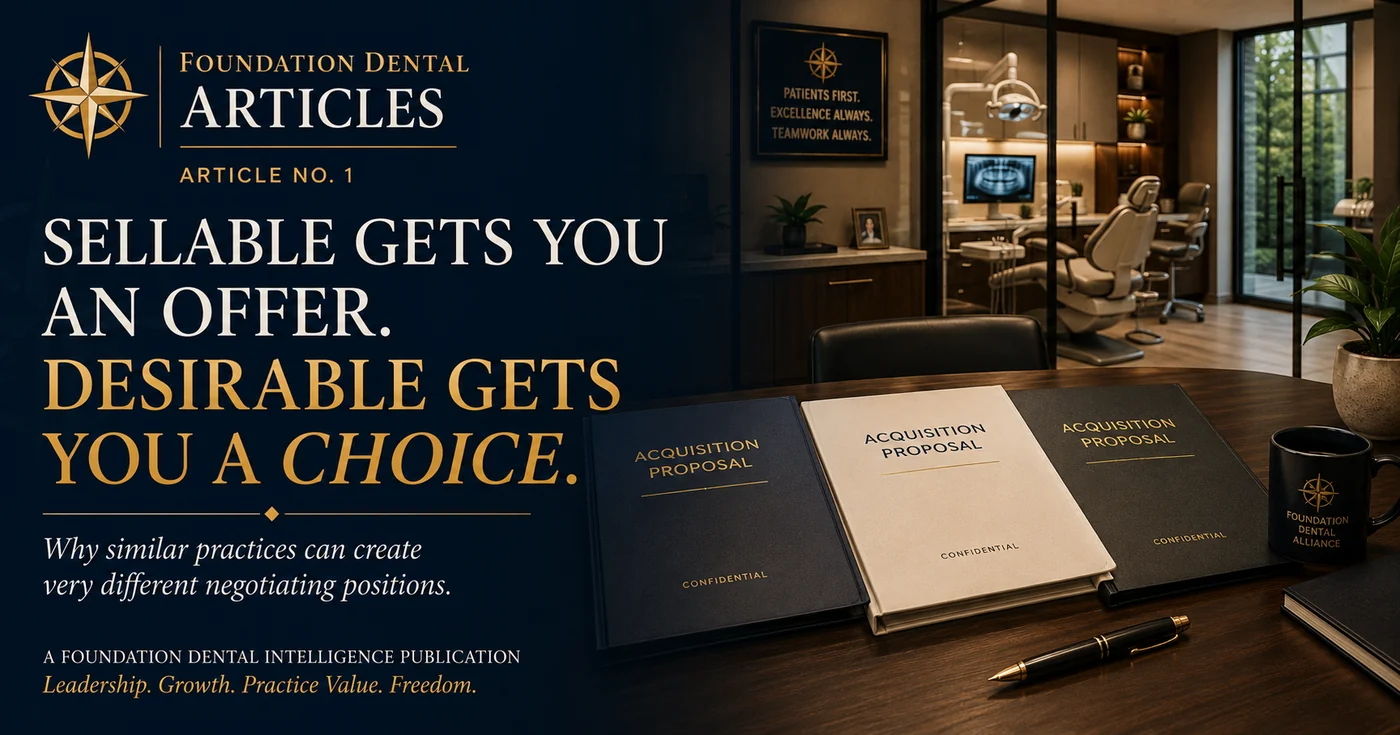
Sellable Gets You an Offer. Desirable Gets You a Choice.
Why similar practices can create very different negotiating positions.
Get the next article.
One signup. Everything we publish.
Almost every dental practice can be sold.
Eventually. At some price. To someone.
But there’s a meaningful difference between a practice that can find a buyer and one that creates competition among buyers.
That difference determines whether you negotiate from strength or necessity. Whether you accept an offer or choose among several. Whether you control the terms or spend the process reacting to them.
And it gets decided long before anyone runs a valuation.
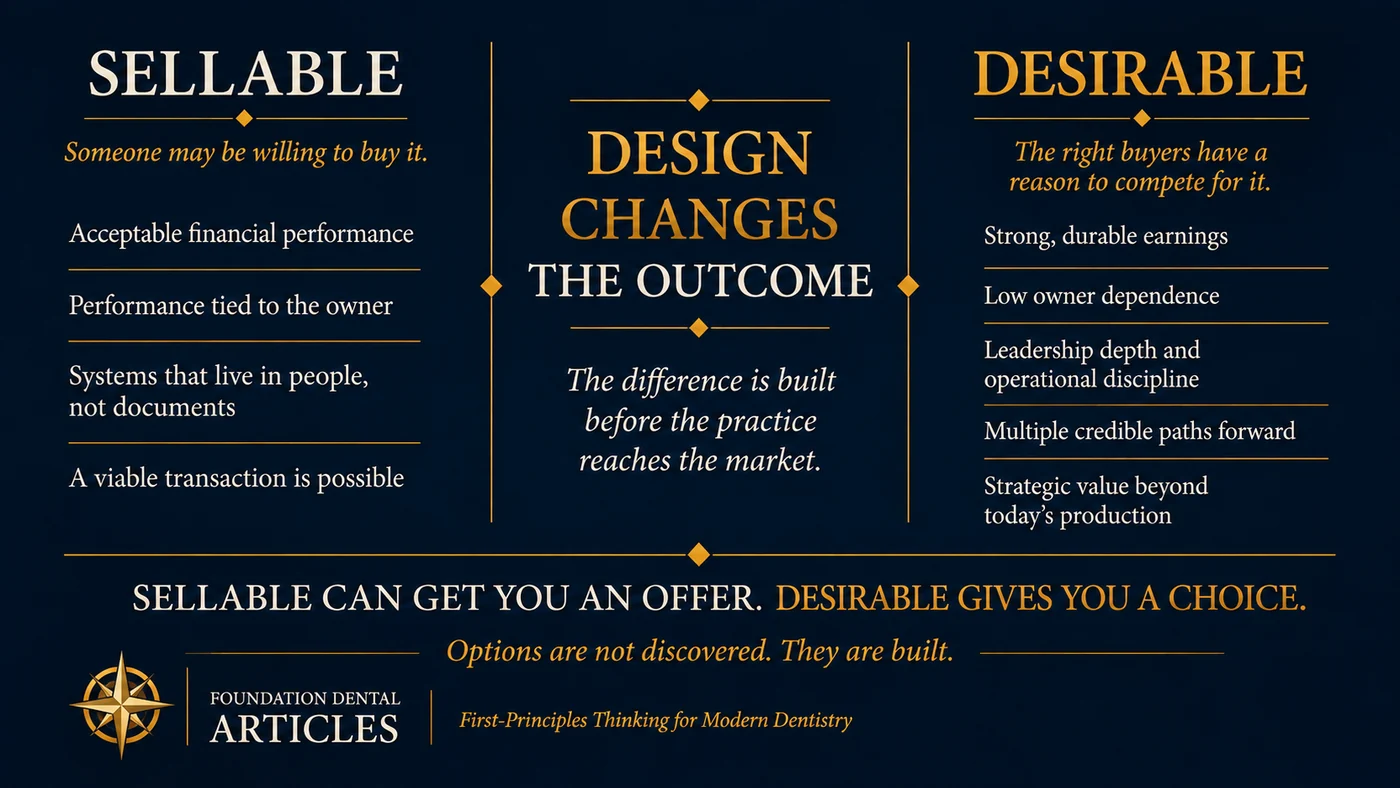
Sellable means someone will buy it. Desirable means several people want to.
The Question That Quietly Sets Your Multiple
When a sophisticated buyer looks at your practice, profitability matters. So do growth, margins, geography, provider mix, and dozens of other variables.
But there’s another question sitting underneath almost all of them:
How much of this practice depends on the current owner being here?
That question affects far more than valuation.
It influences the structure of the offer. The contingencies. The earnout. Your required post-close commitment. How much risk the buyer believes they’re assuming and how aggressively they’re willing to compete for the practice.
Owner dependence is a discount you’ll probably never see identified on a term sheet.
It gets buried inside everything else.
I’ve seen this as a practice owner who sold, as an executive inside the DSO world, and while helping more than 60 dentists through transitions. Today, Brian Mans and I look at the same issue from both sides through Foundation Dental Transitions. Brian spent more than a decade on the institutional buy-side. I came through it as a dentist, seller, executive, and investor.
Different seats. Same conclusion.
The strongest practices weren’t suddenly cleaned up six months before somebody decided to sell them.
They had been built differently for years.
Foundation Dental Transitions →
Sellable and Desirable Aren’t the Same Thing
A sellable practice clears the basic threshold for a transaction.
It has patients. It generates cash flow. It has a team, equipment, systems, and some degree of operational continuity. At the right price and under the right terms, someone may acquire it.
A desirable practice does something different.
It removes uncertainty.
The buyer can see that performance isn’t dependent on one person making every important decision. Leadership exists beyond the owner. Systems transfer. Financial reporting makes sense. The patient experience doesn’t collapse when the owner takes a vacation.
The organization looks capable of continuing after the person who built it is no longer standing in the middle of it.
That changes the conversation.
Two practices can have similar revenue and similar EBITDA and still present very different risk profiles to a buyer.
One gets evaluated.
The other gets pursued.
What Owner Dependence Actually Looks Like
Most dentists underestimate how dependent their practice is on them.
I did for years.
The reason is simple. Dependence often looks like responsibility.
Your team brings unusual situations to you because you’re good at solving them.
Someone asks you where a patient belongs on the schedule because you know how the day should flow.
An associate wants your opinion before presenting a complicated case.
The front desk knows the fee schedule, but anything outside the normal rules comes back to you.
A team member has a problem with another team member, and somehow you become the judge.
A vendor decision comes up. You decide.
A large expenditure comes up. You decide.
A patient is upset. You decide.
None of this means you’ve built a bad practice. In many cases, it’s the natural result of building one successfully.
You solved problems as they appeared. You became good at solving them. Eventually everyone learned that the safest answer was to bring the difficult ones to you.
Do that long enough and you become the operating system.
That’s the problem.
A buyer doesn’t see a hardworking owner who cares deeply about the practice.
The buyer sees concentration risk.
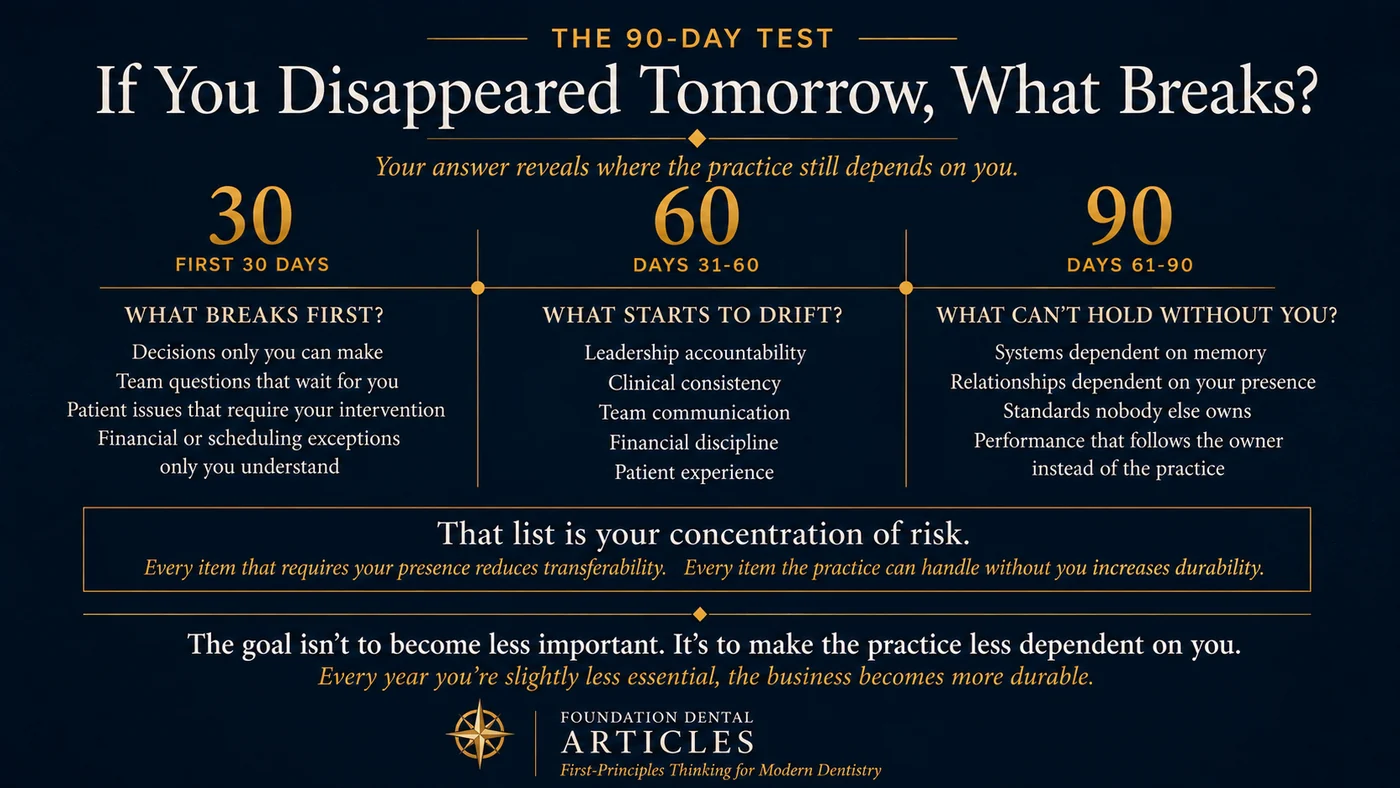
Run the ninety-day test.
If you disappeared tomorrow and couldn’t answer a phone call, text, or email for ninety days, what would stop working?
Write it down.
Don’t make the list prettier than it is.
That’s where the work starts.
What Buyers Actually Pay For
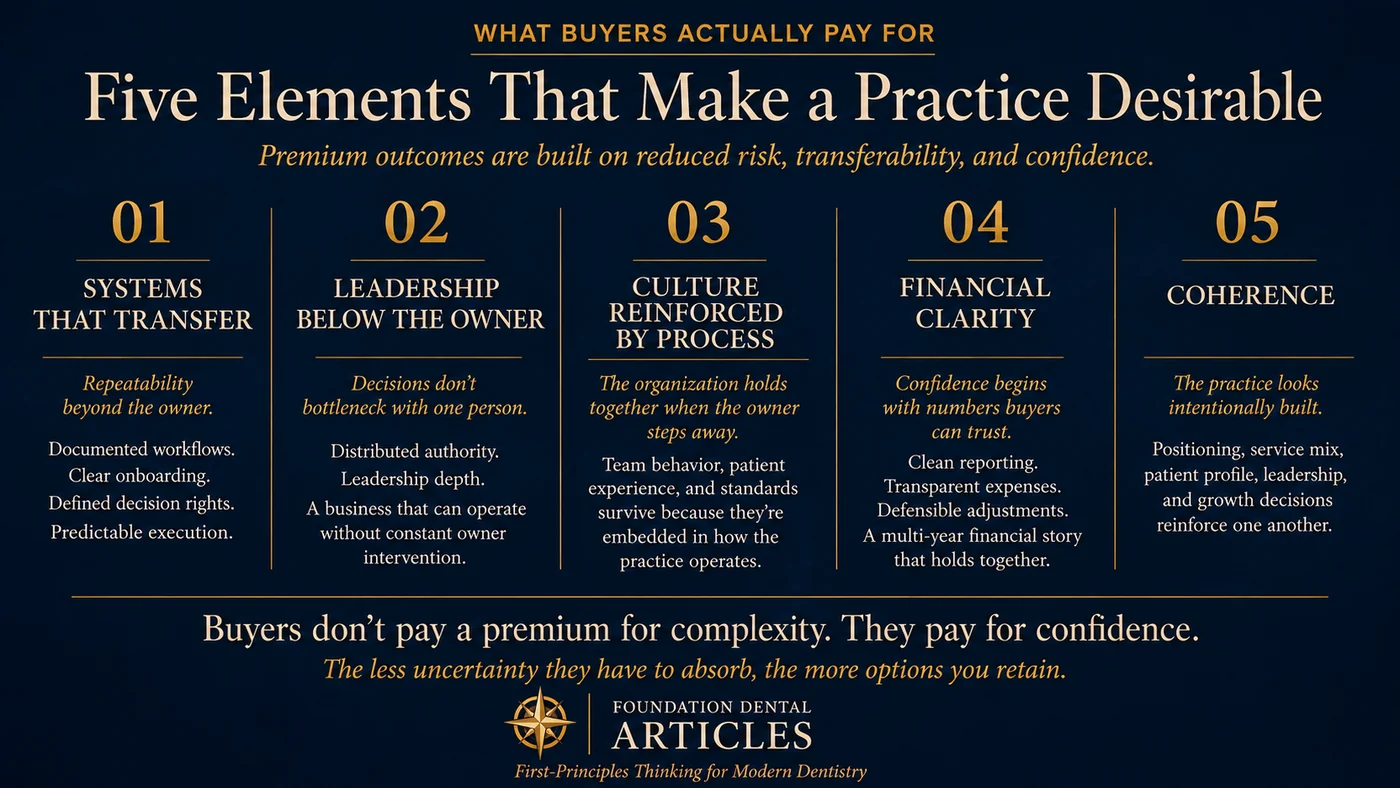
Certain characteristics keep showing up in practices that are easier to transfer and more attractive to sophisticated buyers.
1. Systems that transfer
Buyers aren’t paying a premium for brilliance they can’t transfer.
They want repeatability.
That means the important parts of the practice can’t exist exclusively in your head.
Clinical workflows. Administrative processes. Patient handoffs. Financial reporting. Onboarding. Scheduling. Case presentation. Team communication. Decision rights.
A written SOP by itself doesn’t solve this. A binder nobody opens isn’t a system.
The real test is whether another capable person can understand what happens, why it happens, who owns it, and what to do when something goes wrong.
If every exception still requires a phone call to you, you haven’t transferred the system yet.
You’ve documented part of it.
2. Leadership that exists below you
A practice that bottlenecks at the owner concentrates risk in one person.
There’s no way around that.
Buyers notice when an office manager can run a difficult team meeting with the doctor nowhere in sight. They notice when a lead assistant can train someone to the practice standard. They notice when associates understand expectations and make good decisions without constantly seeking permission.
Leadership below the owner makes the organization more durable.
It also happens to make ownership a lot more enjoyable.
Delegation can feel painfully slow while you’re building it. Sometimes doing something yourself really is faster.
That’s true today.
It’s expensive five years from now.
3. Culture that survives your absence
Culture gets dismissed as a soft concept until you watch a bad one destroy retention, productivity, patient experience, and eventually margin.
A healthy culture doesn’t mean everybody is happy all the time.
It means people understand what’s expected. Problems get addressed. Standards don’t change based on who happens to be working that day. Good people know what good looks like.
If the culture exists primarily because of your personality, energy, or daily presence, part of the culture leaves when you do.
If it’s reinforced by how the practice actually operates, it has a chance to survive you.
4. Financial clarity
Buyers price uncertainty.
Sometimes brutally.
Clean financial reporting doesn’t magically create value that isn’t there. But financial ambiguity can absolutely destroy confidence in value that is.
Personal expenses mixed throughout the business. Inconsistent reporting. Add-backs that require a ten-minute story. Expenses that move around without a clear explanation. Numbers that don’t reconcile.
Every one creates another question.
Enough questions eventually change how a buyer thinks about risk.
You want the financial story of the practice to make sense before anyone has to explain it.
5. Coherence
Some practices look intentionally built.
Others look like twenty years of individual decisions stacked on top of one another.
You can feel the difference.
The service mix makes sense. The team structure makes sense. The patient experience fits the positioning. Growth decisions support each other. The economics fit the model.
That doesn’t mean every decision was perfect.
Mine certainly weren’t.
It means the practice has a logic to it that another person can understand.
A buyer isn’t trying to purchase twenty years of explanations.
They’re trying to understand what they’re buying.
Replaceable in the operational sense is exactly what makes you irreplaceable in the financial one.
Profitability Can Hide a Fragile Business
This is where dentists get fooled.
A practice can be extremely profitable and still be fragile.
High production can hide owner dependence for a long time because the numbers look good.
I know that personally.
Some of my highest-production years weren’t my best years as an owner. I was working incredibly hard. Patients wanted me. The schedule was full. Production looked great.
I was also too important to the machine.
There’s a difference between being highly productive and owning a business that produces a return independent of your clinical labor.
Dentists blur those two numbers all the time.
A buyer won’t.
Your clinical production has value because you’re doing the dentistry. Your ownership return has value because you own an asset.
The more those two are inseparable, the harder the asset is to transfer.
I Spent Years Trying to Make Myself Less Important
I spent five or six years deliberately making myself less necessary to my own practice before I ever sat down at a negotiating table.
That sounds strange when I say it that way.
I loved practicing dentistry. I cared deeply about the patients. I’d spent years building the practice.
But I also understood something that eventually became impossible to ignore.
If the practice couldn’t function without me, I didn’t own the kind of asset I thought I owned.
So I worked on it.
I built systems that didn’t require me to remember everything. I developed people who could make decisions. I brought in another dentist who could replicate much of what I had been doing clinically. The team became less dependent on my presence.
Every year I became a little less essential to the daily operation.
And something unexpected happened.
My life got better before I ever sold anything.
That’s the part of this conversation that gets missed when people call this “exit planning.”
It wasn’t just making the practice more valuable someday.
It was making the practice work better now.
I could step away more easily. Other people grew. Decisions didn’t pile up waiting for me. My income became less tightly connected to how many procedures I personally completed that month.
By the time a transaction happened, much of the uncertainty a buyer might have priced into the deal had already been removed.
Foundation Dental Mastermind →
Then I Learned a Completely Different Lesson
Building the asset correctly is one decision.
What you do with the wealth it creates is another.
I learned that distinction the expensive way.
My first transaction went extremely well. I rolled equity, and at the first recapitalization that investment returned roughly nine times.
That kind of outcome can make you feel pretty smart.
It made me feel pretty smart.
When the second recapitalization came, I had about forty-eight hours to decide how much to roll forward.
I went all in.
Part of the reason was confidence. Part of it was greed. Part of it was thinking about how much more I could have made the first time if I’d invested more.
Whatever label I put on it now, it wasn’t disciplined risk management.
Then COVID shut dentistry down.
The business ran into problems. The debt structure became unsustainable.
On September 3, 2020, at about 5:30 in the evening, I joined an investor call.
It lasted roughly forty-five seconds.
It wasn’t even a conversation. It was a recorded message.
The money was gone.
About $15 million in equity disappeared.
I’d spent twenty-four years building toward financial freedom and managed to put an enormous amount of it back at risk because the first bet had worked.
Jim’s $15 Million Collapse story/video →
I’m not telling you that because it makes this article more dramatic.
I’m telling you because these are two separate lessons and dentists need both of them.
Build an asset buyers want.
Then protect what that asset creates.
Success at the first does not guarantee wisdom at the second.
I learned that.
Pushed to Market or Pulled Toward Buyers
There’s another difference between sellable and desirable practices that matters.
Sellable practices often have to be pushed into the market.
The owner decides it’s time. The process begins. Buyers are contacted. Offers are solicited. The seller starts trying to create interest.
Desirable practices can create a different dynamic.
People already know about them.
Sophisticated buyers pay attention to well-run practices. They notice strong groups, good margins, leadership depth, attractive markets, strong teams, and businesses that appear capable of transferring successfully.
That interest can exist before the owner has decided to do anything.
And that changes the power dynamic.
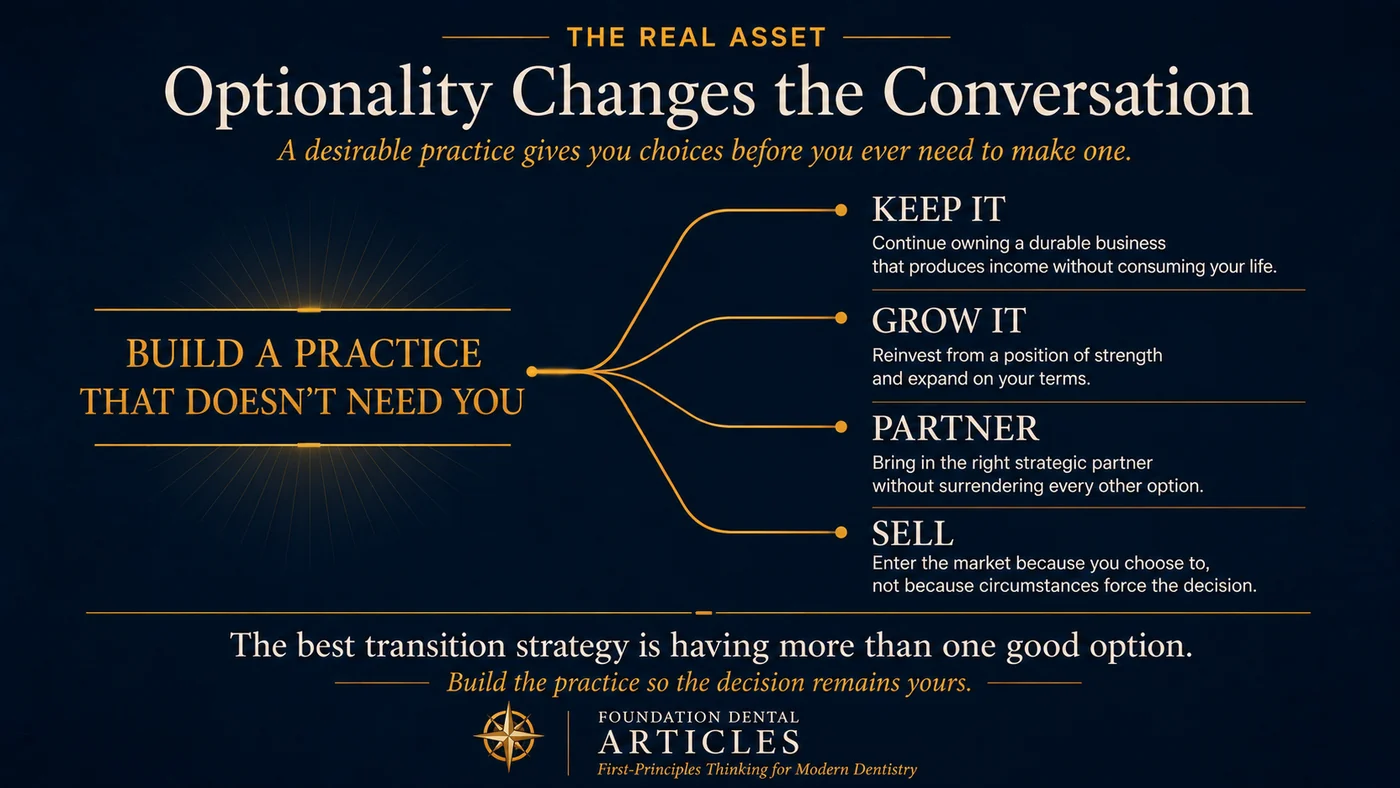
Competition creates negotiating strength.
Negotiating strength creates options.
Choice is the actual asset.
This Matters Even If You Never Sell
I don’t think dentists should build better practices because private equity might pay them more someday.
That’s backwards.
Build a better practice because you have to live inside the thing for the next five, ten, or twenty years.
The qualities that make a practice desirable to a buyer are remarkably similar to the qualities that make it better to own.
A team that can function without you.
Systems that don’t depend on your memory.
Leadership that exists at multiple levels.
Financials you can actually understand.
Margins that don’t collapse when your personal production drops.
Time away that doesn’t require you to monitor your phone.
Those things have value whether you sell the practice or keep it until the day you retire.
The transaction value is downstream.
Freedom comes first.
From Practitioner to Designer
Eventually every successful practice owner runs into the same problem.
The skills that made you valuable early can become the skills that keep the business dependent on you later.
You were the problem-solver.
You were the producer.
You knew every patient.
You made the decisions.
You held the standard.
That works for a long time.
Then the practice grows, and the thing that once made it successful starts limiting what it can become.
The job changes.
You have to stop proving that you can carry everything and start building something that doesn’t require you to.
That isn’t stepping away from leadership.
It’s finally doing the highest form of it.
Options are not discovered. They are built.
The Question Worth Sitting With
Forget your production number for a minute.
Forget new patients.
Forget what somebody told you your practice might be worth.
If you disappeared for ninety days and a sophisticated buyer walked through the door on day ninety-one, what would they find?
Would the team still be functioning?
Would decisions still be made?
Would the patient experience still feel the same?
Would the financial performance hold?
Would anyone know how the important things get done without calling you?
If some of those answers make you uncomfortable, good.
Now you know where to start.
This doesn’t get fixed by producing another $200,000 next year.
It gets fixed by changing how the business works.
One decision. One system. One leader. One responsibility that no longer has to come back to you.
Do that long enough and you build something very different.
Not just a practice somebody might buy.
A practice you don’t have to sell.
That’s where the real leverage begins.
Foundation Dental Transitions →
Frequently Asked Questions
What actually separates a sellable dental practice from a desirable one?
Transferability.
A sellable practice can attract a buyer under the right price and terms. A desirable practice gives buyers confidence that its performance can continue after the owner leaves.
That difference can affect valuation, deal structure, post-close obligations, contingencies, and how much competition the seller is able to create.
How long does it take to reduce owner dependence?
There’s no universal timeline.
It took me five or six years of deliberate work before my own practice became substantially less dependent on me.
The better question is whether the practice becomes slightly less dependent on you every year or slightly more.
Those two paths eventually lead to very different businesses.
Does this matter if I don’t plan to sell my practice?
Yes.
In fact, that may be the best reason to do it.
The same qualities buyers value are the qualities that improve ownership now: stronger leadership, transferable systems, cleaner financials, less dependence on your clinical production, and the ability to step away without the business falling apart.
You don’t need an exit date to benefit from any of those.
What’s the fastest way to see how dependent my practice is on me?
Run the ninety-day test.
Imagine that tomorrow you become completely unavailable for ninety days. No calls. No texts. No email. No quick answers.
What breaks first?
Then what?
Write the list down in order.
That list gives you a remarkably useful picture of where risk is concentrated.
Can a smaller dental practice be more desirable than a larger one?
Absolutely.
Revenue alone doesn’t determine desirability.
A smaller practice with healthy margins, leadership depth, clean financials, transferable systems, and low owner dependence may present substantially less risk than a larger practice whose performance depends heavily on one dentist.
Buyers evaluate the durability of the earnings, not simply the size of the revenue number.
Where should an owner start?
Start with the first thing on your ninety-day list.
Don’t try to redesign the entire practice at once.
Find the responsibility, decision, relationship, or process most dependent on you and ask what would have to change for someone else to own it well.
Then do the next one.
That work compounds.
So does the freedom it creates.
About the Author
Dr. Jim Arnold, DDS is the Founder and CEO of Foundation Dental Alliance. He has spent 30 years in dentistry as a clinician, multi-practice owner, DSO executive, educator, advisor, and entrepreneur. He built and sold his own practices, achieved 31% EBITDA in a multi-practice group, and has personally guided more than 60 dentists through practice transitions. Today, his work across Foundation Dental Mastermind, Luxury Dental Retreats, Foundation Dental Transitions, and Foundation Dental Intelligence is focused on helping dentists make better decisions about leadership, growth, practice value, and what comes next.
Foundation Dental Articles are written by Dr. Jim Arnold and by faculty, advisory board members, and partners of Foundation Dental Alliance.
Foundation Dental Intelligence | Article #1 | Year 1, Issue #1 | August 2026