Foundation Dental Intelligence
Article No. 2
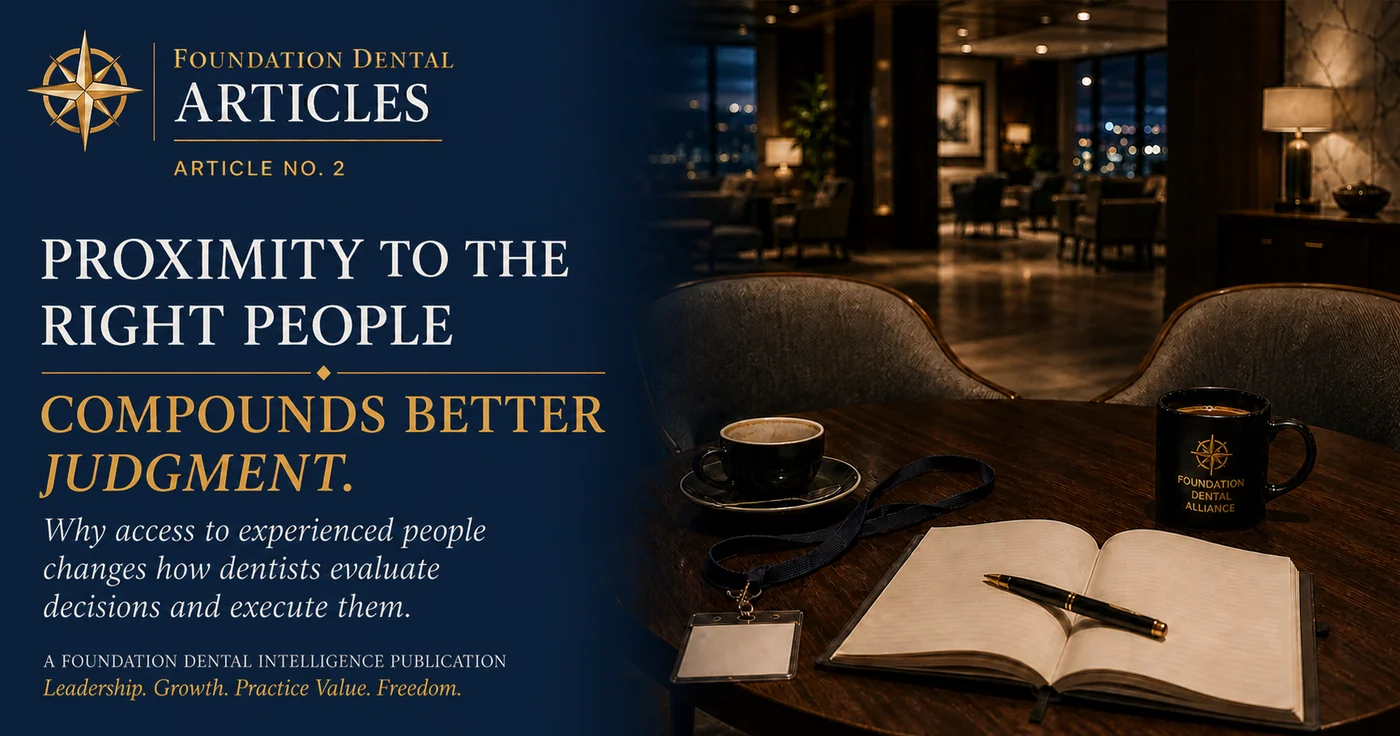
Proximity to the Right People Compounds Better Judgment
Why access to experienced people changes how dentists evaluate decisions and execute them.
Get the next article.
One signup. Everything we publish.
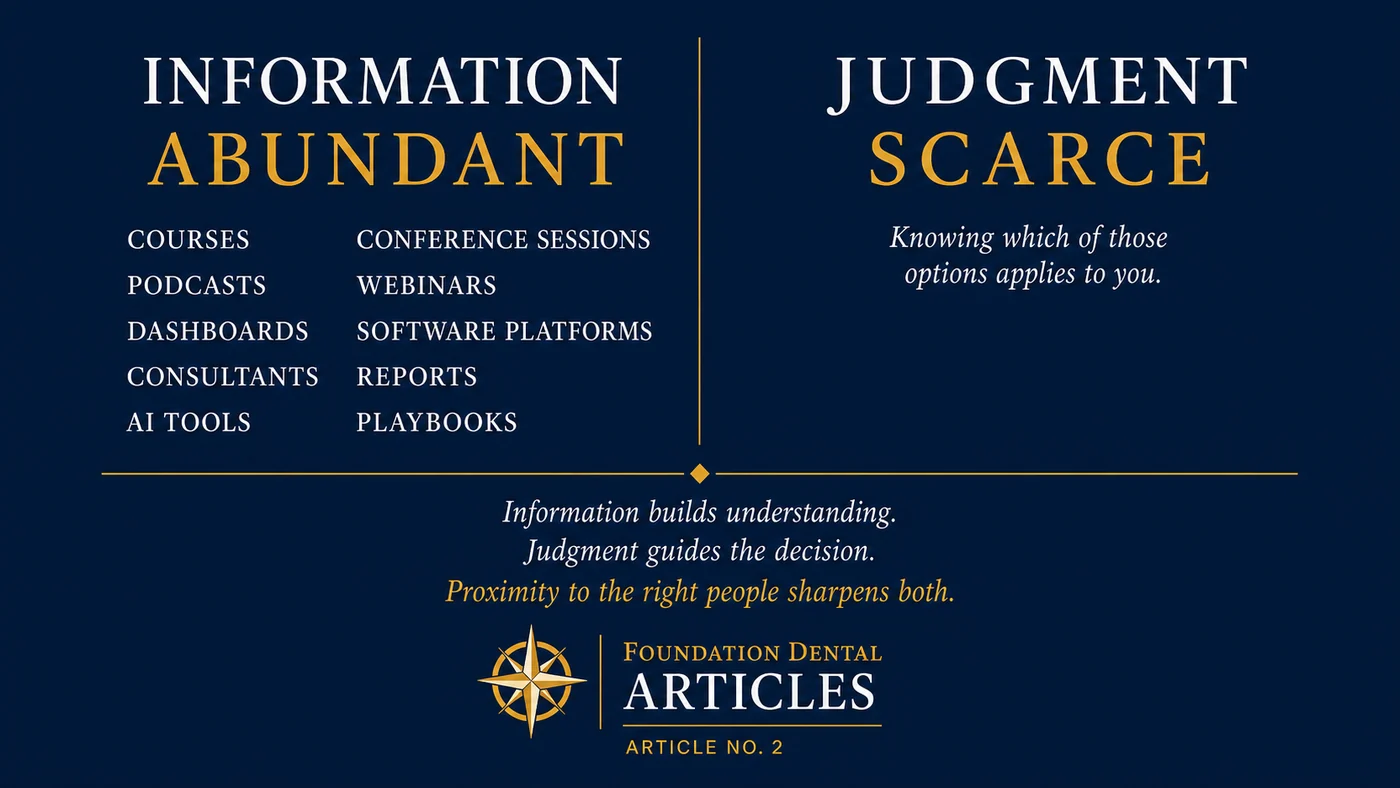
Dentistry doesn't have an information problem.
We have more courses, podcasts, webinars, consultants, dashboards, software platforms, AI demonstrations, and conference sessions than any dentist could reasonably consume. Education is abundant. Technology keeps improving. Useful information sits within reach of anyone who wants it.
And the profession's hardest problems haven't moved.
Practices still end up dependent on one person. Leadership teams still postpone the difficult discussion until it becomes an expensive one. Owners still confuse activity with progress. Dentists still make the decision that solves this month and creates a much larger problem in year three.
None of that persists because the answer is hidden somewhere. The answers are everywhere.
What's scarce is judgment.
Information can tell you what somebody else did. Judgment tells you whether it fits your practice, your team, your risk tolerance, and the next ten years of your life. A technically correct answer can still be the wrong decision once the context changes, and context is exactly what gets stripped out of anything packaged for a wide audience.
Five Events, One Month, No Voice
Early in 2026 I went to Dental Podfest in Florida, then Smiles at Sea with Devin Giesen and Elijah Desmond, then five days at the Chicago Midwinter Dental Meeting, then the Planet DDS Orbit meeting.
At Midwinter alone I had roughly three hundred conversations and completely lost my voice.
By the third night of any major meeting I'm running on fumes. That was true again. Voice gone. Social battery empty. Early breakfasts, late dinners, continuous engagement, no gap anywhere in the day. I wanted to be home.
It was worth the trade, and not because of the sessions.
The Useful Part Happens After the Session Ends
Speakers matter. Formal education matters. I have no interest in dismissing the content, and I have paid for plenty of it.
But the exchanges that changed how I think almost never happened in a ballroom.
They happened at dinner. In hallways. In the five minutes between sessions when someone casually explains how they restructured their executive team, exited a partnership, repriced an offering, tightened their acquisition criteria, or handled the exact situation you are currently losing sleep over.
Those exchanges aren't polished. They aren't reduced to three steps. Nobody optimized them for an audience, which is precisely why they still contain the context that packaged content removes.
Content shows you a tactic. Proximity lets you hear why someone chose it, what they considered first, what nearly went wrong, and what they would do differently now. It exposes the thinking underneath the decision rather than the decision itself.
Content gives you the tactic. Proximity gives you the reasoning.
That's what shifts your internal reference points.
A number that seemed unrealistic becomes ordinary once you see the systems producing it. A strategy that looked impressive from a distance becomes far less attractive once you understand what it costs to run. A problem you assumed was unique to you turns out to be a familiar leadership failure with a known shape and a known fix.
You don't get that from a slide. You get it from watching how someone evaluates a deal in fifteen minutes, declines an opportunity without hesitating, protects their calendar, or talks about alignment when the doors are closed.
Why Judgment Beats Another Tactic
Dentists are trained to value precision, technique, and repeatability. That training serves us extremely well clinically. It also creates an expectation that every business problem has a correct procedural answer waiting somewhere.
Most of them don't.
Should you add an associate? Expand the building? Acquire the practice across town? Change the compensation model? Replace a leader who has been loyal for eleven years? Take the partnership? Sell now, or keep building?
Each of those depends on facts that refuse to fit a generic playbook. Timing. Cash position. Team strength. Personal goals. Risk tolerance. The character of the people on the other side of the table.
Information expands the list of things you could do. Judgment decides which one survives contact with your actual situation.
That is why two dentists can attend the same lecture, buy the same software, hire the same consultant, and end up in completely different places five years later. Better tools do not reduce the need for discernment. They raise it, because they let you make more decisions faster.
Speed without judgment is not leverage. It is a faster way to compound a weak decision.
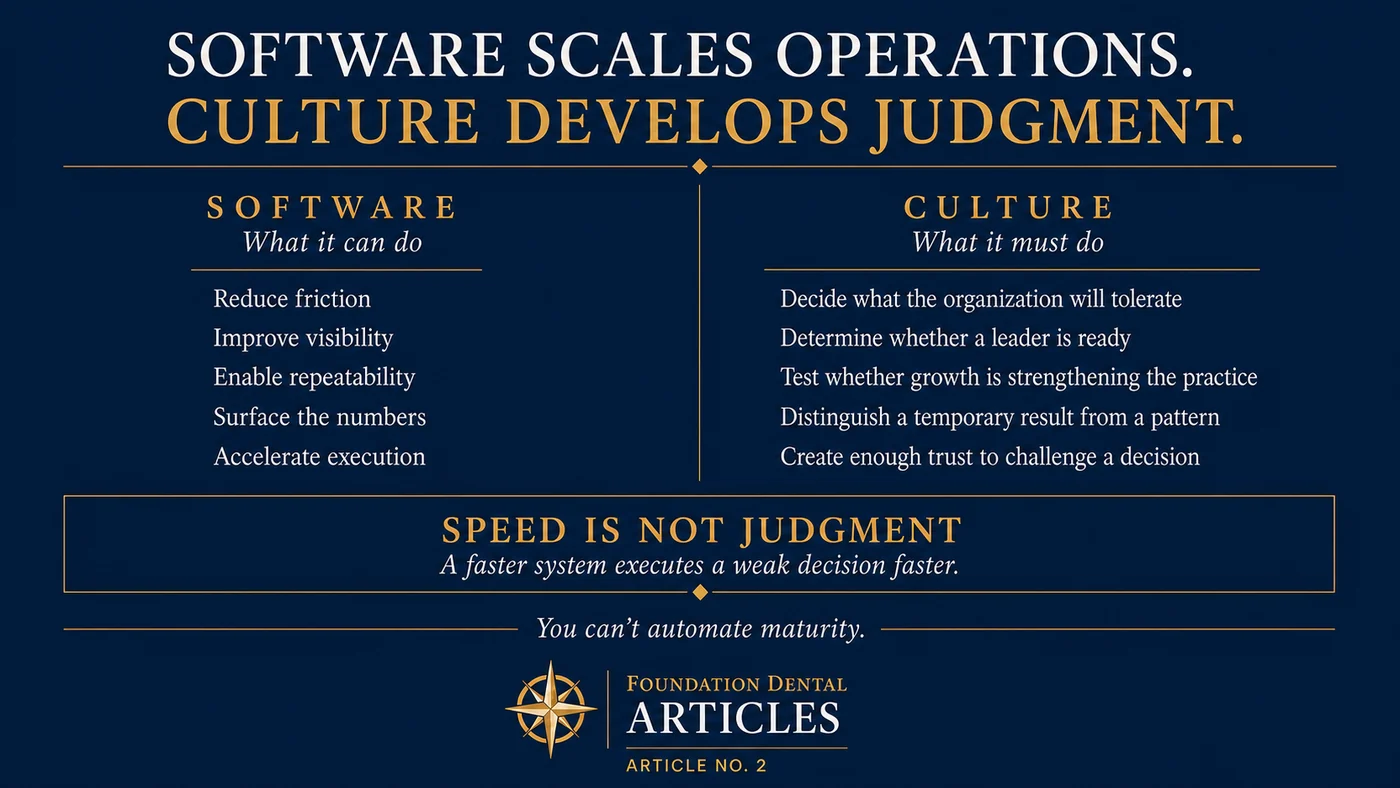
Software Scales Operations. Culture Develops Judgment.
Good systems reduce friction, improve visibility, and make things repeatable. I have built and grown practices, worked inside DSO structures, and seen exactly what strong technology does for an organization. This is not a case against software.
It is a case about what software cannot do.
It cannot decide what your organization will tolerate. It cannot tell you whether a partnership is aligned or whether a leader is ready. It cannot distinguish a metric that reflects a bad month from one that reveals a pattern nobody wants to name.
At the Planet DDS Orbit meeting, what stood out was not Denticon's capability. It was the seriousness of the leadership discussion and the attention paid to long-term direction rather than quarterly noise.
Technology surfaces information. Culture determines what people do with it.
A healthy culture lets people challenge assumptions, raise concerns before the fracture widens, and discuss tradeoffs without defending territory. That is how judgment spreads through an organization. People learn not just which decision got made but how the group arrived at it.
An unhealthy culture can own excellent software and still produce bad decisions on schedule. Dashboards become decoration. Meetings become reporting exercises. Problems stay quiet until the cost of addressing them has tripled.
You cannot automate maturity.
What Isolation Actually Cost Me
I can tell you exactly what happens when your reference points all come from inside the same orbit.
My first transaction went well. I rolled equity and it returned roughly nine times at the first recapitalization. When the second recap came, I had about forty-eight hours to decide how much to roll forward.
So I called the people I trusted most. My private equity partners. Smart, experienced, genuinely good people who I still respect and still consider friends.
They told me they were going all in. I said you know this world far better than I do, so let's go.
Here is what I did not notice at the time. Every single person I asked had identical exposure to the outcome, identical incentives, and identical blind spots. I had surrounded myself with people smarter than me, which I had always believed was the right instinct. It is the right instinct. But smart is not the same as independent, and I had no one outside that circle to ask the obvious question.
Nobody said: what happens to that debt structure if revenue stops for ten weeks.
Nobody said it because nobody in the group had any reason to.
Then the pandemic shut dentistry down. The debt-to-EBITDA ratio came apart, the bank took everything by contract, and roughly fifteen million dollars in equity disappeared during a forty-five second recorded phone call.
Smart is not the same as independent. My entire reference set had the same blind spot I did.
I have told that story before as a lesson about risk management, and it is one. But there is a second lesson in it that took me longer to see.
I had proximity. What I did not have was proximity to anyone with a different vantage point. Forty-eight hours is not enough time to build that. You either already have people who think differently from you and owe you honesty, or you don't, and the moment you need them is exactly the moment it is too late to go find them.
Jim's $15 Million Collapse story →
Pattern Recognition Is the Actual Return
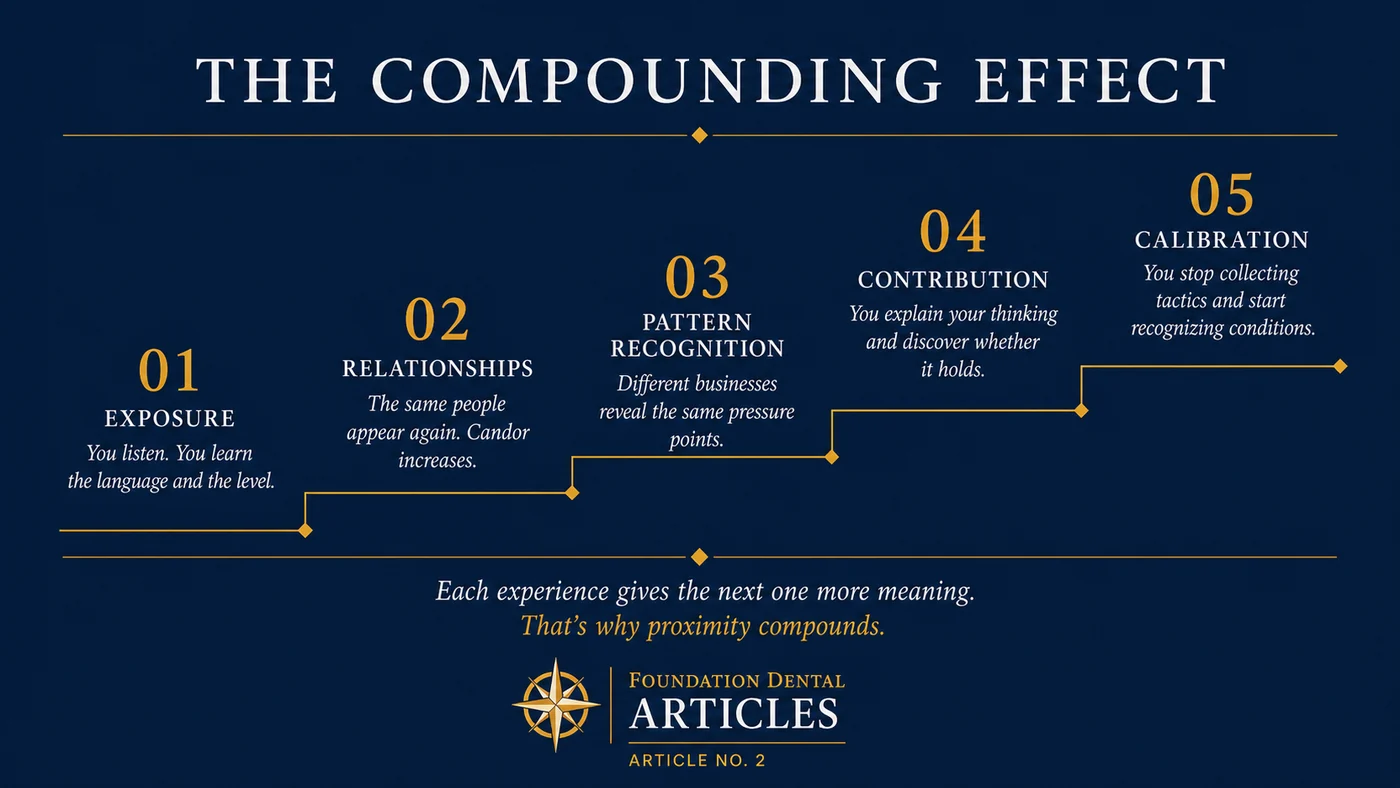
One good exchange is helpful. A concentrated series of them produces something more durable: pattern recognition.
At Midwinter I talked with founders working through private equity decisions, DSO executives reconsidering their acquisition filters, startup leaders refining distribution, and multi-practice owners quietly asking whether growth had actually improved their lives.
Different organizations. Different capital structures. Different definitions of winning.
The same themes kept surfacing. The strongest leaders addressed hard things earlier. They filtered opportunities instead of chasing them. They paid attention to alignment before a visible fracture forced the issue. They understood that growth can increase revenue while quietly degrading control, culture, and quality of life.
No single exchange produced that. The pattern emerged across dozens of them, and it only emerged because they were compressed into a short window where I could still hold them all in my head at once.
That is what compounding means here. Each experience gives the next one more meaning. You arrive with better questions. You notice distinctions you would have missed a year ago. You can test a new claim against a deep set of real ones.
Eventually you stop collecting tactics and start recognizing the conditions that make a tactic work.
The Shift From Consumer to Contributor
The first time you walk into a genuinely strong peer group, your job is to listen. That is appropriate. You need to learn the people, the language, and the altitude.
But the value changes when you start contributing.
Contribution forces clarity. Explain how you handled a transition, built a leadership team, or fixed a structural problem, and somebody will ask the question you have been avoiding asking yourself. Defend a position out loud and you find out whether your reasoning holds. Sometimes it does. Sometimes it collapses in real time in front of people whose opinion you care about, which is uncomfortable and extremely useful.
Nothing exposes weak thinking faster than having to teach it.
It also turns your experience into something other people can use, and the exchange becomes reciprocal. Your judgment improves because you have to articulate it. The group improves because hard-won experience is not being hoarded.
This is not networking. The point is not to collect contacts or be photographed near influential people. The point is to be somewhere that candor, experience, and better questions are actually improving decisions, including yours.
Foundation Dental Mastermind →
Access Without Selectivity Is Just Noise
Not every event, group, or relationship deserves equal investment.
Access by itself is worth very little. A packed calendar creates the appearance of momentum while leaving no time to think. A group that agrees with everything you say feels good and improves nothing.
The strongest leaders I watched over that month were selective. They evaluated by strategic fit, cultural alignment, and whether the people involved would discuss what went wrong honestly. They were not looking for agreement. They wanted informed challenge from people with no reason to flatter them.
Before committing time to another event or group, five questions worth answering honestly:
Will this challenge how I currently think, or confirm it?
Are these people willing to talk about what did not work?
Does the experience in the group actually match the decisions in front of me?
Will I get real discussion, or only formal presentations?
Do I have enough space afterward to reflect and apply any of it?
That last one gets ignored constantly. Proximity without reflection is just a more expensive form of consumption.
The Exhaustion Is Part of the Exchange
Back to the third night with no voice.
If you leave a major meeting feeling exactly the way you did when you arrived, it's worth asking whether you leaned in at all. Not every good week has to end with no voice. But the weeks that changed something for me usually did, because I had pushed past surface introductions and contributed instead of spectating.
Exhaustion is temporary. Perspective is not. That is the trade, and it is one I keep making, selectively.
Better Judgment Changes What Happens Next
Dentistry will keep producing more information, more technology, and more advice. That is a good thing and we should use all three.
But information alone does not produce a capable leader. Software alone does not produce an aligned organization. And access alone does not produce wisdom. I had plenty of access in 2020.
Judgment develops when experience gets examined, assumptions get challenged, and serious people are willing to show each other how decisions actually get made, including the ones that went badly.
Its effect shows up in the opportunity you decline. The discussion you stop postponing. The system you choose not to buy. The decision you finally make after eighteen months of circling it.
Information tells you what is possible.
Proximity improves your judgment about what is appropriate.
Better judgment changes execution.
And when that repeats, proximity to the right people compounds better judgment.
Information is abundant. Judgment is scarce. Only one of them is worth traveling for.
Frequently Asked Questions
What does proximity actually mean here?
Sustained access to experienced people who will tell you how they reached a decision, not just which decision they reached. It is more than attending an event or knowing someone influential. The value lives in context, participation, and the reflection afterward.
Why can't courses and online content do the same thing?
They can teach ideas efficiently and they are worth the money. What they cannot reproduce is the follow-up question, the subtle disagreement, the detail somebody only mentions because nobody is recording. Packaged content removes context by design. Context is the part that determines whether the idea applies to you.
How do I choose the right peer group?
Look for relevant experience, intellectual honesty, candid discussion of failure, and enough access that real exchange is possible. A group that challenges your assumptions is worth more than one that confirms them, even though the second one feels better in the moment.
How does this show up in a practice?
Earlier pattern recognition, better questions, and more context around decisions about leadership, growth, technology, partnerships, and transitions. The benefit comes from applying better judgment to your own situation, not from copying what worked in somebody else’s.
Can proximity become a distraction?
Easily. Too many events and too many relationships create noise and eliminate the time required to think. The goal is not maximum access. It is the right experience at the right time, followed by enough space to do something with it.
What if I already have a strong peer group?
Ask whether everyone in it shares your exposure and your incentives. That was my mistake. I had surrounded myself with people far smarter than me who happened to have identical blind spots. A group that thinks like you is comfortable. A group that can see what you cannot is useful.
About the Author
Dr. Jim Arnold, DDS is the Founder and CEO of Foundation Dental Alliance. He has spent 30 years in dentistry as a clinician, multi-practice owner, DSO executive, educator, advisor, and entrepreneur. He built and sold his own practices, achieved 31% EBITDA in a multi-practice group, and has personally guided more than 60 dentists through practice transitions. Today, his work across Foundation Dental Mastermind, Luxury Dental Retreats, Foundation Dental Transitions, and Foundation Dental Intelligence is focused on helping dentists make better decisions about leadership, growth, practice value, and what comes next.
Foundation Dental Articles are written by Dr. Jim Arnold and by faculty, advisory board members, and partners of Foundation Dental Alliance.
Foundation Dental Intelligence | Article No. 2 | Year 1, Issue 2 | August 2026