Foundation Dental Intelligence
Newsletter No. 63
The Real Reason Your Best People Stay.
Get the next issue.
One signup. Everything we publish.
Culture isn’t a perk - it’s a pattern.
A few years into building my practices, I made a decision that had nothing to do with clinical systems or production targets. I decided that every person on my team would have their birthday off - with pay. Doctors included. Nobody was exempt, and nobody was above it.
It sounds small. It wasn't. What it communicated, quietly and consistently, was that this was a place where you mattered as a person - not just as a hygienist or an assistant or a front desk coordinator. You were part of something, and that something noticed you.
I didn't implement that policy because I read it in a management book. I did it because I'd watched what happens when a team genuinely feels valued, and I'd watched what happens when they don't. The difference is visible within about ten minutes of walking through the door. It's in how people talk to each other, how they handle a difficult patient, how they respond when something goes sideways at 4:45 on a Friday afternoon.
That's culture. And right now, in the current environment for dental staffing, it's the most important thing you can build.
A practice can feel good and still be unstable
Before 2020, practices could get away with a lot. Pay was important, but a predictable schedule, decent management, and reasonable coworkers were often enough to keep a team intact. Turnover existed, but it was manageable. You could absorb it.
Then the pandemic hit, and something shifted that hasn't shifted back. A significant number of auxiliaries - hygienists especially - left clinical practice entirely. Some took positions in industry. Some moved into education or consulting. Some simply left healthcare. The reasons were different for each person, but the underlying current was the same: they had an opportunity to reassess what they were willing to tolerate, and a lot of them decided they weren't willing to tolerate what they'd been tolerating.
That created a staffing reality every practice owner in the country has felt. There are fewer qualified auxiliaries available today than there were five years ago, and the ones who are available have options. They're not desperate for a job. They're choosing where they want to work. And what they're choosing based on has changed.
Pay matters. It always has. But culture has moved up in the hierarchy - and in many cases, it's now the deciding factor.
Some practices improve. Then they slide back.
I always paid above industry averages. That was intentional. I wanted my key people to know their compensation reflected their value, not just the market rate for their role. But pay is a floor, not a ceiling. You have to get above a certain threshold before people stop worrying about money - and once you're above it, culture determines almost everything else about whether they stay.
What culture actually is - and what it isn't
The word gets used loosely. People describe culture as a feeling - positivity, a team that gets along, no conflict in the break room. They invest in the signals: the holiday parties, the paid birthdays, the occasional trip. Those things matter. But they're signals of culture, not culture itself.
Here's the part most owners don't want to hear. There's a version of "positive culture" that's actually a mask for a lack of design. When "everyone helps everyone" exists not because the team is invested but because the schedule is always falling apart, that's not culture - that's survival. The hygienist helping at the front desk isn't demonstrating team spirit. She's compensating for a broken system. Over time, that distinction matters more than most owners realize.
Real culture is what happens when the doctor isn't in the room. If your team only operates well because you're there modeling the expectation, you haven't built culture. You've built a shadow.
In my practices, culture meant one thing above everything else: nobody was above helping someone else. It didn't matter what your job title was. If you had a free moment and a teammate needed something, you helped. That wasn't enforced through discipline - it was modeled from the top down, consistently, until it became the way things worked. And the modeling started with me.
The doctors - myself included - were not on a pedestal. That matters more than most people realize. When leadership operates from a position of "I'm the doctor, that's not my job," it creates a ceiling on everything beneath it. The team mirrors what they see at the top. Removing the pedestal wasn't about being more relatable. It was about removing the barrier to distributed leadership. If the team feels they're just helping out the doctor, they never take ownership. When they feel they own a specific piece of the patient experience, the culture shifts from supportive to something closer to truly agentic.
Culture isn't built inside the office. It's built in the moments outside of it - when people see each other as humans instead of job titles.
We got outside the practice on purpose. Dinners, activities, offsite meetings. The agenda wasn't production - it was remembering we were humans first and coworkers second. We set goals together, and when we hit them, we celebrated in ways that meant something. A trip to Mexico isn't just a trip. It's a shared experience that becomes part of the story of the team. People who went still talk about it. It became part of how they understood what the practice stood for - that results were recognized, that effort had a return, that this wasn't just a job.
Where 'everyone helps' starts to break down
There's a version of "everyone helps" that builds a strong team. There's another version that hides dysfunction. When you don't have enough people, the "everyone helps" mantra stops being a supportive value and starts being a coping mechanism. And here's the hidden cost: if everyone is responsible for everything, no one is responsible for anything. "Everyone helps out" sounds noble. It can also mask broken systems and unclear ownership behind a warm feeling that nobody wants to challenge.
Helping is cultural. Ownership still has to be clear.
I went through that phase myself - the rollerskates era, trying to be the clinician, the leader, and the business owner all at once, stepping in on everything because it was faster than letting someone else work through it. What I was actually doing was preventing my team from building their own judgment. I was solving problems so fast that the underlying systems never had to evolve. As long as I stepped in, nothing had to change.
Helping should be cultural. Ownership should be clear. When those two get blurred, you don't get teamwork. You get dependency. And a practice built on dependency doesn't hold when you step back - regardless of how good the systems look on paper.
The shift that changed the talent market
Whether you're running a single practice, a multi-location group, or a DSO, the math is the same. Without a culture of genuine positivity and support - grounded in structure, not just personality - three things eventually break.
Recruiting stalls. Top hygienists and assistants compare offers based on how a place feels as much as what the compensation looks like. They talk to people they trust. They read the room during a working interview when you're not standing right there. If they sense drama, silos, or low-grade misery, they'll thank you for the opportunity and quietly disappear. Practices that invested in culture before the staffing shortage are now recruiting through reputation, not job ads. When an open position comes up, candidates come to them.
Retention collapses when people feel unseen. The ones you most want to keep are also the ones with the most options. They usually don't argue when they've had enough - they just leave. Most owners are blindsided because they only see the moment. They miss the eighteen months of small cultural signals that made the decision easy.
And leadership can't be distributed in an environment of survival mode or quiet frustration. People in that environment are too busy protecting themselves to volunteer for more responsibility. They'll take a raise. They won't take ownership. You can't build an ownership-minded, systems-driven practice on a revolving door.
Culture becomes the operating system that makes every other system easier to build. Or it becomes the invisible friction that makes every upgrade feel like pushing a boulder uphill.
Why some practices hold and others don't
Newsletter #62 was about the hidden cost of convenience - the pattern where everything still depends on the owner because the owner kept stepping in. The solution to that problem requires a team that genuinely owns their responsibilities and acts without constant supervision.
But here's what most owners miss: you can build all the systems you want, and if the culture doesn't support them, the systems won't hold. People follow procedures in environments where they feel invested. They find workarounds in environments where they feel like they're just filling a role. Culture is what makes distributed leadership possible. When your team genuinely feels like they belong to something worth protecting - when they care about the practice's reputation, its patients, its standards - they make decisions in the spirit of what you've built, not just the letter of what you've written down.
I've watched this play out across my own practices and in more than 60 transitions over 25-plus years. The practices that are easiest to transition - that hold their value, retain their teams through ownership changes, and sustain their performance - are almost always the ones where the culture was strong. A stable, engaged team that's been together for years de-risks an acquisition before the first letter of intent is drafted.
Buyers don't just buy numbers. They buy how predictable those numbers are without you. Culture is a valuation strategy whether you're planning to sell or planning to stay for another decade.
Most culture problems are tolerance problems
If your culture isn't where you want it, you don't fix it with a motivational speech. You fix it with visible, structural decisions that people can actually feel - and then you enforce them consistently.
Get off the pedestal and stay off it. Stop insulating yourself from the daily work. Walk the front. Sit in the back. Jump in where help is needed, even when it's technically not your job. When your team sees you roll up your sleeves, their story about you changes. You go from the doctor who doesn't understand what they deal with to the doctor who's actually in it with them.
Make helping each other an expectation, not a personality trait. Make it clear - in plain language and in how you evaluate performance - that helping a teammate is part of every role in the building. When people know that territorial behavior isn't quietly tolerated, they relax. They stop burning energy protecting themselves and start spending that energy on patients and each other.
Trade some dollars for memories. Pick one meaningful shared experience and fund it. Tie it to a real goal when you can - that way it reinforces both performance and belonging. People rarely remember the exact size of a bonus ten years later. They remember the trip, the dinner, the night everyone laughed until they cried. Those memories compete directly with the industry email that offers remote work at the same pay. They won't stop everyone from leaving. They'll stop more people than another generic raise ever will.
And underneath all of it - enforce the culture, not just promote it. Culture is not what you intend. It's what you tolerate. Every time something inconsistent with what you've built goes uncorrected, it becomes the new standard. Whatever you allow to repeat becomes the culture, regardless of what you say you value.
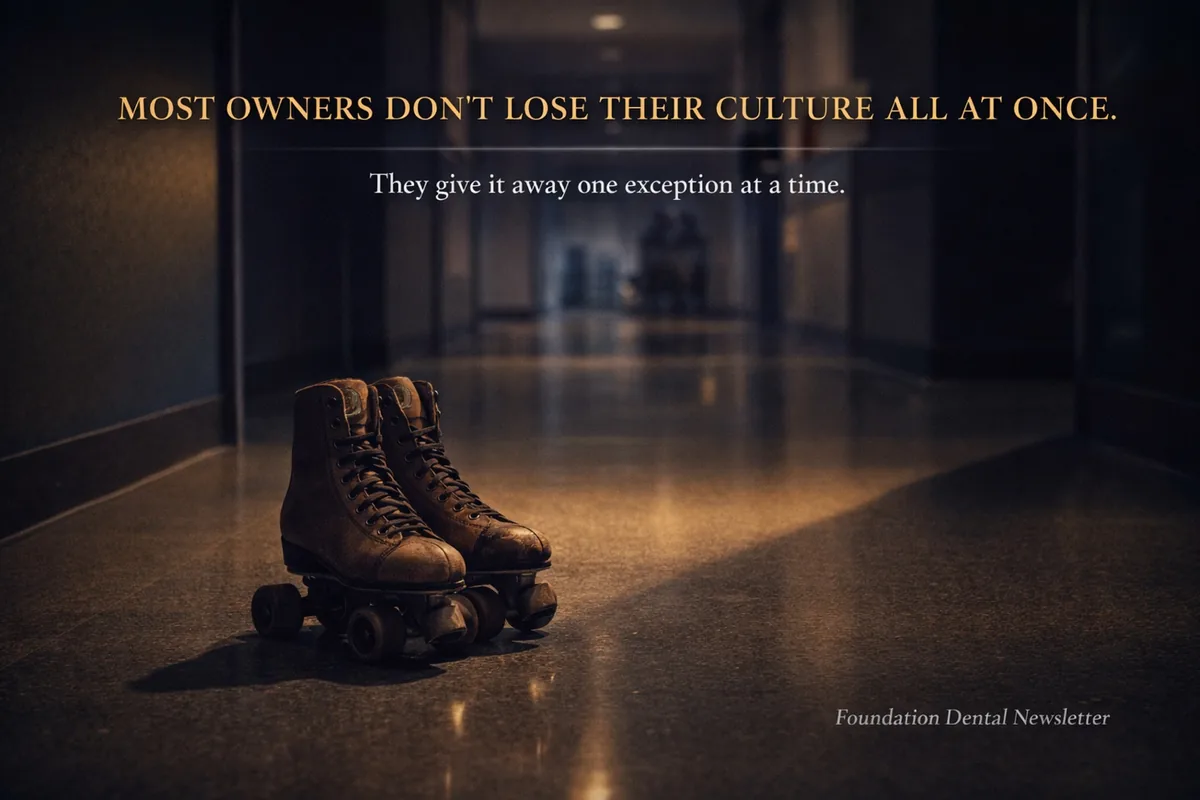
Culture usually erodes quietly first.
Most owners don't lose their culture all at once. They give it away one exception at a time.
One question that answers everything
If you strip away your intent, your stories, and your explanations, you're left with what people actually experience when they walk through your doors every day.
If a top-tier hygienist spent one full day inside your practice - quietly watching, working alongside your team, reading the room when you weren't standing nearby - would she leave thinking "this is the place I want to fight for," or would she leave thinking "nice people, good dentistry, but I've got better options"?
That’s the question that exposes everything.
You don't answer that question with words. You answer it with the culture you build, on purpose, every single day.
Culture is not what you do to reward your team. It's how your team behaves when you aren't there to reward them.
Culture isn't a line item on your P&L. It doesn't show up in your production report or your collections rate. But it shows up everywhere else - in how your patients feel when they walk through the door, in how your team handles the hard days, in whether your best people are still with you next year.
Build something people actually want to be part of. Everything else gets a lot easier after that.
About the Author
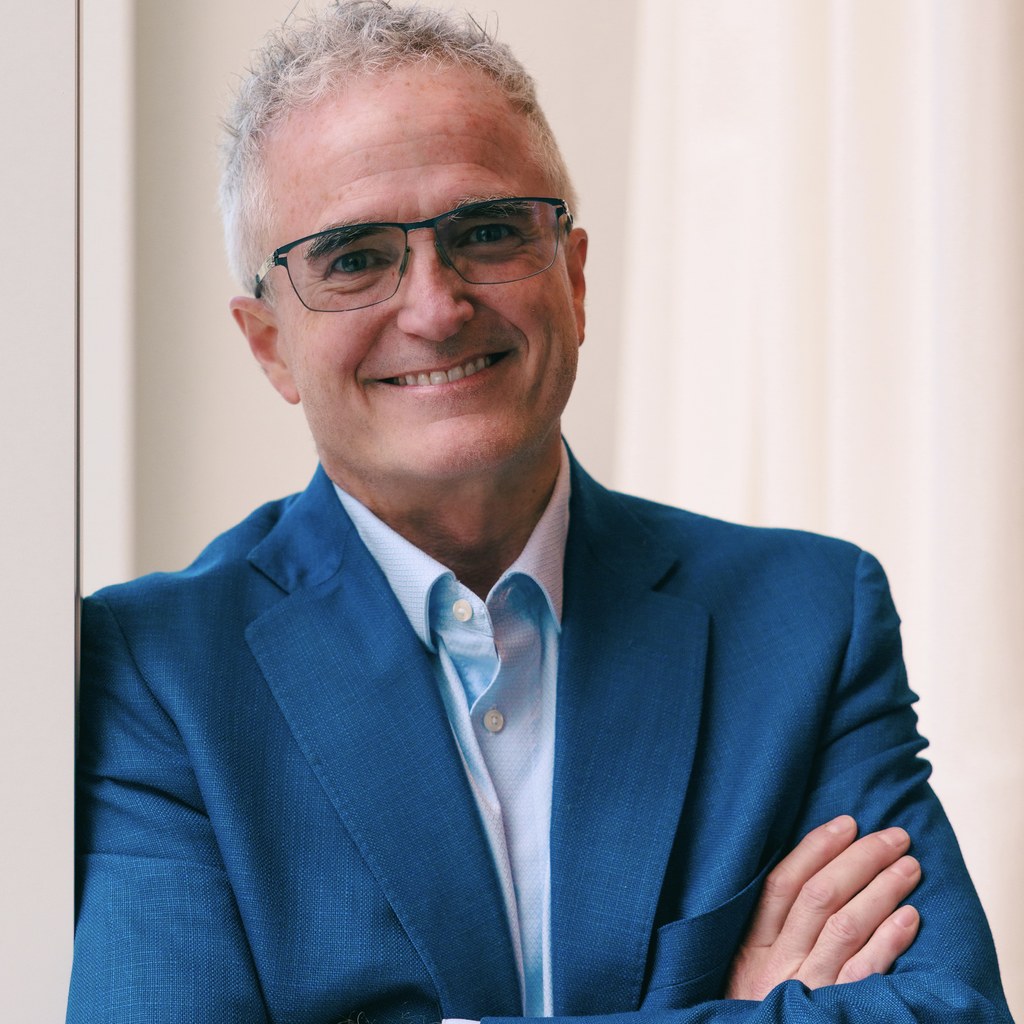
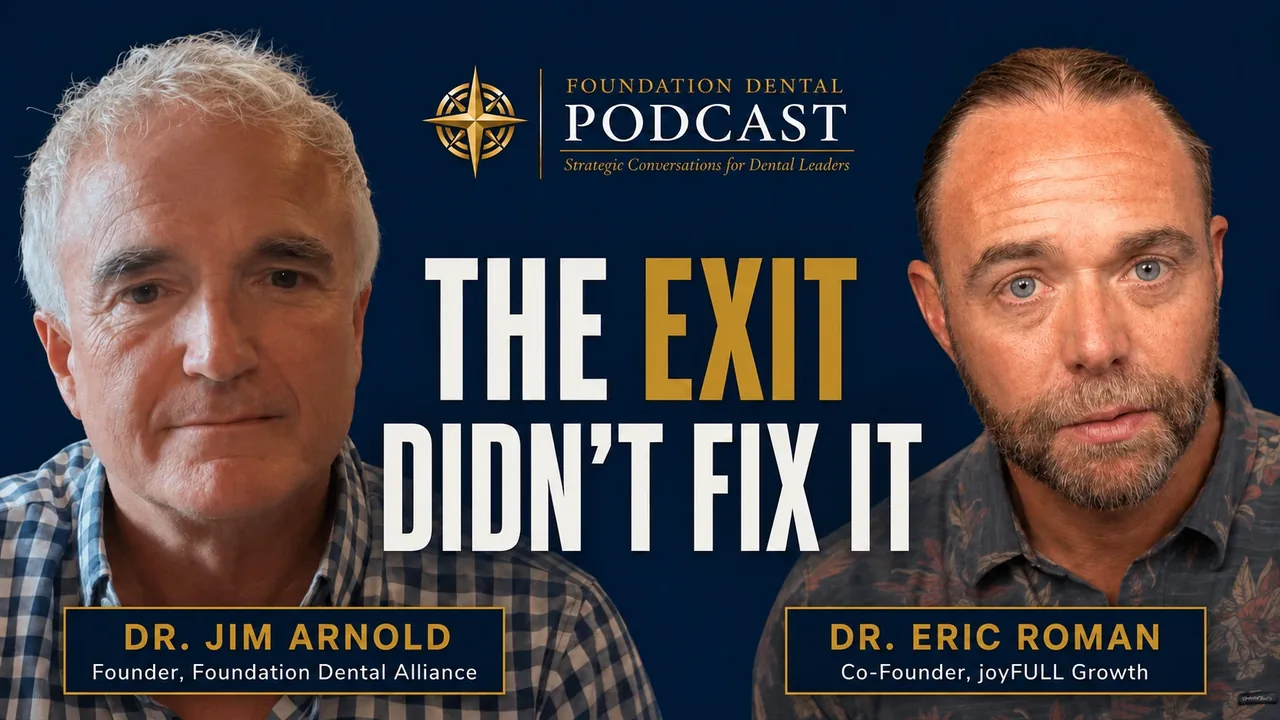
Dr. Jim Arnold, DDS is the Founder and CEO of Foundation Dental Alliance, a leadership and practice development organization serving dentists from graduation through retirement. He has more than 25 years of experience as a multi-practice owner and has been involved in more than 60 dental practice transitions. He leads the Foundation Dental Mastermind and Luxury Dental Retreats, and hosts the Foundation Dental Podcast. He also publishes the Foundation Dental Newsletter and Blog weekly, focused on leadership, practice design, and long-term sustainability in dentistry.
Stay Connected
Foundation Dental Alliance: www.FoundationDentalAlliance.com
Foundation Dental Mastermind: www.FoundationDentalMastermind.com
Foundation Dental Transitions: www.FoundationDentalTransitions.com
Foundation Dental Network: www.FoundationDentalNetwork.com
Dubai Luxury Dental Retreat: https://www.FoundationDentalAlliance.com/dubai
Foundation Dental Newsletter: https://www.linkedin.com/newsletters/foundation-dental-newsletter-7289675134649450496
LinkedIn: www.LinkedIn.com/in/arnoldjim
Instagram: www.Instagram.com/smilesbyarnold
Facebook: www.Facebook.com/smilesbyarnold
Twitter/X: www.twitter.com/smilesbyarnold
YouTube: www.youtube.com/@DrJimArnold