Foundation Dental Intelligence
Newsletter No. 64
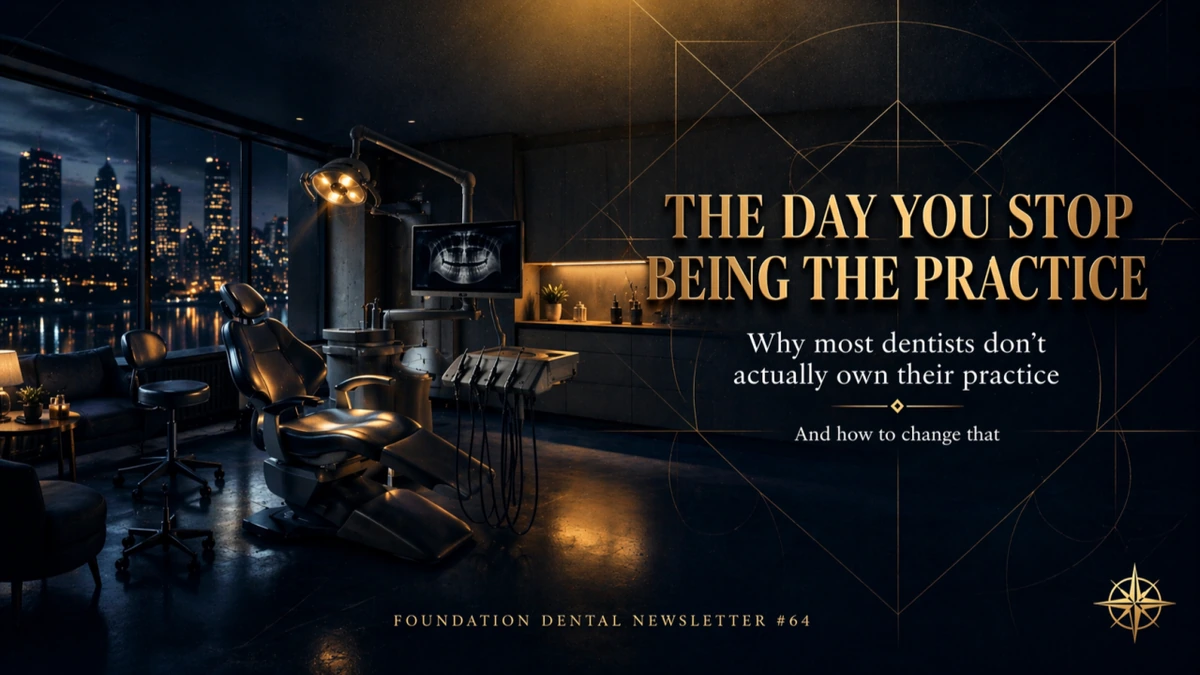
The Day You Stop Being the Practice.
Get the next issue.
One signup. Everything we publish.
About twenty years ago, my wife and I went to the Four Seasons Hualalai in Hawaii to celebrate our anniversary. It happened to coincide with the Ironman World Championship, which was unfolding all around us - athletes everywhere, the energy of something genuinely extraordinary in the air.
My phone never stopped vibrating.
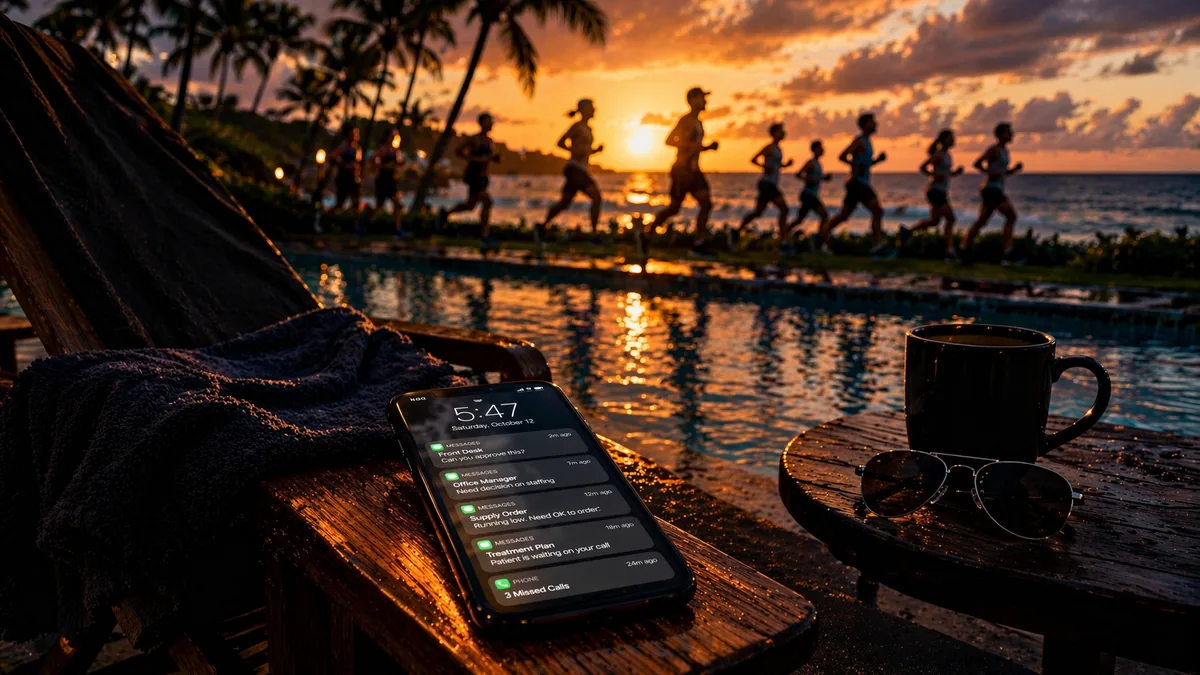
You can leave the office, but the office doesn’t always leave you.
Questions from the team. Decisions that apparently couldn't wait. Situations that needed my input before anyone would move forward. We were sitting at one of the most beautiful places on earth watching the best endurance athletes in the world compete, and I was managing scheduling decisions and supply orders from a lounge chair.
That trip was when I first understood the real problem. Not that my team was needy or incompetent - they weren't. The problem was that I had built something that required me. Every decision pathway led back to me. Every question had to clear through me. I was the practice, and the practice was me. And that meant I had no freedom regardless of where I was standing.
I came home from that trip with one clear intention: this had to change.
What ownership actually feels like from the inside
Most dentists feel like owners because they carry all the risk, make all the decisions, and absorb all the pressure. That's not ownership. That's dependency with a higher income.
Real ownership feels different. It feels like optionality - the ability to step back without everything degrading. It feels like durability - systems that hold their standard whether you're in the building or not. It feels like the quiet confidence that comes from knowing your practice is not a fragile thing that exists only because you're holding it together.
Most dentists I talk to describe their practice with pride - and they should. They've built something real. But when I ask what would happen if they disappeared for thirty days, the answers reveal the gap between what they have and what they think they have.
What breaks first? Who makes the call when something goes sideways on a Wednesday afternoon? What decisions get made and what decisions get stalled while everyone waits for you to return? Those questions don't have comfortable answers for most practice owners - not because their teams are weak, but because the design never required anything different.
You don't become an owner when you buy a practice. You become an owner the day the practice no longer depends on you to function.
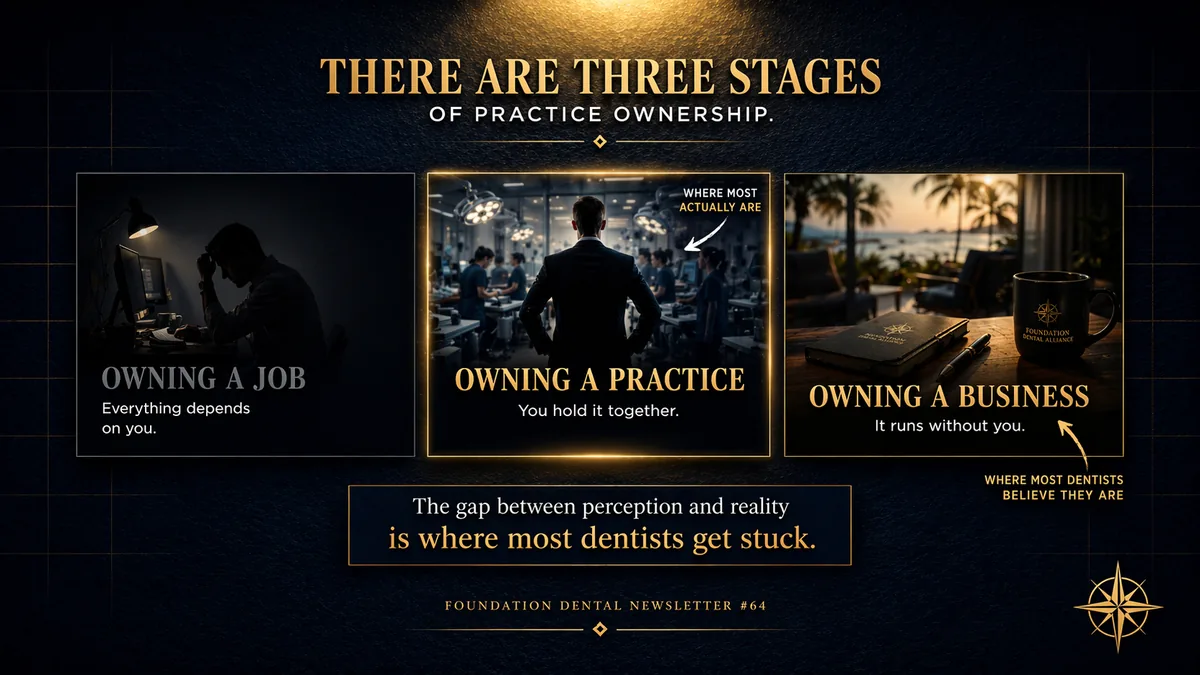
Most dentists don’t lack success. They lack separation.
The trap that hides inside strong production
Here's the part that makes this genuinely difficult to see. High production is one of the best camouflages for dependency that exists.
When the numbers are strong, everything feels like it's working. Patients are coming, treatment is getting done, collections are solid, the team seems engaged. There's no obvious signal that anything is wrong. The practice feels healthy because by every external measure it is healthy.
But the question isn't whether the practice is performing. The question is whether the performance is tied to your personal presence. Those are very different things. A practice can produce at an exceptional level and still be completely fragile - because the production is driven by you specifically, not by a system that could replicate those results without you.
That fragility doesn't show up in the daily numbers. It shows up when you try to take a real vacation. It shows up when you get sick. It shows up when a buyer walks through the door and starts asking questions about what happens after you're gone. And it shows up in the exhaustion that accumulates over years of being the person everything runs through.
I lived inside that trap for longer than I should have. I was productive, profitable, and perpetually in the loop. None of those things felt like problems until I understood that the loop was the problem.
They were already ready
When I came home from Hawaii and decided things needed to change, I made an assumption that turned out to be completely wrong. I assumed it would take years to develop the kind of leaders who could run things without me. I prepared myself for a long, slow process of building capability from the ground up.
What I discovered instead was a great revelation.
The people were already there. They had been there the whole time. My team wasn't waiting for development - they were waiting for an opportunity. They were patiently, quietly ready to take on real responsibility, and the only thing standing between them and that responsibility was my inability to fully recognize and appreciate what they were already capable of.
That realization changed everything. Within less than a year - not the several years I had braced for - each practice had genuine leaders who owned their sphere of influence. Not managers who checked boxes. Leaders who made decisions, held each other accountable, and found it easier to act in the moment than to wait for me to weigh in. The team felt trusted. They felt empowered. And that feeling translated directly into how they showed up for patients, for each other, and for the practice.
They were already extraordinary. I just had to fully recognize and appreciate that fact. And that's when everything changed.
The irony is that I had been the bottleneck not because I was indispensable, but because I hadn't yet made the decision to stop being one. The capability was sitting right in front of me the entire time.
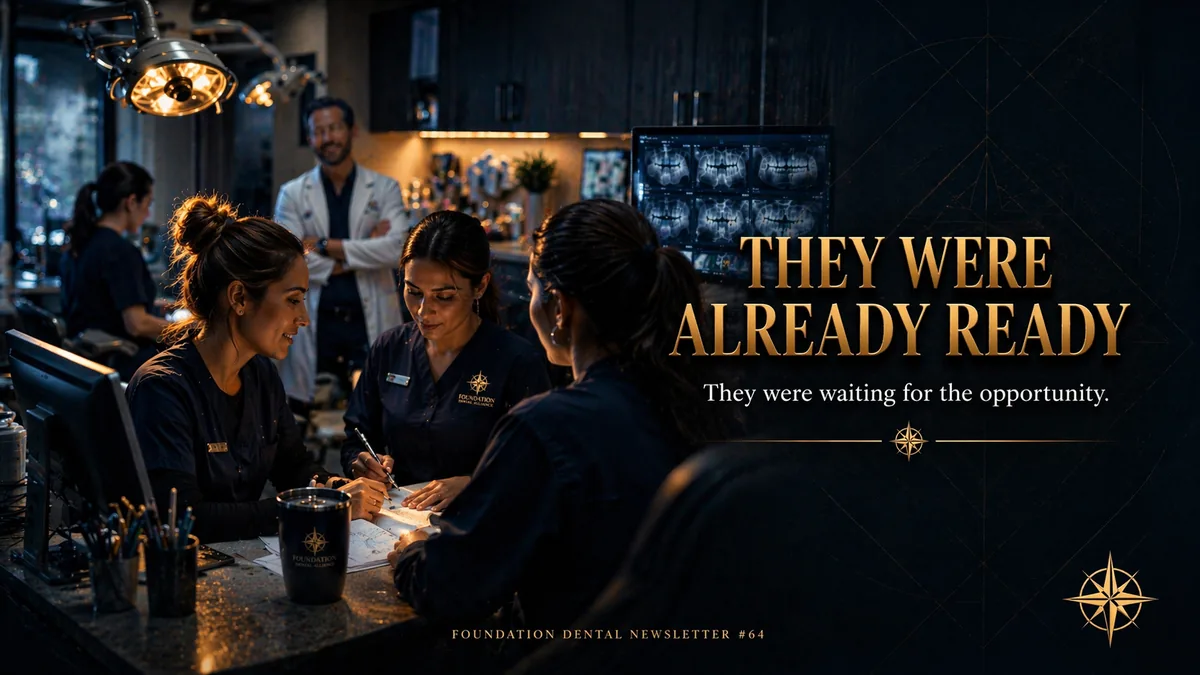
They didn’t need more training. They needed more trust.
What the next trip felt like
The following year, my wife and I went back to Hualalai. Same resort. Same anniversary. Same Ironman weekend.
I made the comment to her that this was a far better experience than the year before. At the time I may not have been fully articulate about why - but the evidence was right there in my hand. Or more accurately, it was the absence of evidence. The calls had dropped off dramatically. The texts had nearly stopped. The emails that used to stack up while I was away simply weren't coming.
The practice was running. Without me running it.
That's a feeling I want every dentist to experience at least once before they're too burned out to appreciate it. Not the absence of connection to your practice - I still cared deeply about everything happening there. But the presence of genuine freedom. The ability to be fully somewhere else because the people you trusted were fully present where it mattered.
It's a different kind of ownership. And once you've felt it, the alternative stops being acceptable.

We returned a year later, and the experience was completely different.
What distributed leadership actually produces
The team members who grew into leaders during that period didn't just make my life easier. Their own trajectories changed. Five or six of them are now high-level executives inside DSOs - people who are running large organizations, leading teams of their own, making decisions that affect hundreds of employees and patients.
I think about those years when they were taking on more responsibility in our offices, making some mistakes, learning from those mistakes, and building the kind of judgment that can only come from actually being trusted with something real. I believe those years formed the foundation for where they are today. I couldn't be more proud of what they've accomplished, or more grateful for what they gave to the practice and to me during that time.
That's the outcome that never shows up in a valuation model. You invest in distributing leadership and you get a practice that runs better and a team that grows beyond what either of you imagined. The returns compound in ways that are impossible to fully anticipate.
When you finally trust your team completely, two things happen simultaneously. The practice gets stronger. And the people in it become more than you expected them to be.
The connection to what buyers see
Newsletter #63 and Blog #63 were both about what buyers actually evaluate when they walk through a practice. The numbers matter, but predictability is what determines premium versus discount. And predictability comes from systems that run without the owner and a team that protects those systems when no one is watching.
What I didn't say explicitly in either of those pieces is that you can't build that kind of practice through systems alone. You build it by doing what I did - recognizing that the people around you are already capable of more than you've asked of them, and then making the decision to actually ask.
The practices that command premiums at exit are almost always the ones where the owner made this shift years earlier - not as a transition strategy, but as a philosophy about how a practice should be led. The valuation benefit is a byproduct of a decision that was made for completely different reasons.
Culture protects systems. Distributed leadership sustains culture. And the day you stop being the practice is the day all of it becomes genuinely durable.
The thirty-day test
This is the test that most owners avoid.
If you want an honest read on where you stand, there's one question worth sitting with seriously: if you disappeared from your practice for thirty days, what would actually happen?
Not what you hope would happen. Not what your team would attempt. What would actually happen to production, to patient experience, to the quality of decisions being made, to the standard your practice operates at every day.
If the honest answer creates anxiety, that anxiety is pointing at something real. It's not an indictment of your team - it's a signal about the design. The design hasn't yet required them to function at the level they're capable of. And that's fixable. Faster than you think, if you're willing to make the same decision I made after that first Hawaii trip.
The capability is probably already there. It was in my practices. It took me too long to see it, but when I did, the change came quickly. Your team may be sitting right where mine was - patient, ready, and waiting for you to fully recognize and appreciate what they're already capable of.
The day you stop being the practice is the day you finally own one.
Most people never ask this question honestly.
Bottom line
Ownership in dentistry is not a legal status. It's not equity or a deed or a tax structure. It's the experience of having built something that functions beyond your personal presence.
Most dentists never fully get there - not because it's impossible, but because the transition requires a level of trust that feels uncomfortable until you've been to the other side of it. The phone has to stop vibrating before you believe it can.
But when it does - when you're sitting somewhere extraordinary and your practice is running exactly as it should without a single question that needs your input - that's when you understand what you were actually building toward all along.
It was never just a practice. It was freedom. And freedom turns out to be built the same way everything else worth having is built: by trusting the people around you more than feels safe, and discovering they were ready for it the whole time.
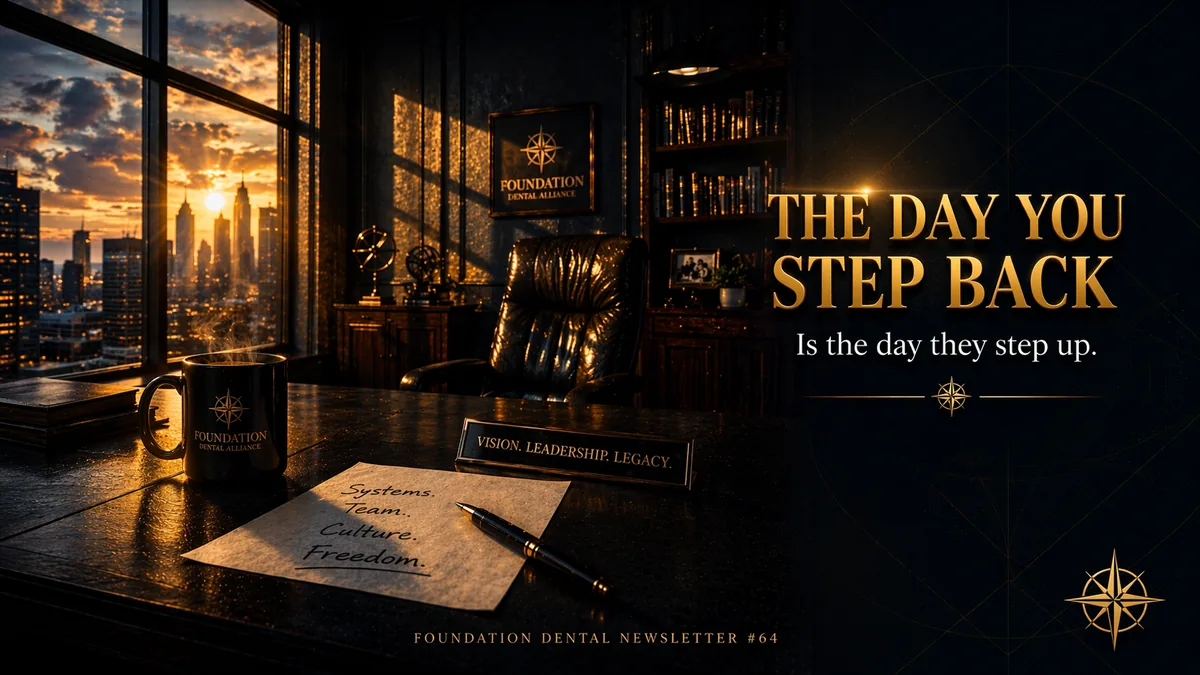
The practice runs because of who you trusted to lead it.
About the Author
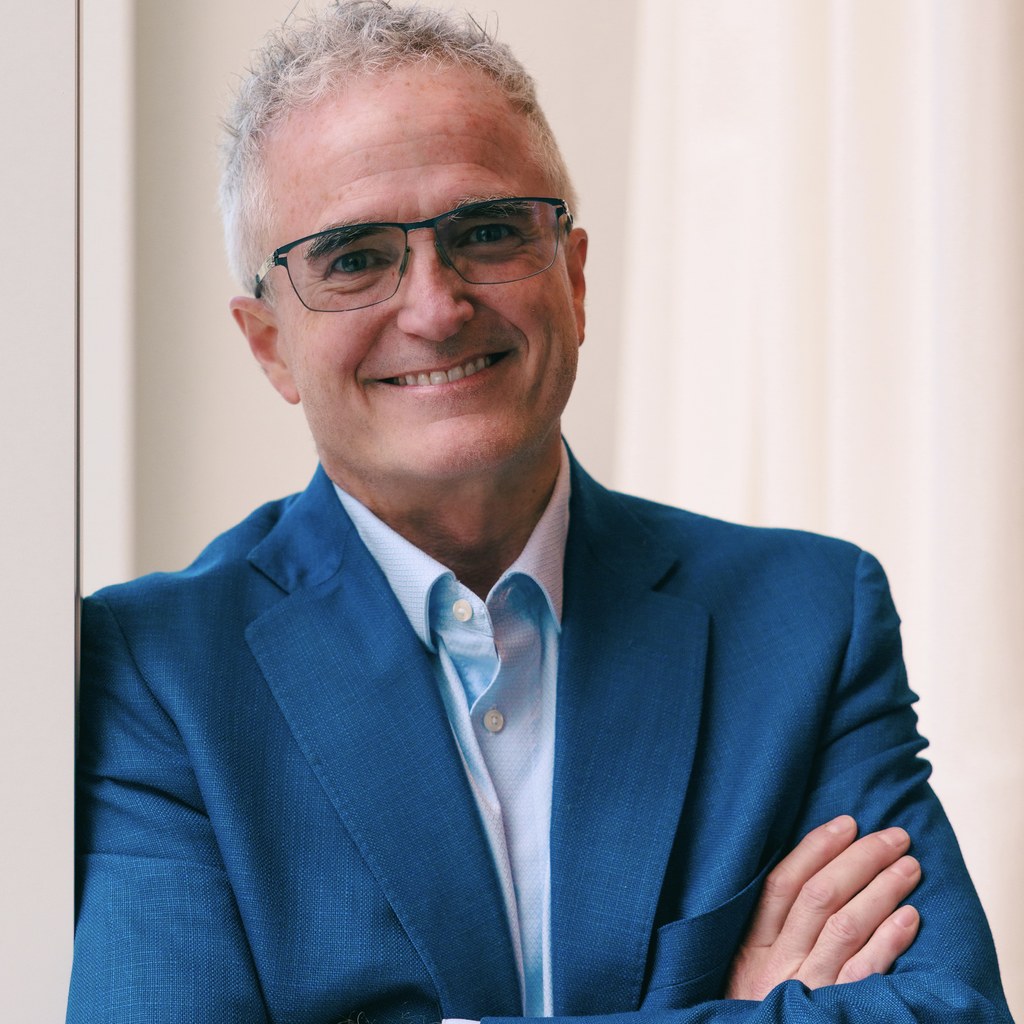
Dr. Jim Arnold, DDS is the Founder and CEO of Foundation Dental Alliance, a leadership and practice development organization serving dentists from graduation through retirement. He has more than 25 years of experience as a multi-practice owner and has been involved in more than 60 dental practice transitions. He leads the Foundation Dental Mastermind and Luxury Dental Retreats, and hosts the Foundation Dental Podcast. He also publishes the Foundation Dental Newsletter and Blog weekly, focused on leadership, practice design, and long-term sustainability in dentistry.
Stay Connected
FoundationDentalAlliance.com
FoundationDentalMastermind.com
FoundationDentalTransitions.com
FoundationDentalNetwork.com
LuxuryDentalRetreats.com
LinkedIn: linkedin.com/in/arnoldjim
Instagram: instagram.com/smilesbyarnold
YouTube: youtube.com/@DrJimArnold
Facebook: www.Facebook.com/smilesbyarnold
Twitter/X: www.twitter.com/smilesbyarnold
TikTok: www.tiktok.com/@foundationdentalalliance
Foundation Dental Newsletter: https://www.linkedin.com/newsletters/foundation-dental-newsletter-7289675134649450496
Google Business Profile: tinyurl.com/2t3chcv6
Professional Email: drarnold@foundationdentalalliance.com