Foundation Dental Intelligence
Newsletter No. 68
You Hit Your Number. Now What.
Get the next issue.
One signup. Everything we publish.

The production goal gets reached. The feeling you expected never arrives.
There's a moment most dental practice owners don't talk about honestly. Not the struggle years. Not the startup phase. Not the grind of building the practice, carrying debt, or trying to survive the pressure that comes with ownership. Those stories get told constantly.
The moment I'm talking about happens later.
It's the moment after the number finally arrives. The production goal. The collections target. The EBITDA milestone. The building purchase. The first million. The second location. Whatever version it took, the number had become more than math. It had become emotional architecture. The belief underneath it usually sounded something like: when I finally get there, I'll feel different.
You hit it. Then something strange happens. That moment confuses a lot of owners because dentistry spends an enormous amount of time teaching people how to pursue achievement and almost no time preparing them for what happens psychologically after achievement occurs. Understanding that distinction may matter more than most production strategies ever will.
Because many dentists are not actually exhausted from dentistry. They're exhausted from believing the next number will finally create internal resolution.
THE GOAL WAS NEVER REALLY THE POINT
I've been a goal-driven person my entire life, and my relationship with goals has always been a little unusual.
I tend to aim far higher than what seems realistic. Not as a psychological trick. I genuinely believe the pursuit itself forces growth. I remember thinking that way in high school when I was running cross-country. I wanted to be a state champion. Realistically, I probably wasn't going to get there. But aiming at that standard completely changed how I trained. The gap between where I landed and where I aimed was still dramatically better than where I'd have ended up aiming somewhere modest.
That same logic followed me into dentistry, business, leadership, and every meaningful area of my life. Set the standard high enough that it changes who you become while pursuing it. On the occasions when I actually did hit the number, I rarely stopped to celebrate. I recalibrated. Found a bigger target, a better target, a faster target. The arrival became the new starting line.
For a long time I thought that was just how I was wired. But after decades in dentistry and more than 60 practice transitions, I've come to understand something important about the owners who sustain growth over long periods. They're not the ones who hit the biggest numbers. They're the ones who understood the number was never really the destination.
It was direction. Mistake it for a destination and you'll find yourself somewhere you didn't plan to stay.

Most dentists spend years chasing a number. Very few ask what happens when they reach it.
The goal was never really the point. The goal was the direction. Achievement without direction eventually becomes success that no longer feels meaningful.
WHAT COMFORTABLE ACTUALLY FEELS LIKE
Comfort rarely looks dangerous from the outside. That's part of what makes it so deceptive.
Most dentists who've become professionally comfortable still appear highly successful. The practice is busy. Production is strong. The schedule stays full. The income looks impressive. Nothing obvious looks broken.
What changes is more subtle. The practice stops feeling like something you're intentionally building and starts feeling like something you're maintaining. Conversations become less energizing. Curiosity starts fading. The standard quietly softens. Urgency disappears. Growth becomes more reactive than intentional.
I've been there myself more than once. Hit a number, plateaued, settled into a routine that felt earned but was actually a rut. It usually took a few months before I could name what was happening. The days weren't bad, exactly. They just weren't pointed at anything.
The strange part is that comfortable doesn't necessarily feel bad. That's what makes it genuinely dangerous. It simply feels less alive. The practice still functions. But something important has stopped expanding. Usually it's the owner.

The practice is running. The schedule is full, and the income looks fine. And usually something important has stopped growing. Usually it’s the owner.
And comfortable rarely shows up on a production report first. It shows up psychologically first. You feel it before the numbers do.
WHY THE NUMBER DIDN'T FEEL THE WAY YOU EXPECTED
Achievement culture quietly teaches something extremely misleading: that hitting the number creates emotional arrival. Not just financial improvement. Resolution. Security. Confidence. Peace.
Sometimes those feelings appear briefly. But for many high-performing owners, they disappear faster than expected because the number was never solving the deeper thing driving the pursuit.
Some dentists chase production because they genuinely love building. Others are chasing security, significance, identity, approval, proof, comparison, or fear. Most are chasing some combination simultaneously. The difficult part is that production is measurable while alignment is not. So owners naturally organize their emotional lives around what they can quantify - collections, EBITDA, acquisitions, net worth. Numbers become emotionally seductive because they create the illusion of certainty.
The external metrics improved. The internal architecture never got recalibrated.

The owners who thrive long-term keep redesigning the practice before the market forces them to.
And eventually the nervous system notices - not dramatically at first, but subtly. Less presence. More reactivity. Shorter satisfaction cycles. More comparison. Less gratitude.
One of the most dangerous patterns in ownership is unconscious escalation. Every achievement quietly becomes the new baseline. At first, growth feels exciting. Then it becomes expected. Then it becomes emotionally necessary just to maintain equilibrium. Once growth becomes emotionally required rather than strategically intentional, owners begin operating from pressure instead of clarity. Patience decreases. Comparison increases. Gratitude fades. Fulfillment drops. The practice may be thriving. The owner may not be.
Certainty and peace are not the same thing. That's why some dentists become objectively more successful while simultaneously feeling internally less settled.
THE TWO PATHS MOST OWNERS TAKE FROM HERE
When you zoom out on owners who hit their number, two patterns show up consistently.
The first group quietly downshifts. They stay clinically busy, keep production in a comfortable range, and use the comfort zone as a reason not to change anything structural. They tell themselves they'll figure out the exit later. They keep rescuing the day when systems fail because it feels easier than rebuilding anything. Five years pass. The practice looks similar on the outside. On the inside, the owner is more tired, the team is more fragile, and the practice is more dependent on a person who's thinking about slowing down. They didn't decide to drift. They just never decided not to.
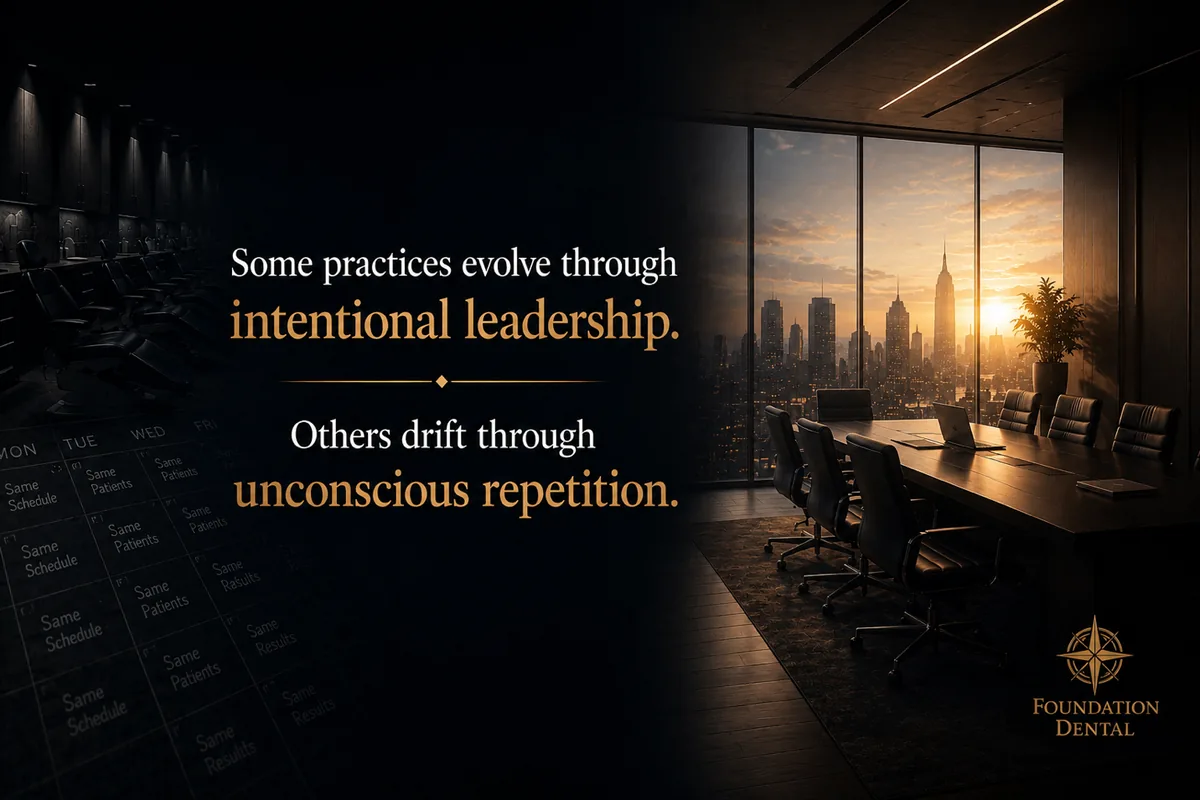
Most practices don’t decline dramatically. They repeat quietly.
The second group uses hitting the number as a pivot point. They ask a harder question: if money weren't the primary driver anymore, what would I actually want this practice and this next decade to look like? Then they rebuild around that answer. They redesign decision rights, develop leaders, and rewire their own role so the practice runs at a high level without burning them out.
On paper, both groups may show similar collections for a while. But the second group owns an asset that functions independently of their personal stamina. The first group owns a job with overhead that pays well - until it doesn't.
The owners who hold up best over time are the ones who used comfort as leverage rather than letting it become drift. They're less desperate. Less reactive. Less comparison-driven. Their growth becomes cleaner because it's no longer compensating for unresolved internal pressure. And many continue growing financially anyway - because emotionally grounded people make better long-term decisions.
HERE'S WHAT REALLY MATTERS
The most sustainable version of goal-setting I've found is treating goals as directional devices, not finish lines. A finish line implies rest on the other side. A direction implies continued movement. One produces the arrival problem. The other doesn't.
Once you've hit your number, the practical work organizes into three areas.
First: decisions. For the next 30 days, track every non-clinical decision that reaches you. At month end, sort them into three buckets - only I can decide this, someone else could with the right structure, and I should never have seen this. If the first bucket has more than ten items, you don't have a talent problem. You have a control problem. The owners who stay healthy in this phase are ruthless about shrinking that list. The work in Newsletters #65, #66, and #67 - decision rights, leadership development, authority transfer - was building toward exactly this.
Second: role. Write a one-paragraph job description for yourself for the next three years. What you'll still own clinically. What you'll own in leadership. What you'll refuse to keep doing regardless of how much the old version of you wants to step back in. Until that description exists on paper, you'll default to the job you already know because that's where your comfort lives.
Third: runway. Comfort is most dangerous when there's no defined horizon. Pick a real window - three, five, or seven years - and ask two questions. What would I regret not having built when I get there? What would I regret still being stuck in? Those answers belong in your operating decisions now, not after the building is paid off.
YOU CANNOT RESET YOUR STANDARD IN THE SAME ROOM THAT NORMALIZED IT
The reset mechanism isn't internal. You can't think your way out of comfortable. You need proximity to people who are operating at a level that resets your sense of what's possible.
Every meaningful growth period I've had professionally came the same way. Not through discipline alone. Not through a new system. Through being around people who were doing remarkable things and making my current level look modest by comparison. The room recalibrated the ceiling. Then I went back and raised mine.
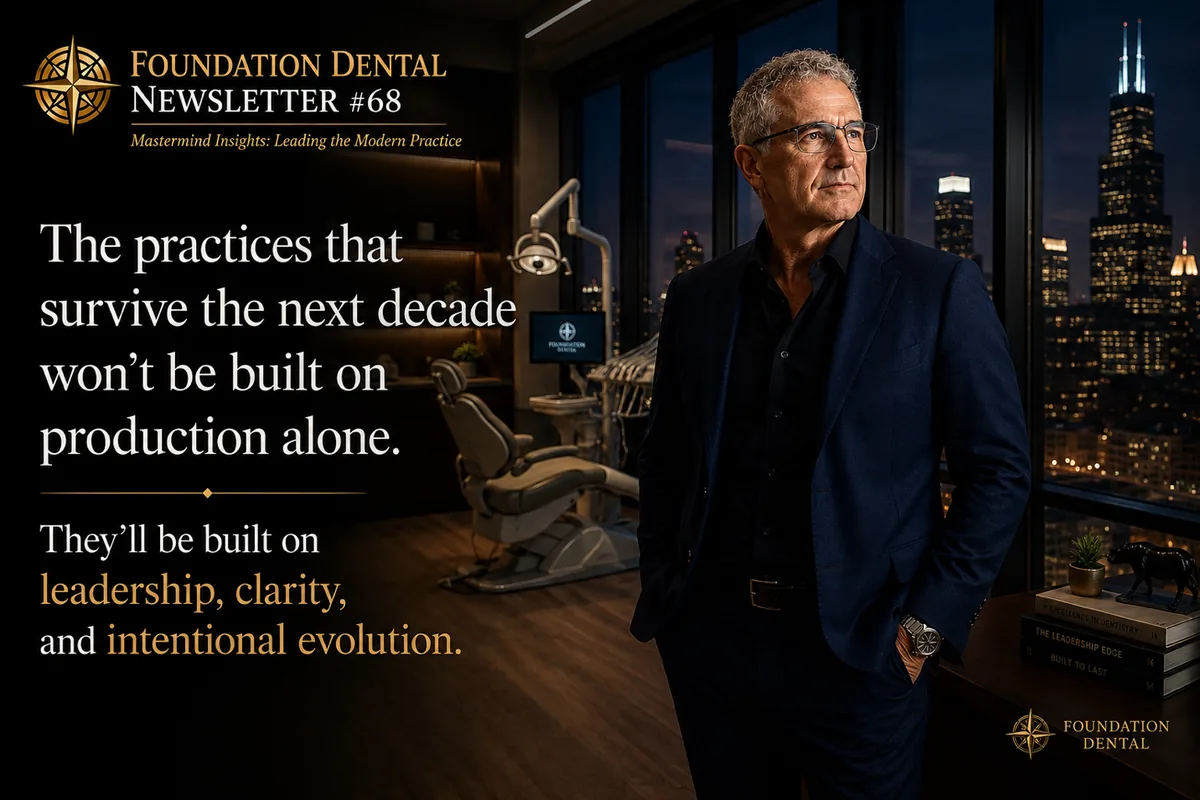
The next stage of practice ownership isn’t about producing more. It’s about building something that no longer depends upon you.
That's not a coincidence. That's a design principle. When you're around people who have already solved the problems you're working on, who are operating at a standard you haven't reached yet, who are building things you haven't built yet - the internal conversation changes. The questions you ask yourself change. The options you can see change. Proximity does what information alone cannot.
Newsletters #63 through #67 were about what buyers see, how decision rights drive value, and how authority transfer creates leadership that functions without you. This newsletter is about the psychology underneath all of those moves - the internal recalibration that has to happen once you've already hit your number before any of the structural changes stick.
The people you spend significant time with are the primary variable in whether your ceiling rises or holds. You cannot reset to a higher standard in the same environment that normalized the current one. At some point, you have to leave the room.
Three illusions tend to keep comfortable owners stuck. The first: 'I'll restructure closer to my transition.' The practices that command premiums are the ones where the owner made themselves less necessary years earlier - not 18 months before listing. You can't retrofit independence at the end. The second: stepping back means performance drops. In practice, when the owner stops being the bottleneck for every decision, the practice usually runs more efficiently, not less. The third: 'I can always push again if I need to.' Maybe. Or maybe the body, the family, and the team have one more sprint in them and you've already used it. Counting on future hustle to solve present drift isn't a strategy.
WHAT THIS LOOKS LIKE IN PRACTICE
This is why Foundation Dental Mastermind exists. Not as a coaching program. As a calibration environment. A room where the standard of what's possible in independent dentistry is set by the people actually doing it at a high level - and where proximity to that standard does something no curriculum can replicate.
The Luxury Dental Retreats work the same way. When you take people who are serious about building something meaningful out of the daily operational pressure that keeps ceilings low, the conversations are different. The recalibration that results is different. People come back pointed at something they weren't pointed at before they left.
That's a deliberate design. The practices that sustain growth over long periods - and I've watched this play out across more than 60 transitions over 30 years in this industry - are not the ones that found the right number and held it. They're the ones led by owners who kept leaving the room. Who kept surrounding themselves with people operating just beyond their current reach. Who never let the number they last hit become the definition of what they were capable of.
You cannot reset to a higher standard in the same environment that normalized the current one. At some point, you have to leave the room.
The owners who age best in this profession learned something important that dental school never taught.
External success means very little if you remain internally unsettled the entire time. Success without alignment eventually becomes psychologically consumptive. The scoreboard changes. The question is whether your internal life evolves with it.
The number you've been working toward is real. The work it took to get there is real.
Give yourself a moment to acknowledge that.
Then ask the question that matters more than the one you just answered.
What's the direction from here?
The number was never supposed to be the ending. It was supposed to change the direction.
EXTRACTABLE TAKEAWAY
The number you hit doesn't mean you're done. It means the game changed. If you stay in the center after that point, comfort quietly turns into drift - and drift always gets priced in later. The owners who win this stage use their comfort as leverage to redesign their decisions, their role, and their runway long before they're forced to.
Comfort feels free in the moment. It shows up later as a discount when someone else is deciding what your practice is worth.
FREQUENTLY ASKED QUESTIONS
What should I do right after I hit a big production or financial goal?
Take a month to audit every non-clinical decision that reaches you. At the end, identify what only you should still decide and start transferring everything else into defined lanes with real authority behind them. That single exercise usually reveals more about where your practice is stuck than any production report will.
Does hitting my number mean I should stop growing?
It means you should change what growth looks like. At this stage, growth is less about more production and more about independence, leadership depth, and options. The owners who stop growing confuse arrival with permission to coast - not because growth stopped being available.
How does comfort affect my eventual practice value?
Comfort often leads to drift and renewed owner dependency. Buyers price that risk in, even when current production looks strong. A practice that runs through the owner is worth less than a practice that runs without them - and that difference shows up at the transaction table regardless of how good the numbers look.
About the Author
Dr. Jim Arnold, DDS is the Founder and CEO of Foundation Dental Alliance, a leadership and practice development organization serving dentists from graduation through retirement. He has 30 years of experience as a multi-practice owner and has been involved in more than 60 dental practice transitions. He leads the Foundation Dental Mastermind and Luxury Dental Retreats, and hosts the Foundation Dental Podcast. He also publishes the Foundation Dental Newsletter and Blog weekly, focused on leadership, practice design, and long-term sustainability in dentistry.
Stay Connected
Websites
FoundationDentalAlliance.com
FoundationDentalMastermind.com
FoundationDentalTransitions.com
FoundationDentalNetwork.com
LuxuryDentalRetreats.com/dubai
Social Media
LinkedIn: linkedin.com/in/arnoldjim
Instagram: instagram.com/smilesbyarnold
YouTube: youtube.com/@DrJimArnold
Facebook: facebook.com/smilesbyarnold
Twitter/X: twitter.com/smilesbyarnold
TikTok: tiktok.com/@foundationdentalalliance
Google Business Profile: tinyurl.com/2t3chcv6
Publications
Foundation Dental Newsletter: linkedin.com/newsletters/foundation-dental-newsletter-7289675134649450496
Contact
Professional Email: drarnold@foundationdentalalliance.com