Foundation Dental Intelligence
Newsletter No. 67
The Employee You Trust the Most Is Still Waiting for Permission.
Get the next issue.
One signup. Everything we publish.
There's someone on your team right now who knows what to do.
They've seen the situation before. They've handled versions of it. They've watched you handle it. And when it comes up again tomorrow, they'll do the same thing they always do.
They'll wait for you.
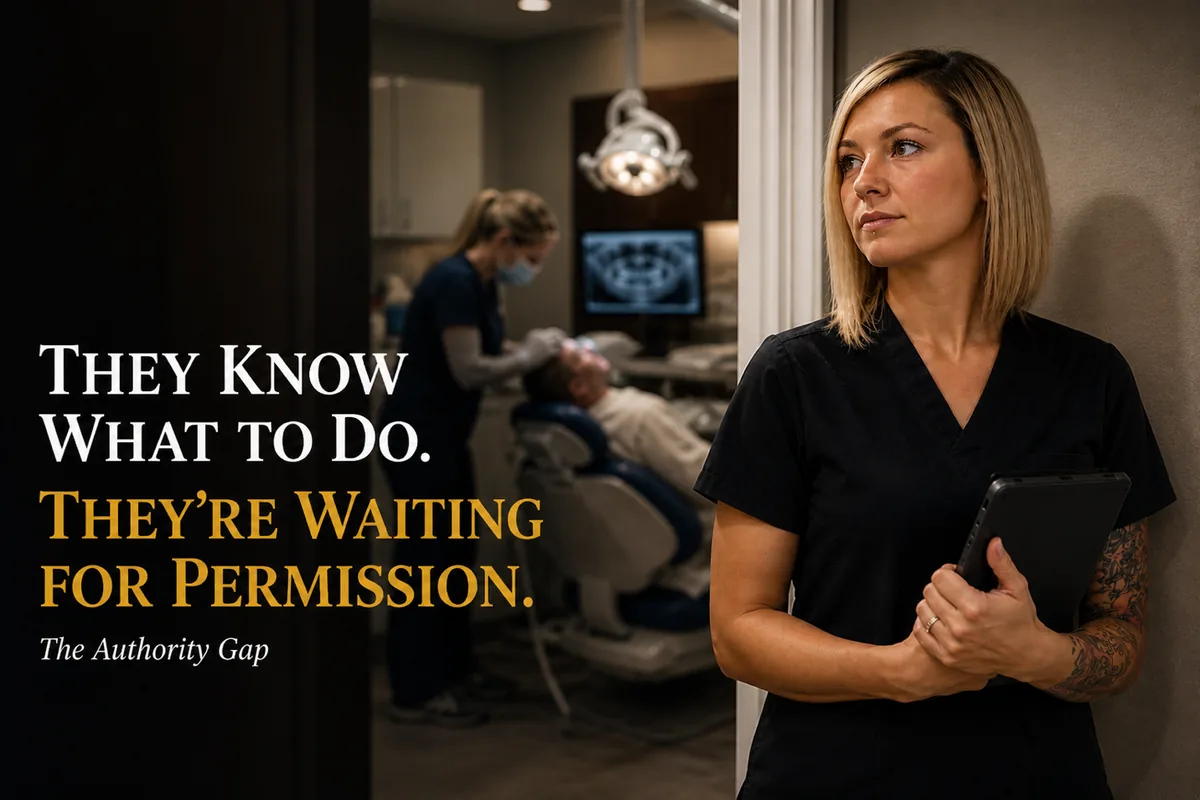
Not unsure. Not incapable. Waiting for the signal that the authority is actually theirs.
Not because they lack the ability. Not because they're unsure. They're waiting because the system you built taught them to.
If you want your practice to stop routing every decision through you, three things have to happen in order. Get specific about what your key person now owns - in writing, not in your head. Say it out loud in front of the team so the authority is real and not just implied. And stand behind their first hard decision even when it costs you something in the moment. Anything short of all three is delegation without real authority.
THE PART MOST OWNERS NEVER SEE
Most dentists think this is a people problem. Wrong hire. Wrong personality. Someone who just won't step up. So they train more, hire again, try to motivate differently.
That's not the first problem. The first problem is structural.
You created an environment where the safest move - for anyone on your team - is to ask you. Smart people make safe decisions. The rule becomes simple: if there's any chance the doctor wouldn't like the outcome, check first.
So they check. You answer. The day moves. The practice runs. You feel needed, which feels like leadership.
Not unsure. Not incapable. Waiting for the signal that the authority is actually theirs.
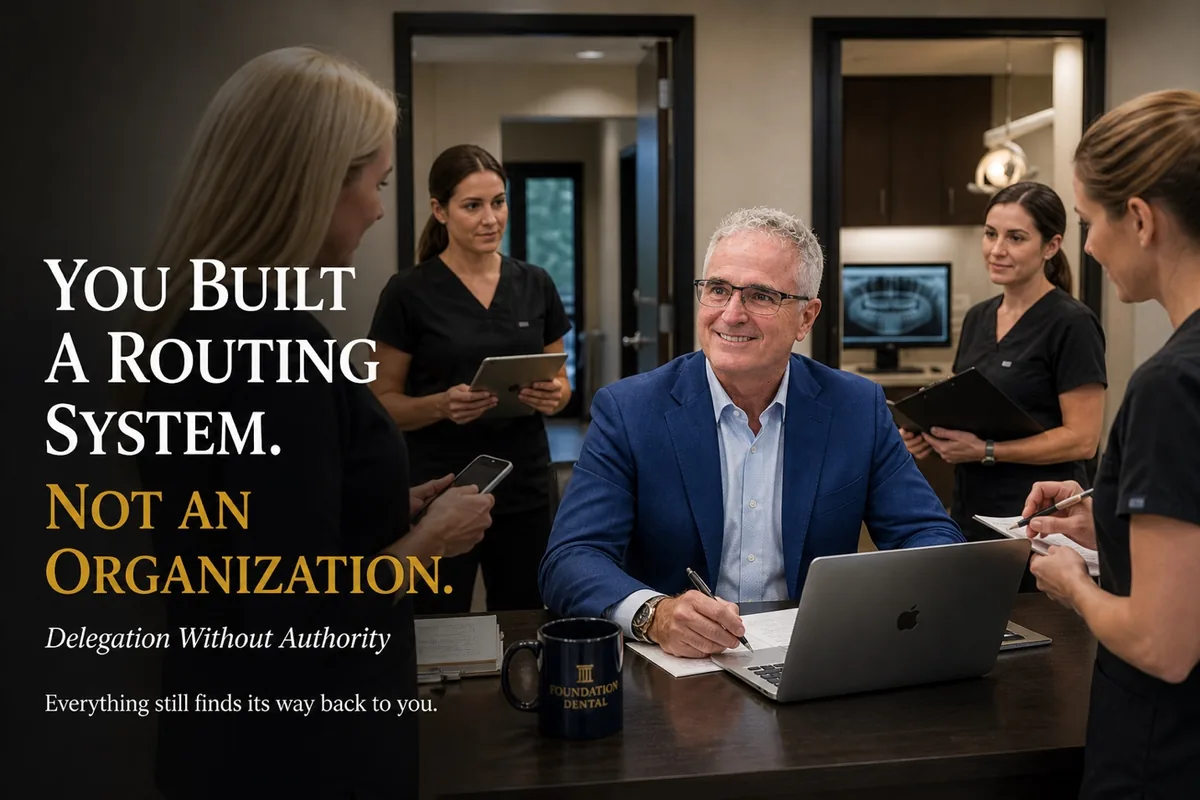
But what you've actually built is a routing system, not an organization. And routing systems don't scale. They don't survive transitions. They don't function the week you're in Kona.
The practice runs through you because you made it safe to route everything through you. That's not a leadership structure. That's a bottleneck with better intentions.
THE GAP NOBODY NAMES
You delegated the role. You didn't transfer the authority.
Those are not the same thing. Delegation moves work. Authority moves decisions. If the decisions didn't move, nothing changed.
Most owners carry a detailed sense of what they want their best person to own - in their heads. She should own the schedule. He should own anything patient-facing. She should own how the front of the house feels. Those are concepts, not assignments. And concepts don't hold when things get uncomfortable.
Newsletter #65 mapped the decisions. Newsletter #66 exposed the leadership gap. This one finishes the arc by forcing the actual transfer.
WHAT THIS ACTUALLY LOOKS LIKE
I worked with an owner a few years back who had a clinical director she described as the best hire she'd ever made. Smart, experienced, trusted by the whole team. The owner was preparing for a transition and assumed this person would anchor the practice through the process.
We tracked decisions for two weeks. Every decision that touched the clinical director - where it started, who brought it, who signed off.
Forty-one decisions. Thirty-seven still required the owner's involvement before anything moved.
That clinical director wasn't leading the clinical operation. She was managing it inside the owner's decision perimeter. The owner was stunned. She genuinely believed she'd built an autonomous leadership layer. What she'd built was a very capable second-in-command who had learned to work inside tight constraints without complaining about them.
That's not a personnel problem. That's an authority transfer problem. And it's fixable.
HERE'S WHAT REALLY MATTERS
Authority transfer isn't a conversation. It's a structure. And it only holds if three things happen in sequence.
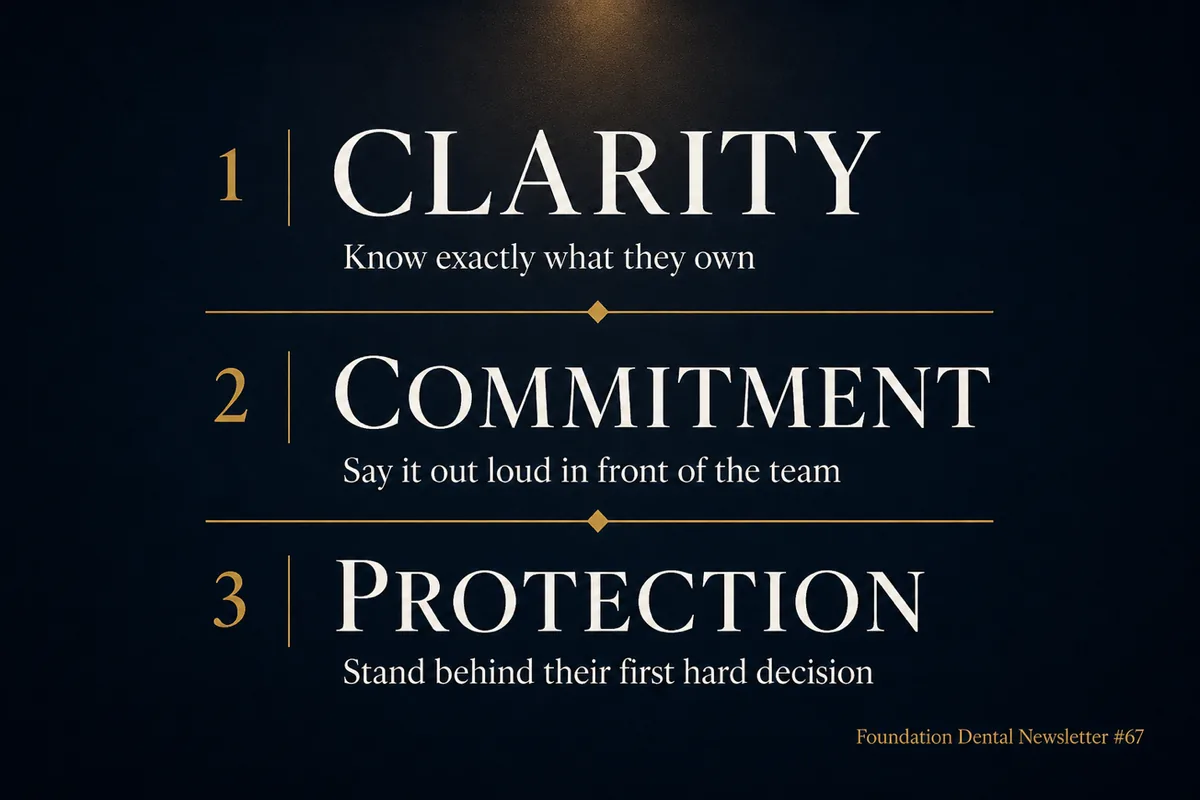
Not unsure. Not incapable. Waiting for the signal that the authority is actually theirs.
Clarity. Your leader needs to know exactly what they own - not concepts, decisions. What used to come to you that now comes to them. What they can decide without checking. When you still need to be involved. If they can't answer those three questions in plain language, the authority doesn't exist yet. You've shared a hope, not made an assignment.
Public commitment. Authority that lives in private dies in public. You have to say it out loud, in a team meeting or morning huddle, in specific terms. 'From today forward, anything related to scheduling conflicts goes to Taylor first. She owns that lane. If it comes to me, I'm sending it back.' That moment gives your best person something they've probably never had: cover. They can point back to your words when someone pushes.
Protection. This is where most owners break the system. The first time their decision creates friction - a patient complaint, a team member who's unhappy, a day that runs tight because your leader held a standard instead of bending it - everyone is watching. If you step in and soften the outcome in front of the team, you just took the authority back. If you say 'this is Sarah's lane and I support the call she made,' you cement it. In public you stand with them. In private you debrief. That sequence - real authority, real friction, real support - is what changes someone permanently.
Your most trusted employee will not lead like an owner until they've felt you stand behind a decision that cost you something in the moment.
MOST PEOPLE MISS THIS
The problem isn't your team. It's the identity shift required of you.
You built this practice by making thousands of decisions. You developed judgment through repetition, through mistakes, through years of navigating situations your team hasn't lived yet. That judgment is real. It's earned. And it's also the thing keeping your best people from developing their own.
Every time you step back into a decision that belongs to someone else, you remove a rep from their development and add one more thing to your own load. Six months from now, that person is either more capable or more dependent. The variable is whether you stayed in their lane or got out of it.
If every development rep still goes to you, you're training dependency, not leadership.
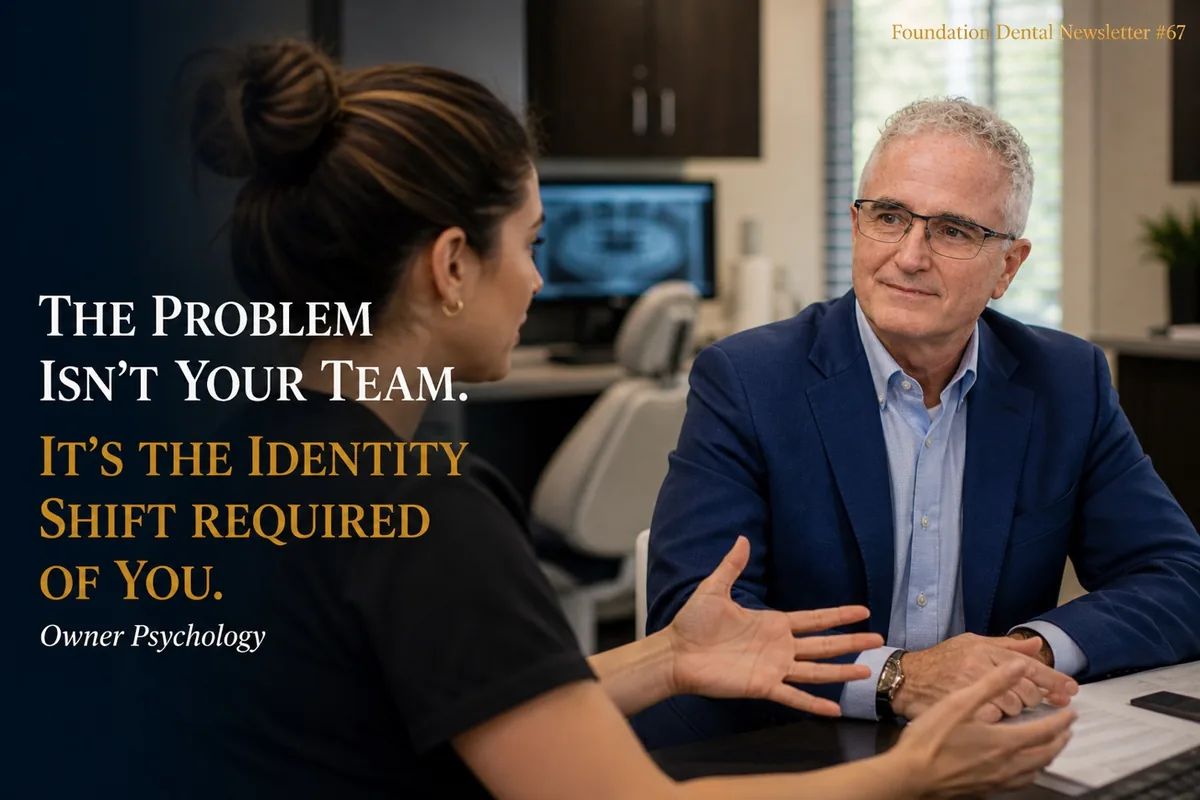
Every decision you take back removes a rep from their development. Six months from now, they’re either more capable or more dependent.
The owners I've seen do this well have one thing in common: they got deliberate about which decisions they were going to stop making - and then actually stopped. Not because they didn't have opinions. Because they decided their job was to develop the people who should be making those calls. That's a different job description than the one most owners are living.
THE PATTERN THAT KEEPS YOU STUCK
Most owners address this with training. A leadership course. A consultant to define roles. An org chart with cleaner lines. None of that touches the actual problem, which is behavioral, not structural.
The org chart can say your clinical director owns clinical operations. If you still get pulled into every patient complaint and scheduling conflict, the org chart is a document, not a reality.
At some point, the choice is simple. You can keep your sense of control. Or you can build a practice that can run without you. There's no version of real authority transfer that doesn't involve letting someone else's judgment stand when it would be easier to override it. You don't get both.
WHY THIS MATTERS MORE THAN YOU THINK
Across more than 60 transitions, the most valuable practices aren't the busiest. They're the ones that don't depend on the owner for decisions.
Buyers aren't just buying production. They're buying predictability. A developed leader who holds explicit authority is one of the clearest signals that lowers risk when a buyer evaluates your practice. At Foundation Dental Alliance and Foundation Dental Transitions, we see the difference consistently - practices where the owner is still the real operating authority on every meaningful decision take longer to close, attract different buyer profiles, and often transact at lower multiples.
The production may be identical. The risk is not. And the valuation reflects it.
The practices that command the best multiples aren’t the busiest. They’re the ones that don’t require the owner to function.
Building the authority structure now - years before any transition conversation - isn't just a leadership decision. It's a financial one.
THE SIMPLEST PLACE TO START
You don't need a new hire. You already know who this person is.
In the next thirty days, do three things. Sit down together and write their lane on one page - what used to come to you that now comes to them, what they can decide without checking, and when you still need to be involved. Then announce it to the team in plain language at a huddle. And when their first real call in that lane creates friction, stand with them in public and debrief privately.
By the end of those thirty days, you'll know two things: whether this is truly the person you want carrying more authority, and whether you're willing to let go of enough control for the transfer to mean anything.
Trust is a feeling. Authority is a structure. If your best employee is still asking what to do, you didn't transfer authority. You left them waiting for permission.
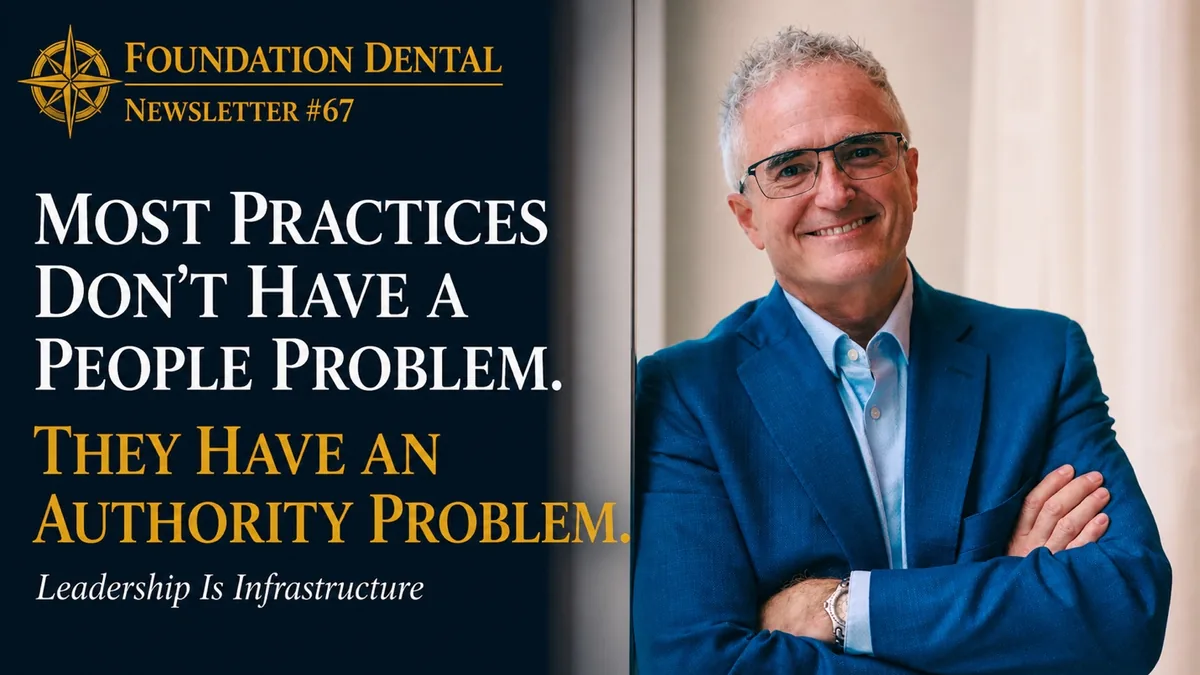
You don't have a people problem.
You have an authority problem.
The employee you trust the most isn't waiting for another conversation about how much you value them. They're waiting for you to make what you say you believe about them structurally true.
Until that changes, everything still runs through you.
About the Author
Dr. Jim Arnold, DDS is the Founder and CEO of Foundation Dental Alliance, a leadership and practice development organization serving dentists from graduation through retirement. He has more than 25 years of experience as a multi-practice owner and has been involved in more than 60 dental practice transitions. He leads the Foundation Dental Mastermind, Luxury Dental Retreats, and hosts the Foundation Dental Podcast. He also publishes the Foundation Dental Newsletter and Blog weekly, focused on leadership, practice design, and long-term sustainability in dentistry.
Stay Connected
FoundationDentalAlliance.com
FoundationDentalMastermind.com
FoundationDentalTransitions.com
FoundationDentalNetwork.com
LuxuryDentalRetreats.com/dubai
LinkedIn: linkedin.com/in/arnoldjim
Instagram: instagram.com/smilesbyarnold
YouTube: youtube.com/@DrJimArnold
Foundation Dental Newsletter on LinkedIn: linkedin.com/newsletters/foundation-dental-newsletter-7289675134649450496
Email: drarnold@foundationdentalalliance.com