Foundation Dental Podcast
$467,000 in Treatment Went Unaccepted. Nobody Had Time to Call
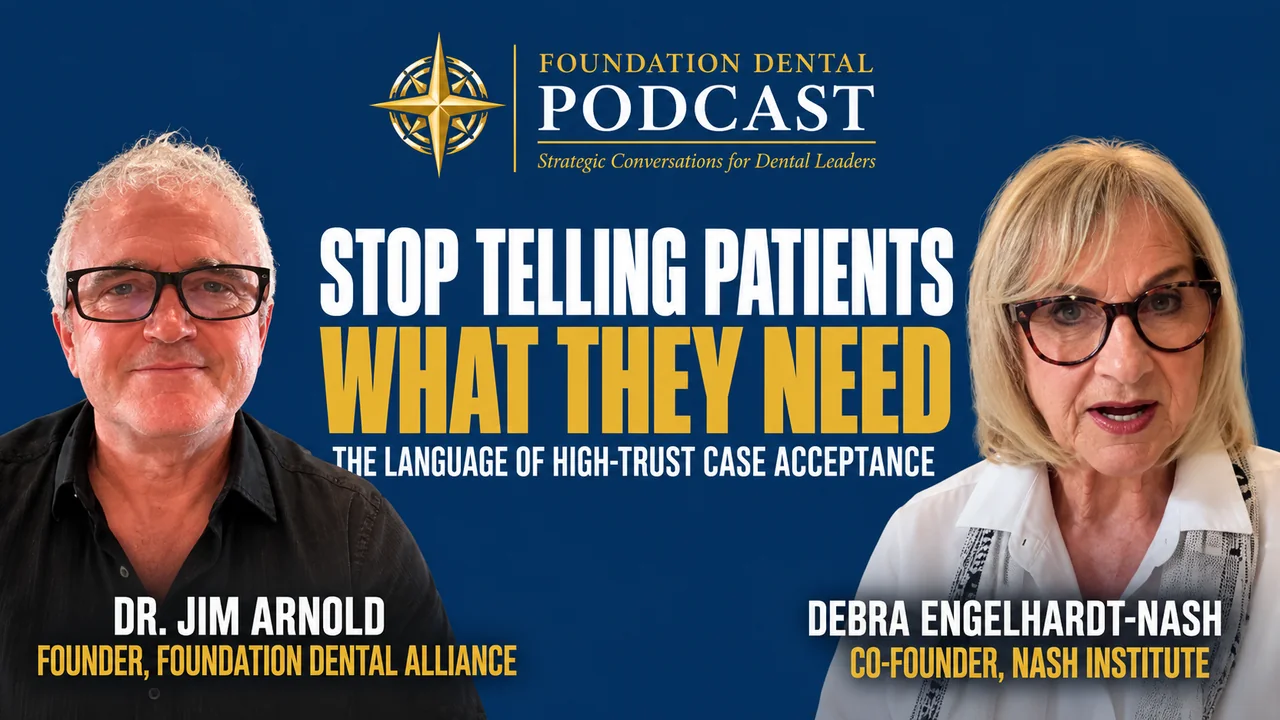
With Debra Engelhardt-Nash, Co-Founder, Nash Institute
Get the next conversation.
One signup. Everything we publish.
 Coming Soon
Read the full transcript
0:00Dr. Jim Arnold My guest today is Deborah Inglehart Nash, co-founder of the Nash Institute for Dental Learning, past president of the Academy for Private Dental Practice, a founding member and three-term president of the Academy of Dental Management Consultants, and a faculty member inside the Foundation Dental Mastermind. What makes Deborah different is that she didn't build her career from a textbook. She started ChairSide. Earned her CDA, ran a front desk, built a national consulting career, and still works inside a live cosmetic practice. Her ideas continue to be tested with real patients, real teams, and real pressure. I've known Deborah and her husband, Dr. Ross Nash, for 25 years, and they've had a profound impact on how I think about dentistry, leadership, and excellence. Deborah, welcome to the Foundation Dental Podcast.
0:47Debra Engelhardt-Nash Thank you so much for having me, Doctor Arnold. I appreciate it. Yeah, this will be fun. I'm looking forward to it.
0:51Dr. Jim Arnold Yeah, absolutely. I have I've been looking forward to it too. I mean, I always enjoy our conversations and you know, this is just an opportunity for somebody else, a lot hopefully a lot of people. That's right. Exactly. Exactly. So first question I I've got to ask this because you have spent decades teaching dentists what not to say. What's the one phrase Ross still uses that you just can't train out of him? There's gotta be one.
1:00Debra Engelhardt-Nash To enjoy our conversations. Good. The one that's the the winning one? The winning one. I mean, there are s you know, I would say there's, you know, actually seven critical questions, but the win winning one is criti is question number four. Instead of telling the patient or telling the patient this is what you need or having the starting the conversation with, I'm gonna tell you you need, it's and I'll tell a quick story about this in you know with with a young a young associate dentist. and this is famous he's famous for this, and now I guess I am too.
1:22Dr. Jim Arnold Yeah.
1:48Debra Engelhardt-Nash Would you allow me to tell you what I'd like to do for you if you were my brother? So that is, I mean, I will tell you what, I have never heard a patient turn away from, no, don't tell me what you what you would like to do for me. But I've heard I've seen the body language and the behavior when a patient, when a when a dentist or treatment coordinator says, I'm gonna tell you what you need, the wall goes up. The wall goes up. So th I was in a in a town in in in an office in Scapoose, Oregon, and I just love using the the example because I love saying scapoose, Oregon.
1:55Dr. Jim Arnold Okay. Absolutely.
2:23Debra Engelhardt-Nash suburb of of Portland and I'm listening to this young dentist talk to a recare patient and the hygienist went in, prepared him, and she the patient was an eighty-two eighty-two-year-old man, and she said, I just finished picking his lunch out of the open margin and his tooth in the back. And he, you know, we really need to, you know, address that. But da da da well, Dr. B, young Dr. B walks into this eighty-two year old
2:36Dr. Jim Arnold Mm-hmm.
2:51Debra Engelhardt-Nash man from skipoose and says you have necrotic tissue behind that tooth on the upper right side. Well first of all, does an 82-year-old man understand what I mean layman understand what necrotic tissue is? No. And then he suggests to the patient, he says, I'd really like to put a crown on that or I could do a very large filling. We've got to close up, you know, we've got an open margin that does he even know what that means. So I'd like to put a crown on that tooth or I'd like to do a filling Or the the the the best or the worst case scenario is you need to buy a water pig so you can keep that area clean. So, what you think patient did? Nothing. Nothing. The patient said, I'm 82, and it's and I I think I'm gonna be okay. And I'm not even sure what you mean by necrotic tissue. I mean, so I turned to Dr. B and I said, Imagine if you had approached him this way. And if you know whether or not, you know, say his name is George. George, would you allow me to tell you what I'd like to do if you were my dad? And
3:34Dr. Jim Arnold my god. Water pick, I'm sure. Yeah, exactly.
3:57Debra Engelhardt-Nash And one of the things I've taught myself to do is change your tone of voice, slower your pace, slow your pace, and and sit eye to eye. So body language is critical. I teach this for another, I actually white label for another consulting company. And I come in a couple of times a year to their two locations, big consulting group, and I teach treatment presentation and body language for that consulting firm. but I think it goes back to
4:04Dr. Jim Arnold Yeah. Nice. Right.
4:24Debra Engelhardt-Nash Man, would you allow me to I mean that's it's such a personable conversation as opposed to trying to sell dentistry. Would you allow me to tell you what I'd like to do for you? If you were my brother or or if and Ross always says if you gave me carte blanche, but I you know, if you were my if you were my dad, I mean, what a wonderful now engaging conversation to have with that patient. So that's that's a famous question for me. The question that actually Gary Cady and Lois Banta and my other friends use on stage and they give me full credit for is instead of When new patient calls an office, and so many times, you know, I I call and I Hi, my name is Deborah Nash. I'd like to make an appointment for a new patient examination and cleaning. And here's what I get one or two things. What insurance do you have? Or I get well, all new patients get a full master's x-rays, they get periodal probing, they get comprehensive examination, oral care answer screening examination, and we tell them what we're gonna do to them, but not what we're gonna do for them, not for them. Yeah.
5:06Dr. Jim Arnold Right. Yes. Two, not four. Four or width. Yes. my God.
5:23Debra Engelhardt-Nash Yeah. And so I think it's in, you know, so I so in sp instead of or what's even worse, because and we can talk about technologies, if I'm a patient of record, you shouldn't have to ask me if I'm a patient of record. You should have the technology that shows that I'm a patient of record. So, Jim, if you called my office and you just wrote me a check for twenty two thousand dollars a month ago for your treatment, I shouldn't say, Are you a patient of record? I I I should know who you are. So new technologies, and I don't care which one you use.
5:46Dr. Jim Arnold Absolutely.
5:51Debra Engelhardt-Nash New technologies allow you, and I'll have to talk about that. We gotta I gotta make a note to talk about this. Yeah. So I think it's really critical. The question is, so that I can schedule the appropriate appointment for you and meet your expectations, may ask you a few questions. And the first question is, tell me what inspired you to call today. What inspired you to call? Because the patient made a decision today to pick up the phone and call the practice because they want to make a difference in their dental life. I need to find out what they want to do.
5:56Dr. Jim Arnold we'll we'll get there. We w it it's definitely in the plan. Yeah.
6:21Debra Engelhardt-Nash as opposed to all new patients get this. So if you tell me you're patient-centric, if you tell me you're a patient-centric practice, you don't have a menu that you're gonna provide them. Not that you're not gonna do those things, but the patient needs to feel that you are customizing the experience based on what they're looking for.
6:24Dr. Jim Arnold Yeah. man. You have hit all the hot buttons and almost all my pet peeves when it comes to communication. And when you hear doctors or team members say some of these things, you know, the most egregious one of the most egregious is, we're gonna do an FMX on you. Like, what the hell did you just say? What you're gonna do what on me? What the hell is an FMX?
6:58Debra Engelhardt-Nash Hey Hey, periodal probing, it sounds sexual. You're gonna probe me.
7:02Dr. Jim Arnold It's like, yeah, why do why do dentists and teams still use such inappropriate dentist language instead of talking to them like human beings that didn't get a D D S or D D behind their name? It's crazy.
7:09Debra Engelhardt-Nash I know. And here's, you know, it's interesting because I just I was we were talking about this. I did a program about AI technologies and the patient experience. And the the AI AI is here. I mean, people are, you know, there's no reason to get all upset about it. It's how you're going to use it. Well, I mean, think about change. Think about what things that changed us. And I was talking about this. I mean, think about fire. Fire changed the the the creation, the found whoever, you know, the creation of fire, the discovery of fire changed us, electricity changed us.
7:22Dr. Jim Arnold Mm-hmm. Mm.
7:45Debra Engelhardt-Nash The automobile changed us, the computer changed us, smartphones changed us, and now AI changed us. Changes we do that. We know how to do that. It's how we leverage it and how we use it to our advantage. that that that works. So but
7:51Dr. Jim Arnold Yeah. hundred percent. There's too many people like worried that it's gonna take their job and all these kind of things. No, what it does it makes us better versions of ourselves, or it should if you harness its power in the right way. And by the way, it makes your office run more efficiently so that you have more time to build relationships with patients and you're less rushed. And at a time in the industry when
8:04Debra Engelhardt-Nash It's it's never gonna replace the human. It will never replace the human. Exactly. Yeah.
8:26Dr. Jim Arnold It's harder to recruit and retain top talent than it's ever been. And almost every practice is shorthanded. Like, why not bring in this technology that takes over tasks that are just time consuming?
8:35Debra Engelhardt-Nash Exactly. I mean, it's it's crazy. I was talking to an office this morning and we had a Zoom meeting and we were talking about AI and they're reluctant, they're nervous. And I said, Let me ask you a question. and I said, I don't drive through McDonald's very often, but sometimes, you know, when push comes to shove and I'm on the road or I'm, you know, it's 10 o'clock at night and I just haven't had dinner and I just landed till the on my way to the hotel. I'll drive through McDonald's and they'll say, you know, you pull through, and I don't know exact words because I don't go there that often, but they'll say,
8:50Dr. Jim Arnold Mm-hmm.
9:05Debra Engelhardt-Nash Do you have the McDonald's app? Welcome to McDonald's. do you have the McDonald's app? And if I say, and I always say no because I don't, well, you are greeted by AI at the McDonald's drive-thru. That's AI asking you if welcome to McDonald's. It that's McDonald's, that's AI. And when you say no, you don't have the app, then you get a person. But if you have the app, you are going to order through artificial intelligence. Did you know that?
9:08Dr. Jim Arnold Right. I did not know that. Interesting. Okay. I you know, I I did not know that, but it doesn't surprise me at all. I mean, things are changing by the week right now. I mean, there I don't think we've ever had a technology or such a disruption in human history as we have with AI. And because it kind of grows upon itself, th it's just accelerating everything. And, you know, if you're not at least keeping up with the bare minimum, like you're just gonna be left behind, unfortunately.
9:38Debra Engelhardt-Nash Crazy. No. Well, I mean, once again, you we talked about it. This the the the advantages of a of AI and any technology is that you can delegate processes to technology and you can focus on the people. So I have for yeah a million years I have said focus on people work, not paperwork. Outsource processes as much as you can so you can focus on the internal relationships that you develop with the patients.
10:14Dr. Jim Arnold Yeah. Yeah.
10:28Debra Engelhardt-Nash We were just talking about this when I was showing you that report from that office I was d describing a little bit a little bit earlier. So an example would I have an office outside of Boston. So I I still go into in offices and coach. So I was in an office and they have a peop people, this is these are the people, and I hopefully and I might offend or not offend and I don't know what's gonna happen. But obviously insurance coordinators get the most upset when you talk about outsourcing insurance, whether that be
10:34Dr. Jim Arnold Mm-hmm. Yeah. Of course.
10:56Debra Engelhardt-Nash To AI or whether the a virtual assistant or to a third party. And so they say, my gosh, what am I gonna with my job? So this person is sitting all day long going into insurance portals, going in and getting verifying benefits, going in and having getting all this conversation, which could be outsourced to artificial intelligence or to a virtual assistant. This office is sitting with $467,000 worth of incomplete treatment to patients who had treatment plans.
11:22Dr. Jim Arnold Mm.
11:25Debra Engelhardt-Nash Who didn't move forward with care. And the question is, who's calling those people and re-engaging them and re-enrolling them back into treatment? Well, nobody has nobody has time because they're doing this insurance stuff. So he said, what if you delegated the insurance work out and you outsource that so you could actually, the human could talk to the human about getting them rescheduled?
11:27Dr. Jim Arnold Mm-hmm. Right. Yep. Exactly. You know, I I I hear you and I think that's true. And I do love the the efficiencies created and the opportunity to spend more time on higher leverage activities that involved the people. On the other hand, you know, that's another task that, you know, you and I both know, a great program in Code and AI that does that for you, which is another beautiful thing because in my practices, I had what three well-trained teams. I mean, they I looked at them as the best of the best.
12:07Debra Engelhardt-Nash We know we don't do it.
12:19Dr. Jim Arnold And that was the one task that that got overlooked or got rushed through all the time because we as humans were busy. We've got people coming and going and the phone ringing off the hook. There's so many things going on at the same time that to get on that list, it's it almost feels like punishment for people who have eight million things to do. But with code and AI.
12:37Debra Engelhardt-Nash Yeah. So this could be yeah, this could be done in in the background. And you know the other thing about about technology and the other thing about is can number one, consistency of the languaging, consistency of the call of the call, making sure that I mean you can actually you're you can program that to be to be the conversation can be said the exact way you want it said, as opposed to a human fumbling, because so many my gosh.
12:50Dr. Jim Arnold Mm-hmm. Yeah. Exactly.
13:06Debra Engelhardt-Nash We talked about pet peeves. Hi, Jim. This is Deborah from Dr. Smegley's office. I was just calling to see if you're ready to schedule that appointment now. That is not the way I was doing the Zoom training this morning, and they're there. They say I first of all, they're calling the patient way too late. They're calling them within if the patient didn't schedule, they're waiting two weeks before they call them, too long. And they're saying, I'm just calling to see if you're ready to go ahead and schedule an appointment. The killer, it's a killer question.
13:06Dr. Jim Arnold So much more effective. Nope. Yeah. Don't call me, I'll call you. Yeah.
13:36Debra Engelhardt-Nash It's a killer question where you can you can program your AI or your virtual assistant, you can program them to say it the way you want it said, and it will be consistent. So that's a beautiful thing.
13:47Dr. Jim Arnold Mm-hmm. That consistency piece is huge. And the the important thing with the AI when you're dealing with humans is that it sound human and some are better than others. You know, I mean I think I think if they're sending messages, they better be hyper personalized to the patient and feel like it's coming from a member of the team.
13:57Debra Engelhardt-Nash Yeah. I I absolutely agree. And I I had that type of Absolutely. Yeah. So you really wanna you really wanna test and listen to whatever company you're gonna use the, you know, their AI technology, listen to how it sounds. I mean, you know, once again, do that secret shopper call and make, you know, make sure that it is how you want it, how you want it how you want it sound.
14:17Dr. Jim Arnold Mm-hmm. Well, I think I think with question one, you answered seventeen of the twenty questions so far. So we're almost ready to wrap things. Just kidding. No, I love it. You know, these are the conversations we have. I I love I love all the segues because there's yeah. You gotta be passionate.
14:40Debra Engelhardt-Nash Excited about this stuff because it, I mean, I mean, if you like if you think about the tipping point, and it can be one, there's could be one thing for and one thing that makes a big difference. Example, I was working with a technology communication custom company years and years ago, and this is their text message to the patient. This was the text message to the patient. This is just a friendly reminder about your appointment on such and such a date. And I said, You totally minimized and re and the importance of that message.
14:50Dr. Jim Arnold Yeah. Mm-hmm.
15:09Debra Engelhardt-Nash One word can change that message. So think so listen to the message, Jim. This is gonna be you now. So this is just a friendly reminder regarding your upcoming appointment.
15:18Dr. Jim Arnold Remove the word just, please.
15:21Debra Engelhardt-Nash Remove the word just and change the word friendly. This is an important reminder regarding your exclusive appointment. Yeah. Yeah.
15:28Dr. Jim Arnold Boom. Yeah, you know, I think we as dentists and teams have a a propensity for minimizing, using minimizing language. And if we don't give them a sense of urgency or at least a sense of how important this is and how things can go south in a hurry, they're not going to take it that seriously, unfortunately. And you just have to create that that you gotta create enough value that they understand that. Hey, what they say I need to do. And some some teams are better than others, of course.
16:02Debra Engelhardt-Nash I yeah. Well, I think that man, now we're gonna go down a whole new rabbit hole because I think sometimes what happens what happens is that sometimes team members feel awkward for a couple of reasons. And that's that whole belief cycle. They are concerned about affordability. And sometimes we always say, you know, they're diagnosing their own pocketbook and saying, I couldn't afford to do this. And the question always becomes, and I once again had this conversation with a team meeting last week.
16:09Dr. Jim Arnold Actually, yeah. Mm-hmm. Yeah. Yeah.
16:31Debra Engelhardt-Nash They have this, you know, when do you stop telling the patient that they have outstanding treatment? And and some offices feel very awkward about they feel like they're hounding or they feel like they're doing high pressure sales. And that's an attitudinal, that's a psychological, that's an attitude. That is not the patient telling you that. That's you telling yourself that. So how do I get out of that? So one of the things that I help teams understand when they say, I just don't want to feel like I'm pressuring the patient.
16:47Dr. Jim Arnold It is. Yep.
17:01Debra Engelhardt-Nash Here's what I say to them. I say, I would say to you, Jim, we have discovered that this was a periodal office. So I said, you know, we've discovered that there's a there's disease that needs to be addressed, controlled, and you know, re-remediated. And we have a professional obligation and a moral responsibility to continue to tell you that you have this condition or you this situation until something is taken until it's taken care of. And so I go back to this is This is not I'm not hounding them. I have a professional obligation to let them know. Yeah.
17:31Dr. Jim Arnold Mm-hmm. We we do. It's incumbent upon us to do it because nobody else is going to tell them. No one else is going to tell them. And if you don't create that value and the the real reason and benefit to doing the treatment, they're not going to do it. And so not only not only do we have to have those conversations and tell them everything that's going on, but we got to get better at communication. That's our responsibility. If we don't communicate effectively with patients, they're not going to make good decisions. So the better we communicate, the better we build value, the better decisions they make. And that's exactly what we are tasked with as dental professionals.
18:08Debra Engelhardt-Nash Exactly. And it goes back to so many doctors sometimes they go to a meeting and they and they brag about how many new patients they're attracting or, you know, or or your social media or your website designers will say, We're gonna bring you fifty new patients a month. That doesn't impress me. That doesn't impress me. What impresses me is what are you doing with those fifty new patients? Are you are you moving them forward with care and are you keeping them? Because attrition is as important it to monitor as attraction. I mean
18:15Dr. Jim Arnold Mm-hmm. Mm-hmm. Yeah. That's exactly right. Yeah. Right.
18:37Debra Engelhardt-Nash So you're bringing them in. Are they staying? Are they saying yes? Those are the critical numbers to monitor. Not how many. Number that not how many.
18:41Dr. Jim Arnold Right. Absolutely. So hey, I gotta ask you if you're not fixing somebody's practice, which I know you probably s do for sixty hours a week. I know 'cause you're passionate about it. If you're not fixing somebody's practice, what makes you lose track of time?
19:04Debra Engelhardt-Nash my yard. I love my yard. I love working out in my yard, even weeding my yard. So I did that today. I was out there and I was, I love, you know, I've got hummingbird feeders and I've got I'm out there checking out the feeders, making sure that the water the that the stuff is still good. And I mean once Ross discovered that hummingbird food was simple syrup, he thinks he can put it in an alcoholic beverage. And now I've got, you know. So it's like
19:08Dr. Jim Arnold yeah. Yeah. My God.
19:33Debra Engelhardt-Nash So I go, my gosh, that's just simple syrup. I said, Yeah. But so I I love to be out in my yard. yeah. I like I mean, I love community service. I so I really like to volunteer when I can. I love the arts and sciences. So, you know, working on the Arts and Science Council for you know, for my community, I really like to do that. Yeah. yeah.
19:43Dr. Jim Arnold Mm-hmm. Mm-hmm. Nice. I love it. Are you ever able to like turn off the consultant's brain? Like or are you still like reviewing every restaurant hostess and waitress and bartender?
20:06Debra Engelhardt-Nash I yeah, I no, I do not I do not turn off. In fact, this was interesting. So Ross and I were watching Gordon Ramsey's Kitchen Night Bears. And you know, Gordon comes in and he he comes in and he eats the food and somebody from the restaurant has said, We need you. So he comes in and then he actually comes back and says, Okay, this is what you need to fix. You guys are a disaster. So Ross says, This can't be real. These restaurants can't be that bad. So I went, yeah.
20:12Dr. Jim Arnold Yeah. Yeah. yes.
20:34Debra Engelhardt-Nash So I went on to ChatGPT and said, tell me about Gordon Ramsey's Kitchen Nightmares and is that real? And what is the what is the status of those restaurants that he that he goes in and helps? And interesting enough, Chat G GP said, well, remember, you're getting a one hour show and he's been there for weeks. So you're getting the, you're getting the you know, the drama of the the visit and you're getting the good and the bad. And yeah. So yeah, you're bringing it down to one hour.
20:53Dr. Jim Arnold Mm-hmm. Yeah. It's all condensed into one hour.
21:03Debra Engelhardt-Nash But they said it's interesting enough, they said that forty percent of the restaurants that Gordon goes into actually continue to succeed and sixty percent fail. And you know what they cite is the number one reason for failure? You know, you know what it is. The owner's unwillingness, the un owner's unwillingness to change.
21:14Dr. Jim Arnold What? No go you tell me. Of course. And and that's just human nature. You know, we we get so routinized. We get so set in our ways that we either are too lazy or incapable or just we don't see it, you know? They're Yeah, yeah. They're looking at Gordon Ramsay and thinking, what does he know that I don't? You know? It's like
21:36Debra Engelhardt-Nash Our e or our ego gets in the way. Our ego gets in the way. Yeah. And apparently the word is that, you know, he has his whole Hell's Kitchen and all that. And everybody I've spoken I s I sat with next to a chef on a flight one afternoon and I was talking we were talking about Gordon Ramsay and he said, you know, he really is a really nice guy. He's not that person. That's his show. He said he's really nice guy. That that's just his that's his showmanship. But he said, so somebody said they said, Deborah, you're like the Gordon Ramsay of Dental Offices.
22:01Dr. Jim Arnold he is. Yeah. We It what a compliment. Hey. I like it. Well
22:12Debra Engelhardt-Nash I said maybe I know, I know that was pretty cool. you know, I that I screamed, but sometimes it's what it's one significant, I mean it's it seems insignificant, but it it's significant. So it's like where is the doctor sitting when the doctor is presenting the treatment plan? Where is the assistant in the operatory or in the consult room when the doctor's presenting the treatment plan? And is there a person in
22:27Dr. Jim Arnold Mm-hmm. Mm-hmm.
22:41Debra Engelhardt-Nash So that's it's all these these little things when you put them all together, you say, wow, this is like this beautiful orchestrated choreography, the choreography dance. I mean, if you think about you know these these these amazing dancers, or you think about trapeze artists, they didn't just get up on a swing and say, Hey, let's catch you that each other in in mid-air. I mean, how many times
22:41Dr. Jim Arnold Yeah. Mm-hmm. Right. Yeah.
23:07Debra Engelhardt-Nash Did they practice? And how many times did they fall into the net before they got it right? How many times did those dancers have a misstep? So we have to give ourselves permission to say, you know, we're gonna misstep along the way. But if if we that's how you learn, and that's how you get better. And that's when you say, you know what, this is really good. How can we make it even better? What can we do to make it better? And I think the other piece of that is the whole reason we have a team is that we involve the team and saying, okay.
23:14Dr. Jim Arnold Yeah. no. Absolutely. And that's how you learn, you know? Yeah.
23:37Debra Engelhardt-Nash You're I what did I I used to work for Pride consulting and Jim Pride when he was living used to say this he said you may be smarter than me but you're not as smart as my whole team. So if you if you commandeer all the brains and say to collectively we will come up with better solutions than one of us. And it's I mean, you know, there's so many tests that prove that out. You know, the survival tests and then those tests you can take.
23:49Dr. Jim Arnold Mm. Okay. Mm-hmm. I love that. that that's why it's so important to be collaborative. You know, with with my teams, look, they could they could put me in my place anytime. You know, we had the kind of relationship where my expectation was we all make one another better. And sometimes you have a bad day, sometimes you make a mistake. And you know what? They they could call me out. They say, Doc, hey, what why did you do this? I gosh, right. And you know, when you let ego get in the way, you're never gonna learn and grow. But
24:07Debra Engelhardt-Nash Absolutely. I used to yeah, I used to have to say that to Ross would do something in the operatory and with a consult and I'd be at the front desk going, my gosh, what so I would go in and rather than saying, What the hell, which is what I really, you know, what I would say, Dr. Nash, help me understand, help me understand that decision that you made with that patient. Help me understand, or if he countermanded the schedule in some way, you know the scary part is he usually
24:44Dr. Jim Arnold Yeah, yeah, right.
25:00Debra Engelhardt-Nash It usually worked out because of, you know, and I'll say help but rather than accusing or being accusatory or rather than blaming, those are that's a magic word. When you're gonna talk to either a patient or a coworker, Jim, help me understand why you have been late six days out of the last 10, as opposed to Jim, you've been late six days out of the last ten ten. And if you don't shape up, we're gonna have to dock your pay or we're gonna so it's like ch Jim help you know, it's that empathetic that AI doesn't have.
25:02Dr. Jim Arnold Of course. Yeah. Yeah. Mm-hmm. Yeah. No.
25:29Debra Engelhardt-Nash Jim, help me understand why you've been late in the la in the past six days out of you know, the last ten days you've been late six days. Because you could be going through something.
25:34Dr. Jim Arnold And and you know, there's the whole there's also the whole feel-felt found thing, you know, to be relatable. Like I used to feel that way until I found out that. And, you know, da da da it's it's like if you can put them put yourself in their shoes and like try to be relatable in some way, they take things so much better than if you just are blasting them like tennis tend to do, unfortunately. So
25:40Debra Engelhardt-Nash Yeah. Yeah. I agree. Yeah. Well, I think we also have a tendency to think that, I mean, I I'm I'm I'm a pretty good employee. And if just if everybody had the same philosophies and the same work ethic and the same skills that I have, then man, we would be a great team, but we wouldn't. Because there are some things I don't do as well as others. So we have to have a collective, that's why we have to have a collective body of, say, those people who have strengths that I don't have, who shore up my weaknesses and I shore up theirs.
26:09Dr. Jim Arnold Mm-hmm. Yeah. That's right. Mm-hmm. That's right.
26:27Debra Engelhardt-Nash And together we make a pretty awesome team. You don't want all Debras. You don't want all Jim's. You want a you want a combination of ingredients that make up a really good team.
26:30Dr. Jim Arnold That's right. That's absolutely right. And you know, that that collective I guess expertise is what I think lends itself to excellence for sure. So with all the stuff
26:45Debra Engelhardt-Nash And it's actually one of the criteria for your fees. So when people ask about fees, say you charge a lot. I say, no, I'd be happy to tell you how we determine our fees are based on three things. Number one is the skill required to do it right. Number two is the time it takes to do it well. And number three are the skills required by our team, the collaborate the collaboration of our team, the exceptional laboratory with whom we partner, the materials that we use, the environment we provide you to offer our best care possible.
26:50Dr. Jim Arnold Yeah. Hm. Oof, that is gold. You know, you have the best you have the best verbiage of anybody in the industry, Deborah. And that that's something I mean, I knew that twenty five years ago. You already did. And twenty five years of continued you know, learning and teaching and dialing it into an even higher level. I'm just I'm so impressed, so proud of you. No, really.
27:20Debra Engelhardt-Nash No, thank you. Thank you. I'm getting ready to okay, my little pitch. And now I'm gonna, it's gonna make make me accountable. I just told Ross this morning, I said I am gonna continue this process. So people always say, you know, how do I how do I say that? How do I say that? And people come to me all the time. I was at a meeting a couple of weeks ago and I mentioned how you talk to patients about insurance. And people came up to me with their phones and said, Can I record that? Can I record that? I go, Yeah, put hit your record button, record this statement. So I thought, you know what? I'm gonna create cue cards.
27:46Dr. Jim Arnold Mm-hmm. Yeah. Yeah. Mm.
28:04Debra Engelhardt-Nash And the they're gonna be called. What do I say? So here's the situation on the front and the back is this is how you respond. That's my new that's my product. What do I say? Communication cue cards. I'm working on it.
28:14Dr. Jim Arnold I love it. I believe you were handing those out in Anaheim at the CDA meeting this year. Were you handing those out at the CDA in Anaheim? Okay. You were handing out cards and I I can't remember exactly Okay. Okay. I love it.
28:22Debra Engelhardt-Nash Pardon? yeah, they were not that. No, they weren't that. They were something else. But yeah, so I'm gonna I'm gonna create this little c these little communication cue cards that you know because people ask me all the time, and it's there's gonna be a book that's gonna go along with it, but it's you know, what do I say? What do I how do I say that? How do I change it? So when people talk about insurance, you know, there's a there's a way of you making so it doesn't sound defensive or punitive or or argumentative. yeah, it's it's always like
28:40Dr. Jim Arnold Fantastic. Mm-hmm. Mm. Mm-hmm.
28:57Debra Engelhardt-Nash Turn to your gentle nature and say, I can say something that the patient may or may not be thrilled about, but if I say it with a gentle nature, it will be more accepting.
28:59Dr. Jim Arnold Mm-hmm. You know, one of the things I like most about you, Deborah, is just you're so passionate about everything you do and you're doing a lot of things. But like right now, with all the things you have going on, all the things you that you're doing, which part of your work like gives you the most energy right now? What gets you the most fired up?
29:25Debra Engelhardt-Nash Hmm. I love working with I love doing communication workshops with teams. I really love that. I love helping. I love talking about I also really like to work on treatment presentation skills. I think that's yeah, because that's not something that people learn. So man, I've yeah, like I I was talking to a a team and you know, they they're a seventy three percent treatment acceptance rate. That's not bad. I mean, that's average. I mean
29:30Dr. Jim Arnold Hm, cool. Okay. See I don't. Mm-hmm.
29:54Debra Engelhardt-Nash 60 to 75% is kind of the average. And I said, what if so there's 73%? And I said, think about your number. If you took, if we could increase that by 2%, if we could increase that acceptance rate by 2%, what would that look like? Well, how would that affect your bottom line? So I guess for me, and actually it's something I've I had on my wall for years. I I I want to make a difference in the lives that I touch, whether it be
29:58Dr. Jim Arnold Mm-hmm. Mm, my gosh.
30:24Debra Engelhardt-Nash For for my work or for myself personally, I I I like making a difference.
30:28Dr. Jim Arnold What? Well, the beautiful thing about what you do is you're not just impacting dentists and teams and practices. By extension, you're impacting hundreds of thousands, if not millions, of patients and their experience. And the skills that these teams and dentists are learning from you make it far more likely that those millions of people are actually getting the treatment they need. And so there's a
30:57Debra Engelhardt-Nash Yeah. That's your you're you're right. You're right.
30:59Dr. Jim Arnold Huge lever that that you are responsible for and
31:03Debra Engelhardt-Nash Yeah. So I love the fact when they when when offices can figure out build the relationship first and the transaction will follow, as opposed to you know, creating this transaction. So so many offices start with a transaction and you're never gonna get now it's gonna always be about the transaction. It's not gonna be about the relationship. And I'm I'm gonna be more inclined to stay, refer my friends, and accept treatment when we have a when we've established a relationship. So
31:09Dr. Jim Arnold Mm-hmm. Yeah. Mm-hmm. Yeah. That's right.
31:33Debra Engelhardt-Nash Build a relationship, learn how to build relationship. And you only have 17, seven to fifteen seconds to initiate that relationship starter. And then the transaction will follow. I buy from people that I like. We say buy, it's kind of a crude term. I say yes to people that I like. I want to work with you. If I don't like you, I don't want to work with you. Yeah.
31:34Dr. Jim Arnold Mm-hmm. Right. Yeah. Yeah. You say yes to people you like. Yeah. Of course. Yeah. I I I I think I think that's kind of the foundation of everything. You know, when you when you can i establish rapport immediately and then have that rapport lead into relationship, well, people are gonna stay with you forever. That goes for both team and patients. And that's why dentists are so desperately need
32:00Debra Engelhardt-Nash Yeah, yeah.
32:16Dr. Jim Arnold to learn these skills that they didn't learn in dental school. And not enough of them are doing it. I mean, we are resources that can help them get there. They just have to actually avail themselves of these opportunities to grow.
32:29Debra Engelhardt-Nash Well, and you know, we we I think the critical piece and for what did I I was talking to somebody said how much how much training how much time training time do you spend with your team monthly? And some people say, We never have team meetings. Wait, wait, we never have and there's a difference between a team meeting and a training session. So how much y people I mean I love it when the when the doctor say, my gosh, this person I this office the other day, she said she has 20 years down experience. That doesn't mean it's good experience.
32:48Dr. Jim Arnold Yeah. Right. my God.
32:59Debra Engelhardt-Nash So that doesn't mean you don't have to train this person. She's never worked with Eagle Soft. She's never she's worked in a pedo office. You're a general practice. And you think that you have just hired a turnkey employee because she's worked in a dental office for twenty years.
33:08Dr. Jim Arnold Mm-hmm. my God. I learned that lesson a long time ago, Deborah. Like as a young dentist, when I bought my first practice, I remember hiring a lot of resumes. Like, my God, 20 years of experience. So they have all these things. my gosh, it's gonna be amazing. And then they come in and they're a complete dud as far as their personality goes. And they don't they just didn't have that skill set. And some people are not going to learn that skill set. And
33:38Debra Engelhardt-Nash Yes, yeah.
33:39Dr. Jim Arnold Some of the long-term people need more training than new people because they have the established bad habits that they have to overcome. Whereas somebody new, I loved people coming to me like from outside the industry who had the right personality, the right mindset, the right work ethic, and the right values. You know, when I found people like that, I think Roger Levin said this a million years ago, but I it never left me. When you find the right person, it doesn't matter whether you need them now or not. Hire them and you will figure it out. And that's what I did.
34:12Debra Engelhardt-Nash That's smart. Yeah. And I think you're right. I mean, I would hire I would hire creativity and enthusiasm over experience any day the week. Cause sometimes you have to untrain the experienced because they'll say, and this is oftentimes what happens. They'll say, Well, in my other office we did it this way. Well, in my other office we did it this way. And if they're not if they're not open to learning something new, because that's that's a critical piece. so we always said when in when if you were gonna come to work for us, we'd say there's three things you need to
34:19Dr. Jim Arnold Yep. That's right. Mm-hmm. It is.
34:42Debra Engelhardt-Nash understand, you know, to work here. Number one, we hire grown-ups. We don't have we don't have time, we don't yeah, we don't have time to babysit. You know how to behave as a grown-up so you know where your cell phones need to be during working hours. And you know, you know, you know how to behave as an adult. So we hire grown ups, number one. Number two, keep your knees bent because we are going to pivot and we are going to change and we're gonna be dynamic. So we don't get set in our ways because technology's changing us.
34:47Dr. Jim Arnold I like that. Mm-hmm.
35:11Debra Engelhardt-Nash Patients are changing us. Everything is changing. Everything is changing. So we have to grow with the times. Number two. Number three, we truly believe that you get what you give. If we ask you to give to us, you could expect us to give back to you. I mean, that's you know, you know, there's there's a give. You get what you give. So we will never ask you to give to us if if we never if we don't give back to you. Yeah. Those are the three things you need to loan if you want to work here. Yeah.
35:15Dr. Jim Arnold Yeah. Mm. Amen. I love that. That's leadership right there. So what are what are the challenges that practices are bringing you today that they weren't bringing to you five years ago?
35:49Debra Engelhardt-Nash Well, let's you know, let's talk of you know about the the the obvious one and that's not being able to find people, you know, so team, teamwork employment, employees. I mean, I think that's difficult. And, you know, they've talked about I was talking to my friend who's a hygiene consultant, and she talked about the shortage in hygiene is real and it's going to continue to decline.
35:56Dr. Jim Arnold Mm-hmm. Yeah.
36:12Debra Engelhardt-Nash the availability of hygienist per doctor is going to decline. But what's is interesting, Jim, so you have what some doctors who can't find a hygienist. I have a doctor in Virginia who can't find one. And then I have a doctor who has five.
36:22Dr. Jim Arnold Yeah. Crazy. Well, you know what the difference is. The difference is the culture. They're they are in a practice that they want to be in. And that's why it the culture piece is more important than ever for the team.
36:29Debra Engelhardt-Nash Thanks. Yeah. They want to be and they feel, yeah. So yeah. But we have to talk about, and I'm and I mentioned this a couple of weeks ago, and actually I'm getting rid, I'm finishing an article about how leaders show up, communication and culture in the dental practice. That's my and I know that's my article I'm working on. And I think it goes back, it's not what you wrote on a wall, it's how you behave every day. Your team is watching not what you said or what you wrote or what's in the manual, what you what you learn from you know hearing somebody.
36:51Dr. Jim Arnold Excellent. Mm.
37:10Debra Engelhardt-Nash It's how you show up every day and that is that is the culture. It's how you show up every day. and you will default to that. So if I have a doctor who is willing to compromise their whatever, the team is paying attention. I mean, whether you like it or not, team's paying attention to how you behave and they will act in accordance to your behavior.
37:16Dr. Jim Arnold Amen. Mm-hmm. No doubt about it. And that comes down to, you know, the the leadership tenets. I mean, you gotta have empathy and you gotta have self awareness. And if you don't have self awareness, you don't see you don't understand how other people see you and how they draw from either your energy or your behavior, invariably. So
37:52Debra Engelhardt-Nash Yeah. So I think it goes back to, I mean, kind of extrapolating on that. So when people talk about performance reviews, and I don't call them performance review, I call them growth conferences. And by the way, growth conferences or performance reviews, whatever you want to call them, should never be related to compensation reviews. They are totally separate. So it's not so many doctors avoid having a performance review because they're afraid now we're gonna have to talk about a raise. Or when when if I came to you and I were your employee.
38:09Dr. Jim Arnold Mm-hmm.
38:20Debra Engelhardt-Nash Dr. Arnold, I would come to you and say, Dr. Arnold, it's really time for my review. Your expectation is I want more money. I want to raise. So you disassociate the two. You disassociate the two of them. But one of the things that should happen in the growth conference is not only are we assessing the skills, the the eagerness for that person to learn new things, the you know, where they feel like they need help, you're also giving them permission to say, How am I doing as your employer? How how am I doing what
38:26Dr. Jim Arnold Yeah. Mm-hmm. Yeah, yeah.
38:49Debra Engelhardt-Nash What can I do to help you feel more successful here? What can I do for you? So it's not only the team saying, here's, you know, we we have a collaborative convers conversation about what I'm doing for the practice, but then there's that how great for an employer to turn to an employee and say, How am I doing? How am I assess me? How am I how how what can I do to be more helpful? What can I do to help you be more effective? What help me understand what you need from me? Can you imagine?
38:54Dr. Jim Arnold Mm. Mm. Yeah, yeah. Mm-hmm. Yeah. absolutely. Well that just shows mutual respect and you know, conversations need to be a two way street.
39:19Debra Engelhardt-Nash Talk about retention. Exactly. And act on, I mean, unless it's something that's absolutely stupid, crazy, you know, I hey doctor, I want you to get me a new car. But I mean, take to heart if the team member has if a team member ha is has the confidence and the comfort to be to be vulnerable, first of all, never use it against them. And second of all, act on it. So if a team member comes to you and says, you know, Dr. Arnold, I have a problem, I need your help.
39:43Dr. Jim Arnold Mm-hmm. Yeah. Mm-hmm. Mm-hmm.
39:54Debra Engelhardt-Nash And and I'm I'm actually being vulnerable to you. so the doctor, I mean, as hard as it might be for some, the doctor should never feel resentful or feel as though I mean, unless it's something that's, you know, really out you know, an exception. The the doctor should take it to heart and say, help me understand what what can I do for you? How can I change that? How can I change your perception of that? Yeah, yeah.
40:12Dr. Jim Arnold Mm-hmm. Yeah, I love that. So you s you mentioned it before, you secret shop practices still, which I love. So what are you hearing from the way they talk on the phone today that's different from how they communicated twenty years ago? Are they better today or is it kind of all the same over the last couple of decades?
40:44Debra Engelhardt-Nash think they're worse today than they used to be.
40:46Dr. Jim Arnold Interesting. What do you attribute that to?
40:48Debra Engelhardt-Nash get them in, get them done, get them out, get them. How quickly can I get off the phone? Not asking questions, not engaged, not understanding the importance of engagement. having, you know, the conversation becomes very I I did a secret shopper call for an office, and I did the, I mean, I really set the tone. I said, Hey, my husband, I mean, I did some research, I found out about the community, and I said,
40:59Dr. Jim Arnold Mm-hmm.
41:14Debra Engelhardt-Nash My husband and I my husband just got transferred to this position and we're getting ready to move in an area. And I my husband needs some dental work that we didn't have completed what in our old town because we knew we were moving and I'm I know I'm due for my cleaning. and I'm, you know, I'm I'm I was referred to your office. And her first comment was, you know we don't take insurance.
41:27Dr. Jim Arnold Mm-hmm. Wow, welcome to the practice.
41:39Debra Engelhardt-Nash And I I said, well, I don't even know if we have dental insurance. And then she started talking about her fees. Well, our new patient exam, this is what we do, and this is the fee. And I went, okay. And then I said, Well, can you give me an idea of I said, I think my husband needs a couple of crowns. Can you talk to me about about about your fees for that? And she said, Yeah, our crown fee is fifteen hundred dollars, whatever that fee, you know. And I'm thinking, wow, we did not have there was no welcome to the practice.
41:49Dr. Jim Arnold Mm.
42:09Debra Engelhardt-Nash Here's what we do for you. I'll be happy to discuss our fees with you. not here's how we you know, how and this and this practice, and the reason I was secret shopping, this practice is wanting to lean towards insurance independence.
42:12Dr. Jim Arnold boy. Mm, good luck with that. I mean, you you have a long way to go.
42:25Debra Engelhardt-Nash So I think I there is something to be said for scripting, but you've got to teach your team to be agile, to be able to, you know, have the comfort and confidence knowing how to move within the framework of the conversation that the patient brings to you. Not what my what not what my script says. It's what what kind of conversation is the patient bringing and how do I move in that conversation to guide them and lead them into what I want them to do?
42:42Dr. Jim Arnold Right. Mm-hmm. Well, Deborah, you're you're jumping into like my my passion project now because you know I was fee for service my whole career. I I used to say as a young dentist, I would rather sell used cars than give an insurance company 40% of all of my hard work. And so Foundation Dental Mastermind is really geared to help dentists be more insurance independent or less insurance dependent. I mean, it's so important because not only Do you make more money when you see less patients, but you have more time with the patients? There's less compromise. You do create a culture where the best talent wants to come work there. I mean, the top people in dentistry all want to work in a fee-for-service practice, but yet less than five percent of practices are fee for service, which I think is just absurd because it's such a better way to practice. But to your point, you gotta develop those skill sets. so that you can create value, build relationships and all of those things. And if your team if you or your team isn't trainable, well, you need to s get a new team and maybe get training somewhere else.
43:57Debra Engelhardt-Nash Yeah, yeah. Well, I think it goes also back to sometimes doctors t don't take a look at their key performance indicators effectively in it. So they look at their production, but you have to take a look at here was my gross production, here was my net after insurance write-offs. So there's this whole thing about do I you know, and we won't even talk about, you know, what offices do in terms of how they calculate and how they determine and how they how they record the fee.
44:13Dr. Jim Arnold Yeah. boy. Mm.
44:32Debra Engelhardt-Nash Well, I mean, here's my full fee. Okay, and here's what I said I'd be I would be willing to write off. So I have to take a look at here was my here was my gross here would be my gross production and here are my write-offs. And sometimes I'll turn to the doctor and I'll say, Here's how much you wrote off last year because of your of insurance assignments. And they go, What? I say, Yeah, so would wouldn't it be great if you could have fewer patients and and make that make your gross production as opposed to
44:34Dr. Jim Arnold Mm-hmm. Yeah. Mm-hmm.
45:01Debra Engelhardt-Nash having to take a a a net. So you know, taking taking the loss. So
45:03Dr. Jim Arnold That's right. There are a lot of practices seeing half as many patients, you know, not having such chaos of a high volume practice that are more profitable also. And so there's a better way to all the dentists out there, you know, accepting you know, whatever fee schedule an insurance company gets gives you, there's a way out. And that's why you're part of the part of the faculty because you're one of the masters at that, you know.
45:16Debra Engelhardt-Nash Yeah, yeah. Yeah, yeah. Well, and Ross, as you know, he he made a decision over forty plus years ago that he would never let a third party dictate what kind of the level of care that he's gonna provide his patients. I mean, he made that decision long before it became popular. yeah, he said I am
45:32Dr. Jim Arnold The communication thing. I love it. Mm-hmm. Well, and you know, one of the things I learned from David Hornbrook as a young dentist when I when I had the privilege of of working with him for a few years, he really talked a lot about setting your fees at a level where you will never compromise. If something needs to be redone, you're not even thinking about, gosh, am I gonna lose money here? Like you always make the right decision and you always make it all about the patient when your fee is at a level where it it covers it. And it's fine, and it's never even a thought in your mind.
46:16Debra Engelhardt-Nash Isn't it amazing? I was looking at some Facebook group and I can't much remember I can't remember which one it was. And they were the the office was complaining that their insurance is going to cover the crown. And I think it was at 755. And the doctor's lab fee was $349. And so now they're so now they're talking about
46:29Dr. Jim Arnold Got it. come on. How much money did he lose? jeeze.
46:41Debra Engelhardt-Nash Could could you all could you all advise us on finding a lab that would that's less but it still has the same quality? The answer is no, we can't help you. I mean, I mean, so seven ninety f the insurance is gonna cover it at seven ninety five. The lab your lab fee is three forty nine, and then you have your team to pay, and you have I mean, you're not making any money. You're losing money. In fact
47:05Dr. Jim Arnold Yeah. Well, I'll tell you what.
47:07Debra Engelhardt-Nash One of my clients said to me one time that before he became insurance independent, he said, I'm practically paying my patients in in hygiene, based after I pay my hygienist and after I take the deductions, what insurance will cover, I'm basically almost paying my team my my patients to show up.
47:25Dr. Jim Arnold man. So I was I was an exec with a 250 practice DSO for a year, a few years ago. And I saw this every single day, Deborah. Like I saw dentists producing $20,000, but they're only gonna collect maybe 7,000 of it. I I saw a dentist doing four chairs at a time and checking three hygienists at the same time. Dentists right out of dental school, by the way. And then on the hygiene side, so many of their practices.
47:41Debra Engelhardt-Nash Yeah.
47:53Dr. Jim Arnold were paying the hygienists more per hour than they were like producing for collections. I mean it was just such a such an upside down system and they wondered why the a lot of their practices were failing.
47:59Debra Engelhardt-Nash Yeah. Yeah. And don't you love it when the when you tell the patient that you know the here are the great here's here's the interesting things about Dell insurance. In nineteen fifty-seven, insurance was Dell insurance was introduced to the consumer by three unions, Washington, Oregon, and California in 1957. In 1957, the allowance per year was $1,000. 1957, 1957. 1957.
48:21Dr. Jim Arnold Yeah. see, I thought it was nineteen sixty eight, but fifty seven is eleven years earlier. my god.
48:37Debra Engelhardt-Nash Seven. Ninety and there was a thousand dollars maximum allowance per year. So when we talk about yeah, cost of cost of living.
48:46Dr. Jim Arnold Today's numbers, what would that be? Ten thousand would be the allowance per year. Something.
48:50Debra Engelhardt-Nash Yeah, maybe 'cause I think what did we we actually looked this up last week at the Nash Institute. We were doing a course.
48:58Dr. Jim Arnold You're muted. Hm. I don't know what happened, but I can't hear you.
49:31Debra Engelhardt-Nash Can you hear me now? All right. okay, so new recording trick. So I think it goes he said the average household in 1957, the average house was $12,000. You could buy a house for $12,000. So think about, you know, inflation. Well, the other thing that I was the point I was getting to was when the patient says, Well, if my insurance isn't gonna cover it, I don't I only want to come in, I only want to come in and pay what my come in for what my insurance will cover.
49:32Dr. Jim Arnold Yes, you got it. Yeah.
50:00Debra Engelhardt-Nash But you have periodnal disease. mean we need to see you at least four times a year. And I we don't call them for I I we talked about terminology. We need you we need to see you for RPC or periomaintenance. I don't understand what those words are. I don't understand RPC. I don't understand period maintenance, perioprophy. I don't understand that. What we have to say to the patient is you have you have dental disease. And in order for us to help you control that disease, we need to put you on a disease control program. This is a disease.
50:07Dr. Jim Arnold Mm. Yeah. Yeah. Mm-hmm.
50:29Debra Engelhardt-Nash We need to put you on a disease control program. And that's four times a year for us to control the disease. So, so we have and the good news is, if I the patient has insurance and we're still insurance involved, the good news is out of the four appointments, your insurance will cover two of them. And only fifty percent, five zero percent of Americans have dental insurance. Fifty percent.
50:53Dr. Jim Arnold Mm-hmm. So you're really fortunate. It's it's all in how you frame it. You know, you've got to control the narrative and and make it a positive. When in your own heart and mind you're thinking, why aren't don't they have five thousand or seven thousand in annual benefits like, you know, insurance or I'm sorry, inflation has grown so quickly, but dental insurance benefits have not. And it's it's maddening, isn't it?
50:57Debra Engelhardt-Nash It's still you're very fortunate. Yeah. Well here's the here's Medical. Yeah. Yeah, they don't. Crazy. So here's the phrase that everybody always says, okay, Deborah, I want to record it. When we since we're talking about insurance. So when the patients ask about insurance, here's the phrase. We will do our very best to help you receive whatever dental allowance your employer has provided for you. However, we will never compromise our standards based on the exceptions, exclusions, or limitations of any particular plan, because that's not fair to you.
51:44Dr. Jim Arnold Mm. That's really good. Yeah. I'm glad we're recording this so people can go back and mm-hmm.
51:49Debra Engelhardt-Nash Yeah. So I think it goes back to yeah. So the employer made a decision on what they would and would not cover, what their maximum allowance will be. So I I you know, and I hear some offices when I go in and I and I'll hear offices say, We're gonna do our best to help you maximize your insurance. That almost sounds like we're gonna manipulate information or we're gonna manipulate statistics to help that patient. And it almost seems like it's maybe we're gonna do something not.
51:57Dr. Jim Arnold Mm-hmm. Hm. Interesting.
52:19Debra Engelhardt-Nash White.
52:20Dr. Jim Arnold Yeah. I you know, I never thought about it like that. Cause I mean, we definitely used that expression all the time and and literally it never even crossed my mind. But you're right, it could be construed that way by by some people, certainly. Mm-hmm.
52:30Debra Engelhardt-Nash So I would say we're gonna help you receive whatever allowance your employer has provided for you. It's not an it's not a benefit. It's an allowance, it's a subsidy, you know, it's yeah, yeah, yeah, it's and it was
52:39Dr. Jim Arnold Mm-hmm. You know, you're gonna you're gonna be teaching case presentation and high trust patient conversations in the mastermind, which is awesome because you are I mean, you're on the Mount Rushmore of patient communication, you know, experts out there. But what makes a treatment conversation like genuinely high trust? What's the what are the biggest keys?
53:02Debra Engelhardt-Nash Well, I think it goes back to it's and some people probably already know this. When we talk about case presentation, fifty-five percent is body language. Where am I sitting? So I used to do a program called Where Do I Sit? How should I stand? What do I wear? so fifty yeah. Yeah. so fifty-five percent of the way we communicate with our patients is body language. Thirty-eight percent is our tone of voice.
53:11Dr. Jim Arnold Mm-hmm. I never saw that one. That sounds good. I like it. Mm-hmm. Mm.
53:28Debra Engelhardt-Nash So one of the things I have learned to do, and now I do it naturally. And then I stop myself to and I I ask my offices or I ask the audience, Did you hear me make a shift? Did you hear me shift something in my in my tone of voice or in my pace? So tone of voice and pace are huge. And then certainly the words that we use, but that's the one of the last pieces. So if I'm sitting too far away, or if I'm st if I'm not looking at the patient and if I'm
53:45Dr. Jim Arnold Mm-hmm.
53:56Debra Engelhardt-Nash looking at the computer screen or if I'm looking down at a piece of paper or I'm handing the treatment plan to the patient and we're gonna look at that together. I've lost my ability to have a con to to connect. So it's connected it's that how do I it's that connection. How do I connect with that patient? And it's where are you sitting to make the connection? We used to we have a mutual friend who used to be Ross's associate and he used to say they all want Ross. They still want Ross and you know And I say, Yeah,
54:01Dr. Jim Arnold Yeah. No doubt. He's told me that story. yeah.
54:25Debra Engelhardt-Nash And I said to him, look at the difference of where you sit and where he sits. You lean up against the counter with your arms crossed and your legs crossed. And he sits down on a stool and pulls himself into that patient and looks him in the eye. I said, absolutely model the behavior that works. And actually, he started doing that. And then our treatment coordinator said, You know, she said, you know how I learned to be so good at presenting treatment to patients? I watched Ross. I watched Dr. Nash and I watched.
54:39Dr. Jim Arnold Mm-hmm. Yeah.
54:55Debra Engelhardt-Nash his body language. I watched how he leaned in to the patient when he was getting ready to present the treatment. I wa I listened to how he slowed his tempo and lowered his voice and became very intentional. And it sounds it sounds mechanical and it sounds fabricated. It for some people say, you know, that's manipulative. It isn't. It's it's it's careful kindness. It's learning how to do it. It's learning to how I mean if you're getting ready to to train a dog,
55:05Dr. Jim Arnold Mm. Mm. Yes.
55:26Debra Engelhardt-Nash You have a you you you talk to the dog a certain way. You don't yell at the dog, you don't push the dog. You have commands and you command in a certain tone of voice. And we so we we can learn how to do this. I mean, there was a whole concept. Do you remember the book, Neurolinguistic Programming? Remember NLP and people were
55:33Dr. Jim Arnold Yeah. Mm-hmm. Yeah. Actually I I listened to that last year on Audible and I even I even downloaded the app and like used that for quite a while. It's good.
55:54Debra Engelhardt-Nash Yeah. So when you think about it and sometimes that could be a little bit mechanical, but if you take some of the tenets from that and you and you apply that body language and and and and your posture, that's people are judging you. People are are are paying attention to that. It's it's pretty good.
56:05Dr. Jim Arnold Mm-hmm. And and sometimes they don't even know they don't like consciously know it, but subconsciously it makes them feel a certain way too. And you know, that goes back to what we talked about earlier about how it's our responsibility to become better communicators so people get the care that they need. I I think it's the standard of care. Like you've got to be competent when it comes to not just diagnosis and and treatment planning, but case presentation, because that's where I think most practices kind of lose lose the game. You know, they
56:19Debra Engelhardt-Nash absolutely. I also think what's also pretty critical is to teach your team how to endorse the doctor and the practice. So when I mean, think about this. My team is my second opinion. And how many times the doctor walks out of the room and the patient turns to the team and says, What did he say? What was or what how what do you think? I mean, we are looking for sec we are looking for this second opinion to validate that we're making the right decision, whether it be haircuts.
56:51Dr. Jim Arnold Mm-hmm. Yeah, right. Yeah. Right. Right.
57:11Debra Engelhardt-Nash Cars, clothing. We're looking for somebody to say, wow, that looks great on you, or wow, that was a great decision. Or when you you've heard this, you buy a new car and suddenly you see that car everywhere. It's not because all of a sudden there was a sale on that car. You're finding, you're looking for that car to validate you bought the right car, you made the right decision. So the team has the responsibility of validating the treatment of most the and endorsing the doctor, most dentists.
57:23Dr. Jim Arnold Yeah.
57:40Debra Engelhardt-Nash Are very humble, they're very kind. They're and sometimes that can play for us and against us. Most dentists do not walk into a consultation or an operatory and say, Damn, I'm good, you're so lucky to be here. Can you imagine? We do. We I know, I know. And sometimes, you know, they can say, I mean, if they if they have a long-term relationship with a patient, they can, you know, yeah. In fact, I just had to have an Omlay replacement Ross, you know, you know, his language skills. He said, This is gonna hurt a lot.
57:46Dr. Jim Arnold Mm-hmm. I know a few who almost say that verbatim. Yeah, yeah, of course. Yeah.
58:10Debra Engelhardt-Nash I mean, you know, so we're laughing. but I think when the pay when the team says, Can I tell you a little bit more about about Dr. Arnold? Can I tell you a little bit more about Doctor and and his clinical abilities and his human abilities? And I w I have a office in Oregon and Crystal says and she's tell telling them about and he's an older, he's a more mature dentist, and so she's actually extolling the virtues of his passion for new technologies and learning and continued education, because she wants them to know.
58:32Dr. Jim Arnold Mm-hmm.
58:39Debra Engelhardt-Nash Even though he's older, he's still current. But one of the other things she always says, she says, you know, not only does he treat our patients, she's I've been here for 22 years. And the reason for that is I I witnessed doctor treating our patients with integrity and respect. And not only does he teach treat our patients with integrity and respect, he treats me with the same level of integrity and respect. I know. And so so we laughed and I Well, Chris, so
58:49Dr. Jim Arnold Mm-hmm. that's so good. my gosh.
59:08Debra Engelhardt-Nash How do you how do you respond when we were to we worked on this? I said, How do you respond when the patient turn would turn to you and say, Dr. Curtis probably tell pays you to tell me that? And she said, I say, you know what? He pays me to be here. You're right. But he earned my trust and respect.
59:25Dr. Jim Arnold gosh, man, that's so good. So good. So I want to circle back to the beginning a little bit here. You know, you studied education and took geology specifically so you wouldn't have to cut up a frog. How in the world did you end up in dentistry?
59:28Debra Engelhardt-Nash I mean well. I was this is interesting. So I was recruited by my dentist. I was a substitute teacher teaching liberal arts. All the bond issues had failed in the state of Washington. Nobody was hiring a liberal arts school teacher. I mean, you know, the first thing that goes when bond issues fail are the arts. I mean, they don't have the money. I mean, they'll keep the sports program going, but because they get sponsors for that, but they don't get sponsors for theater or music or literature.
59:52Dr. Jim Arnold Mm. Mm-hmm. Mm-hmm. Yeah, it's true. Right.
1:00:14Debra Engelhardt-Nash So I was substitute teaching and I mentioned something to my dentist about I was driving like, you know, 60 miles one way to go to substitute teach at this school. And he said, you know, you'd be great in a dental office. And I looked at him, his name his first name was George, and I said, Are you dentistry's a science, isn't it? I don't do science. I did geology. I I don't even, you know, and he said, and he was smart. He taught he taught at the University of Washington and he said
1:00:34Dr. Jim Arnold Yeah. Okay.
1:00:44Debra Engelhardt-Nash that the part of dentistry that's the science, that's my part. But the part of people, that's your part. And he said, I think he would do that really well. So he had me take Mary Meeker survey of occupational interests. He had me take a couple, you know, personality profiles, and then he says, I'm gonna train you to be a dental assistant so that you can see what we do in the back, so you can talk about it in the front.
1:00:52Dr. Jim Arnold my gosh. Mm.
1:01:14Debra Engelhardt-Nash So I'm gonna train you to a dental assistant. And then he and then he said you can go for your certification because there's expanded duties function in the state of Washington. It's probably one of the most expanded duties states in the country. And he said, But then we're gonna, we're gonna, we'll move you to the front desk. So some people thought call that a demotion. For me, that was a promotion, but yeah. So from there, I moved to his front desk to work at his, and then I ended up managing a four-man group.
1:01:33Dr. Jim Arnold heck yeah.
1:01:43Debra Engelhardt-Nash Remember solo group? Remember the concept solo group? So four dentists, four dentists operating under one roof, community sterilization, two community sterilization centers on each side. So four dentists in each corner, common reception room, sing a singular staff. They were solo dentists, but they shared supplies, they shared facility, they shared sterilization technicians.
1:01:47Dr. Jim Arnold Yeah.
1:02:11Debra Engelhardt-Nash they shared shared certain instruments and then they and so I I ended up managed that four man group and one of them stem decided that he was gonna go and move and start his own practice without being he wanted to get out of the solo group. And he said, if you come with me, if you if you come with me, I promise I will beat their your your compensation here and I will make you one of the highest paid office administrators in Seattle. And he lived up to his promise.
1:02:25Dr. Jim Arnold Mm-hmm. Wow, that's fantastic. That's great.
1:02:41Debra Engelhardt-Nash He lived up and he said, Someday, Deborah, someday you're gonna outgrow my practice. And so when I was with him at a seminar, and we started, and he he really liked back in the day, there was a gentleman who worked for with Pride Consultant by the name of Dr. Phil Whitner. You might remember Phil. He was USC grad, sharp dent, not only a sharp dentist, but a sharp dental businessman.
1:02:49Dr. Jim Arnold Mm. I don't. Okay. Mm.
1:03:11Debra Engelhardt-Nash in in Orange County, California. And he was doing these seminars about the business side of dentistry and some of the you know, some of the philosophies we are talking about today. And he kept seeing that we were there. I mean, I think my boss was a groupie. You know, he was con anytime Phil was in town, we went to this the program. And Phil started asking Doug about me. And Phil asked him permission. He said, Would you allow
1:03:28Dr. Jim Arnold Cool.
1:03:40Debra Engelhardt-Nash Would would would it bother you if approached her about possibly coming to work for us? And Doug said, I just knew the day was gonna come. I knew he's I've had her for eight years. I knew their day was gonna come that she was gonna grow me and this was a really nice fit for her. And so so I worked for Pride Institute until I started my own company in nineteen eighty five.
1:03:54Dr. Jim Arnold That's fantastic. You know You know, I love that story and it reminds me of a story of a young woman I I hired. She was nineteen, single mother. hire her sight unseen. She faxed me her resume. I didn't need anybody, but I'm reading this and I'm like, how does she know all this at nineteen? I I just I brought her in as a dental assistant. And Deborah she had to fill in for my front office. I I guess you could call her office manager, but She she was going to New Zealand for a month. I said, Angie, I'm so sorry, but she already trained herself in the front office in the first three months she was there. You're gonna need to to take over for Judy. She's like, my gosh, really? I'm like, Yeah. Deborah, she was so good in that month. She changed everything because she was the first person pe patients saw and the last person patients saw. And she did it so effortlessly just with her persona. Well, I told her, You're gonna outgrow me. You know, you're you're amazing already. And I can only imagine as the years go by, you know, and twenty years later, you know, she's a a a a DSO executive, you know, and so similar story.
1:05:07Debra Engelhardt-Nash Yeah. Yeah. So I think it goes, you know, people say, I think it it's funny when you talk about training or we talk about consulting, you say, Wow, what if we train this person to be really good, but they're only gonna stay with me two years? I'll say, What if you don't train them at all and they stay with you two years? I mean, that's the worst that's the worst scenario. But by not training. So you get two great years. It's it would be like marrying the love of your life and they find out that they that that they're terminally ill and you're gonna lose them in a year, but you had but the time you had with them was amazing. I mean
1:05:23Dr. Jim Arnold Yeah. That's right. That's right. Yeah.
1:05:41Debra Engelhardt-Nash You've got to cherish every day. you and just tell yourself that I cherish I cherish every day that I have with an amazing team member. And someday they may leave me. But if I can replicate their behaviors, if I can rep if I can replicate them, they will never be the same. But if I can come close, and now I know what I'm striving for, I know what I'm shooting for.
1:05:43Dr. Jim Arnold And Mm-hmm. Yeah. Hey, the best leaders want to elevate the people around them. They want to do all the right things, put them in the right positions, give them all the right tools to not just do their job really well, but to always be improving, with the caveat that yeah, they may move on to some bigger opportunity. And and that should be celebrated, not you know, feared.
1:06:06Debra Engelhardt-Nash Lily. Yeah. Yeah. So as a coworker, I should never feel, we wanna hire someone less than me. I remember when I my first interview in the with that four man group, the her name was I'll never forget her name was Jane Crane and she was moving to Alaska. She was looking for a replacement and she interviewed me and she went into the the senior doctor, the administrator and she said, She's better than me. You need she sh you need to hire her because she's gonna be better than me. I mean, what a great attitude as opposed to I'm irreplaceable. yeah. So one of the things that Ross and I always say is what we love our team and we love it when they stay a long time and they, you know, things things happen, they move, they change. But we always say, you know what, you have to remember when all is said and done, an employee is an employee is an employee. So there comes that there's that there it does still have to be that fine line between
1:06:51Dr. Jim Arnold Wow. that's right. Mm-hmm.
1:07:17Debra Engelhardt-Nash You've got to make sure first of all, you everybody has to have this the same consistent systems. I mean, that's by law, we have to be treated fairly. But you have to tell yourself that someday this person their life's t is gonna change, and that may mean they're no longer with me. But while I have them, I want them to be the best they can be.
1:07:27Dr. Jim Arnold Mm-hmm. Mm-hmm. So what did you learn at the front desk that you could have never learned chair side?
1:07:43Debra Engelhardt-Nash I I think you I think you get more objections at the front desk, the patient objections, the the pushback about from about systems, about scheduling, about money. So you have to learn to be agile when you know with with meeting patients' objections and the pushback. so you have to get comfortable answering the difficult questions. I think so I think you have to I think you have to feel those way more than you ever have to do it back at the chair. Yeah.
1:07:51Dr. Jim Arnold Mm-hmm. Mm-hmm. Mm-hmm. I I agree a hundred percent. But like for you, Deborah, how long were you in that first practice before you knew like dentistry was your calling? I mean, there had to be a point where you're like, my God, I love this.
1:08:23Debra Engelhardt-Nash because I because I was having so much fun with the patients. I mean I was I mean the fact that the di once again, the difference in the lives that the I mean the we were changing lives. not only in their their their what we did clinically, but how we made them feel while they were in our care, that we made them feel special, that we made them feel I remember this this young man came in and the funny thing was that nobody would like to see him because he came in and
1:08:36Dr. Jim Arnold Mm.
1:08:52Debra Engelhardt-Nash He usually had some some odor, whether it be bodily functions or recreational functions. He always came in smelling kind of funky. And the team was like, my gosh, what are we gonna do? And I said, Well, we need to have a conversation. So they said, That's you. You de get you get to have that conversation. And I remember saying to him, I need to give you some preoperative instructions. So prior to your your the appointment, your your next your restorative appointment is a surgical procedure.
1:09:03Dr. Jim Arnold Ha ha ha.
1:09:22Debra Engelhardt-Nash I mean, think about this. Dentistry is a surgical procedure. We're cutting tissue or, you know, and I said, so let me give you the preoperative instructions. I mean, so no recreational drugs, you know, 24 hours ahead. and I said, you you know, make sure you either shower the night before or shower in the morning, wear a clean t-shirt. So I basically turned it into a preoperative instructions as opposed to you don't smell very good when you come in here. And you know what? He came in and we said, my gosh, you look different, you look better.
1:09:23Dr. Jim Arnold Mm. Right? Good job.
1:09:51Debra Engelhardt-Nash What did you do? Did you get a new hair? Did you get a haircut? We started telling him, my gosh, you look amazing.
1:09:56Dr. Jim Arnold you yeah, you complimented him on the things that you wanted him to do. Yeah.
1:10:03Debra Engelhardt-Nash Yeah. And all of a sudden he changed his behaviors. so I think it's like when you tell yourself that when I come to work in a dental office, I have the ability to to make a difference in the lives of the people that I touch. And that's that's that's my for me, that's my calling. Wha I mean I'm making I'm making a difference for these people. I'm making that that 82 year old woman who gets her hair done and brings you her rum cake because she sees you more.
1:10:06Dr. Jim Arnold Amazing. Mm-hmm.
1:10:31Debra Engelhardt-Nash Then she sees her family and you treat her better than her family, and you become important to her. So the fact that you, you know, the good news about working in a dental office, and there's a good news and the bad news, and it's the same news. The good news about working in a dental office is you go to work every day and you matter. And the bad news about going to dental office is you go to work every day and you matter. Your behavior matters to the people with whom you come in contact.
1:10:34Dr. Jim Arnold Yeah, right. Right. That's right.
1:11:00Debra Engelhardt-Nash Matters every day.
1:11:00Dr. Jim Arnold Well, you know, some sometimes you have to remember that you don't know where the people are coming from, like what's going on in their personal lives. And for a lot of people, you know, an empathetic team is like they're the only people who really listen to them and and value them and you know, might give a little pat on the shoulder and things like that. I mean, there are people who enjoy coming in just because of those those relationships that they have nowhere else. And so
1:11:27Debra Engelhardt-Nash Yeah, and we have to learn how we can edit those conversations. I'll tell a quick story about that. But I think I think there are you're right. So I think rather than throwing a rule let's say you have a patient who is chronically late or chronically cancels, and all of a sudden we think we have to have a rule or a regulation or a policy, which is my least favorite word in the that we have to have a policy about broken appointments and short notice cancellations because this person is violating the rule.
1:11:47Dr. Jim Arnold Mm-hmm.
1:11:56Debra Engelhardt-Nash Well, before you throw this policy at this person, so I would wanna, you know, have a conversation with you as if human hu to human, and I would say, Jim, I have a problem, but I need your help. They continue to make appointments for you that you fail to keep. Help me understand why. As opposed to, Jim, we have a broken we have a broken appointment policy. You have, you know, you get one for free, but now we're gonna start charging you. I you could be going through a horrible
1:12:07Dr. Jim Arnold Mm. Mm, help me understand.
1:12:25Debra Engelhardt-Nash family crisis, you could be going through a medical crisis. I need to understand and say, I have a problem. I need your help. and I can say the same thing to a coworker about it. The other thing that I have to be careful about is any strength taken to excess becomes a weakness. So we do create relationships. You have to you have to learn how to edit that. And I tell a story, yeah.
1:12:26Dr. Jim Arnold Yeah. Yeah, I like that. Mm-hmm. A fine line.
1:12:48Debra Engelhardt-Nash You know, you have the the the elderly woman who comes in and she wants to talk about her cats and her casseroles and you know the boy you know the the the sore she has on her big toe and you're twenty minutes into the appointment, you're thinking, I need her to shut up. I need to move I need to get on. You don't want to say that to her. But I you know it's interesting because you know, but the the creating that value in that appointment. So about two years ago, my former husband, I say ex because it sounds so weak, he's a great guy. We're we're still friends.
1:12:54Dr. Jim Arnold Ha ha ha. That's right. Mm-hmm. Okay.
1:13:17Debra Engelhardt-Nash Which just and it proves a point because he called me and he said, Deborah, I need some verbal skills to talk to my dentist. Okay, what's going on, John? He lives in Washington State. He said, I just got my dental bill and he's I have insurance, but I just got my dental. He's I'm gonna dispute my recall exam fee. Now, I know I will say conditionally, my former husband's from England and he's kind of thrifty. He only shots at shops at Nordstroms when it's the half yearly sale.
1:13:24Dr. Jim Arnold Mm. What? Mm-hmm. Mm-hmm.
1:13:48Debra Engelhardt-Nash So I said, Well, John, what's going on? I mean, he said, Well, I got charged for a recall exam. And I said, Well, did Don come in the room with you when you were there? And he said, Yeah. I said, Did he have some little instruments in his hands when you were there? And you put them in your mouth? He said, Yeah. And he said, But Deborah, he said, he asked me about you and Ross and Sophie. And he asked me about the film I was working on. And he asked me about what it was like living on ocean shores. And he said, and then we were talking about what was going on with him.
1:14:00Dr. Jim Arnold Yeah.
1:14:18Debra Engelhardt-Nash He said, Deborah, that time that I spent with Don was a social call, not a dental appointment.
1:14:22Dr. Jim Arnold wow the perception.
1:14:25Debra Engelhardt-Nash And he said, he said, why am I spending $130, you know, on a social visit with Don? So any strength taken to excess becomes a weakness. So you have to once again learn to say, my gosh, Jim, I love it when you come in and you show me pictures of the cats and all the kittens. And you know what? I I would love to be able to spend some quality time with you on that. So let's go ahead and get started with what we need to do today and what you were scheduled for.
1:14:32Dr. Jim Arnold Yeah. Yeah. Mm-hmm.
1:14:52Debra Engelhardt-Nash And boy, if we still have some time at the end of the visit, let's spend some time looking at those pictures of those cats.
1:14:56Dr. Jim Arnold Mm-hmm. You know what's funny? the the patients that we dreaded when we saw them on the schedule were like the nicest patients who talked incessantly because it's sometimes so hard. I mean, there are a handful that I I really just had to say, look, Mark, we've got this much time and I want to do a great job for you. So, you know, we'll catch up at the end, but let's get going. And
1:15:21Debra Engelhardt-Nash Exactly.
1:15:22Dr. Jim Arnold You know, sometimes you just have to be like straight to the point or you're gonna run thirty minutes behind every day.
1:15:27Debra Engelhardt-Nash I love the way you said it because you didn't say, Hey, I have people before I have people the after you and I've got to be respect I have to respect the the you know the patients who are coming after you and so the fact that you kept it focused on them and say, Man, you know, I've I've got so much time with you and I wanna do my best. So let's go ahead and get started as opposed to, hey, I've got other patients or you know, I don't have time to have this conversation with you. I think when you can finesse it, and if you can delegate. So if you don't have that suggest
1:15:43Dr. Jim Arnold Yeah.
1:15:57Debra Engelhardt-Nash that I'm a patient and you thought it was gonna be a recare exam, and all of a sudden I'm saying, Hey, Dr. Arnold, and you're thinking, Hey, Deborah, everything looks great. We'll see you next time. And I say, Dr. Arnold, I think I might be ready to go ahead and start that imp those implants and and those veneers. Can we talk about that today? And you're kind of going, well, yikes. So now I've turned this into a very important conversation.
1:16:13Dr. Jim Arnold Mm-hmm. Yeah.
1:16:24Debra Engelhardt-Nash That you could delegate. So you could say, my gosh, Deborah, you know what? Kathy is an expert. She has worked with me for so long on these types of procedures. And she can probably answer all the questions you have and probably give you more information at, you know, and then than than I can. So, Kathy, would you spend a little bit of time with Deborah and going over the procedure and answering those questions she has for her? So you we can learn to delegate that.
1:16:26Dr. Jim Arnold Mm-hmm. Mm-hmm. Mm-hmm. Mm-hmm. Yeah.
1:16:53Debra Engelhardt-Nash To a as opposed to saying, well, I don't have time, or we're gonna have to reschedule you and say, you know what? Kathy is she has worked with on so many procedures that you've described with me, she could almost do the dentistry because she's she is so adept at this. So Kathy, spend a little bit of time with Deborah talking about that. So we turn everybody into a treatment coordinator.
1:16:56Dr. Jim Arnold Mm-hmm. Mm-hmm. Yeah. Mm-hmm. Yeah, I think I think it's incumbent upon everybody to have those same communication skill sets and so you know, you mentioned earlier that you you know worked with the Pride Institute. And and I did. I was a client for a couple of years back early in my career and it was incredibly helpful. But you left. Like what gave you the courage to leave and start your own company?
1:17:22Debra Engelhardt-Nash Yes. Ha the courage or that well,
1:17:41Dr. Jim Arnold Yeah. And were you afraid? Were did it were you scared when he left?
1:17:45Debra Engelhardt-Nash yeah. I mean, yeah. I mean, I was single and I yeah. So I what was happening, first of all, when I started working with them in the when they did the end of the year re you know, kind of prizes, top producers and everything, I'd only been with them for five months and I was the second top producer in the company. So that was great. But here's what and and I think
1:18:01Dr. Jim Arnold Mm-hmm. course you were. Doesn't s doesn't surprise me at all.
1:18:13Debra Engelhardt-Nash I I'm not I I think they have great systems. I think they have a great process. But any large consulting company, if you think about this, you have people out, you have X amount of consultants in the field. You have to have pretty much very consistent systems for quality control. So you have to almost have, not saying it's a bad thing, it's a different thing. You almost have to have a very cookbook approach. You know, this is the manual, this is what we teach.
1:18:16Dr. Jim Arnold Mm-hmm. Mm-hmm. Mm-hmm. Mm-hmm. Yeah. Mm-hmm.
1:18:41Debra Engelhardt-Nash Yeah, I mean, so everybody's gonna get this system. And so I at the time we were talking about they were increasing the fee for the to the client and reducing the number of consultant visits. So it was almost like the catch 22, you know, increasing the bomb emissions. So they were increasing the fee, reducing the number of visits to the client. And I said, to the CFO at the time, I said, I have a question.
1:18:55Dr. Jim Arnold Oof. Yeah.
1:19:09Debra Engelhardt-Nash What if the client needs more than seven visits? What if they need less than seven visits? What if we really shouldn't start with scheduling? What if we should start somewhere else in the manual? I mean, do we have to start at page one? Could we start at maybe page 40? Do we have to go exactly the way it's been outlined for every single client? Could we customize the approach based on what the client's needs are? And the answer was no.
1:19:36Dr. Jim Arnold Mm. that's a shame. I mean
1:19:39Debra Engelhardt-Nash No. We have we have X amount of people in the field. There is an expectation of the the process and that's the process. So I said, then that is incongruent with my values.
1:19:46Dr. Jim Arnold Yeah, yeah. Good for you. Wow.
1:19:56Debra Engelhardt-Nash And I I if I if I don't believe it help me, I said help me understand the process so I believe in the process, because if you're asking me to sell the process, I have to believe in it. And if I don't believe in the process, it's gonna be hard for me to sell it. So can you give me some in can you help me understand the benefits of the process? And he said, I can't. I said, Well then I am
1:20:12Dr. Jim Arnold Mm. What a shame.
1:20:24Debra Engelhardt-Nash I will no longer be a really viable employee for you. so I'm gonna need to s you know, write a letter of resignation. Six of us did that in a in a six month period of time. I was sued for violating noncompete.
1:20:37Dr. Jim Arnold Mm-hmm. I was gonna ask you about that because I know a lot of the a lot of consultants were
1:20:43Debra Engelhardt-Nash Yeah. I was. And it didn't hold. I mean, you know, so so yeah, it was it was tough. And later on, Jim, you know, may he rest in peace. He's got great wine. we love their Merlot. So later on he was sort of kind of not nice to us when we all left. Later on, he apologized for the way he handled it.
1:20:57Dr. Jim Arnold No he does. I love their cabernet. my gosh. Yeah. Mm.
1:21:13Debra Engelhardt-Nash And that meant a lot to me that he that he up that he came to me and said, I'm really sorry for the way the way I treated you during that time.
1:21:22Dr. Jim Arnold So that whole experience, how did that shape the creation of the Academy of Dental Management Consultants?
1:21:29Debra Engelhardt-Nash Well, interestingly enough, that's how we also because we love we that's when we started the Academy of Dental Management Consultants, because we loved to be able to collaborate with one another. So if somebody needed some help, I I had worked in ortho and I had worked in PETO. I hadn't worked in oral surgery. So if if somebody was getting ready to go work in an ortho office, they would call me and ask me, hey, how you know, tell me a little bit more about ortho.
1:21:36Dr. Jim Arnold Mm-hmm. Right. Mm.
1:21:58Debra Engelhardt-Nash And so we would or hey, I had this situation with a client. Tell me what's been working for you. And so we could collaborate. We could do best practices with one another. We became a consultant mastermind. We so we liked that part of being under the roof of pride. So we said, well, what if we started an academy that we could meet and we could collaborate, we could continue to collaborate, but we could be independent consultants. And that's and that's
1:22:07Dr. Jim Arnold Love it. Yeah. Mm-hmm. I love that. I mean collaboration over competition is one of my mantras. And, you know, I think it's so important in the industry to share resources and share genius so that you can have a bigger impact than you would by yourself.
1:22:31Debra Engelhardt-Nash Absolutely. Well it goes back to share best share best practices. What what's been working for you? Yeah. yeah. So I think that's a whole mastermind approach. What's you know, what's been working for you? Can I adopt it? Can I modify it to suit me? sometimes we need I mean it's one thing and I hey it's one thing to commiserate with friends and families, but they're not in the industry. And so sometimes it's nice to have people in the industry.
1:22:42Dr. Jim Arnold Yeah. Yeah. For sure. Mm-hmm. That's right.
1:23:07Debra Engelhardt-Nash appreciate that's why I'm a huge fan of working with dental CPAs. I'm a big proponent of working with dental CPAs because they understand our industry. So yeah. Yeah. So having having a a an attorney who understands dental, you know, dental practice laws and sell by sell. It okay.
1:23:19Dr. Jim Arnold That's right. Absolutely. Yeah.
1:23:35Debra Engelhardt-Nash One of my pet peeves is these doctors who get on Facebook groups and say, I'm getting ready to sign an associate agreement. And what do you all think? It's like, are these people attorneys? Are these people real CPAs? I mean, I understand you asking them for some advice, what do you think? But that don't make that your defining, unless that's a dental CPA or a dental attorney, don't make that your your definitive reason for moving forward. yeah, I mean, I might have my own history and I might have my own story.
1:23:49Dr. Jim Arnold Yeah.
1:24:03Debra Engelhardt-Nash But I don't have the legality of it.
1:24:05Dr. Jim Arnold That's exactly right. And you know, I it's kinda that's another passion of mine. myself and a couple of partners are putting together a platform to help put together deal teams. You know, when it comes time to transition, you know, most dentists don't have a dental attorney and a dental CPA and a dental real estate agent and all of the things that, you know, are are so important when when you get to that point. And so giving dentists a list. an area, a place where they can interview them and figure out who's the right fit and know that they're getting professionals, not to say that other CPAs aren't good, it's just there's so many things that are dental specific.
1:24:47Debra Engelhardt-Nash I was talking to a woman today. We're getting ready to do the a program this summer. Mel Melissa Somerfield is in Canon, Toronto, and she's a publisher, but she was talking about a dentist, you probably know who he is, but she said that one of the things that he has, and he worked through it with his attorney and his dental CPA, and she says he has this drawer, it's called in case of emergency break glass. So we were talking about it. So you open the drawer and
1:25:13Dr. Jim Arnold Ha ha ha
1:25:15Debra Engelhardt-Nash And everything about his practice, if he had if something happened to him, he could tell his survivors, and whether that be his significant other or you know, or his family, all everything you need to know about my practice, if something happens to me before I sell it, everything you need to know about my practice and the sale of my practice is in this drawer, is in this file, is in this, because so many times a dentist something happens, and you have a surviving spouse who says, I
1:25:20Dr. Jim Arnold Mm-hmm. Mm.
1:25:45Debra Engelhardt-Nash I don't know what to do. I have this practice and I don't know what to do. I don't know. Do I bring an associate? Who do I call? Well, are there some people that will work for with with me while this practice is for sale? So he has this drawer and he calls it in case of emergency. I said, Melissa, we need to have a course in case of emergency. Break class. What do you need to have on hand for your survivor?
1:25:46Dr. Jim Arnold Yeah. Hmm, so important. Yeah. So take us back to the ADA meeting in Seattle all those years ago. What did you see in Ross beyond the clinical talent?
1:26:10Debra Engelhardt-Nash Yeah. Yeah. I didn't know anything about his clinical talent. Yeah, I knew nothing about that. So we I was speaking and he had actually he had actually and my friend, I don't know if you recall, she was a she was probably the first clinical consultant. Her name was Risa Simon, Reesa Pollock. So Risa was a was worked at ULP with Jim Pride, and he hired her to be the clinical consultant.
1:26:41Dr. Jim Arnold Mm. Mm-hmm.
1:26:50Debra Engelhardt-Nash For because you know, once again, I go into dental offices and I don't know about armamentarium and set up armamentarium and organization. So I would we would subcontract Risa to come in and teach clinical efficiency at the chair and tray setups. And so I had had a meeting with Risa for after my program, and Reesa kept telling me about this other consultant. And she said, my gosh, Deborah, there is a woman who
1:27:01Dr. Jim Arnold Mm-hmm.
1:27:17Debra Engelhardt-Nash a s who's another consultant and you and you the two of you are like clones. You need to meet her. Her name is Kathy Jameson. You two are so much alike. You need to meet Kathy Jameson. Well Kathy was had a luncheon with with Ross. So Risa and Kathy and Ross came and met me after my lecture at the eight A meeting. That's how it all started. And then we started doing some
1:27:25Dr. Jim Arnold my gosh. Amazing. Okay.
1:27:46Debra Engelhardt-Nash you know mutual cocktail parties and you know blah blah blah blah blah and then we sat down and I said well tell me a little bit more about you and he said well I I'm a cosmetic and aesthetic focused dentist and back then this is back in 1990 I was like what what's that mean? And he says you know I I have this little tiny I had this little teaching center adjacent to my practice and I teach cl cosmetic and aesthetic procedures to dentists and I said and he said well who are you
1:27:50Dr. Jim Arnold Yeah.
1:28:15Debra Engelhardt-Nash And I said, Well, you know, I teach communication skills and practice management and systems to practices. And he says, And I said, you know, that would that that would be an interesting collaboration, wouldn't it? To teach, you know, the clinical side and the practice management communication skills side together. And he said, That would be interesting. At any rate, we didn't see each other for a year, but we kind of kept in touch. And then the final year, the final the next ADA.
1:28:22Dr. Jim Arnold Mm. Mm.
1:28:44Debra Engelhardt-Nash we were both going through I had was separated, he was separated, and he said, Yeah, I have to be honest with you, I haven't been able to stop thinking about you. And I said, Ditto. And so we dated five years, Charlotte, Seattle. and then he was actually okay, this was pretty pretty telling. So I my daughter was six at the time, and the conversation was that if
1:28:56Dr. Jim Arnold Hm. Amazing.
1:29:12Debra Engelhardt-Nash John, who we talked about earlier, if John was not willing to let me move, then Ross was gonna sell his practice and take the boards and move to Seattle and start up new practice start over. That that was true love. And I said, Wow. Wow. Well, John ended up really liking Ross.
1:29:21Dr. Jim Arnold Wow. Wow. That yeah, no no doubt about that. Wow.
1:29:31Debra Engelhardt-Nash And John was a s from England. He didn't have any relatives in the United States. His parents were both deceased. And he said, You know, I love the fact that Ross comes from a large family. And that would mean that Sophie would have cousins and aunts and uncles and a grandmother. And he said, I think that would be really good for her. So I think that would be a good a a good move. So for years before John remarried,
1:29:35Dr. Jim Arnold Mm-hmm. Wow. my gosh.
1:29:54Debra Engelhardt-Nash he would come, he would fly to Charlotte and spend Christmas with us. We did we did some vacations together. We did di we went to Disneyland together. you know, like the Yeah, it was a really great it was a really great thing. So thirty two years later, here we are.
1:30:01Dr. Jim Arnold Mm. That's so good for your daughter, especially. Yeah. That's fantastic. I I love that story. So you you've
1:30:13Debra Engelhardt-Nash So I had to show what so I actually I was teaching at Oregon Health Sciences University and I was doing a postgraduate study club for them and I invited Ross to come. I said, Why don't you come and do this study club by study club with me at OHSU and you do the clinical what's possible in cosmetic and aesthetic dentistry and I'll talk about how you make it happen. So you could talk about what we what what's possible and I'll say how do you make it happen in your practice? And we started that, that's when we
1:30:22Dr. Jim Arnold Mm-hmm. Mm.
1:30:42Debra Engelhardt-Nash We started speaking together.
1:30:43Dr. Jim Arnold You know, some people are additive. I think you two are multiplicative. I mean, you've both accomplished so much. Yeah, I think so. It is. you both accomplished so much in the industry t to g separately and then together. I mean, I I said earlier that you'd be on the Mount Rushmore of, you know, communications experts in the industry and Ross is on the all time Mount Rushmore for, you know, aesthetic dentists. And, you know, you guys have both just gif
1:30:48Debra Engelhardt-Nash Is that a word?
1:31:12Dr. Jim Arnold created so much value for so many people. And I I can only imagine that your collaborative nature and coming together I think amplified both of your messages in a a significant way.
1:31:23Debra Engelhardt-Nash Thanks. He is he's he's an amazing human. I always say, you know, the joke is the man cannot change a roll of toilet paper. But he is a brilliant dentist and he's a brilliant, he's a brilliant dental artist, but he's he he is he is a great mentor. I mean he has mentored some of the he has been to some of the greats. He has mentored some of the very, you know, renowned dentists that, you know, in our industry. And he and Ross was was was the mentor. Ross was very cavalier. He stepped out.
1:31:40Dr. Jim Arnold He is.
1:31:52Debra Engelhardt-Nash doing fever service dentistry long before. he stepped out doing composite bonding before, you know, it was accepted. He was taken to peer review twice over cosmetic and aesthetic dentistry. We won both times, but he was you know but he had to prove that he never said he was a cosmetic dentist. He said he was a general dentist during cosmetic procedures. but you know there were some people that didn't like the the trend and you know so
1:31:54Dr. Jim Arnold Mm. my gosh. Of course he did. Yeah.
1:32:21Debra Engelhardt-Nash Yeah, Ross was one of the outliers. and
1:32:24Dr. Jim Arnold You you've described him as the as a person who throws the rock and everyone around him as the sweepers. Where do those two roles collide for you guys?
1:32:33Debra Engelhardt-Nash Yeah. yeah. Yeah. Yeah. Yeah. So that's we always say that in curling. Yeah. You know, I always say he throw you know, once again, he's the rock the and we all are we're the sweepers and you know he we just make sure that he gets in the right position and we can go as fast as as we can sweep. So and I think isn't that a team? I mean if you think about it, isn't that a team? Yeah. It's amazing. You know, you you you you sweep some ice and you make that thing, that rock. It's cr incredible.
1:32:53Dr. Jim Arnold Absolutely. isn't it though? The only time I ever watch it is during the Winter Olympics, but when the w Olympics are going on, I will watch several hours of curling because it's such a cool strategic game. Yeah, yeah.
1:33:04Debra Engelhardt-Nash Me too. Me too. And the women's curling. I watch women's curling. But think about it. People people watch crazy things. I mean, you know, they they're they're cornhole tournaments for gosh sakes. Cornhole tournaments. So which is like I don't know. I guess that's redneck curling. I don't know what that is, but
1:33:21Dr. Jim Arnold yeah, yeah, that's right. I have a good friend who just went up to Alaska a couple of weeks ago for their annual bocce ball tournament. You know, they get like ninety people traveling to Alaska every year to have a bocce ball tournament and they are passionate about it. I don't know if I'd watch it on T V, but
1:33:43Debra Engelhardt-Nash Wow. Well, I mean, and yeah, there's a dentist in Michigan, and I mean, he talks more about pickleball than he does about dentistry. I mean, he's a Peter donist. So yeah. So I think, yeah, but I think, you know, here's it goes back to tying it back in. Ross's passion for dentistry and for cosmetic and aesthetic dentistry, real his passion and his commitment really dro has always driven the practice. It's always driven the practice. And then he always says, you know,
1:33:51Dr. Jim Arnold Hm. Yeah. Mm-hmm.
1:34:13Debra Engelhardt-Nash You know, he says to he always tells the patient, if he says to our the and to our team, he says, you know what, we will always strive to do the right thing. Because when you do the right thing, the right thing will always happen. so we st it it's almost like the you know, Nordstrom has that, you know, attitude of, you know, that we'll take anything back. I mean we'll return anything. The customer's always right, kind of thing. So Ross always says, you know, if we if we always attempt to do the right thing, we we
1:34:22Dr. Jim Arnold Mm. Mm.
1:34:41Debra Engelhardt-Nash The right thing will always will what will usually happen. I mean, there will always be missteps and there will always be those exceptions. And you know, and have there been times that that patients have taken advantage of Rosh's benevolence? Absolutely. There have been times that other professionals have taken advantage of Rosh's benevolence, but that doesn't change Ross. Doesn't change him. His I mean he's his number one value is loyalty. and he he is loyal sometimes to a fault.
1:34:45Dr. Jim Arnold Mm-hmm. Of course. Mm-hmm. I'm sure. Mm. That's amazing. Mm-hmm.
1:35:10Debra Engelhardt-Nash But it goes back to how many times does a team know the doctor's top values? Do they know them? and that would be an important. So what if I were talking to you? And I say, Can I tell you a little bit more about the doctor? And I will say to team when I'm answering the telephone, I always end the the initial conversation with, Can I tell you a little bit more about Dr. Nash? And I'll say, Not only is he an amazing dental artist and scientist, but he's also very humble and he's very affable.
1:35:37Dr. Jim Arnold Mm.
1:35:39Debra Engelhardt-Nash He's got a great chairside manner. And he was he will give you all the time you need to help you make the right choices for your care. So I and that's very critical because I don't say he's gonna tell what you need. He's gonna give you the so when people talk about diagnostic information, he's gonna give you all the time you need to help you make the right choices. We're not gonna do what you need. We're gonna give you the information and the time to help you make the right choices for your care, whatever that may be.
1:35:40Dr. Jim Arnold Mm, he does. Hm. So Mm-hmm. You know, a lot of couples can't work together, but you guys have been doing it for more than three decades. You guys have to have some rules to protect your marriage, protect your business.
1:36:09Debra Engelhardt-Nash yeah. We have. I supp you know, one of the things that I have always remembered that at the office he is he it's his executive decision. So I may, I, you know, I I may, I mean, it's his practice, it's his license, he's the clinician. So no matter what, I mean, and we we collaborate and he'll say, you know, if the somebody if a team member asks a management question, he'll say, you know, that's not my
1:36:29Dr. Jim Arnold Mm-hmm. Yeah. Mm-hmm.
1:36:48Debra Engelhardt-Nash You know, that's not my comfort. That that's a Deborah question. But if it comes down to an executive decision, he he has he has veto power. He you know.
1:36:50Dr. Jim Arnold Yeah. Well, I think it's good to have, you know, sort of clear boundaries. And, you know, to that extent, I mean, are there c conversations that you guys just don't take home with you?
1:37:09Debra Engelhardt-Nash I wish I could say yes, but no. I w I do say that when Sophie was living with us, we were having a we were talking about work at the office, at work at the the dinner table, and this little seven year old girl raised her hand and and we looked at her and we she said we said, you know what? And she said, How do I get in on this conversation? huh. So we knew we said, Okay, moratorium. We do not talk work at dinner.
1:37:10Dr. Jim Arnold Ha ha ha. Really?
1:37:38Debra Engelhardt-Nash We don't talk work at dinner time. so that was kind of one of the things we made that rule that when we're sitting at the table enjoying the meal, we're we're gonna enjoy the meal. So we don't talk work. You know what the difference is? Work for us is not a distraction. It's what we do, it's who we are, and we love it. So it's not like, we gotta talk about work. yeah. Sometimes the other thing that we did is we always drove to work separately, even though we live in the same house and we
1:37:40Dr. Jim Arnold boy. Mm-hmm. Yeah, yeah. Yeah. Mm-hmm. Yeah. Yeah. Yeah.
1:38:06Debra Engelhardt-Nash came and went kind of the same time. We needed time to detox. So we needed time to be away from each other. The drive home gave us a time to kind of unravel unb you know the the the work work day. So we had a we you know we didn't go from work to car to home. We had some time to process. yeah
1:38:21Dr. Jim Arnold Mm-hmm. That's brilliant, actually. You know, my wife and I worked like that for about three, three and a half years after we got married. And and it was all dentistry all the time because we were building a new business together. And when we had kids, she started to stay home. But we we drove together to the office every day. I mean, we were 24-7. And and honestly, it's interesting because I think it was a really fun time in our marriage because we're so on the same page.
1:38:51Debra Engelhardt-Nash Yeah.
1:38:59Dr. Jim Arnold And we knew exactly what was going on. And to your point, it was our world. That was the only thing that really mattered because we didn't have kids yet.
1:39:06Debra Engelhardt-Nash Yeah. I mean, you know, and and we you know, the the fact that we we work together and I I I knew what it I knew what it took. I mean, some people I think if if you're not in the dental if you're not in the dental practice and your spouse comes home, they don't understand that you sat at a chair for X amount of hours per day with people saying, I'd rather not be here, I really don't like you and you're working in this little environment. It's it's it's mentally and physically fatiguing.
1:39:21Dr. Jim Arnold Mm-hmm. It is.
1:39:35Debra Engelhardt-Nash And you know, when I turn, I said, Man, I really admire. I mean, you have patients, I mean, you know, you do a beautiful 10 unit veneer case with natural translucency, and the patient comes back for their post op and says, I hate this gray shadow. What's that? What did you know? Then they get crap. I these are the most and Ross many times will say, I just had to cut off the most beautiful set of veneers because the patient wasn't happy. So understanding not only the psychological and the physical.
1:39:52Dr. Jim Arnold Yeah. yeah.
1:40:04Debra Engelhardt-Nash what it took every day from here from you know for him to do that. I and I think I really appreciated and admired him all the more for it. because it's not simply the clinical skills, it's the psych psychological skills as well. and it's not only the the physical fatigue, but it's also the mental fatigue. And and I liked being able to understand that. So you know when he came home, people said, you know, how how could you come home exhausted? You sat in a chair every day. Are you joking me?
1:40:06Dr. Jim Arnold Mm-hmm. Mm-hmm. Yeah, yeah. It's crazy, isn't it? You know, and it I I'm I think that that was one of the best things that we ever did together because she heard and all the conversation. She saw everything that happened. She saw how I was at the start of the day, how I was at the end of the day, and she got it and still gets it. And I think that spouses who never spend any time in the office, I think it's hard for them to wrap their brains around what a typical day in the office is like and how stressful it can be and how effortful it is.
1:41:01Debra Engelhardt-Nash I I I agree with you. So I think and I think sometimes the you know, sometimes doctors don't share enough they don't even share the numbers with their with their significant other. It's like, let's take a look at your overhead and your team your your spouse who's res you know, who's taking a look at that, and looking at, you know, let's take a look at this is the business that's supporting our lifestyle. And let's take a look at what it takes to run this business so that you understand this lifestyle. I remember years ago.
1:41:23Dr. Jim Arnold Mm-hmm.
1:41:31Debra Engelhardt-Nash who's the the the the radio guy? Is it Dave Ramsey? And a woman called in and she said, my husband just graduated from dental school and we bought this house and we bought this car, and you know, we're kind of strapped. And and he Ramsey said, you didn't marry a rich dentist, you married a poor dentist who's just starting out. So don't expect that you're gonna have all of these luxuries.
1:41:37Dr. Jim Arnold Yeah.
1:42:00Debra Engelhardt-Nash Starting out, he said, you know, you need to understand the business and and the overhead of that business and you know what it takes to run that business. So I think it goes back to somebody said, I mean, the the when the young doctor bought Ross's practice, the first thing one of his things his spouse said, She says, I don't want to have any part of the business. And I said, Yes, you do. I'm gonna teach you. I'm gonna mentor you. So I so I had a three year contract. So I could mentor them.
1:42:07Dr. Jim Arnold Mm-hmm. Mm.
1:42:29Debra Engelhardt-Nash So she could understand this is this is gonna this is your livelihood. And you need to understand what he's doing to to cover to pay for your livelihood. You need to understand that. So I worked with her to and she's amazing now. She's she's she got she got it better than me. I mean she's doing they're doing incredible things for the practice. So I think it's important to have, even if you had a little lesson, maybe that should be like a a little spouse program of what you need to know. What what are some
1:42:33Dr. Jim Arnold Mm-hmm. Mm-hmm. Hmm. that's actually a great idea. It never occurred to me before. One of the things you've mentioned that I I've never heard this expression anywhere else, but you talk about the wallet biopsy and how, you know, sometimes people judge a patient's treatment through their own bank account. So talk about that a little bit and how tell us how a leader can stop that.
1:43:00Debra Engelhardt-Nash Yeah, yeah. Yeah. Yeah. Sometimes I say don't diagnose from your own pocket. Yeah. Yeah. so I think so, you know, we have to help the pay the especially teams teams who are who are presenting it's very c you know, complex or very high end, anything, you know, ten thousand dollars and above sometimes for for team members, a lot of money. So they're looking at their own wallet, they're looking at their income thinking, man, I can't I couldn't afford this. This is luxury. So they look at that as luxury. So I think we have to have
1:43:22Dr. Jim Arnold Mm-hmm. Mm-hmm. Mm-hmm.
1:43:47Debra Engelhardt-Nash You know, once again, training with our team of let's talk about those that skill set, that belief cycle. Because if we believe that the patient doesn't want it, can't afford it, doesn't need it, we'll start behaving according to our belief. So we we start behaving according to our and if our belief is patient doesn't want it, patient isn't interested, patient can't afford it, I'm gonna start setting up my communications, I'm gonna start setting up my systems, my my approaches to the patients are going to are going to
1:43:53Dr. Jim Arnold Mm-hmm. Yeah.
1:44:17Debra Engelhardt-Nash confirm my belief. So I have to change my belief and say, you know what, this may not be something that would be in my in in my affordability right now, but if I could, I would. So
1:44:32Dr. Jim Arnold You know, that's that's such an important thing. And I think Paul Homily was the one who used to call it the crossover point. You know, everybody has a different crossover point where they're really comfortable talking about money up until here. For some people it's a thousand dollars. For some people it's twenty thousand. For some people there is no, you know, number that they're not comfortable with. And you know, I found over the years I had a lot of great people and some of them I mean they had low crossover points. You know, they weren't comfortable talking about that. And you know, a as a leader, all I could do
1:45:01Debra Engelhardt-Nash Hey, you have some you have some people working day. You have people living paycheck to paycheck.
1:45:06Dr. Jim Arnold Yeah, absolutely. So, you know, we just pivoted and you know, if you had a low crossover point, you weren't really presenting, you know, large treatment plans, you know, because yeah again, you want to put people in positions to succeed. And some of those, you know, kind of core beliefs aren't going to change just through conversation. And that comes through in the way that they present, and that's problematic, of course.
1:45:32Debra Engelhardt-Nash Well, and I think the other piece that you have that that that's when you start training people and say, so many consumers are used to breaking it down into some sort of payment structure, and that's when you really get comfortable talking about third party financing. Because if you go to buy a car, typically they're gonna say your payments are gonna be three forty nine a month. They don't say it's a sixty thousand dollar car. You know, we could probably make these payments three forty nine a month. So
1:45:48Dr. Jim Arnold Yeah, right. Mm-hmm.
1:46:01Debra Engelhardt-Nash When we talk to the patients and say, when we're talking about big treatment, which whatever number whatever that means to that particular person, and say, you know, we have found that many of our patients to prefer to make smaller payments over a longer period of time. And we have resources that can help you do that. Our my goal is to help you find an affordable solution. That's my goal. So so when I say when I turn I remember I was coaching a young girl who was
1:46:22Dr. Jim Arnold Perfect.
1:46:30Debra Engelhardt-Nash A new hire for one of my clients in upstate New York. So we were doing a Zoom training. And she's I think she's maybe 22, 23. And I said, Let's and this doctor is presenting $30,000, $40,000 treatment plans. And this person is going to be responsible for that. And I said, Have you talked to me about presenting a $40,000 treatment? And you can see dear and dear caught in the headlights. I said, You're going to be presenting $40,000 treatment plans to patients. I said, That's probably your annual income, isn't it? And she says, Yeah. I said, So let's talk about your comfort.
1:46:34Dr. Jim Arnold Mm-hmm. Mm-hmm. Mm-hmm.
1:46:59Debra Engelhardt-Nash Let's talk about your comfort. So let you know, so for you that would be a luxury. But for some of these patients, having restorative dentistry is not a luxury, it's a necessity. So would would you be would you find a way if you wanted something badly enough or was something important enough or something had was it necessary enough, would you find a way to afford it? And she said, Yeah, I'd find a way. I said, then that's what we that that's what that's your approach to the patient is you know what?
1:47:00Dr. Jim Arnold Mm-hmm. Mm-hmm. Yeah. Mm-hmm.
1:47:30Debra Engelhardt-Nash we help our patients find a way to make this affordable.
1:47:33Dr. Jim Arnold Mm-hmm. Yeah, I that's absolutely true. People, people will find a way if it's important enough to them, you know, and so many of those people, you know, I remember when they have satellite dishes and, you know, big screen TVs and all that sort of thing, but they couldn't afford to get their teeth cleaned, you know, and it's just about the person.
1:47:51Debra Engelhardt-Nash And I got the biggest. I was in an office in Boston and I was sitting at the front desk. The patient came out and they talked about she needed two crowns. She wanted to figure out what her insurance was going to cover. Would they possibly predetermine that for her before she would appoint? She wanted to make sure it was going to be covered. And then she proceeded to tell them about flying to Florida to get her eyebrows tattooed by this person who is the best.
1:48:18Dr. Jim Arnold Okay.
1:48:20Debra Engelhardt-Nash Eyebrow tattoo artist on the planet. So she flies to Florida for eyebrow tattoos, but she's questioning whether or not she should do these two crowns. And a a portion of it will be covered by her plan. So she can't, she doesn't want to make a decision about affording these two crowns, but she certainly made a decision about flying to Florida for eyebrow tattoos.
1:48:22Dr. Jim Arnold Gosh. Mm-hmm. You know, it and you going back to not diagnosing the patient's wallet either, which people have a tendency to do. I'll say story when I was a young dentist, one of my very first veneer cases was for a woman who was a janitor at a truck stop. She was so nice. Judy was such a wonderful person, but when she came in one day and asked, Hey, can you do veneers for me? I was kind of dumbfounded. And and in my mind, I was like, How the hell is she gonna pay for this? And you know. It's just a perfect example of you never know what kind of money people have access to if they want something badly enough. And and it was it was really fun, Deborah, because you know, I got to enjoy the the y seeing that case for almost twenty years every time she came in with this big smile that changed her life.
1:49:34Debra Engelhardt-Nash You changed her li once again, you changed her life. Yeah. Yeah. And she knew that was critical.
1:49:37Dr. Jim Arnold Yeah. So tell me about high producers as arsonists. What does that mean exactly? Have you made that comment or am I just making that up? Like protecting production and leadership failure. We'll skip over that.
1:49:56Debra Engelhardt-Nash I I kind of like the term, but I I I don't think it was I can't take credit for that. Productive harness. Yeah, I I I don't know I if I if I ever said it. Huh. Huh. Yeah, okay, yeah.
1:50:01Dr. Jim Arnold Okay. Then we'll skip over that and we'll edit that out actually. I don't know where that came up in the research, but all right. Well we'll just move on to the next question. So how do you create consistency in communication without the team feeling scripted? 'Cause we talk about scripting and how sometimes it has value, but how do you how do you say the things without it f sounding scripted?
1:50:31Debra Engelhardt-Nash Think great question. And first of all, that Matt means training is, you know, you're gonna need to spend some time with your team. So I think when you talk about, hey, let's talk about some scenarios that were either roadblocks, obstacles, or awkward in the in the last month. Let's create some of the situations that happen in the practice. How could we have handled it differently? What could we have said differently? So I think it goes back to let's talk about some real case scenarios and how could we that didn't go as well as we would have liked.
1:50:37Dr. Jim Arnold Mm-hmm. Mm-hmm.
1:51:01Debra Engelhardt-Nash How could we have handled it differently? And having that conversation as opposed to learn this script, memorize this script. So I think when you when you sit down with them and say, let's create let's create these, whether they be real scenarios that have occurred or put or possible scenarios, let's walk through them. So let's do a walkthrough as opposed to I I mean when
1:51:03Dr. Jim Arnold Mm-hmm. Mm-hmm.
1:51:25Debra Engelhardt-Nash When I go into offices back in the day, we used to say, We're gonna do some role playing and the team would go, my gosh, I'm suddenly feeling quite ill. they hated it. I mean, when you say we're gonna role play, let's roleplay it go, first of all, I mean, they always say and this is what they always will say, I'm always better at it when you're not here. Right. Yeah. I'm always better at it. And if I were if I in a re in real li in real life situations, I'm much better than than than having to do this, you know.
1:51:32Dr. Jim Arnold Yeah. huh, of course. Of course.
1:51:54Debra Engelhardt-Nash this mechanized process. So I'll say, well, you know, let's create a, let's create some scenarios. What would you say? And I always, you know, sometimes I bring my own little, it's almost like charades, I bring my own little notes. I say, what would you say to a patient who who said this? What would you do when a pay if a patient did this? So let's let's let's talk about real life situations, real life scenarios that have occurred that didn't go as well as we had as we had hoped.
1:51:59Dr. Jim Arnold Mm. Mm.
1:52:21Debra Engelhardt-Nash What could we have done differently? What could we have said differently? What could we have mod how could we have modified that to for a better outcome? Ask them. Ask.
1:52:29Dr. Jim Arnold Mm-hmm. Well, I think sometimes it's a great baseline, you know, to to understand w what you're supposed to say, but then you say it how you're comfortable and fits your personality. And that's really how we try to do that. Cause we worked with several coaches, you know, early in my career. And some of them were really heavily scripted. And it and it really was. It was like, look, let's just get used to telling this story, but in your own words.
1:52:39Debra Engelhardt-Nash Yeah, yeah. Exactly. So I would say understand the framework of what we're trying to convey and then put your personality into it. So here's the framework of what we want to convey, but say it the way you would want it to be said. You're not gonna I always tell audiences, you're not gonna use my words. They're you're not gonna be comfortable with my words. So use your own, but here's what we're trying to convey. So make sure that the team understands what is our objective in having this conversation and how would you say it? How would you say it?
1:53:00Dr. Jim Arnold Mm, yeah. Mm. Mm-hmm. Mm-hmm. Mm-hmm.
1:53:25Debra Engelhardt-Nash so but to to help teams get comfortable, sometimes I'll say, if I said, Have you ever had an argument with a with a significant other or with a child and then you went back and you kind of told your friend about it, and you know, your friend said, Wow, what did you say? Well, I said this, or hey, I'm getting ready to have this conversation. What should I say? That's called role playing. We do it all the time. So but when you put it in if when you put it in a work environment, it becomes obligatory.
1:53:44Dr. Jim Arnold Mm-hmm. That's right. Yeah, absolutely.
1:53:55Debra Engelhardt-Nash So I think it's really important to say, Hey, let's talk about some of the situations that could have that didn't go as well as we had hoped and what could we have done differently to make it ha made ha to to have made it better.
1:54:05Dr. Jim Arnold So you you advocate for growth conferences with team members rather than performance reviews. Tell me about that and what's what's a question that every leader should ask in that conversation?
1:54:11Debra Engelhardt-Nash Yep. Not related to compensation. Tell me what's been going well for you.
1:54:21Dr. Jim Arnold Mmm. I like that.
1:54:24Debra Engelhardt-Nash And then the neck and then you tell and then I tell you. And I then then it might be a situation where I tell you, something I think I'm doing well, and you say, Wow, Deborah, I didn't even know you were doing that. Yeah. Or or you're thinking, damn, she thinks she's doing that really well. And that was one of the areas where I think she needs to improve. So then I so then then you ask me, Deborah, where would you like to grow and improve? Or what areas are causing you, you know, some of your your your your your concerns? So I'm gonna I might say to you, man, I just feel like my wash fail technique needs some work because I just feel like every time I'm trying to aspirate somehow.
1:54:57Dr. Jim Arnold Mm.
1:55:06Debra Engelhardt-Nash I'm I'm in your way. And you're thinking, my gosh, she sees it too. Isn't that great? So now you know that you're on the same say. So what is it going so well? Where could, you know, where would you like to grow? Where would you like to improve? What what do you think you need some help with? And then I tell you, and you say, Well, let's let's choose a couple things that you know that we would I I call it the HPA. What are gonna be the highest payoff activities that we should approve upon? What's gonna be what's gonna give us the highest payoff?
1:55:11Dr. Jim Arnold Yeah. Ooh.
1:55:33Debra Engelhardt-Nash So then we'd make a decision together on what we're going to work on. And and so you say, okay, let's let's create an im now let's create an improvement plan. So I need to walk out with an improv with an improvement plan. What are we gonna do? What did we agree that we're gonna take action on? Who's gonna be responsible for making sure you get trained on that? And when are we gonna follow up? So you've got to follow up. If you're gonna ask me to change behavior and you never follow up with me and say, Hey, how does has the change occurred? What have been the outcomes of that change? If you never follow up with me, I didn't need to change. Yeah, why did yeah, if you don't bring me accountable Yeah. I mean then why did we have this conversation? Yeah. Yeah. And then that goes back to that, what could I have done? What could how could I have been a more effective leader for you?
1:56:06Dr. Jim Arnold It's all about accountability. I mean, we we don't change without accountability, really. Mm-hmm. Absolutely. So you say that Mm-hmm. Yeah, you said that earlier. And I I love that. I and I don't think I ever asked that question, but it's I think it's really important and especially seeing it through different perspectives, different people's eyes. Because we all have blind spots, you know, we're so routinized and some good habits, some bad habits, and you know, understanding how we're being perceived, I think is really important to turn that around.
1:56:46Debra Engelhardt-Nash Yeah, I think it yeah. Yeah. Yeah. Yeah, I think sometimes have you ever done a situation where whether it be work related or family related, when your tone of voice implies that you're being denigrated. And you didn't you didn't mean it to be that way at all. But when the p somebody said, Wow, why did you come at me that way? He Wait a minute, well, how did I come at it? How did I come at you? I didn't mean I didn't intend it to to sound that way. So that goes back to Wow, I if somebody says
1:56:49Dr. Jim Arnold So right Yeah, yeah. Mm-hmm.
1:57:14Debra Engelhardt-Nash Well, this is how this is what this is how I'm reacting to your behavior. Wow, that was never my intent.
1:57:21Dr. Jim Arnold Mm-hmm. Yeah, that's good. So, you know, there a lot of there's so much conversation about private practice versus DSOs and you know, you insist that private practice isn't dying, and I agree with that. But what are DSOs offering younger dentists that private practice needs to do a better job offering?
1:57:42Debra Engelhardt-Nash Well, I think it goes back to if I'm gonna if I'm a general if I'm going into private practice of if I'm doing it de novo or if I'm buying into one. I think certainly a DSO offers a patient base. They offer a team, they offer train once again, here's one of the things the DSOs offer team training. accountability, you know, somebody who's looking at the numbers.
1:57:52Dr. Jim Arnold Mm-hmm.
1:58:10Debra Engelhardt-Nash So if I'm a young dentist and I've never had to look at I don't know about overhead analysis and I don't have a dental CPA and I don't know how to run a business, I don't know how to run a business. And all of a sudden I'm I'm I think I'm going to into being a dentist. I'm I'm going, I'm starting a dental business. So so I think the business of dentistry is something that DSOs do for young dentists. They teach them the business of dentistry. It's an I think for some of them, it's a good training ground.
1:58:10Dr. Jim Arnold Mm-hmm. Mm-hmm. Mm-hmm. Mm-hmm.
1:58:41Debra Engelhardt-Nash I don't have to hire my people are hired for me. That means that that means you you get who you got. I mean, I mean you don't have a you don't have a control over who you're who you're working with, your employee. there's great stories and there's bad stories. So so I think that it's, you know, I think there's not there's not necessarily guarantee income. I mean, I think I think there's a mis misperception that
1:58:50Dr. Jim Arnold Yeah. Mm-hmm.
1:59:08Debra Engelhardt-Nash you go to work for a DSO there's a guaranteed income. No, there isn't. You have you have a quota. I mean you've got to meet a quota. So there's not a guaranteed income, but there's a guaranteed patient base and there's guaranteed treatment out there to be done. So you will typically have a full schedule. Whether you want it if you whether you want it as full as it is or not, you will have typically, although I've heard some DSO some
1:59:11Dr. Jim Arnold Mm-hmm. Yeah.
1:59:34Debra Engelhardt-Nash Dentists going into DSOs are now saying that, wow, my schedule's empty. And this is interesting. In certain states, when you have a some in some states, this is whether it be an associate or a hygienist, there used to be a situation that if the patient fell out and the pay and the associate or the hygienist didn't have a patient, some dentists would some owners would say clock out. In certain states, you can't do that.
1:59:38Dr. Jim Arnold Mm-hmm. Well you you're not Mm, mm, mm.
2:00:04Debra Engelhardt-Nash You can't you cannot interrupt their trade. You have to pay them regardless. And that's that's a labor law. So I think so I think Diaz, so I think I think there's a comfort in having an overseer, an overlooker, in DS.
2:00:22Dr. Jim Arnold Yeah. Well, you know, the majority of dentists come out of school without the relationship skills, relationship building skills, leadership and business, you know, knowledge. And that is a good opportunity for them to go in and kind of learn some of those things. So are GPRs. I mean, there's a lot of there's a lot of different ways to do that. Or you kind of search while you're in dental school for mentors. And I'm actually gonna allow dental students into the mastermind for you know, very little. very little money just because I I mean over the next 20 years, I would really like to drive the industry in the direction of less insurance dependence. And you've got to you got to learn those skill sets in dental school so that when you come out, you have the confidence to communicate more effectively. And, you know, fee for service dentists, they have young dentists who they can hire, you know, who will come in and do a be more prepared and do a great job.
2:01:18Debra Engelhardt-Nash Yeah. Yeah. But I think what once again, if I come in knowing understanding the business of dentistry and what it takes, I think it'll be helpful. I think the one thing that could possibly be lacking, you know, I work with some DSOs, some big DSOs, and I do some coaching with them and some skills training, is they still they still they don't te they while they're there, they're not teaching them the business of dentistry. They're still not teaching them the business of dentistry. They're coming in and they're employees.
2:01:31Dr. Jim Arnold Mm-hmm. Mm-hmm.
2:01:47Debra Engelhardt-Nash And it's like like you know what? We need to teach you the business skills of this. And they're not teaching them treatment presentation skills. They're you know, they're not teaching them those soft skills. basically claiming
2:01:48Dr. Jim Arnold Yeah. Mm-hmm. Mm. Yeah. The soft skills are every bit as important as the clinical skills because you could have the best clinical skills in the world. And but without the soft skills, you're not going to do much dentistry. And we both know super talented, well educated dentists who just don't have the ability to communicate with patients. And some of the most talented dentists out there are doing very little of what they really love to do.
2:02:02Debra Engelhardt-Nash Yeah. Yeah. Absolutely. Yeah, absolutely. So sometimes I come in as an employee dentist and I'm and I'm I'm put to work at the chair and I'm really not learning how to how how if if I ever want to start my own practice, how do I how do I do it? So one of the things that sometimes happens is I is I certainly improve my clinical skill, hopefully, and in improve my speed. They want you to they want they you know they want you to to to run on time, they want you to be on time. So
2:02:39Dr. Jim Arnold Mm-hmm. Yeah, absolutely.
2:02:49Debra Engelhardt-Nash That's one of the things that that sometimes the DSOs help me is they help me improve my clinical skills and they offer me continued education to to be able, you know, the ability to to improve my skill.
2:02:55Dr. Jim Arnold Mm-hmm. Yeah. So I I saw one of your LinkedIn posts recently where you said care is a verb, not a noun. So what does that look like when the practice is short staffed and running forty minutes behind?
2:03:13Debra Engelhardt-Nash you know what? we still have to care. I mean we can't say, I'm sorry, we're sorry, we don't have to we don't have time to care today. We gotta take the we still have to stop and take the time. And once again, you know, yeah, and we tell ourselves if if it's a can if it's never make a rule out of the exceptions. If running behind, running forty minutes behind is an exception, it will happen.
2:03:17Dr. Jim Arnold Mm-hmm. Yeah. Mm-hmm. Mm-hmm.
2:03:36Debra Engelhardt-Nash If it's a rule, we have to change our system. If we are always 40 minutes behind, then let's be realistic about the schedule. Let's let's go back and say this isn't working for us and it's not working for our patients. So the other thing I've said for a gazillion years, if you ever want to wonder, if you ever wonder whether or not whether or not you're doing the right thing in your practice, ask yourself these two questions. Is this good for the patient? Number one.
2:03:45Dr. Jim Arnold Yeah.
2:04:04Debra Engelhardt-Nash Is running 40 minutes, continually running 40 minutes behind, throwing patients in, knowing we're gonna run behind every day, is that good for the patient? It's not. Okay. is it good for the practice? No, it's not. Then it's not the right thing to do. If you is allowing your patients to make to to leave without paying, without having proper financial arrangements, without having a financial commitment. Is that good for the patient? You could say, yeah.
2:04:14Dr. Jim Arnold No I don't know Mm-hmm.
2:04:33Debra Engelhardt-Nash Yeah, it's great for the patient. Is it good for the practice? No. Then it's not gonna work. You have to be able to answer the yes to both questions. So as a consultant, as a coach, when I go in into a practice and I observe, those are the two questions that I use as my filter. Is this system good for the practice? Is this employee good for the practice? And if I say yes, okay, is it good for is this employee good for the patient? Is this employee good for the practice?
2:04:36Dr. Jim Arnold Mm, mm-hmm. Mm. Mm.
2:05:02Debra Engelhardt-Nash I I mean it has to I have to say yes to both, you know, through it whether it be systems, whether it be protocols, whether it be other things. If I have to be able to say yes to both of those two questions.
2:05:04Dr. Jim Arnold Mm. Well that that's really good. I mean, there are practices that just consistently run late and the team gets out late and that's bad for morale, you know. When you consistently go past your designated hours, it's it's a nightmare. And so that was something that we were really focused on. I mean, y there t when I was ten minutes behind, I felt a certain level of stress because I really valued other people's time. And, you know, at the end of the day, th
2:05:19Debra Engelhardt-Nash It's resentful.
2:05:39Dr. Jim Arnold i in fifty days, we might have gotten out fifteen minutes late like once because it was so important to everybody and and that's that morale is really critically important.
2:05:50Debra Engelhardt-Nash think it's also a I think it's also a a sign of respect, not only for your patient, but for your team. I mean you oftentimes in today's world, you could have a single mom who's got, I mean, you've got you've got team members who have daycare situations, and if they are if for every minute they are late picking up their kid, it's 10 bucks a minute. I mean, they can't afford to do that. They they they absolutely cannot afford to do that. And they may not have the provisions or accommodations for someone else to pick up the child. So you have to you know say, hey
2:05:56Dr. Jim Arnold Absolutely. That's right. Mm-hmm.
2:06:19Debra Engelhardt-Nash What personal situations do I need to know about that are going to affect you work you know being here? I mean, you know, that I want to make sure that you're not stressed out all day because you think that we're constantly running behind. I I was just on some Facebook post, this is sort of related, and and the young person, the person who's just started working for this office was seeing some of the how in arrears the doctor was and paying their bills and very concerned.
2:06:25Dr. Jim Arnold Mm-hmm. boy.
2:06:49Debra Engelhardt-Nash Very concerned about that. I shouldn't have to come in and worry. I mean, should I be, should I have a stake in the business of the practice? Yes. Should I have to worry about it? And that that I should be a practice owner. I'm not a practice owner. So like that was sort of a convoluted message. But I I absolutely think that, you know, be respectful, be respectful of everybody's time. There are, once again, there will always be exceptions. And you know, I think of this fun exception. So
2:07:15Dr. Jim Arnold Mm-hmm. Of course. Yeah.
2:07:17Debra Engelhardt-Nash A patient came into for a consult, I think it was like three o'clock one afternoon. She wanted twenty veneers and she wanted them before her daughter's graduation. She wanted to have this work done before her daughter's graduation. It was like three o'clock on an afternoon. And we s and so Doctor Nash said, When is your daughter graduating? And she said, in three weeks. Well, if we're gonna get 20 veneers done in three weeks, when do we need to start? Right now. So the team, because we were on a bonus plan, Ross turned to the team and said, and he turned to the team. He didn't make the decision. He turned to the team, he said, You guys, how can we make this work? And the team someone someone said, Hey, let me make a phone call. And one of them said, You know what? I can stay. Let me just make a phone call. They ended up prep starting to prep 20 teeth.
2:07:46Dr. Jim Arnold Right now. Mm-hmm. Mm-hmm.
2:08:11Debra Engelhardt-Nash At three o' thirty in the afternoon. They finished at ten o'clock that night. Now they got paid time and a half. They're on a bonus plan. But it was it was their call and it was it was rare. It that was a rare situation. That was absolutely rare. But when
2:08:16Dr. Jim Arnold Mm-hmm. Mm-hmm. Look, I think that rules should be firm but flexible, you know, and that's one of those common sense, flexible times. And the fact that he showed the team the respect, ask them rather than just tell them this is what we're gonna do.
2:08:28Debra Engelhardt-Nash Yeah. You've got to be you Yeah. Yeah. And he asked him in front of the patient. So he said, you know, hey, how can we and he turned to the T he says, How can we make this work, you guys? And said, We'll we'll stay. We'll let's just we'll just stay. And he's like, Okay and I mean it's something we've never forgotten. We'll never forget it. I mean that they that they did that. But they but they weren't told they had to. They were asked if they could. It actually was their decision to do it. Yeah.
2:08:45Dr. Jim Arnold Mm-hmm. Mm-hmm. Yeah. Mm-hmm. Well, I just have a couple more questions and that this is this is one of the I think more important questions and it's something I know you're passionate about. So you know why why is helping dental teams like see the signs of human trafficking become so important to you? And what are those signs?
2:09:16Debra Engelhardt-Nash Ho ho ho. wow. Well, because, and I'm, and I don't know if this is still, if this statistic is still current, but 25% of people who have who have have been trafficked visited a dentist while they were being trafficked. They were brought in because they had dental pain or they were anaesthetic. And so to increase their attractiveness, they were brought in. So, but yeah, so 25% of of and and if you think about it, in certain states, you now have to post signage in your patient laboratories, you know, are you a victim of human trafficking? So there are certain states that require that. I'm not sure which all how many of them and how
2:09:51Dr. Jim Arnold Earning potential. Mm-hmm. Mm.
2:10:12Debra Engelhardt-Nash But but because it's so prevalent. And now there are certain states that the dentists and the tental team are required to take a class on the signs of human trafficking because it's so prevalent. It's so prevalent. yeah. So typically a couple of the signs, a couple of the signs are the patient doesn't know their own address. So there's always the spokesperson for them that gives you all the information.
2:10:29Dr. Jim Arnold Mm. So
2:10:42Debra Engelhardt-Nash And you start asking the patient the information and they don't have it. And there's typically, this is my cousin or this is my niece. She's staying with me for they are he, they're staying with me for a while. they don't know their birth date. yeah. so those are some of the some of of the signs. Yeah, they don't know, they don't, they really don't, they don't have an address, so they don't know an address, so they can't answer those questions.
2:10:55Dr. Jim Arnold Mm. Wow.
2:11:11Debra Engelhardt-Nash The the person always wants to go back with them into the operator. They don't want to leave this person alone because they they're f they're concerned. and so we have to actually set set some, you know, if we have any suspicions and we set the parameters of, you know, there are certain things we do that require a sterile environment. And that means that the patient needs to need, you know, needs to needs to step in by themselves at this time. We can we'll c we can bring we can bring you back when it's appropriate, but right now, you know.
2:11:16Dr. Jim Arnold Mm, mm.
2:11:40Debra Engelhardt-Nash Yeah. And you never want to get into a situation where you are you don't want to be directly saying, Are you okay or are you, you know. So if you have a suspicion, then I want to see, is there anything we need to be aware of to increase your comfort? you know, so, but if you have a suspicion, then you, you know, if you you know you should be alerting authorities and say, not it is not, you know, they have not come out and told us.
2:11:47Dr. Jim Arnold Mm-hmm. Mm-hmm.
2:12:08Debra Engelhardt-Nash But we have a suspicion that this might be a person who's being trapped and being victimized.
2:12:11Dr. Jim Arnold Hm. How are you creating awareness of this problem in the industry? I mean, I I've heard a couple of people talk about that over the past maybe six months or so, but how how do we like announce this through the whole profession? Hmm.
2:12:23Debra Engelhardt-Nash Well, there there are courses. there's a Panda course. There are courses now. Like I as I said, AGD. AGD is a great proponent of of having courses. I think they have some online online. Some states require at least it's almost like I think New York requires smoking cessation as a course for your license. There are certain states that require a human trafficking course, annual human trafficking course to create that awareness.
2:12:33Dr. Jim Arnold Yeah. Mm-hmm.
2:12:50Debra Engelhardt-Nash You know, if if if somebody is a victim and they come into your office. So I think that would so I think a doctor should I think that should be one of the requirements. once again that it's it's very sad. It's so it's so prevalent. I was trying to rem remember the statistic I just read about, in terms of predators and they're prolific. They're prolific. But it's typically, yeah,
2:13:00Dr. Jim Arnold Mm-hmm.
2:13:17Debra Engelhardt-Nash that person who comes in very unaware of their surroundings and that person has to do all of their speaking for them. if it's a if the if the if if they say they're a parent or they say they're a relative, but they don't know that patient's birth date, that's a sign. yeah. So and sometimes a patient the depending on the the age of when this person was trafficked, they may not know their own birthday. Yeah. Isn't that sad?
2:13:23Dr. Jim Arnold Mm-hmm. Mm-hmm. Mm-hmm. Mm. Amazing. Jeez. It it's really sad. So
2:13:46Debra Engelhardt-Nash Yeah. Facial trauma is it one of the things. How did this happen? yeah. So yeah, it could be that they were hit in the mouth. you know, they were whether it be by the person who's trafficking them or by a client. Yeah. Yeah.
2:13:50Dr. Jim Arnold Mm-hmm. Mm-hmm. Well, Deborah, you've done a lot in the industry, of course, and you know, after everything you've built, w what are you proudest of that won't necessarily show up on your like professional biography?
2:14:16Debra Engelhardt-Nash Interesting. I want to go back into that human because I want to call out someone that you and I both that are near and near. human trafficking was was a passion of mine because I had been, I had gone to an awareness program through my church and I went, my gosh. I mean, some of the people you you least suspect are being were being are being trafficked are trafficked. And it really, it it really called to me. And that's one of the things I'm in my community, one of my community services is a program here about against human trafficking.
2:14:20Dr. Jim Arnold Yeah. please.
2:14:46Debra Engelhardt-Nash And make creating awareness. So, but but how I got involved talking about it in dentistry, and probably one of the best programs I ever did was Elijah Desmond. Elijah Desmond sat with me at a meeting. He will probably remember. And he said, Deborah, he said, a very similar question. He said, Aside of dentistry, what are you really passionate about? And I said, I'm really passionate about human trafficking. And he said,
2:14:58Dr. Jim Arnold Really?
2:15:15Debra Engelhardt-Nash What about human trafficking and dentistry? And I I gave I said, you know, here's the statistic. And he said, Why don't you talk about that? And I said, No one's ever asked me. He said, I want you to come to Smiles at Sea, and I want you to do a program on human trafficking. And it was probably one of the most somber, one of the most significant programs I've ever done. And it was Elijah.
2:15:26Dr. Jim Arnold Wow. well I'm I'm glad you had that that opportunity and that stage. Yeah, yeah. That's that's amazing. So, you know, I I think that sometimes we want to turn the other way. As humans, we don't want to get involved, but this is something that everybody has to be aware of and everybody needs to get involved to the extent that they can and at the very least, at at a practice, you know, recognize those signs and
2:16:04Debra Engelhardt-Nash Well, if you think about it, I mean the least you should do is find out, and I'm sure most states will tell you that, if your state requires you to post a sign in your laboratory, you know, are you being trafficked? That's a sign that it's rather rather prevalent in your state. Well, the very least you should find that out. And if you're posting that in your in your office, then there you should understand what's behind that. Why why do you have to do that? So I think that's
2:16:13Dr. Jim Arnold Mm-hmm. Yeah, definitely. Mm-hmm.
2:16:32Debra Engelhardt-Nash That's in incredible. So
2:16:34Dr. Jim Arnold Well, I think those states where it's so prevalent, should have mandatory programs, you know, that they understand. Yeah, good. Okay.
2:16:40Debra Engelhardt-Nash And they do, they probably do. Texas is one of them. yeah. so I know that Texas is pretty prominent. There, they're probably, I think, 14 that are pretty, pretty prevalent, pretty prominent. And part part of a North Carolina is a high trafficked area because we have an international hub, so they can get them in and out of the airport very quickly. where you know, our hub is that you can get into there's three or four different freeways. So I can get somebody in here and get him out of here very quickly. So it's interesting. I was at the airport getting ready to go on a trip. And the director of the group that which I work with, human traffic against human trafficking, was at the airport getting ready to pick up a person that they knew was coming in that was being trafficked, and they were going to intervene and they were gonna take this person. And so, but he when I looked at him, I was gonna say hello, and he looked at me and he's sort of like, I'm I'm undercover here. You can't and he is Probably five foot six, maybe, maybe five foot five. And he's put himself in some rather threatening situations to get people out, to help people. Yeah, kind of interesting. He's a hero. He's a hero.
2:17:41Dr. Jim Arnold Mm-hmm. Wow. he's a hero, for sure. So Deborah, kinda to wrap things up, you know, I'd love to know what you're proudest of, you know, over the years, all the amazing things that you've done in the industry that people don't necessarily know about or it's not gonna be in your your biography someday.
2:18:07Debra Engelhardt-Nash Wow. There have been a lot of people who have who whose careers have risen as a result of being a par being part of my life. And I take great pride in helping helping them rise. I take great pride in them.
2:18:35Dr. Jim Arnold I love that. I mean, and it goes back to that whole idea that we want to elevate the people around us. You know, we want to surround ourselves with highly intelligent, talented, people who inspire us to be better, do more, raise the bar, that sort of thing. And Deborah, you're one of those people, you know, everybody wants to spend time with you because you you do inspire people and you've inspired me.
2:18:57Debra Engelhardt-Nash I like to connect. I was talking to somebody today about I was helping somebody create a workshop, which is going to be a brilliant workshop. Are you ready for this workshop idea? So imagine, you know, if you talk about social media and you talk about whether or not your website's working for you. And I said, what if you had a workshop where everybody brought their laptop and you opened up the like your laptop and you opened up your website and you were actually assessing with this workshop facilitator the viability.
2:19:06Dr. Jim Arnold Yeah.
2:19:27Debra Engelhardt-Nash of your site, you know, and you're walking through your own site and really examining your own site. And so I thought this was a great idea for workshop. This organization is going to do that workshop. And so I said, here's a person I think would be a great workshop leader for that program. And I connected them. So I love connecting people with people and making it a win-win for everybody, not only the organizer, the speaker, and the attendees. I love being a part of that. Love it.
2:19:32Dr. Jim Arnold Hmm. Amazing. Well, when when you have such a a broad sphere of influence and so many friends in the industry, I I'm right there with you. It's like you want great people to meet other great people and you see the synergy and you see the potential. And again, those things can become multiplicative rather than additive. So I love it. So Deborah
2:20:16Debra Engelhardt-Nash Absolutely. Well, it's like our relationship with you. I mean, how we've known each other forever and we keep running into each other and crossing paths and having similarities. And yeah. Yeah. Yeah.
2:20:26Dr. Jim Arnold Yeah. That's great. Well, Deborah, thanks for your friendship and thanks for everything you continue to do for the industry. you're you're a real gem and I appreciate you giving me so much of your time this afternoon. it's it's my pleasure and I've been looking forward to it and it exceeded all my expectations. So thank you so much. So you can find Deborah at Deborah Englehart Nash dot com and through the Nash Institute.
2:20:38Debra Engelhardt-Nash Well, I'm honored that you asked me. Anything I can do. Good. Yeah, you're welcome. Thank you.
2:20:53Dr. Jim Arnold She also teaches inside the Foundation Dell Mastermind. To learn more about that, visit Foundation Dell Mastermind dot com. If Deborah said anything that really made you think today, please send this podcast link to someone in dentistry who needs to hear it.