Foundation Dental Intelligence
Newsletter No. 66
The Leader You're Not Developing.
Get the next issue.
One signup. Everything we publish.

Most dental practice owners don't have a people problem. They have a vision problem about their people.
The person who could actually take weight off your shoulders is probably already in the building. They know every patient by name. They hold the floor together on hard days. They've been there long enough that newer team members quietly orbit them. They're the one you'd call if you had to be out for a week and needed someone to hold things together.
And there's a very good chance you've never once had a real conversation about developing them into a leader.
Not because you don't value them. Because developing a leader requires a different kind of investment than training someone on a process. Most owners know how to train. They don't always know how to develop. And that gap is one of the most expensive things in dental practice ownership.
What actually got promoted
There's a moment I've watched play out more times than I can count. Across more than 60 practice transitions, the same pattern shows up. A practice owner decides it's time to step back. The numbers are solid, the team is stable, the systems are mostly in place. So they do what feels natural.
They promote the person who's been there the longest. The one who knows every patient, who keeps the day from falling apart, who's trusted by the team. They give them a title. Lead assistant. Office manager. Practice administrator. Sometimes even clinical director. The expectation is that leadership follows.
It doesn't. Not automatically. And the owner doesn't find that out until they're already trying to step back.
What they promoted wasn't a leader. It was their most capable operator. Those aren't the same thing, and treating them as interchangeable is one of the most expensive assumptions in practice ownership.
Operators execute. They're consistent, they carry institutional knowledge, they keep things moving. The best operators in a dental practice are invaluable. But leadership requires something different. It requires decision-making without a script. It requires holding other people accountable to a standard rather than just meeting it themselves. It requires owning outcomes when there's no clear answer.
And here's the part most owners miss: they didn't create a leader when they gave that title. They created an exhausted clinician with a new email signature. Because the clinical load stayed. The production expectations stayed. The meetings, the emotional labor, and the responsibility for other people's performance got stacked on top of a plate that was already full.
You can build a decision rights map and hand it to someone who was never developed to carry it. The map won't save you. The person has to come first.
The promotion without redesign trap
The biggest trap owners fall into is a quiet one. They assume leadership is something you add to a job rather than something you redesign from the ground up.
You see it in sentences like these. She's our lead assistant but she still works a full column. He's the clinical director but he still hits the same production goals. She's the practice administrator but she still jumps on the front desk when things get busy.
On paper that sounds like dedication. In reality it's a design that makes leadership impossible.
Leadership requires margin. If the person you're calling a leader has no white space in their week, there's nowhere for leadership to live. No time to think about systems, coach team members, watch patterns over a month instead of reacting to whatever just walked through the door. So the practice stays in permanent firefighting mode, and the owner stays at the center of every real decision.
That's not a leadership failure. That's a job design failure.

Leadership without margin becomes overload.
The three-level reality most practices skip
Most practices think about their team in two levels. Clinicians and the owner. But there's a level in between that determines everything, and most practices either skip it entirely or fill it with the wrong people.
Doers execute tasks and follow instructions. They stay inside defined lanes and do that work well. That's exactly what you need from most of your team most of the time.
Operators own outcomes rather than just tasks. They make decisions, solve problems without escalating, and take responsibility for results in their area. This is the level you need someone operating at before you can genuinely step back.
Owner-level thinkers design systems, set direction, and define standards. That's where you are now. The goal isn't to clone yourself. The goal is to develop one or two people to the operator level so the practice doesn't require owner-level presence for routine decisions.
Most practices try to jump from doer to the owner carrying everything. They skip the operator level entirely. Then they wonder why every decision still finds its way back to them.
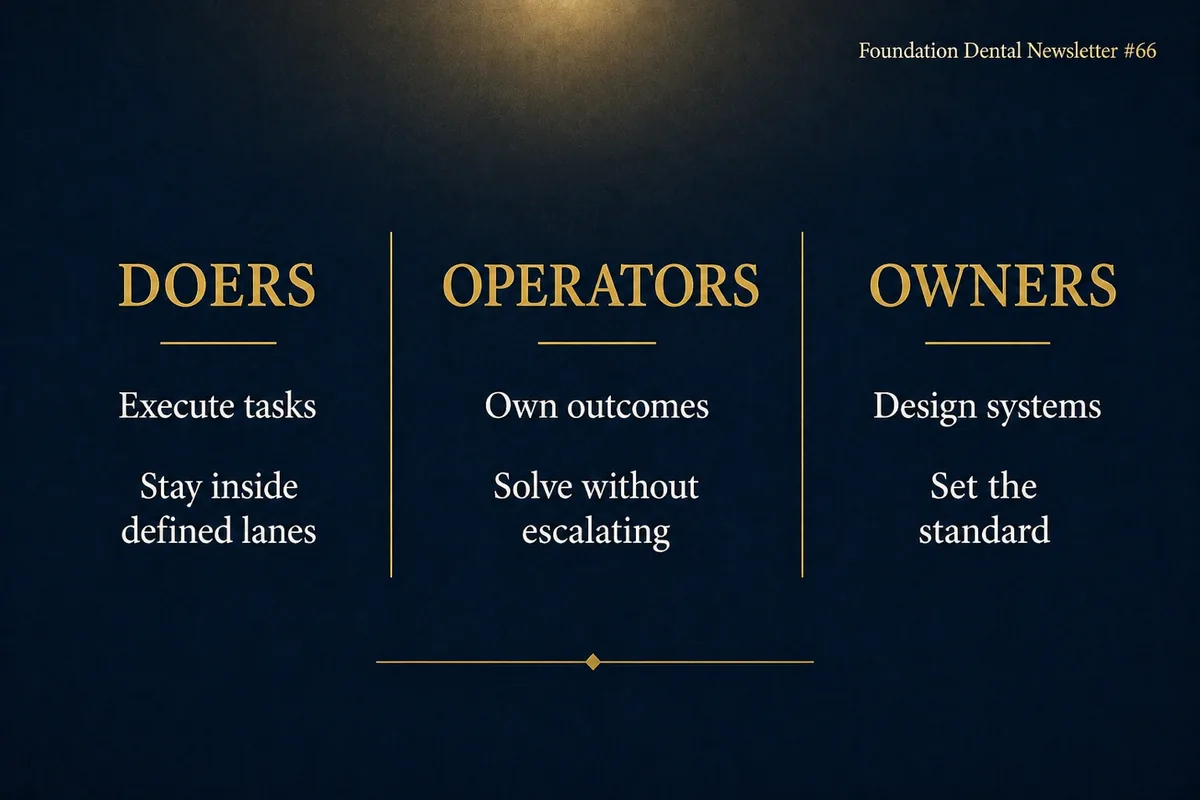
Most practices skip the level that actually creates independence.
Most practices don't lack systems. They lack developed operators who can carry them. Until someone in your practice can own decisions without you, you don't have independence. You have support.
The signal that tells you who's ready
There's a specific moment that reveals whether someone is ready to lead or just ready to handle more tasks. It's not a performance review. It's simpler than that.
Watch what they do when something goes wrong and you're not in the room.
An operator who hasn't been developed looks for someone to tell. They document the problem, loop in the right people, make sure nothing falls through. That's not a failure. That's exactly what you trained them to do.
A leader who's been developed looks for the cause and owns the fix. They don't just escalate the problem. They bring a recommendation. They take responsibility for what happened in their lane and make a decision about what changes. Then they tell you what they did, not to get approval, but to keep you informed.
That second person doesn't show up by accident. They show up because someone invested in building how they think, not just what they do.
Beyond that moment, there are other signals worth watching. Who do people already go to when something is unclear? Who sees problems early and brings you patterns rather than isolated complaints? Who uses 'we' more than 'I' when they talk about the practice? Who defends the standard when you're not in the room?
Your future leader is usually already behaving like an owner of something, even if that something is small. Your job is to notice that behavior, name it, and give it a bigger container.
The four shifts that actually build leaders
Real development doesn't look like sending someone to a weekend course. That's exposure, not development. Development happens in the daily work through a deliberate shift in how you interact with the people you're growing.
The first shift is from production only to production plus ownership. You can't pull a high performer out of the operatory overnight, and you don't have to. What you can do is change how you measure their success. Instead of only tracking personal production, start watching what happens in the parts of the practice they touch. Does team turnover drop in their area? Do new people ramp faster when they train them? Do fewer problems in their lane end up on your desk? Make it clear that their value is no longer just what they produce, but what stays solved because they're in the role.
The second shift is from implied authority to explicit decision rights. A lot of promoted leaders live in a gray zone. The team sort of sees them as a leader. You sort of give them authority. Nobody knows exactly where the lines are. This is where a decision rights map becomes essential. Newsletter 65 covered how to build one. For every leader you're developing, that map needs to define what they fully own, what they recommend and you decide, and what still sits entirely with you. If a leader can't answer 'what decisions are mine,' you haven't given them a role. You've given them a title and a guessing game.
The third shift is from giving answers to requiring thinking. When a team member brings you a problem, the instinct is to solve it. You're faster, you have more context, it's easier to just handle it. But every time you do that, you're removing an opportunity for them to build the judgment they need. Ask what they've tried, what they recommend, and what they'd do if you weren't reachable. Then let them do it. Even when you'd have done it differently.
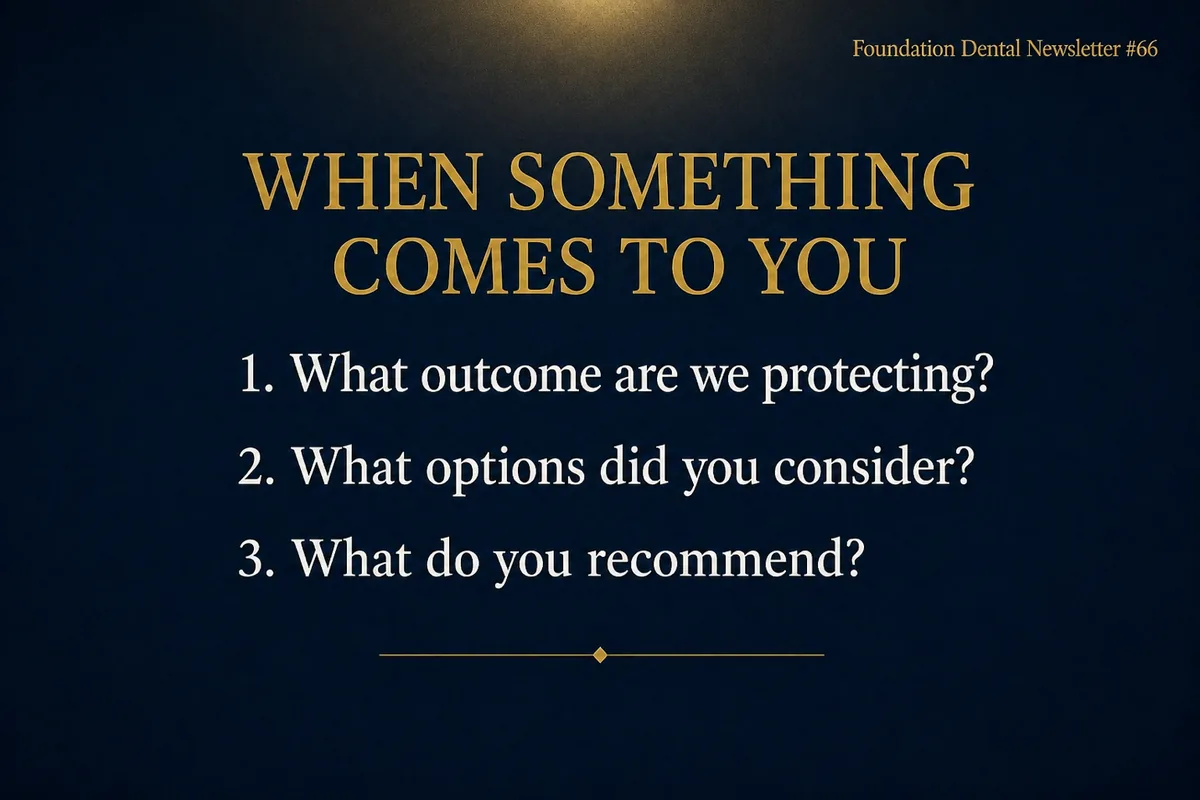
If you answer too fast, you train dependence.
The fourth shift is protecting the authority you gave. This is the one most owners break within a week. Someone brings a recommendation, you refine it, override it, or improve it in front of the team. It feels helpful. What it teaches is that their thinking isn't trusted yet. And the next time, they bring you a question instead of a recommendation. Every time you step back into a lane you already assigned, you're training the practice that the authority wasn't real.
The person you need to lead when you're not there has to lead before you're gone. You can't develop that capability in someone who's never had the real stakes.
What Newsletter 65 actually exposed
Newsletter 65 walked through how to build a decision rights map. How to give every decision a home that isn't you. That structure is necessary. But structure without developed people is just a policy document.
The decision map tells people what they're allowed to decide. Leadership development builds the judgment to decide it well. Owners who build the map but skip the development find that team members own the authority in title only. They still defer, still ask, still route everything back. Not because they don't have permission. Because they've never been developed to trust their own judgment.
The goal isn't a team that follows your system. It's a team that owns it. That's a different level, and it doesn't happen by accident.
Most practices don't lack systems. They lack operators who have actually been trusted with real decisions.
Inside the Foundation Dental Mastermind, the practices that have successfully transitioned to owner independence share a consistent pattern. The owners who get there didn't just build better structures. They identified one or two people early, invested in them deliberately, gave them real authority with real stakes, and protected that authority when it got tested. The practices that stay stuck have usually done the structural work and skipped this part.
The simplest place to start
You don't need a formal program. You need one intentional move in the next 30 days.
Pick the one person in your practice who already behaves the most like a steward. Not the loudest voice. Not necessarily the top producer. The one who quietly takes responsibility for how things go. The one who brings you patterns instead of isolated problems. The one who already cares about the whole day, not just their column.
Then do three things. First, redesign a portion of their time. Even one protected half-day a week out of clinical work, dedicated to leadership work. System review, one-on-ones with their area of the team, following up on commitments, watching patterns. Sacred time. Not available for filling in when the schedule gets tight.
Second, give them a one-page decision rights map. What they own, what they recommend, and what still comes to you. Tell the team explicitly: anything in this lane goes to them first.
Third, commit to routing problems back to them. When people bring you issues inside their lane, ask what they and that person decided. Hold yourself to that even when it would be faster to just answer.
By the end of 30 days you'll know two things. Whether you picked the right person. And whether you're actually willing to get out of the way enough for leadership to grow.
The leader you're not developing is already in the building. They're waiting for you to stop looking only at their production and start trusting them with the part of the practice that's been attached to you for years.
How do I identify who has leadership potential in my practice?
Watch how people behave when there's no clear answer. Operators excel in defined processes. Leaders show up in ambiguous moments. Who steps up when something doesn't go as planned? Who brings you patterns rather than isolated complaints? Who defends the standard when you're not watching? That person is worth investing in, regardless of tenure or clinical production numbers.
How long does real leadership development take?
Meaningful development requires consistent investment over 12 to 18 months minimum. Not a course or a one-time conversation. Regular interaction where you're requiring their thinking, expanding their decision authority, and protecting their ownership when it gets tested. Owners who expect leadership capability to arrive faster than that are usually disappointed because they've developed competence, not judgment. Judgment takes time and real stakes.
What if my best candidate isn't interested in the leadership role?
That's important information and it's better to know early. Some capable operators genuinely don't want the accountability that comes with leadership. If that's true, stop pushing and look for who else has the capacity. A practice dependent on someone who doesn't want the role is fragile regardless of that person's capability. Find the person who wants the responsibility and develop them intentionally.
How does developing a leader affect practice value at transition?
Significantly. Buyers look at what happens when the owner isn't in the room. A practice with a developed leadership layer that holds the standard independently is worth more than one where everything depends on the seller. The presence of a capable, developed leader who isn't leaving with the owner removes one of the primary risk factors buyers price into their offer. It's one of the clearest ways to protect valuation before a transition conversation begins.
Can I do this without a formal program?
Yes. The most effective development happens in the daily work. It's not a separate program you add to your week. It's a shift in how you handle the interactions you're already having. Stop answering questions the developing person should be answering. Require recommendations before giving direction. Give authority slightly ahead of comfort and let the accountability build the capability. Done consistently over 12 months, that approach produces more genuine leadership development than most formal programs.
About the Author
Dr. Jim Arnold, DDS is the Founder and CEO of Foundation Dental Alliance, a leadership and practice development organization serving dentists from graduation through retirement. He has more than 25 years of experience as a multi-practice owner and has been involved in more than 60 dental practice transitions. He is the Co-Founder of Foundation Dental Transitions alongside Brian Mans and leads the Foundation Dental Mastermind and Luxury Dental Retreats.
Stay Connected
Websites
FoundationDentalAlliance.com
FoundationDentalMastermind.com
FoundationDentalTransitions.com
FoundationDentalNetwork.com
LuxuryDentalRetreats.com/dubai
Social Media
LinkedIn: linkedin.com/in/arnoldjim
Instagram: instagram.com/smilesbyarnold
YouTube: youtube.com/@DrJimArnold
Facebook: facebook.com/smilesbyarnold
Twitter/X: twitter.com/smilesbyarnold
TikTok: tiktok.com/@foundationdentalalliance
Google Business Profile: tinyurl.com/2t3chcv6
Publications
Foundation Dental Newsletter: linkedin.com/newsletters/foundation-dental-newsletter-7289675134649450496
Contact
Professional Email: drarnold@foundationdentalalliance.com