Foundation Dental Intelligence
Newsletter No. 65
The Practice That Runs Without You.
Get the next issue.
One signup. Everything we publish.

At one point in my career I was running three practices, raising four kids, serving as peer review chairman, and traveling 25 to 30 weekends a year professionally. Then I decided to train for Ironman triathlons on top of all of it.
That wasn't a strategic decision. It was a breaking point.
There was no extra capacity left. Something had to give. And it wasn't going to be my family, and it wasn't going to be my health. So it had to be the way the practices were running. I didn't step back because I had a leadership epiphany. I stepped back because I had no other option. The training demands made it physically impossible to stay in the loop on everything. So I started handing things over to my team - not as a strategic initiative, but out of pure necessity.
At first, that felt uncomfortable in a way most dentists don't talk about. Because being the one who knows, the one who decides, the one who fixes things - that's not just a role. It's an identity. Letting go of that doesn't feel like leadership. It feels like risk.
But something happened that I didn't expect. Within months the team had taken ownership in a way I hadn't seen before. They were running the show. Decisions were getting made. Problems were getting solved. Not because they suddenly became different people. Because the structure finally required it.
The moment I fully understood what had happened came on a random Wednesday morning. My wife and I were six hours into a training ride. I was out there on the road in the middle of a workday and I realized - clearly, for the first time - that I couldn't have done this a year earlier. The practices were running. Everything was fine. Nobody needed me to be anywhere except where I was.
It felt euphoric. A kind of freedom I hadn't felt in years.

Six hours into our ride on a Wednesday morning, and the practices were fine.
And here's the part that surprised me most: my income didn't decrease. It actually increased over time as the practices ran more efficiently than they ever had when I was the bottleneck.
That's when I realized something most dentists never see clearly. The practice wasn't performing because of me. It was being limited by me.

The trap most dentists fall into
Most dentists say they want a practice that runs without them. When they try to build one, the instinct is to add more - new software, new KPI dashboards, new layers of accountability, new scripts. The thinking is honest: if I tighten everything up enough, the practice will finally run on its own.
In reality, most of that complexity makes the practice more dependent on you. Because you're the only one who understands how all the pieces connect. A practice that runs without you isn't a practice with more things added. It's a practice where the core things are so clear and so owned that they don't need you to function.
Most dentists also believe that stepping back will cost them - in quality, in revenue, in control. That belief keeps them at the center of everything for years longer than necessary. It kept me there longer than it should have. The belief is understandable. In the early years of ownership, your involvement is genuinely necessary. You're setting standards, building culture, establishing how things get done. But most dentists never transition out of that phase. They stay in the operational center long after the team is ready to own more.
Stepping back doesn't cost you the practice. Staying at the center does.
What actually has to exist before you can step back
This is where most advice breaks down. People tell you to let go without telling you what has to exist first. And that gap is where a lot of well-intentioned efforts to build independence fail.
You can't step back from chaos. If the systems don't exist, if ownership isn't defined, if the team hasn't been given the authority that matches their responsibility - stepping back doesn't create independence. It creates instability. What has to exist before you can genuinely step back comes down to five things.
First, there has to be real leadership in the building. Not a title, but a person everyone naturally looks to when you're not there. Sometimes it's a practice administrator. Sometimes it's a lead assistant or hygienist who grew into that role. Leadership is who people actually go to when something is uncertain, not who has the manager badge. Until there's someone other than you who feels responsible for the day, you'll never fully be able to step away from the day.
Second, your systems have to survive a bad Monday. Anyone can follow a checklist when the schedule is light and everything runs on time. The test is what happens when three emergencies call at 9 AM, one assistant is out sick, and lab cases are late. A system that only works on a perfect day isn't a system. It's a suggestion. The systems that need to be bulletproof before you can step back with confidence are new patient intake and scheduling, hygiene reactivation and recall, same-day treatment and schedule compression, and financial conversations and payment arrangements. When those hold without you managing them, most of the chaos that pulls you back in is already contained.
Third, decision rights have to be clear to everyone. Most practices never explicitly define who decides what, so everything defaults to you. In a practice that runs without you, everyone knows what they can decide, what they should recommend, and when they must involve you. We eventually put this in writing - not a giant policy manual nobody read, but a simple one-page map. Clinical decisions above a certain risk level go to the doctor. Discounts beyond a certain dollar amount require the practice administrator and doctor together. Same-day schedule changes go to the lead assistant and front desk lead. HR and conflict issues go to the practice administrator with clear escalation lines. Once that was in place, questions that used to come to me out of habit started getting handled at the right level.
Fourth, the culture has to protect the standard without you policing it. You can't step back from a practice that depends on your personality to keep standards high. What changed everything in my practices was when the team started correcting each other based on shared standards - not in a punitive way, but in a "this is how we do it here" way. When a patient was almost walked out without a reappointment, a hygienist would gently bring it back. When someone slid into a shortcut that didn't match our norm, the team caught it before I heard about it. Culture that protects the standard is what allows systems to hold. Without it, the minute you step away, things drift.
Fifth, the numbers have to tell the truth without you interpreting them. Owners still in the middle of everything tend to be the only ones looking at numbers. They get the reports, interpret them, and hand down decisions. In a practice that runs without the owner, key team members understand the numbers that matter to their role. When hygiene reactivation rate falls, the right people see it and act. When same-day treatment dips, someone notices and asks why. The stories inside the numbers are shared, not guarded. That's what makes the practice self-correcting instead of owner-corrected.
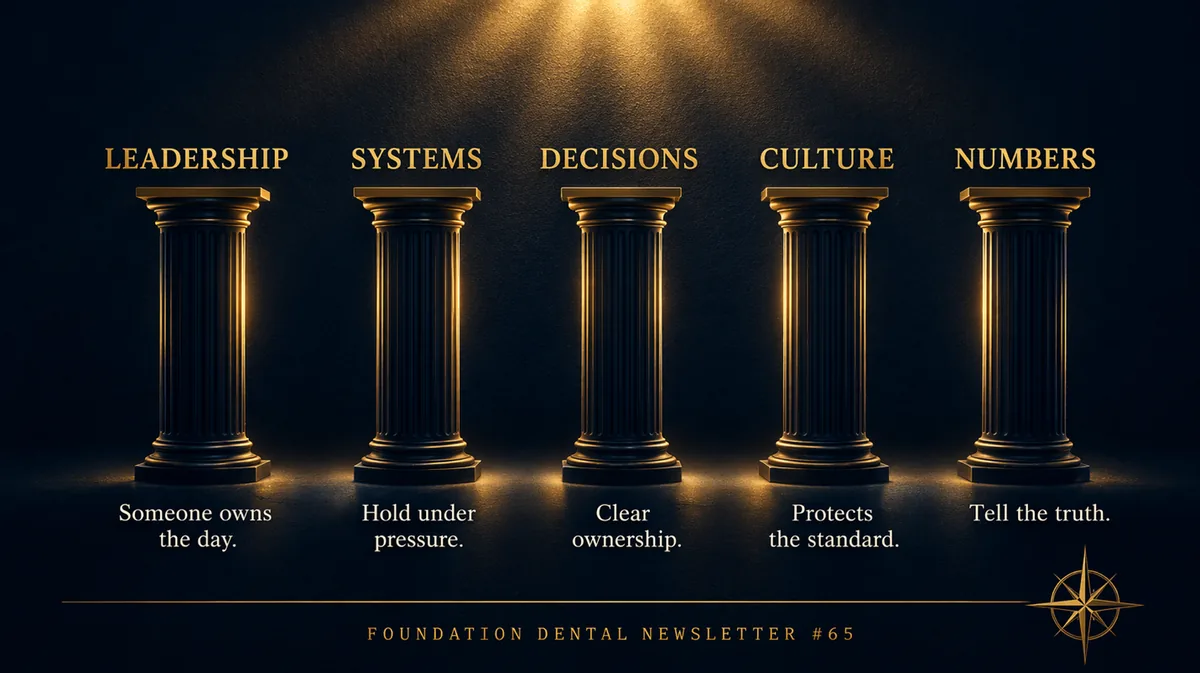
Five things that have to exist before stepping back is safe. Most practices
are missing at least three.
A practice that runs without you doesn't have fewer decisions. It has fewer decisions that need you.
Where most practices actually break
The place where most independence efforts fail isn't a lack of effort. It's a structural issue that rarely gets named directly: the owner is the default decision node.
In most practices, when something is unclear, when a situation is unusual, when a team member isn't sure what to do - the answer is "go ask the doctor." That's not a cultural problem. It's an architectural one. The practice was designed, intentionally or not, with the owner at the center of every decision pathway. Changing that requires more than telling your team to make more decisions. It requires mapping where decisions actually flow today, identifying the ones that shouldn't require you, and building the clarity that allows those decisions to be made at the right level.
Most dentists who try to step back without doing this work find themselves being pulled right back in - not because the team failed, but because nothing changed structurally. The team is still navigating the same system that was designed around the owner's availability. Changing behavior without changing architecture produces frustration on both sides and usually ends with the owner concluding their team "just isn't ready" - when the real problem is the design.

It’s not a people problem. It’s a design problem.
The bottleneck you might not see
Here's something most owners find uncomfortable to consider. In many practices, the thing holding the team back isn't capability or motivation. It's the owner's own behavior.
When you solve problems quickly, you prevent the team from developing judgment. When you approve every decision, you signal that their judgment can't be trusted. When you step in before someone has a chance to work through a challenge, you take away the opportunity that would have built their confidence. Over-involved owners don't create high-performing teams. They create teams that are skilled at one specific thing: getting the owner's approval before moving forward. Those teams look engaged. They're responsive and attentive. But they're not operating independently, and they won't until the design changes.
My team didn't step up because I gave a motivational speech or created a leadership development program. They stepped up because I was physically unable to be available the way I had been. The training schedule made it impossible for me to be the answer to every question. And in that space, they discovered what they were already capable of.
Most people miss this: the capability was always there. The design just hadn't required it yet.
What independence actually looks like operationally
A practice that runs without you doesn't mean a practice that doesn't need leadership. It means a practice where leadership is distributed rather than concentrated - where the people closest to the work have the authority and judgment to handle what comes up in that work.
In practice, this looks like a morning huddle that runs the same way whether you're there or not. It looks like schedule adjustments getting made by the people responsible for the schedule, without a phone call to you. It looks like team members who address small culture issues with each other rather than escalating everything upward. It looks like a practice that handles a difficult patient situation, a supply emergency, or an unexpected schedule disruption without anyone feeling paralyzed.
None of that requires a perfect team. It requires a clear design and a culture built to support independence rather than dependence. The team I had wasn't exceptional by some external standard. They were dedicated dental professionals who had been given real ownership of real outcomes. That combination produces something that looks extraordinary from the outside. And the financial reality confirmed what the experience suggested. When the practices stopped depending on me to hold them together, they ran more efficiently. Less friction from problems that sat unresolved until I could address them. More consistency in patient experience because the team owned it rather than waited for direction. The income increase wasn't a coincidence. It was the logical result of removing a bottleneck from the system.
Three moves to start if you're still at the center
If Newsletter #64 landed and you recognized yourself in the dependency pattern, this is the practical follow-through. Not a complete operational overhaul - three honest moves that begin to shift the architecture.
First, identify the decisions that reach you repeatedly. Not the complex clinical calls that genuinely require your judgment - those belong with you. The scheduling conflicts, the supply approvals, the patient complaint that follows a predictable pattern, the team question asked every week. Pick one category and build the decision home for it. Document the standard, assign the owner, give them the authority. Then hold yourself to not weighing in when that category comes up.
Second, stop solving problems faster than your team can. The next time something lands on your desk that the team could handle, ask three questions before you act: what have you already tried, what do you recommend, what would you do if I weren't available? Then let them do it unless there's legal or ethical risk. The first few times will feel inefficient. Over time it builds something efficiency metrics can't capture - a team that trusts its own judgment.
Third, create space that requires independence. Not a vacation where you're checking in every few hours. A real block of time where you're genuinely unavailable and the practice has to function without access to you. That constraint is the pressure that reveals what the team is actually capable of. In my case it was six-hour training rides on Wednesday mornings. Yours might look different. But the principle is the same. You can't discover what the practice can do without you until you're actually not there.
You don't build a practice that runs without you by stepping back. You build it first. Then you step back and let it prove what you built.

You don’t own the practice when everything depends on you.
You own it when it no longer does.
Bottom line
Newsletter #64 was about recognizing the gap between ownership and dependency. This one is about what closes that gap.
The practice that runs without you isn't a fantasy. It's an engineering problem. It requires real leadership in the building, systems that survive a bad Monday, decision rights that are clear to everyone, a culture that protects the standard without you policing it, and numbers your team understands without you interpreting them. None of that is complicated. All of it takes deliberate effort and the willingness to let go before it feels completely safe.
The practices that command premiums at exit are almost always the ones that were already running without the owner years before the sale. Freedom isn't created at the end of a career. It's built into the structure from the beginning.
Most dentists never get around to this on their own. This is the work we do inside the Foundation Dental Mastermind - not theory, not delegation advice, but actual architecture that removes you as the bottleneck and increases the value of what you've built in the process.
The six-hour training ride on a Wednesday morning is available to you too. Not the ride specifically - the feeling underneath it. The confidence that what you built will hold while you're somewhere else entirely. That things are running not because you're managing them, but because you designed something that doesn't require you to.
You don't own the practice when everything depends on you. You own it when it no longer does.
About the Author
Dr. Jim Arnold, DDS is the Founder and CEO of Foundation Dental Alliance, a leadership and practice development organization serving dentists from graduation through retirement. He has more than 25 years of experience as a multi-practice owner and has been involved in more than 60 dental practice transitions. He leads the Foundation Dental Mastermind and Luxury Dental Retreats, and hosts the Foundation Dental Podcast. He also publishes the Foundation Dental Newsletter and Blog weekly, focused on leadership, practice design, and long-term sustainability in dentistry.
Stay Connected
FoundationDentalAlliance.com
FoundationDentalMastermind.com
FoundationDentalTransitions.com
FoundationDentalNetwork.com
LuxuryDentalRetreats.com/dubai
LinkedIn: linkedin.com/in/arnoldjim
Instagram: instagram.com/smilesbyarnold
YouTube: youtube.com/@DrJimArnold