Foundation Dental Intelligence
Newsletter No. 69
The Practice That Runs Without You Isn't Built in a Day.
Get the next issue.
One signup. Everything we publish.
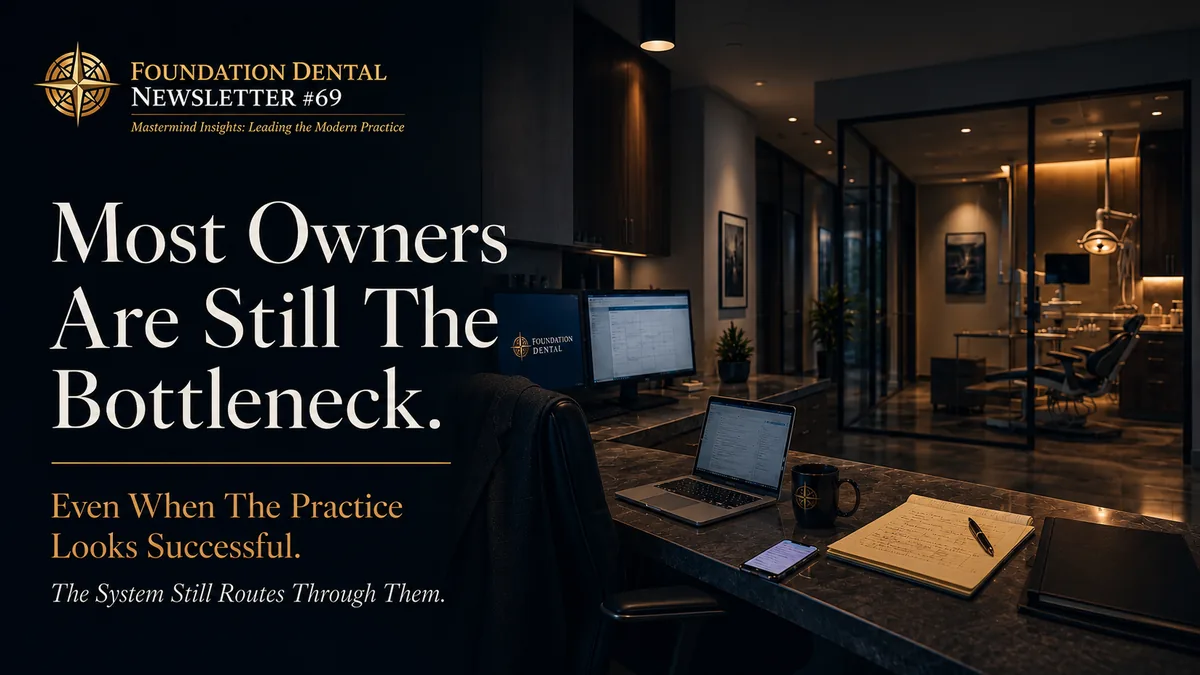
Most dentists don't realize they're still the center of the practice because the practice still looks successful from the outside.
The schedule is full. Collections are solid. The team seems capable. Patients are happy. Nothing obvious feels broken.
That's what makes this phase dangerous.
Newsletter #68 was about what happens psychologically after you hit your number - the strange feeling many owners experience once achievement stops creating the emotional resolution they expected. The external scoreboard improved. The internal architecture never fully recalibrated.
This is the operational side of that conversation.
Because once the pressure to survive decreases, something important gets exposed: whether the practice actually functions without you - or whether you've simply become extremely efficient at carrying more responsibility than anyone realizes.
Those are not the same thing. A practice can produce extremely well while still routing almost every meaningful decision back through the owner. Many high-performing practices operate exactly that way for years because the owner is strong enough to compensate for the structural weakness. Until eventually the compensation becomes exhausting.
THE BOTTLENECK DOESN'T LOOK LIKE FAILURE
The bottleneck phase rarely looks chaotic from the outside. It usually looks responsible.
You answer the question because it's faster. You step into the situation because you know how to solve it. You handle the difficult patient because you don't want the team carrying the stress. You approve the schedule adjustment because nobody feels fully comfortable doing it without you. You review the treatment plan because it's important. You stay reachable because you care.
Individually, none of those decisions feel dangerous. Collectively, they train the practice that forward motion requires your presence.
That's the real problem. The issue isn't that the owner is involved. The issue is that the organization has learned to pause until the owner reappears.
That pattern gets expensive long before anyone notices it financially. Owner dependency doesn't first show up on a P&L. It shows up operationally. Questions stack. Decision velocity slows. Confidence decreases. Escalation increases. Leaders hesitate. The owner gets interrupted constantly. Everyone becomes more reactive.
The practice still performs. But it performs through human strain instead of structural clarity.
The practices that eventually command premium valuations are not the ones where the owner worked the hardest. They're the ones where the owner stopped being required for every repeated decision.
The bottleneck doesn't look like failure. It usually looks responsible. That's what makes it so hard to see - and so expensive to fix late.
MOST OWNERS ARE STILL MAKING DECISIONS THEY SHOULD NEVER SEE
Here's an exercise that reveals more about practice design than almost anything else I've seen.
For the next 30 days, track every non-clinical decision that reaches you. Every interruption. Every approval. Every escalation. Every quick question. At the end of the month, sort them into three buckets: only I should decide this, someone else could decide this with the right structure, and I should never have seen this.
That third category becomes uncomfortable very quickly. Scheduling adjustments. Minor refund decisions. Routine patient complaints. Supply approvals. Front desk conflicts. Simple financial conversations. Calendar management. Basic team accountability.
Most owners are still carrying decisions the organization should have absorbed years earlier.
And here's the difficult truth underneath that: if the same decision reaches you repeatedly, you don't have a people problem. You have a design problem. Most systems failure inside dental practices isn't caused by bad people. It's caused by unclear authority.
THE TEAM ISN'T ALWAYS CONFUSED. THEY'RE CONDITIONED.
This is where a lot of owners misdiagnose the problem. They assume the team lacks confidence.
Sometimes that's true. But more often, the team has simply learned that independent decision-making creates risk while escalation creates safety. So they escalate everything upward. Not because they're weak. Because the culture trained them to.
Every time the owner overrides a decision publicly, rescues a situation instantly, changes direction midstream, or reclaims authority during stress, the organization absorbs the same lesson: wait for Dr. Arnold.
That conditioning compounds over time. Eventually even strong people stop acting independently because the environment stopped rewarding ownership.
The irony is that many owners create this pattern while trying to help. They think they're protecting standards. Protecting patients. Protecting culture. Protecting the team. But constant intervention slowly erodes the very leadership depth they say they want.
Most dentists don't need more motivated teams. They need clearer decision lanes.
Most owners don't become the bottleneck because they want control.
They become the bottleneck because rescuing the system slowly becomes their identity.
Every time the owner reclaims authority during stress, the organization absorbs the same lesson: wait for Dr. Arnold. That conditioning compounds. Eventually even strong people stop acting independently.
HERE'S WHAT REALLY MATTERS
The practice that eventually runs without you isn't built all at once. It's built through repeated operational transfers. Small ones first.
The transfer that works starts with three questions - and all three have to be answered explicitly before the handoff holds.
What exactly is the decision? Vague authority transfers don't stick. The team member needs to know the specific category of decision they now own, not a general sense that they have more responsibility.
Who specifically owns it? Not 'the team' or 'the front desk.' One person. Named. Accountable for the outcome.
What standard determines a good outcome? Without this, the team member second-guesses every decision and escalation creeps back. With this, they can evaluate their own choices and build confidence over time.
When all three are answered clearly, the transfer holds. The team member makes the decision, sees that it worked, and the next transfer becomes easier. The one after that easier still.
Three things to expect going in.
First: identify repeated decisions. Anything that reaches you more than twice a week deserves scrutiny. Repetition is the signal. If the same issue keeps climbing back to the owner, the organization either lacks clarity, authority, training, or all three.
Second: define ownership explicitly. Not 'let the team help more' - that language is too vague. Who owns this? What are they allowed to decide independently? What requires escalation? What doesn't? Authority transfer only works when the boundaries are explicit.
Third: tolerate some discomfort. The practice won't initially perform exactly the same once authority starts moving outward. Some decisions will be slower. Some won't be made exactly as you'd make them. Most owners step back in too early - not because the system failed, but because discomfort returned. You can't build autonomous leadership while simultaneously protecting everyone from every operational consequence.
MOST PEOPLE MISS THIS
The practice that depends on you emotionally will eventually depend on you operationally too.
Owners often think the issue is systems. Sometimes it is. But underneath most operational dependency is an emotional pattern. The owner needs to feel needed. The team needs reassurance. The culture organizes around the rescuer. The owner unconsciously becomes the stabilizer for uncertainty.
That structure works surprisingly well for a long time. Until the owner gets tired. Or wants freedom. Or wants to travel more. Or wants to slow down clinically. Or wants to transition eventually. Or simply realizes the practice cannot hold its standard without constant personal intervention.
That realization hits hard for a lot of dentists because they've spent years building success around being indispensable. Then they discover that indispensability is expensive.
Especially when someone else is evaluating enterprise value. Buyers don't just evaluate production. They evaluate transferability. And transferability is really the ability of the organization to function emotionally and operationally without the owner sitting in the middle of every pathway.
Most owners don't become the bottleneck because they want control. They become the bottleneck because rescuing the system slowly becomes their identity. And once that pattern gets normalized, everyone unconsciously adapts around it.
Indispensability is expensive. Buyers don't just evaluate production. They evaluate transferability - and transferability is the ability of the practice to function without the owner in the center.
THE ILLUSION OF THE FUTURE RESTRUCTURE
There's a version of this conversation I've had many times. The owner understands exactly what needs to happen and has a clear reason why they haven't done it yet. The reason is almost always some version of: not yet.
Not until the new associate is trained. Not until the team is more stable. Not until after the busy season. Not until things slow down.
After watching enough practices over enough years, I'll say this directly: the conditions that would make restructuring feel safe and convenient almost never arrive on their own. The practice that's too busy to restructure now will be too busy in two years. The team that isn't quite ready now will still have gaps in two years.
The change starts when the owner finally stops waiting for ideal conditions. The first move doesn't require a perfect team, a full org chart, or a complete system redesign. It requires one decision, clearly transferred, with real authority behind it.
That's available right now. In this practice. With this team. Today.
WHAT THIS CONNECTS TO
Newsletters #63 through #68 all connect to the same transition: the shift from being the practice to actually owning one.
Decision rights. Leadership depth. Authority transfer. The communication systems that make handoffs hold. The psychological recalibration of comfort versus drift. None of those are separate conversations. They're describing the same structural shift from different angles.
Inside Foundation Dental Mastermind, this is one of the biggest operational shifts owners work through. Not how do I produce more - but how do I stop carrying everything personally. That question changes the entire structure of the practice.
The owners who eventually create real optionality are rarely the most controlling people in the room. They're the people willing to redesign the organization before exhaustion forces them to. They understand that freedom isn't created by income alone. It's created by transferability - of decisions, of leadership, of culture, of operations.
The practices that age best are the ones where authority was intentionally distributed years before the owner desperately needed relief. And that process rarely starts with a giant strategic initiative.
It usually starts with one uncomfortable realization: this decision should not still require me.
That's the beginning. Not the end.
Here's the one move worth making this week.
Pick one non-clinical decision that runs through you regularly. Something real, something the team handles competently in every other way, something that arrives on your desk more out of habit than necessity.
Answer the three questions: What exactly is the decision? Who specifically owns it going forward? What standard determines a good outcome?
Then transfer it. Explicitly. With full authority attached.
The practice that runs without you is built one transferred decision at a time. That's where it starts. Not with a plan. With a transfer.
EXTRACTABLE TAKEAWAY
If the same decision keeps reaching you, the problem usually isn't the team. It's the structure. Practices become owner-dependent slowly, through thousands of small rescues and repeated escalations that train the organization to wait for the owner before moving.
A practice that runs without you isn't built through motivation or one massive overhaul. It's built through clear decision lanes, transferred authority, and the willingness to stop rescuing every operational discomfort.
FREQUENTLY ASKED QUESTIONS
How do I know if I'm still the bottleneck in my practice?
Track every non-clinical decision that reaches you for 30 days. If repeated operational questions continue routing back through you, the organization is still dependent on your presence regardless of how successful the practice looks financially.
What's the first operational change I should make?
Start with repeated decisions. Identify one category that consistently escalates upward unnecessarily and answer three questions explicitly: what is the decision, who specifically owns it, and what standard determines a good outcome. Without all three, the transfer won't hold.
Does stepping back lower standards?
Usually the opposite happens over time. Initially there may be some discomfort while the organization adjusts. But practices that stop routing every decision through the owner often become faster, more stable, and less reactive because leadership depth finally develops.
About the Author
Dr. Jim Arnold, DDS is the Founder and CEO of Foundation Dental Alliance, a leadership and practice development organization serving dentists from graduation through retirement. He has 30 years of experience as a multi-practice owner and has been involved in more than 60 dental practice transitions. He leads the Foundation Dental Mastermind and Luxury Dental Retreats, and hosts the Foundation Dental Podcast. He also publishes the Foundation Dental Newsletter and Blog weekly, focused on leadership, practice design, and long-term sustainability in dentistry.
Stay Connected
Websites
FoundationDentalAlliance.com
FoundationDentalMastermind.com
FoundationDentalTransitions.com
FoundationDentalNetwork.com
LuxuryDentalRetreats.com/dubai
Social Media
LinkedIn: linkedin.com/in/arnoldjim
Instagram: instagram.com/smilesbyarnold
YouTube: youtube.com/@DrJimArnold
Facebook: facebook.com/smilesbyarnold
Twitter/X: twitter.com/smilesbyarnold
TikTok: tiktok.com/@foundationdentalalliance
Google Business Profile: tinyurl.com/2t3chcv6
Publications
Foundation Dental Newsletter: linkedin.com/newsletters/foundation-dental-newsletter-7289675134649450496
Contact
Professional Email: drarnold@foundationdentalalliance.com