Foundation Dental Intelligence
Newsletter No. 73
The Ceiling Nobody Sees.
Get the next issue.
One signup. Everything we publish.
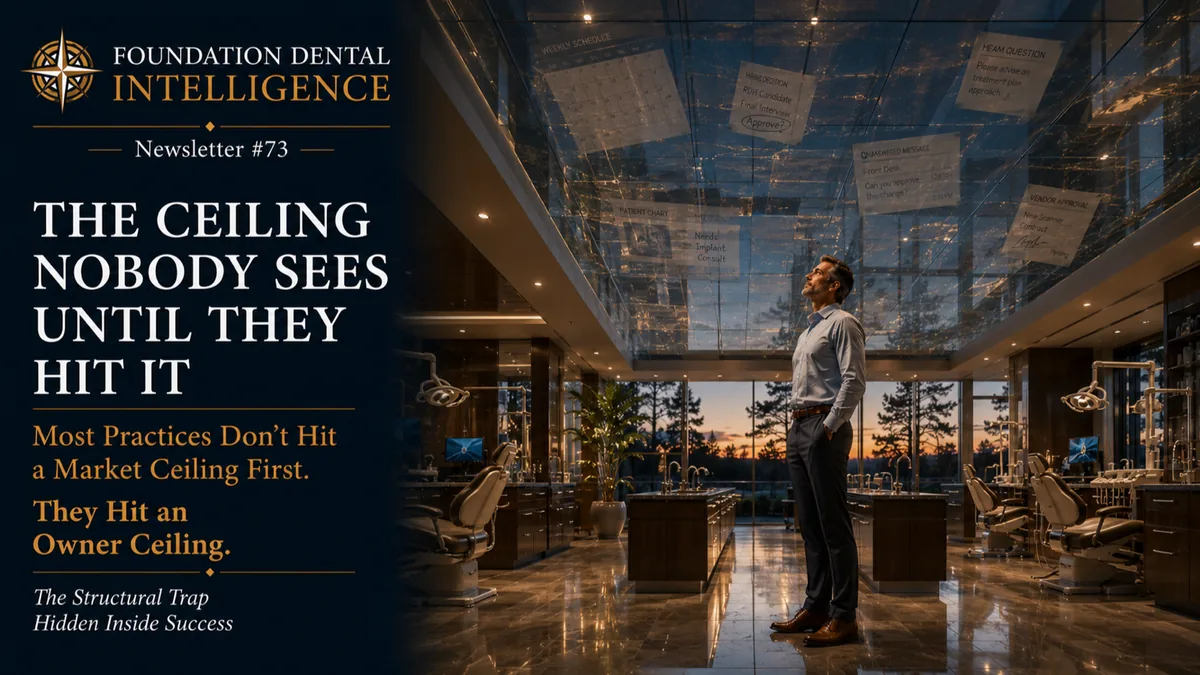
A doctor called me recently because he thought he had a marketing problem.
On paper, the practice looked healthy. Collections were strong. The schedule stayed full. The team had been together for years. Patients were loyal. Most dentists looking at the numbers would have concluded that things were going well.
Yet something had clearly changed.
Three years earlier the practice had been growing steadily. Every year felt a little bigger than the year before. Then growth slowed. Then it flattened. Then it became normal. The owner found himself working just as hard as he ever had while feeling as though the practice had become much harder to move.
His assumption was the same assumption I hear from successful practice owners all the time. He believed the answer was somewhere outside the practice. Maybe competition had increased. Maybe the local market had shifted. Maybe he needed a different marketing strategy or another associate.
The longer we talked, the clearer the real issue became.
Every meaningful decision inside the practice still flowed through one person. Questions about financial arrangements eventually reached the doctor. Team members who were fully capable of handling routine situations still wanted confirmation before acting. Scheduling exceptions, patient concerns, hiring decisions, operational challenges - no matter where the problem originated, it eventually arrived at the owner’s desk.
The practice had grown. The structure hadn’t.
That’s when I told him something he didn’t expect to hear.
“You don’t have a marketing problem. You have an owner ceiling.” |
The line went quiet. Not because he disagreed. Because he already knew it was true.
The owner wasn’t simply leading the organization. The owner had inadvertantly become the organization.
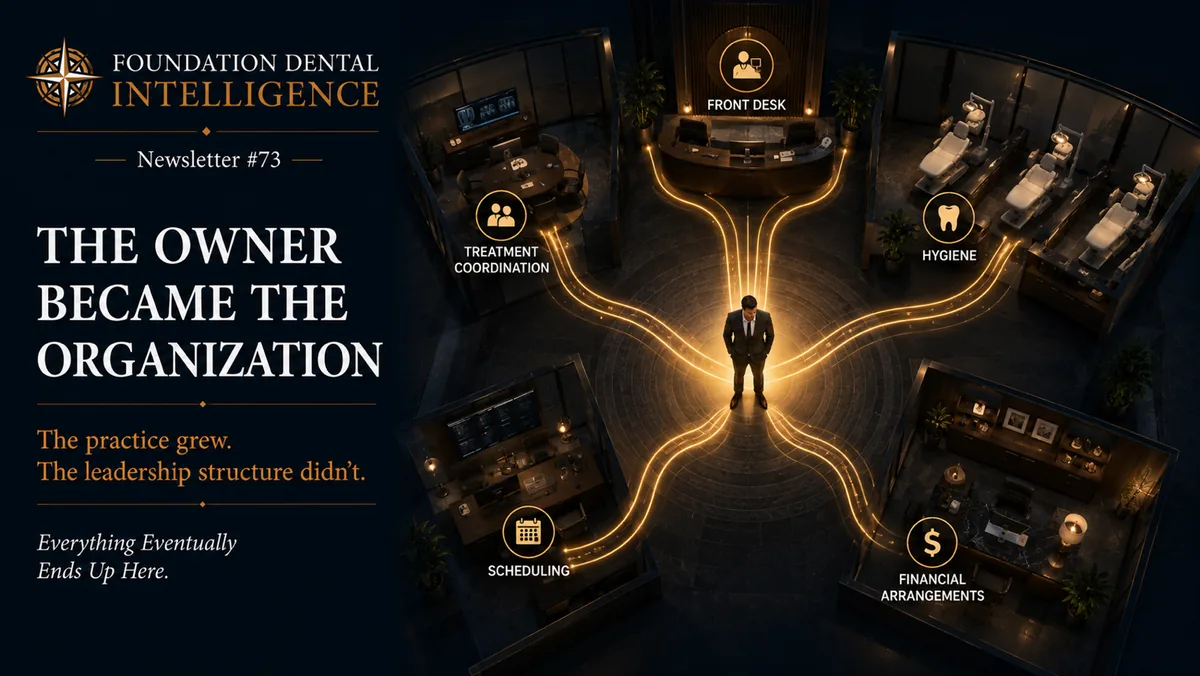
Every decision pathway that ultimately leads back to the owner creates dependency. Most practices accumulate these pathways for years before anyone notices the cost.
Most practices don’t hit a market ceiling first. They hit an owner ceiling. And the dangerous part is that almost nobody recognizes it when it first appears. They just feel the symptoms. The owner becomes busier. Decision fatigue increases. The team waits longer for answers. Opportunities slow down. Growth becomes heavier instead of cleaner.
None of those symptoms point directly at the cause. The practice still looks successful. Patients still show up. The numbers still look respectable.
Which is exactly why this ceiling is so hard to see. You don’t crash into it. You gradually become trapped beneath it.
What the Ceiling Actually Looks Like
The ceiling I’m describing doesn’t feel like a wall. It feels like a slow narrowing.
Decisions that should be routine still route to the owner. The team is capable, but they check before they act. Problems that could be solved closer to the source somehow still land on the doctor’s desk before the end of the day. The owner leaves for a long weekend and comes back to a pile of things that waited. The doctor takes a real vacation - or tries to - and the phone tells a different story.
That is not always a team problem.
In many practices, the team is responding rationally to a structure the owner designed without meaning to design it. Every time the doctor answers a question the team could have answered, the team learns that questions go to the doctor. Every time the owner makes a decision that someone else could have made with clear authority, the practice reinforces a culture where waiting feels safer than acting. Every time the business bends around the owner’s presence, it quietly confirms that the business depends on that presence to function.
Over time, that becomes the ceiling. Not a skill ceiling. Not a market ceiling. A structural one.
A practice can keep producing for years while slowly building the mechanism that eventually caps its growth. That’s why this problem fools smart people. The same behaviors that helped the owner build the practice often become the behaviors that limit what the practice can become.
In the early years, direct control works. The team is smaller. The decisions are closer. The owner’s judgment creates speed. The owner’s oversight prevents things from falling through the cracks. That works beautifully - until the practice outgrows the model.
A one-million-dollar practice can often survive with the owner at the center of everything. A three-million-dollar practice starts showing the strain. A five-million-dollar practice built around one owner’s constant personal involvement becomes fragile, no matter how good the production report looks.
The practice grew. The structure didn’t. That is the ceiling. |
Why Strong Production Hides the Problem
High production is one of the most effective camouflages for structural dependency that exists.
When collections are healthy and the team shows up every day and does the work, nothing feels broken. The owner is proud of what’s been built - and rightly so. Something real has been created. The external signals don’t suggest a problem.
But performance and fragility aren’t opposites.
A practice can produce at a high level and still be completely fragile - because the production depends too heavily on the owner’s personal presence, clinical stamina, relationships, and judgment. That fragility doesn’t announce itself during the good months. It shows up when the owner wants to step back. It shows up when a key team member leaves. It shows up when the doctor gets tired. It shows up when a sophisticated buyer starts asking what happens to production after the current owner is no longer the stabilizing force in the business.
The financial consequences become easier to see when two practices that look identical on paper produce completely different outcomes underneath.
Practice A runs on the owner. Forty patients a day, heavy PPO dependency, a schedule built around accommodation. The owner produces 90% of the dentistry through personal endurance. EBITDA sits around 12% - roughly $180,000 after everything is normalized. A sophisticated buyer looks at that practice and sees a high-risk job, not an asset. Inside Foundation Dental Transitions, Brian Mans and I look at this exact dynamic during due diligence.
Practice B runs on structure. Fewer patients per day, higher production per visit, a team that makes decisions without routing everything upward. EBITDA sits at 28% - roughly $420,000. The buyer sees a system that holds its value when the owner steps away.
Same revenue. Completely different enterprise value. |
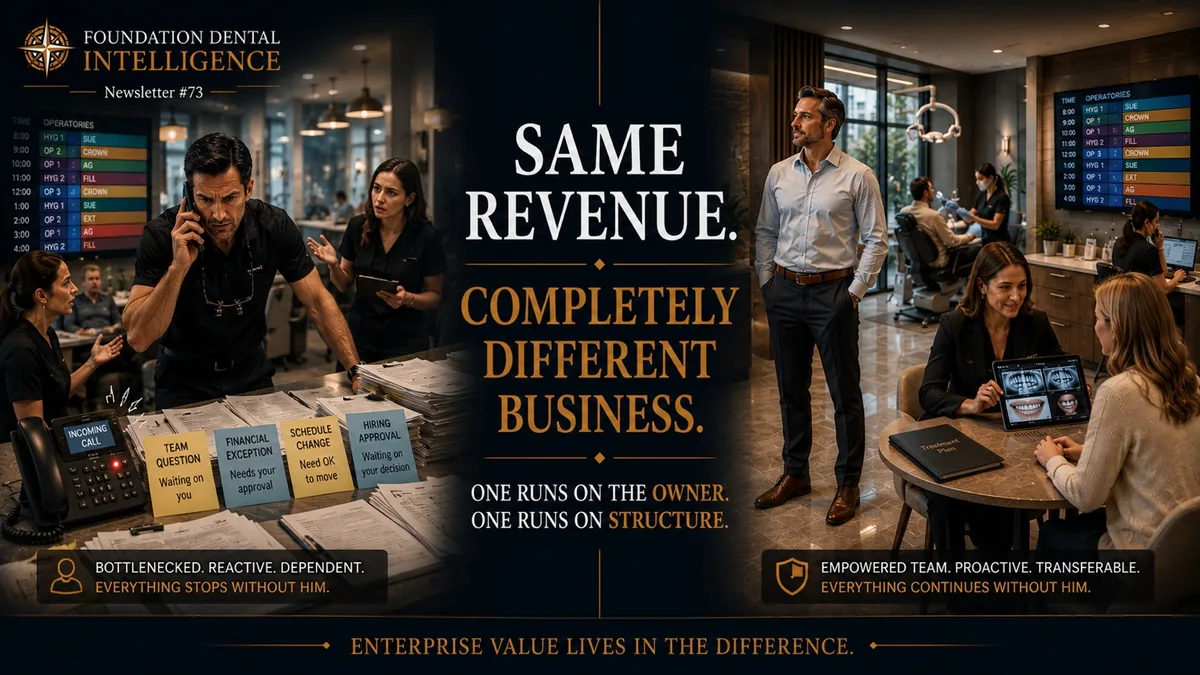
Revenue tells you what happened. Structure determines what survives. Enterprise value lives in the difference.
The difference isn’t the market. It isn’t the clinical skills. It’s the design underneath the numbers.
A buyer is not purchasing historical production. A buyer is evaluating how much of that performance will survive without the current owner holding everything together. The market doesn’t reward personal heroism. It rewards transferable value. That matters long before you ever think about selling.
The Thirty-Day Test
There’s a question I’ve asked in different forms across more than 25 years in dentistry and more than 60 practice transitions:
What would actually break if you disappeared for thirty days? |
Not what would be inconvenient. Not what would feel uncomfortable. Not what would create temporary disruption. What would genuinely break?
Would treatment planning continue with the same clarity? Would financial arrangements stay consistent? Would standards hold? Would team issues get addressed? Would patient experience stay intact? Would the practice keep making good decisions without waiting for the doctor to return?
Most owners know the answer faster than they want to admit.
The list is usually longer than expected. Buried inside that list is the real shape of the ceiling. Every item is a decision pathway that still runs through the owner. Every item is a place where the practice hasn’t been designed to function without a specific person. Every item is a dependency that may not show up on a profit and loss statement, but absolutely shows up in the owner’s life.
If the problem is people, the solution is replacement. If the problem is structure, the solution is redesign.
Most practices that have hit this ceiling don’t need an entirely different team. They need a different operating model for the team they already have. That’s a harder conversation. It’s also a more hopeful one.
Where the Ceiling Actually Comes From
In most practices, the owner ceiling is created by four things that stack on top of each other.
Decision concentration. Too many answers still have to come from the doctor. The practice may call that leadership. A sophisticated operator would call it dependency.
Talent underutilization. Good people stay in support mode too long because the owner never fully hands them ownership of outcomes. They become helpers rather than leaders. Not because they aren’t capable - because the design never asked them to be more.
System fragility. The practice has routines, but not true operating systems that hold their standard without the owner’s presence. There’s a meaningful difference between people knowing the rhythm and the business actually being built to run.
Identity confusion. The owner says they want freedom or growth, but still draws emotional reassurance from being needed at every turn. That last one is harder to talk about. It’s also real. And it’s where the most important work usually lives.
Most people miss this: the behaviors that create the ceiling are the same behaviors that produced early success. Early-stage growth rewards direct control. Later-stage growth punishes it. |
That shift is where most practices quietly stall - and the owner, still trusting the instincts that built the practice, keeps applying the same approach and wondering why the results have changed.
Appointment Density Versus Production Density
A full schedule can make a dentist feel secure while quietly trapping the practice inside a low-margin, high-speed model.
If every chair is packed with the wrong mix of dentistry, the practice may look busy while leaving very little room for comprehensive care, strategic growth, or higher-value clinical work. A productive schedule is different from a full schedule. A full schedule creates activity. A productive schedule creates margin, value, and breathing room.
The ceiling shows up when the practice has no room left to improve because every available hour has already been consumed by the wrong kind of busyness.
That’s why the schedule isn’t just an administrative tool. It’s financial infrastructure. Most owners never see it that way until something forces them to.
Appointment density measures how full the schedule is. Production density measures how effectively clinical time converts into meaningful production, profitability, and long-term enterprise value. Those two scoreboards can tell very different stories. A practice can be packed and still underperform. A doctor can be exhausted and still not have an enterprise that would command premium value.
The owners who confuse busyness with health, production with value, and personal importance with leadership are usually the ones most surprised when growth stops responding to effort.
What Ownership Actually Feels Like When the Design Is Right
Most dentists feel like owners because they carry the risk, sign the checks, and absorb the pressure. That’s not ownership. That’s dependency with a higher income.
Real ownership feels structurally different. It feels like the ability to step back without standards degrading. It feels like a team that makes good decisions without waiting for permission. It feels like a practice that’s genuinely predictable - same quality, same culture, same patient experience, same financial discipline, whether the owner is in the building or not.
The best practices I’ve seen don’t have perfect teams. They have clearer authority. Better decision pathways. Stronger accountability. A schedule built around production density rather than appointment density.
The dentists who’ve built this don’t have better people than the ones who haven’t. They’ve built better systems for the people they already have. They’ve designed a practice where acting is easier than waiting, where accountability runs laterally through the team rather than just downward from the top, and where the owner’s absence doesn’t create a vacuum because the structure fills it.
The ceiling doesn’t lift because the owner works harder. It lifts because the owner stops being the load-bearing wall of the practice. |
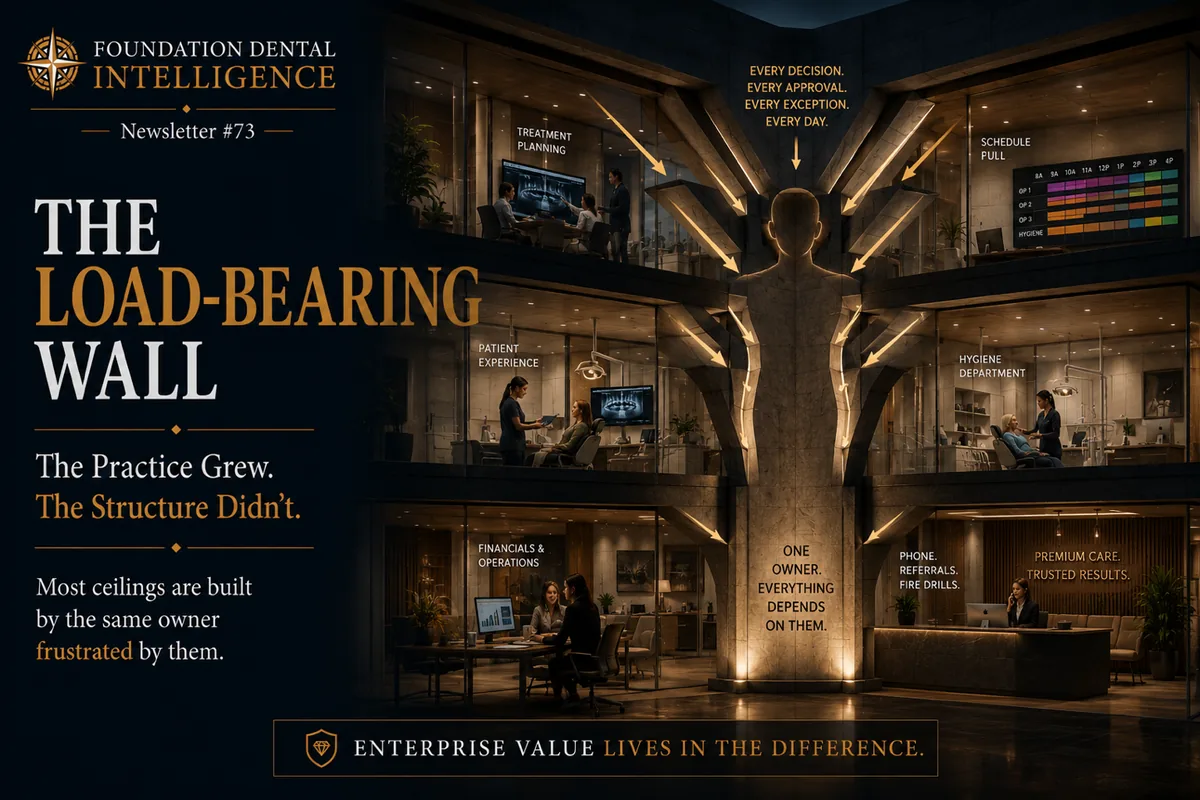
The most dangerous dependency is the one disguised as leadership. The practice appears strong until everything still depends on one person.
You don’t become a real owner when you buy the practice. You become one the day the practice no longer needs you to hold it together.
The Shift That Breaks the Ceiling
The shift from owner-dependent to owner-independent doesn’t require replacing the team. It requires redesigning what the team is empowered and expected to own.
Most dental teams are waiting. They’re waiting for permission, for clarity, for confirmation that their judgment is trusted. They’ve been trained - not deliberately, but unmistakably - to defer. The owner’s presence has functioned as a permission structure, and inside that structure, the most capable people have learned to hold back.
When the design changes, the response usually surprises the owner. People who seemed passive become more capable. Problems that were once routed upward start getting solved closer to the source. Decisions that used to require the doctor begin happening inside a structure the doctor can trust.
What changed? Not the people. The structure changed.

Strong teams don't wait for permission. They operate inside a system that allows good decisions to happen without the owner at the center of every interaction.
A real ownership culture is built by creating clear decision authority, visible standards, communication rhythms, and accountability structures that don’t require the doctor to function as the keystone of every interaction.
And if we’re being honest - being needed can feel like proof that we matter. That’s the emotional trap. The owner says they want freedom, but the practice still gives them identity through dependency. Every question reinforces importance. Every rescue proves value. Real leadership creates capability in others. Control creates dependence on the owner. One builds an organization. The other builds a job with better branding.
The Honest Question Worth Sitting With This Week
Not the quick version. The honest one.
If someone who understood practice operations spent one full week inside your practice while you were absent - watching how decisions got made, how problems got handled, how the team communicated, how the day ended without you - what conclusion would they reach?
Would they see a practice that runs on structure? Or would they see a capable, committed, high-performing doctor who has become, over many years of hard work and genuine competence, the single point of failure in their own organization?
That’s not an indictment. It’s how most successful practices get built. Nothing in dental education or early ownership teaches you to design a practice that doesn’t depend on you. That’s a separate discipline. It has to be learned deliberately - usually from people who’ve already built it and can show you exactly where the work starts.
The ones who learn it are usually the ones who eventually describe their practice with a word most dentists never quite reach.
Free.

Freedom isn't the absence of responsibility. It's knowing that the practice continues to perform because the structure holds without you.
Most practices don’t hit a market ceiling first.
They hit an owner ceiling.
The owner becomes too necessary. Too central. Too responsible for outcomes that should belong to the organization. The business keeps producing. But it stops compounding.
The ceiling nobody sees until they hit it is usually built by the same owner who’s frustrated by it. That’s not a reason for shame. It’s a reason for clarity.
Because if you built it, you can redesign it.
And once the practice no longer depends on you to hold it together, growth often begins to feel lighter again. Not because the opportunity changed. Because the structure finally did.
Frequently Asked Questions
How do I know if my practice has a structural ceiling or just a temporary plateau?
The distinction usually shows up in where decisions live. A temporary plateau often reflects external constraints - market timing, payer mix, capacity limits. A structural ceiling looks like decisions that shouldn’t require the owner still requiring the owner, consistently, across every type of situation. If your absence creates dysfunction that your team’s competence alone can’t explain, it’s structural.
My team is genuinely capable. Why does everything still come back to me?
Because the design asks it to. Capable teams defer when the structure rewards deference - when the owner has historically answered the questions, made the calls, and been the fastest path to resolution. The team isn’t the variable. The design is. Changing the team rarely solves this. Redesigning decision authority almost always does.
How long does it actually take to build a practice that runs without the owner at the center?
Faster than most dentists expect, and slower than most want. In my own experience, meaningful structural change became visible within a year when the design changed deliberately. The requirement is consistency - not answering questions the team can answer, not making decisions the structure should make, and holding the standard even when stepping in would be faster and easier.
What does owner-dependency do to practice value when it’s time to transition?
Everything. A practice where the owner is the ceiling loses significant value the moment the owner steps away. Buyers price dependency aggressively because they’re acquiring future performance, not past production. A practice that runs on structure commands a premium. A practice that runs on the owner is a fundamentally riskier asset, and the offer reflects that.
What’s the most useful first step?
Run a decision audit. For two weeks, track every decision that reaches you. For each one, note whether it required your license, your specific judgment, or your relationships - or whether it arrived simply because the practice has been trained to send it there. That audit tells you exactly where the redesign needs to start. Most owners who do this honestly are surprised by how much of what reaches them didn’t need to.
The Foundation Dental Newsletter publishes every Tuesday. If this reached you through a colleague and you’d like to subscribe, the newsletter is available on LinkedIn or you can reach out directly.
About the Author
Dr. Jim Arnold, DDS is the Founder and CEO of Foundation Dental Alliance, a leadership and practice development organization serving independent dental practice owners. With more than 25 years in dentistry, multiple successful practices, 31% EBITDA achievement, and involvement in more than 60 dental practice transitions, Dr. Arnold writes and speaks on leadership architecture, practice systems, enterprise value, and the future of independent dentistry. He is the host of the Foundation Dental Podcast and the founder of the Foundation Dental Mastermind and Luxury Dental Retreats.
Stay Connected
Websites
FoundationDentalAlliance.com
FoundationDentalMastermind.com
FoundationDentalTransitions.com
FoundationDentalNetwork.com
LuxuryDentalRetreats.com/dubai
Social Media
LinkedIn: linkedin.com/in/arnoldjim
Instagram: instagram.com/smilesbyarnold
YouTube: youtube.com/@DrJimArnold
Facebook: facebook.com/smilesbyarnold
Twitter/X: twitter.com/smilesbyarnold
TikTok: tiktok.com/@foundationdentalalliance
Publications
Foundation Dental Newsletter: linkedin.com/newsletters/foundation-dental-newsletter-7289675134649450496
Contact
Professional Email: drarnold@foundationdentalalliance.com
© 2026 Foundation Dental Alliance. All Rights Reserved.