Foundation Dental Intelligence
Newsletter No. 61
The Monday Morning Fix That Removes You as the Bottleneck.
Get the next issue.
One signup. Everything we publish.

Yesterday alone, how many decisions did your practice force you to make?
Not just the big ones.
All of them.
The scheduling question before your first patient. The vendor call between appointments. The team question at lunch. The patient concern at 3pm. The financial decision before you left. The text message about tomorrow's schedule on your drive home.
Most dentists never count.
But if you did, the number would surprise you.
Fifty decisions. Maybe a hundred. Possibly more.
And here is what almost no one realizes.
Every decision you make that someone else could make costs you twice.
Once in the time it takes to make the decision.
And again in the growth that never happens because you were making that decision instead of building the practice.
And most of those decisions should never reach you in the first place.

When every decision still routes through you, you become the constraint.
The Invisible Load
After watching hundreds of practices over three decades, one pattern appears more consistently than any other.
Practices do not plateau because the owner stops working hard.
They plateau because the owner never stops making decisions.
Scheduling. Vendors. Technology. Team questions. Patient issues.
Different inputs. Same destination.
All of it still routes through one person.
At first this feels efficient.
You know the answer. You make the call. The problem gets solved.
But over time something changes.
The volume increases.
More patients means more decisions. More team members means more questions. More complexity means more judgment calls.
And eventually the owner becomes the constraint.
Not because they lack capacity.
Because decision-making does not scale the way clinical production scales.
You can add associates. You can add hygienists. You can add operatories.
But you cannot add more hours in your day to process decisions.
When Good Instincts Become the Ceiling
Most practice owners developed strong instincts early.
They learned to solve problems quickly. They learned to make judgment calls under pressure. They learned to keep things moving.
Those instincts built the practice.
But the same instincts that create early momentum eventually create the plateau.
Because solving problems quickly means the problem never becomes a system.
Making judgment calls under pressure means the decision never gets documented.
Keeping things moving means no one else learns how to make that call.
And over time the practice becomes entirely dependent on the founder's availability.
Growth slows not because opportunity disappeared.
Growth slows because every new patient, every new team member, every new service creates more decisions that flow to the same person.
The owner.
The Pattern Most Dentists Miss
Here is what typically happens.
A practice grows steadily from startup to about $1.5 million in revenue.
During that phase, the owner's involvement feels appropriate.
The team is small. The systems are simple. The owner can stay close to everything without creating bottlenecks.
But somewhere between $1.5 million and $3 million, something shifts.
The team grows. The systems get more complex. The operational questions multiply.
And suddenly the owner is making fifty decisions a day instead of twenty.
Most assume the solution is better time management.
Work earlier. Stay later. Get more organized.
But time management does not solve a structural problem.
If every decision still requires the owner's input, working longer hours just means the owner can handle slightly higher volume before hitting the ceiling again.
The real solution is not managing time better.
The real solution is reducing the number of decisions that require the owner in the first place.
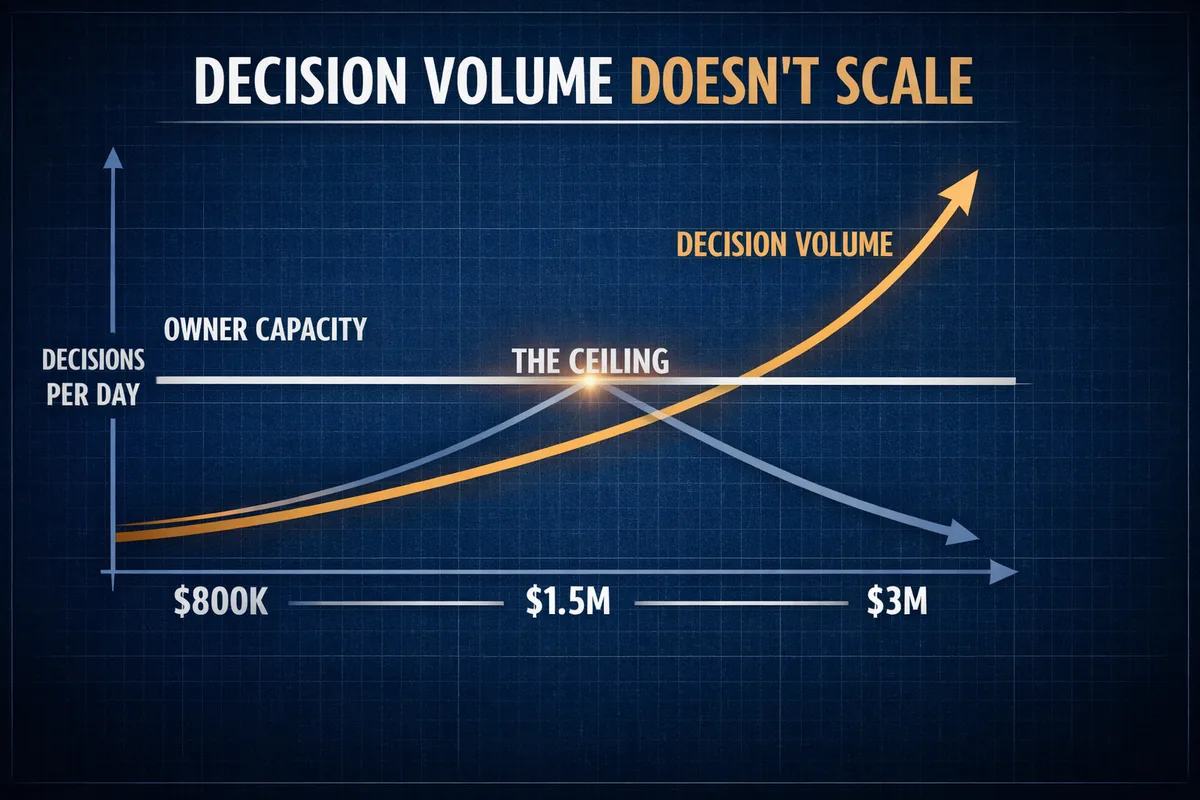
Growth slows when decision demand exceeds leadership capacity. The system that worked at $800K creates bottlenecks at $2M.
The Three-Day Audit That Changes Everything
Last week, I wrote about why practices plateau.
This week is how you fix it.
Most practice owners have never tracked how many decisions they make in a day.
They have never categorized those decisions.
And they have never asked whether each decision actually required them personally.
That lack of visibility creates the bottleneck.
Because you cannot redesign what you cannot see.
So here is the exercise that reveals the constraint.
For the next three days, track every decision you personally make.
Not just the major ones.
Every single decision.
Use your phone. Use a notebook. Use whatever system works.
But capture them all.
Team question about scheduling. Patient concern about treatment. Vendor question about pricing. Operational decision about broken equipment. Financial choice about next month's marketing budget.
Write it down.
At the end of three days, you will have a list.
Probably sixty to a hundred decisions.
Maybe more.
Now comes the part that matters.
The Decision Categories That Reveal the Problem
Take your list and sort every decision into one of three categories.
Category A: Only I Can Decide
These are decisions that genuinely require the owner's judgment, authority, or expertise.
Strategic direction. Major financial commitments. Leadership decisions that shape culture. Clinical decisions that set standards.
These belong with the owner.
Category B: Someone Else Should Decide
These are decisions that do not require the owner's judgment but currently flow to the owner out of habit, unclear authority, or team dependency.
Scheduling conflicts. Supply reorders. Minor operational questions. Patient experience decisions that fall within established standards.
These should belong somewhere else.
Category C: This Should Not Be a Decision At All
These are decisions that repeat.
The same question comes up every week. The same problem appears every month. The same operational friction surfaces again and again.
These should not require human judgment.
They should be systems.
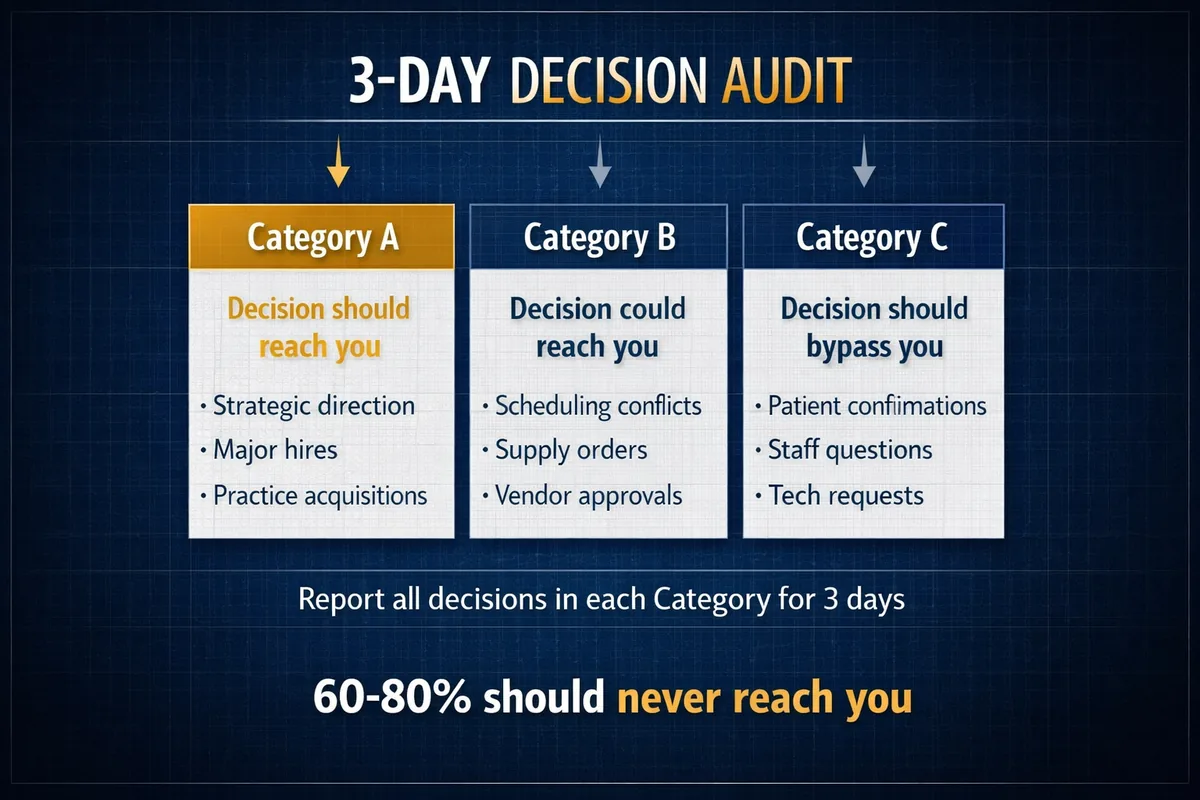
Most practice owners discover that 60-80% of daily decisions fall into Categories B or C. The three-day audit reveals exactly where your time is being lost.
What Most Dentists Discover
When practice owners complete this exercise, three patterns emerge consistently.
Pattern One: Category A is smaller than expected.
Most dentists assume sixty percent of their decisions require them personally.
The actual number is usually closer to twenty percent.
Pattern Two: Category B is larger than expected.
Decisions the owner has been making for years could have been delegated long ago.
But because authority was never explicitly transferred, the team continues asking instead of deciding.
Pattern Three: Category C reveals the real waste.
The same decisions appear over and over.
Scheduling protocols that were never documented. Vendor processes that were never standardized. Operational questions that were never turned into systems.
Every time one of these decisions reappears, it costs the owner time and attention that could have been invested in growth.
The Line That Changes How You Think
If a decision shows up more than once, it should not reach you twice.
If it does, you don't have a people problem. You have a design problem.
Read that again.
Because that single principle solves most decision overload.
Recurring decisions should become systems.
Systems remove decisions from the owner's plate permanently.
Not temporarily. Permanently.
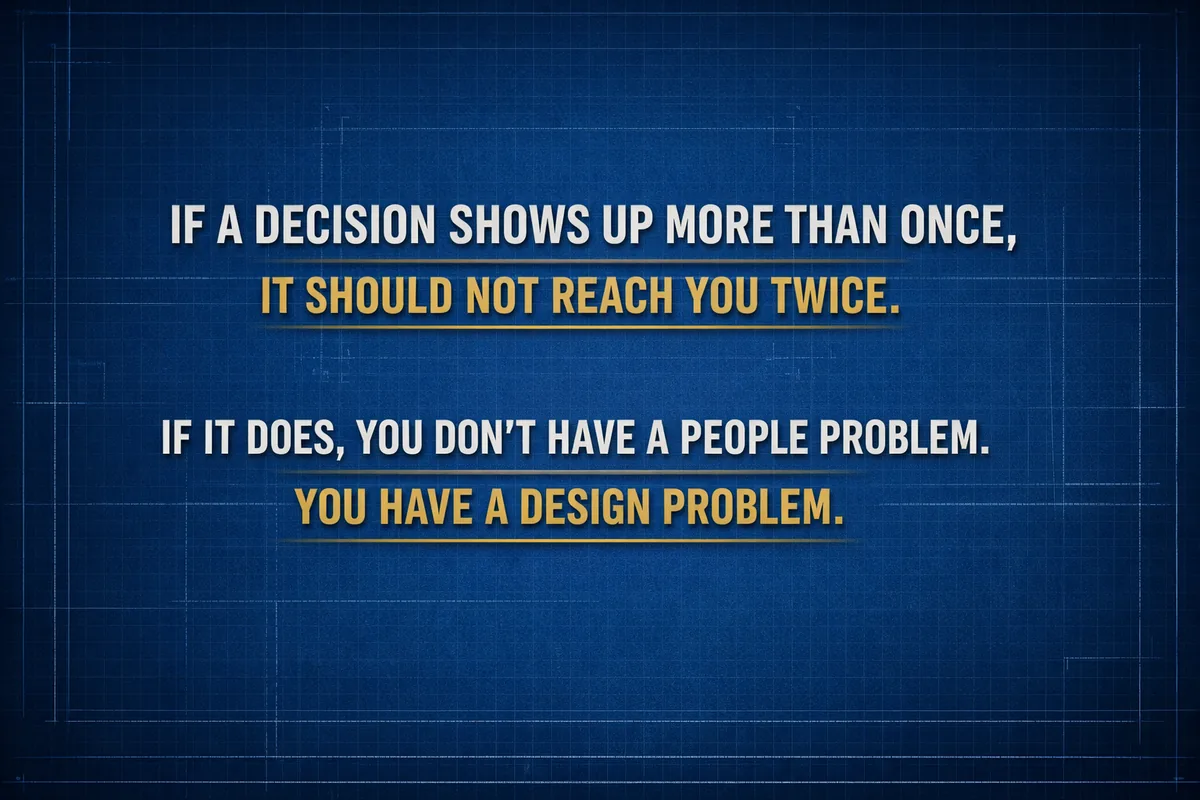
Recurring decisions should become systems. Systems remove decisions from your plate permanently.
Why This Matters More Than Most Dentists Realize
Decision fatigue is real.
Research shows that decision quality declines as decision volume increases.
The fiftieth decision of the day gets less attention than the fifth decision.
And in a dental practice, that declining quality shows up everywhere.
Patient experience suffers when the owner is too mentally exhausted to engage fully.
Team morale suffers when responses become short or inconsistent.
Strategic thinking suffers when all available mental energy goes toward operational decisions.
Most practice owners do not fail because they make bad decisions.
They fail because they make too many decisions.
And eventually decision volume overwhelms decision capacity.
The Shift That Restarts Growth
Once you see where your time actually goes, the path forward becomes clear.
You do not need better time management.
You need decision architecture.
Decision architecture means designing the structure that determines who makes which decisions, how those decisions get made, and when decisions should become systems instead.
Most practices operate without intentional decision architecture.
Decisions flow to whoever has always made them.
Authority lives wherever it landed historically.
And the owner continues making calls that could have been distributed years ago.
But when decision architecture becomes intentional, everything changes.
Shift One: Assign Ownership
Pick three decisions from Category B.
Decisions that do not require you but currently flow to you.
Assign clear ownership to someone else.
Not just delegation. Ownership.
That means the person owns the outcome, makes the call, and does not need to check with you first.
Shift Two: Define How Decisions Get Made
Most teams continue asking the owner not because they lack competence.
But because they lack clarity about how the decision should be made.
What factors matter? What standards apply? What outcomes are we optimizing for?
When those questions get answered once and documented, the decision stops requiring the owner.
Shift Three: Turn Recurring Decisions Into Systems
Pick one decision from Category C.
A decision that has appeared multiple times in the past three days.
Turn it into a system this week.
Document the process. Clarify the standard. Assign ownership. Remove yourself.
That decision will never reach you again.
And every hour you would have spent on that decision can now go toward something that actually grows the practice.
What This Looks Like In Practice
A practice owner completes the three-day audit.
She discovers that scheduling conflicts appear six times in three days.
Every time a patient requests a time that conflicts with another appointment, the team asks the owner how to handle it.
Category C. Recurring decision.
She spends thirty minutes documenting the scheduling protocol.
When do we move patients? When do we hold firm? What language do we use? Who makes the final call?
The system gets documented. The team gets trained. The owner removes herself.
That decision never reaches her again.
Six decisions per week. Twenty-four decisions per month. Nearly three hundred decisions per year.
Gone.
Permanently.
And the mental energy that would have gone toward three hundred scheduling decisions can now go toward designing the next stage of growth.
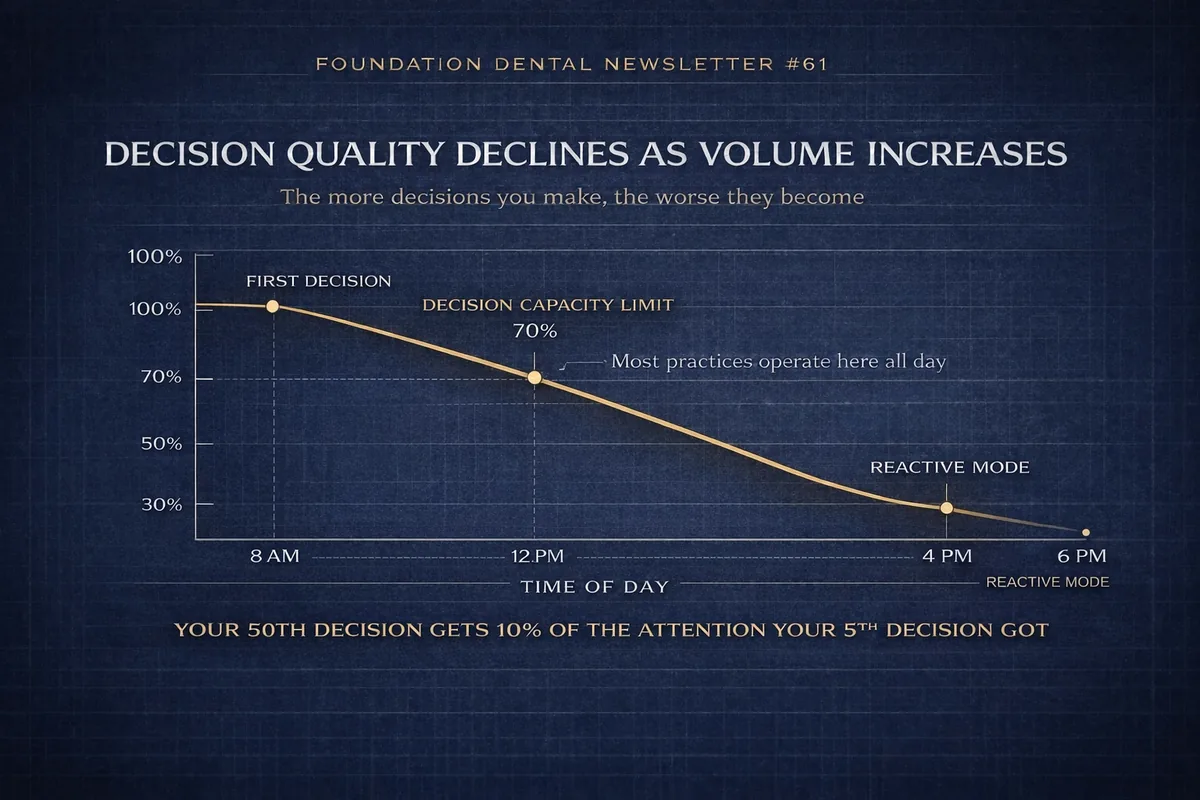
Research shows that decision quality declines as decision volume increases. The fiftieth decision of the day receives a fraction of the cognitive attention the fifth decision received. This isn't a willpower problem. This is a design problem.
The Compounding Effect
Most practice owners underestimate how much decision volume constrains growth.
They assume the constraint is patient demand. Or team capacity. Or operational efficiency.
But in most cases, the constraint is simpler.
The owner ran out of decision bandwidth.
And once that happens, everything slows down.
Hiring slows because hiring decisions require the owner.
Systems development slows because system design requires the owner.
Strategic planning slows because strategy requires mental space the owner no longer has.
But when decision architecture becomes intentional, the constraint disappears.
Not overnight.
But systematically.
One delegated decision removes one bottleneck.
One documented system prevents dozens of future decisions.
One clearly assigned owner frees the founder to focus on architecture instead of operations.
And over time, the practice begins functioning differently.
Growth returns not because the owner works harder.
But because the owner stopped being the answer to every question.
Monday Morning Application
You can start this before lunch today.
This week, do three things.
One: Track every decision you make for three days.
Do not skip this step.
You cannot redesign what you cannot see.
Two: Categorize every decision.
A: Only I can decide.
B: Someone else should decide.
C: This should not be a decision at all.
Most dentists discover that sixty to eighty percent fall into B or C.
Three: Remove yourself from three decisions this week.
Pick one from Category B. Assign ownership. Define how it gets made. Let go.
Pick one from Category C. Document the system. Train the team. Remove yourself.
Do it again next week.
And the week after that.
Within a month, twenty to thirty decisions will no longer require you.
Within a quarter, a hundred decisions will have moved off your plate.
And the practice will begin growing again.
Not because you found more time.
Because you required fewer decisions.
Why This Matters More Than Marketing
Most practices that plateau try to solve the problem with tactics.
More marketing. More technology. More services.
But if the decision structure has not evolved, more activity just creates more decisions.
More patients without better systems means more questions flowing to the same person.
The front door gets bigger.
The bottleneck stays the same.
And growth continues to stall.
Decision architecture is not glamorous.
It does not show up in before-and-after photos.
It does not generate immediate revenue.
But it unlocks everything else.
Because once the owner stops being the constraint, the practice can finally grow past the founder's personal capacity.
The Real Reason Practices Stop Growing
After thirty years in dentistry, the pattern is clear.
Practices rarely stop growing because the market disappears.
They stop growing because the owner never stopped making decisions.
The system that worked at $800K created bottlenecks at $2M.
The structure that felt efficient early on eventually became the ceiling.
And without intentional redesign, effort alone cannot solve the problem.
But when decision architecture becomes intentional, everything changes.
The practice stops functioning as a job that requires the owner's constant presence.
And starts functioning as an organization that continues growing whether the owner is in the building or not.
The goal is not to make better decisions.
The goal is to build a practice that doesn't need you to make most of them.
That shift does not happen by accident.
It happens by design.
And it starts this week.
Track your decisions. Categorize them. Remove yourself from three.
Then do it again next week.
Within a month, you will see the difference.
Not in how hard you are working.
In how much the practice is growing.
If a decision shows up more than once, it should not reach you twice.
If it does, you don't have a people problem. You have a design problem.
That principle alone will change how your practice functions.
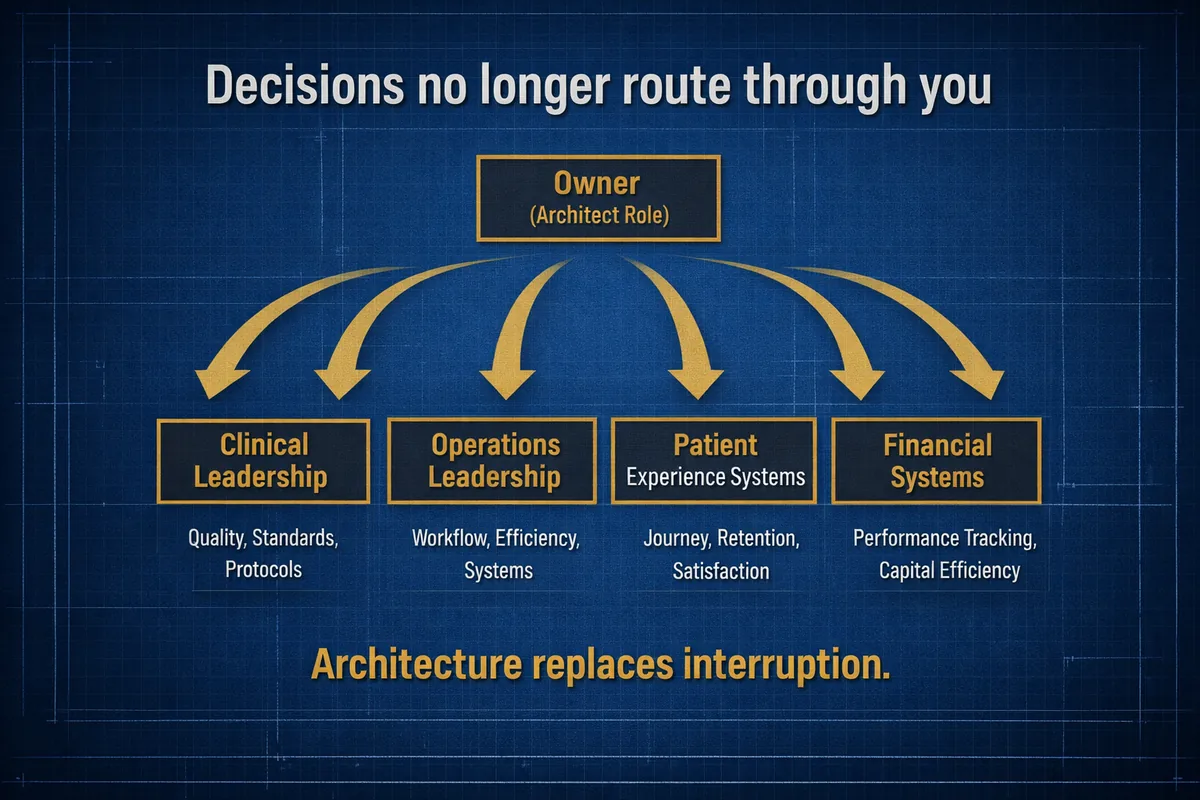
The practice stops functioning as a job that requires your constant presence and starts functioning as an organization that continues growing whether you're in the building or not.
About Dr. Jim Arnold
Dr. Jim Arnold is the Founder and CEO of Foundation Dental Alliance, an ecosystem designed to help dentists build durable, independent practices through leadership development, operational clarity, and strategic architecture.
He writes weekly for dentists who want clarity, leverage, and practices that support both professional success and personal freedom. His work focuses on decisiveness, leadership architecture, and long-term value creation.
With more than 25 years as a multi-practice owner and educator, Dr. Arnold helps dentists move from effort-based success to optionality-driven freedom.
Stay Connected
Foundation Dental Alliance: www.FoundationDentalAlliance.com
Foundation Dental Mastermind: www.FoundationDentalMastermind.com
Foundation Dental Transitions: www.FoundationDentalTransitions.com
Foundation Dental Network: www.FoundationDentalNetwork.com
Dubai Luxury Dental Retreat: https://www.FoundationDentalAlliance.com/dubai
Foundation Dental Newsletter: https://www.linkedin.com/newsletters/foundation-dental-newsletter-7289675134649450496
LinkedIn: www.LinkedIn.com/in/arnoldjim
Instagram: www.Instagram.com/smilesbyarnold
Facebook: www.Facebook.com/smilesbyarnold
Twitter/X: www.twitter.com/smilesbyarnold
YouTube: www.youtube.com/@DrJimArnold
TikTok: www.tiktok.com/@foundationdentalalliance
Email: drarnold@foundationdentalalliance.com
Let's elevate your practice together!
#FoundationDentalAlliance #DentalLeadership #DecisionArchitecture #PracticeGrowth #SystemsDriven #HighPerformanceDentistry