Foundation Dental Intelligence
Newsletter No. 72
The Number Most Practice Owners Have Never Actually Calculated.
Get the next issue.
One signup. Everything we publish.

A few years ago, Sarah and I were celebrating our anniversary at the Four Seasons Hualalai on the Big Island of Hawaii.
If you’ve ever been there, you know it’s one of those places that makes it easy to forget about work. The ocean is right there. The pace is different. You arrive intending to be fully present and you mean it.
My phone had other plans.
It rang at breakfast. It buzzed at the pool. It interrupted dinner. Questions from the office. Decisions that apparently couldn’t wait. Problems that somehow needed my input from 4,300 miles away. None of them were disasters. None of them were emergencies. But together they revealed something I didn’t want to sit with: I thought I owned a business. The truth was that the business owned me.
At the time, I knew my production. I knew my collections. I knew my overhead percentage. I tracked the same numbers most dentists track because those were the numbers everybody talked about. What I didn’t know was that all those numbers were hiding the answer to a much more important question:
Was the business actually becoming more valuable?

I thought that I owned a business. The truth was that the business owned me.
The Numbers We All Know
Ask a room full of dentists about their production and most can answer within thirty seconds. Collections, same thing. Ask about overhead and the conversation usually continues. Ask about EBITDA and the room gets quieter.
Not because dentists aren’t intelligent. Not because they don’t care. Because most owners have never been taught to view their practice through that lens.
Production feels important because it’s visible. Collections feel important because they’re tangible. Both matter. But neither tells you what the business actually earned - and neither tells you what the business is becoming. That distinction is the one that costs most owners the most money, and it’s the one that almost never gets examined until something forces the examination.
I’ve seen practices producing $1.8 million annually that generated surprisingly little owner wealth. I’ve also seen practices collecting substantially less that became highly desirable acquisition targets. The difference wasn’t production. The difference wasn’t collections. The difference was margin - specifically, EBITDA.
The Number Buyers Actually Care About
One of the advantages of working alongside Brian Mans in Foundation Dental Transitions is getting a clear view of how sophisticated buyers evaluate practices. The process is clarifying in ways that most owners never get to experience on their own.
Buyers don’t sit around talking about how hard you worked. The market doesn’t reward effort. It rewards transferable value.
They evaluate risk. They evaluate predictability. And they evaluate EBITDA.

After 60 practice transitions, the question that every buyer asks is the same: what happens to this practice when the owner leaves?
For those unfamiliar with the term: EBITDA stands for Earnings Before Interest, Taxes, Depreciation, and Amortization. The formal definition matters less than the practical one. EBITDA tells you what the business actually earns after the real cost of operating has been accounted for. It’s the closest thing most practices have to a true scoreboard - because while production measures activity, EBITDA measures what that activity is building.
The Math Most Owners Haven’t Run
Here’s a version of the calculation that comes up regularly in the practices I’ve worked with. A practice collects $1.5 million. The owner feels good about the number. The schedule stays full, the team stays busy, patients keep coming through the door. From the outside, everything appears healthy.
Then somebody runs the actual calculation. Overhead is consuming 70% of collections. Owner compensation hasn’t been cleanly separated from true practice earnings. Costs have accumulated over years without meaningful review. When the EBITDA calculation is finally completed, the practice shows a 12% margin. That’s $180,000.
The owner thought they had a $1.5 million practice. What they actually had was a business generating $180,000 in EBITDA. Same production. Same collections. Completely different conclusion.
Many owners spend years measuring the size of the machine without ever measuring what the machine actually produces.
That’s the moment many owners realize they’ve been measuring the size of the machine rather than what the machine actually produces.

Production tells you what happened. EBITDA tells you what you built.
I’ve watched dentists absorb that calculation for the first time and go quiet. Not because the number is wrong. Because it’s right, and they’ve been making decisions based on a different scoreboard for years.
Why Good Practices End Up Here
Most of the time this isn’t caused by incompetence. It’s caused by drift. Small decisions, repeated over many years, that nobody ever examined as a group. Additional subscriptions that seemed reasonable when signed. Additional staff that made sense at the time. Costs that grew incrementally because the practice was growing and nobody was reviewing overhead against a production target.
The insurance write-off is the most common culprit and the hardest to see clearly. A practice can write off $400,000 so gradually that nobody notices it leaving. The money never lands in the bank account, so it never creates the same emotional reaction as a payroll increase or a major equipment purchase. But from an EBITDA perspective, the effect is identical. The dollars are gone before the business ever has a chance to keep them.
This is why two practices collecting the same number can have radically different enterprise values. One built that revenue through retained fee integrity. The other surrendered a substantial percentage before overhead was ever paid. The collections number looks identical. The EBITDA picture doesn’t.
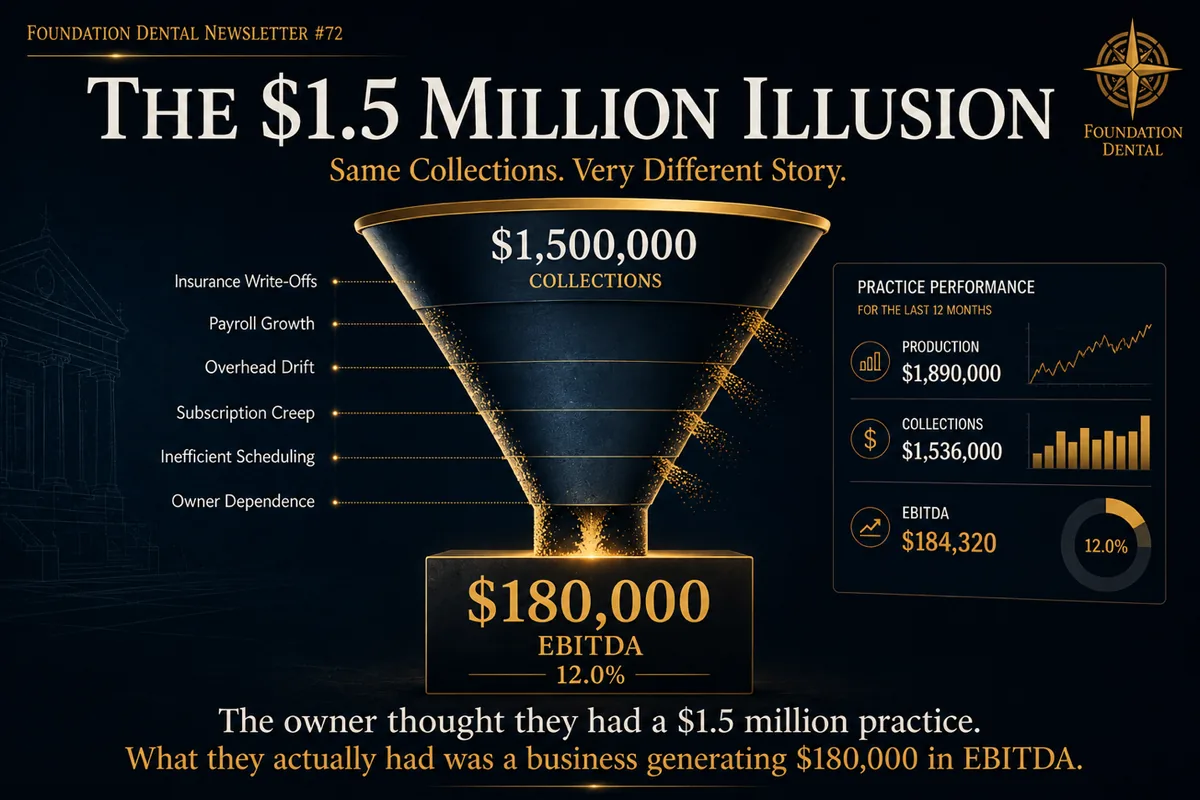
The money doesn’t disappear all at once. It leaves gradually, through six channels most owners never examine together.
The Hualalai Lesson
That trip taught me something I’d been avoiding.
The issue wasn’t my team. They weren’t incompetent. The issue was that I had accidentally trained the organization to depend on me. The issue was that I had confused growth with freedom - and it took being 4,300 miles from the office, phone buzzing constantly, to finally see it clearly. I believed that if production increased, freedom would naturally follow. What I found instead was that I’d built more responsibility alongside more revenue, and the two were scaling together in a way that wasn’t going to resolve itself on its own.
When I started paying attention to what was driving the gap between what the practices produced and what they actually built in terms of wealth and enterprise value, EBITDA became the number that told the truth. Not perfectly. But more accurately than production. More accurately than collections. More accurately than overhead percentage. Because EBITDA revealed not just what was happening clinically, but what was happening structurally - and whether the structure was building something or just sustaining activity.
A healthy EBITDA margin is evidence that the business is functioning efficiently. It’s evidence that the practice is creating options. And options are what most owners are actually chasing when they say they want freedom.
The Calculation Worth Running This Week
Pull your last twelve months of collections. Pull your last twelve months of expenses, including all compensation. Separate owner compensation into two categories: what you’d need to pay a clinical replacement to do your chair work, and what remains as true ownership earnings. Add back depreciation. Remove any non-recurring expenses that won’t repeat.
What’s left is your EBITDA. Express it as a percentage of collections.
If it’s above 25%, your structure is likely working. If it’s between 15% and 25%, there’s meaningful opportunity worth understanding - and it’s worth knowing specifically where the compression is coming from. If it’s below 15%, the practice deserves a much deeper look regardless of how strong the production number appears.
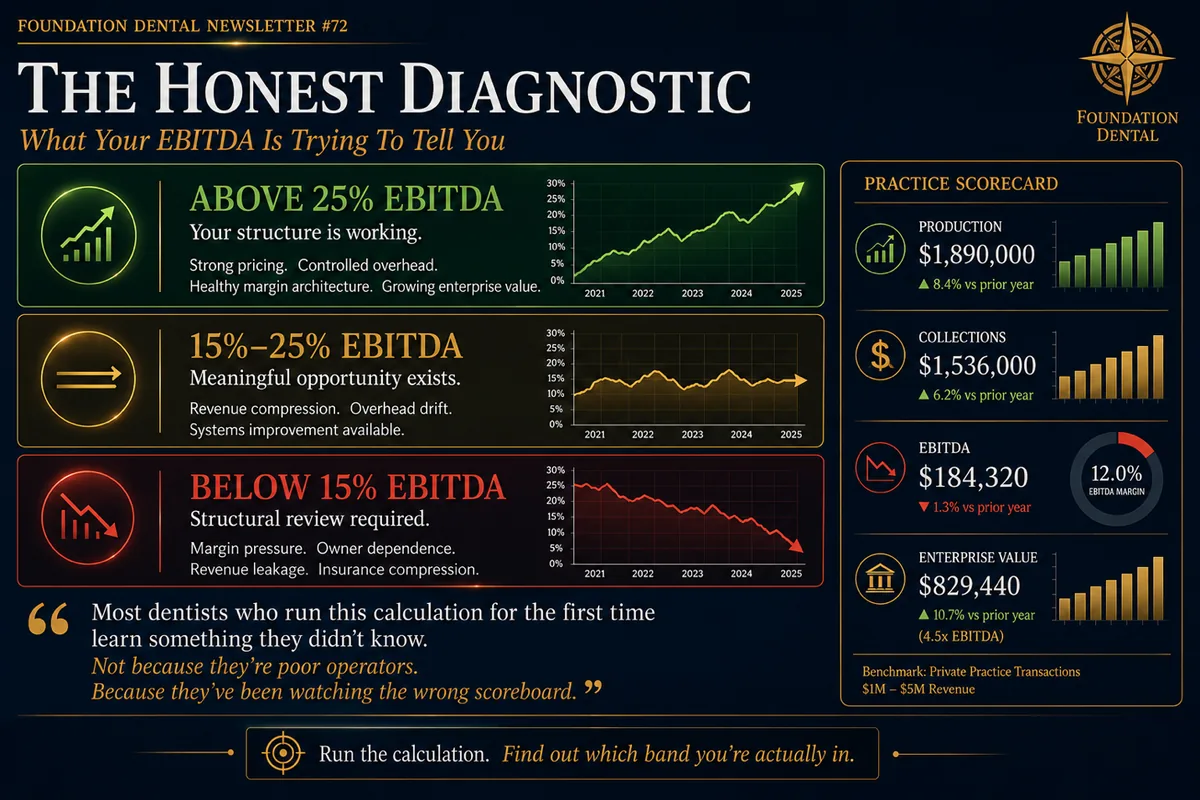
Run the calculation. Find out which band you’re actually in.
Most dentists who run this exercise learn something they didn’t know. Not because they’re bad business owners. Because they’ve been watching the wrong scoreboard.
If you want another set of eyes on what your EBITDA structure actually looks like and what’s driving it, that’s one of the first conversations we have inside Foundation Dental Mastermind.
Final Thoughts
Most dentists spend years trying to increase production. The owners who finish best eventually realize production was never the destination.
Production creates income. EBITDA creates enterprise value.
One pays the bills. The other determines how many choices you’ll have later.
That’s the number most practice owners have never actually calculated. And it’s usually the number that matters most.
That’s the number most practice owners have never actually calculated. And it’s the one that matters most.
Frequently Asked Questions About EBITDA in Dental Practices
What exactly is EBITDA and why does it matter for a dental practice?
EBITDA stands for Earnings Before Interest, Taxes, Depreciation, and Amortization. In a dental practice context, it represents the true operating earnings of the business after all legitimate operating expenses - with owner compensation adjusted to reflect what a market-rate clinical replacement would cost, separating that from true owner profit. It matters because buyers, lenders, and advisors value dental practices primarily on EBITDA multiples. A practice with strong production but weak EBITDA commands a low multiple regardless of how busy the schedule looks.
What is a good EBITDA margin for a dental practice?
The range varies by practice model and market, but as a general framework: EBITDA margins above 25% represent a well-structured practice with strong pricing and controlled overhead. Margins between 15% and 25% are functional but indicate meaningful improvement potential. Margins below 15% typically signal a structural problem - usually some combination of insurance dependency, high overhead relative to revenue, or owner compensation being mixed in ways that obscure the true picture. Fee-for-service practices with well-managed overhead consistently achieve higher EBITDA margins than comparable insurance-dependent practices.
How is EBITDA different from profit?
Net profit is what remains after all expenses including interest, taxes, and depreciation. EBITDA removes those items to show the operating earnings of the business independent of financing structure and accounting decisions. For practice valuation purposes, EBITDA is the more useful number because it allows comparison between practices regardless of how they’re financed or what depreciation schedule they’re using.
How do insurance write-offs affect EBITDA?
Directly and significantly. Every dollar written off to insurance adjustments is a dollar that never enters the revenue base from which overhead is paid. A practice writing off 28% of production is working from a collections base that’s 28% smaller than its production suggests. If overhead is measured as a percentage of collections rather than production, the write-off is invisible in the overhead analysis - but it’s compressing EBITDA from the top line, which is often more damaging than overhead creep from below. Two practices with identical collections and identical overhead percentages can have meaningfully different EBITDA if one arrived at those collections through write-offs and the other didn’t.
When should a practice owner start paying attention to EBITDA?
Now, regardless of how far out any exit or transition might be. EBITDA is not a metric that only matters when you’re selling. It’s the clearest indicator of whether the practice is building real enterprise value or simply generating activity. A dentist who understands their EBITDA structure at 45 has years to improve it. A dentist who first encounters the number at 58, three months before a planned sale, has very limited options.
What’s the most common reason dental practice EBITDA is lower than it should be?
In my experience across more than 60 practice transitions and 30 years of practice ownership: insurance write-offs combined with overhead that grew incrementally without being reviewed against a production target. Neither one announces itself loudly. Both compound quietly for years. The result is a practice that’s genuinely busy, genuinely producing, and generating meaningfully less wealth than its production number would suggest.
About the Author
Dr. Jim Arnold, DDS is the Founder and CEO of Foundation Dental Alliance, a leadership and practice development organization serving dentists from graduation through retirement. He has 30 years of experience as a multi-practice owner and has been involved in more than 60 dental practice transitions. He leads the Foundation Dental Mastermind, Luxury Dental Retreats, co-founded Foundation Dental Transitions, and hosts the Foundation Dental Podcast. He also publishes the Foundation Dental Newsletter and Blog weekly, focused on leadership, practice design, and long-term sustainability in dentistry.
Stay Connected
Websites
FoundationDentalAlliance.com
FoundationDentalMastermind.com
FoundationDentalTransitions.com
FoundationDentalNetwork.com
LuxuryDentalRetreats.com/dubai
Social Media
LinkedIn: linkedin.com/in/arnoldjim
Instagram: instagram.com/smilesbyarnold
YouTube: youtube.com/@DrJimArnold
Facebook: facebook.com/smilesbyarnold
Twitter/X: twitter.com/smilesbyarnold
TikTok: tiktok.com/@foundationdentalalliance
Google Business Profile: tinyurl.com/2t3chcv6
Publications
Foundation Dental Newsletter: linkedin.com/newsletters/foundation-dental-newsletter-7289675134649450496
Contact
Professional Email: drarnold@foundationdentalalliance.com
© 2026 Foundation Dental Alliance. All Rights Reserved.