Foundation Dental Intelligence
Newsletter No. 75
Why Fee-for-Service Isn’t a Personality Type.
It’s a Business Model
Get the next issue.
One signup. Everything we publish.

One of the biggest myths in dentistry is that fee-for-service practices are built for a certain kind of dentist.
People say it works because you’re in an affluent community. Or that their patients would never pay those fees. Or the most common one: “I’m just not that kind of practice.”
I don’t believe any of those things. And I say that as someone who built fee-for-service practices in markets where people told me it wouldn’t work.
Fee-for-service isn’t a personality type. It isn’t a zip code. It isn’t charisma or luck or having wealthy patients. It’s a business model. And like any business model, it either fits the structure you have, or it doesn’t.
My conviction never changed over 30 years. My relationship was always with the patient - not with the insurance company. The patient might have a relationship with the insurance company, but that wasn’t my responsibility. Insurance companies don’t dictate treatment. The doctor does.
I used to say I’d rather sell used cars than give away 40% of my hard work to some insurance executive. That wasn’t just frustration. That was a structural observation about where the value was going.
If someone else has already built what you’re trying to build, that means it’s possible. The question isn’t whether it can be done. The question is whether you’re willing to build the structure that makes it possible.
What Four Newsletters Have Been Building Toward
If you’ve been reading this newsletter over the last several weeks, you’ve already absorbed the core of the argument without me naming it directly.
Newsletter #71 walked through the insurance write-off math. The way a practice can bill $1.9 million, collect $1.5 million, and never quite account for where the other $400,000 went.
Newsletter #72 introduced EBITDA - the number that tells the truth about whether a practice is building wealth or just generating activity.
Newsletter #73 exposed the owner dependency ceiling. The practices that look healthy until someone tries to step back and realizes the machine stops without them.
Newsletter #74 put you in the buyer’s seat. What a sophisticated buyer sees when they walk into a practice for the first time. The systems, the transferable value, the revenue model.
Fee-for-service is where those four threads converge. Because an FFS model, done correctly, strengthens margin, improves EBITDA, reduces owner dependency, and increases enterprise value. That’s why this issue sits where it does. It’s the structural answer that follows four weeks of hard questions.

The production number on the dashboard doesn’t tell you which practice you’d rather own.
What Fee-for-Service Actually Means
A fee-for-service practice is a practice that gets paid directly for the value it delivers without handing pricing authority to outside entities. That can include patients who use insurance for reimbursement on the back end. It can include out-of-network relationships. It can include selective participation where the practice remains in specific plans on purpose.
The common thread is control.
A fee-for-service model is about who sets the fee, who owns the relationship, and who decides what care looks like. PPO dependency reverses that order. The plan sets the fee. The plan influences the decision. The plan shapes what care looks like in real life, no matter what the clinical intention is.
The most important thing to understand about fee-for-service isn’t the billing mechanics. It’s what it permits. It permits you to see fewer patients, spend more time with each one, build real relationships, and often make more money doing it.
A fee-for-service practice that sees 8 to 12 patients a day and collects full fee is often more profitable than an insurance-based practice seeing 20 to 25 patients a day - on lower gross collections. Fewer patients. More money. Less exhaustion at the end of the day.
The Math That Changes the Conversation
Here’s the comparison most dentists have never actually run on their own situation.
Two practices. Same market. Both collecting $1.5 million.
Practice A participates in PPO networks with average write-offs of 28%. Overhead consumes 70% of collections. When you run the EBITDA calculation properly - stripping out owner compensation at market rate and accounting for all real operating costs - the margin comes in at 12%. That’s $180,000 in EBITDA on $1.5 million in collections.
Practice B has retained fee integrity. Same revenue number, but arrived at it by billing close to what it collected rather than billing high and writing off the difference. Overhead discipline held at 60%. EBITDA comes in at 28%. That’s $420,000 on the same $1.5 million in collections.
The production number on the dashboard looks identical. The enterprise value doesn’t. The market doesn’t pay a premium for busy. It pays a premium for predictable, high-margin performance that survives the owner leaving the building.
Apply a multiple to both practices and the valuation gap becomes the most important number in the conversation. That gap doesn’t happen because one practice worked harder. It happens because one practice made a structural decision earlier.

Two practices. Same collections. One of them is worth nearly twice as much.
Why Dropping Plans Is the Wrong First Step
The most common mistake I see is treating a fee-for-service transition as an administrative event rather than a structural transformation. A dentist gets frustrated reviewing adjustment columns, sends a reactive cancellation letter on a Friday afternoon, and hopes for the best.
Three months later, revenue drops. The front desk team doesn’t have the verbal frameworks to handle out-of-network conversations. The doctor scrambles back into the network out of economic fear. They come away convinced that fee-for-service doesn’t work in their market.
The market didn’t fail them. The sequence did.
Fee-for-service amplifies whatever exists underneath it. A practice with strong leadership, clear systems, and real production density tends to get stronger when it recovers fee integrity. A practice with chaotic scheduling, weak financial conversations, and owner dependency tends to feel more fragile when insurance training wheels come off.
The model didn’t fail. The sequence did. You must build the capability inside your walls long before you reduce the dependency outside them.
The Four Pillars of a Fee-for-Service Practice
Every mature fee-for-service practice this ecosystem has studied shares four structural pillars. The exact mix varies. The order doesn’t.
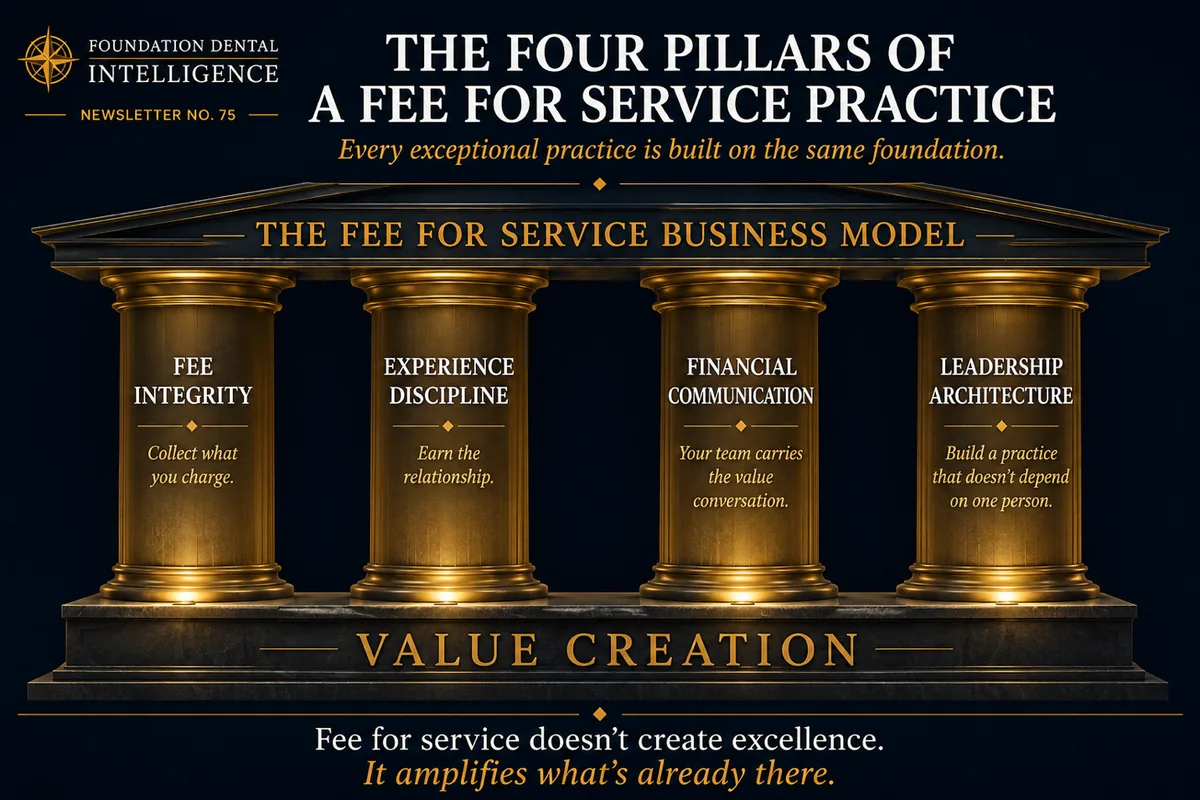
Fee-for-service doesn’t create excellence. It amplifies what’s already there.
Pillar 1: Fee Integrity
Fee integrity is the degree to which your stated fees resemble your collected fees. PPO participation breaks integrity by definition. A plan that pays 72 cents on the dollar for your fee erodes margin before overhead ever enters the picture. You can produce more to compensate. You can’t produce your way out of a structurally broken margin forever.
Restoring fee integrity is the foundational move. It shows up directly in EBITDA. The difference between a practice at 12% EBITDA and the same practice cleaned up to 26-28% is almost always some combination of fee integrity, overhead discipline, and schedule design.
Pillar 2: Experience Discipline
Patients don’t stay with a fee-for-service practice because the fees are low. They stay because they trust the doctor, trust the team, trust the experience, and trust the outcome. When you remove insurance as the primary reason a patient stays, you expose whether the practice has actually earned the right to that relationship.
That means phones answered the same way, every time. Patients greeted the same way. Financial conversations handled the same way. Clinical days designed to reduce chaos instead of rewarding it. Experience discipline isn’t a culture initiative. It’s operational infrastructure.
Pillar 3: Financial Communication
Fee-for-service practices aren’t successful because they charge more. They’re successful because they communicate differently. Team members who can explain value instead of just stating price. Clear written financial arrangements. A consistent process for handling benefits without surrendering control.
Most owners underestimate how heavy this conversation feels to their team. They assume resistance is philosophical. In reality, it’s a design issue. The team hasn’t been given the language, structure, or authority to carry these conversations confidently. Fee-for-service demands the opposite.
Pillar 4: Leadership Architecture
The final pillar is the least glamorous and the most important. Fee-for-service requires a leadership architecture that isn’t owner-dependent. If the only person who can carry the value conversation is the doctor, the model will always feel fragile. If every decision about fees, exceptions, and adjustments still routes through one person, the practice can never truly stabilize.
This is why newsletters 73 and 74 ran before this one. The ceiling nobody sees. The buyer lens. The owner dependency trap. An FFS practice that still runs on one person may produce well. It won’t feel free.
The Talent and Culture Argument
Here’s a part of the fee-for-service conversation that almost never gets discussed: top clinical talent wants to work in this environment.
The best associates, hygienists, and clinical team members have choices about where they work. They’re not choosing based only on compensation. They’re choosing based on whether the practice operates at a standard they’re proud to be part of. A practice that has time for each patient, invests in quality materials and technology, and doesn’t run a production treadmill is a practice where good people want to build careers.
When a practice is more profitable, it can afford better technology, better continuing education, a nicer environment. Those investments aren’t extras. They’re the infrastructure that attracts and retains the team that makes everything else possible.
The hygienist who has 60 minutes with a patient instead of 45 can do better work and has better clinical conversations. The assistant who isn’t bouncing between four rooms can build real patient relationships. The culture of a practice is downstream of its structure, and the fee-for-service structure creates an environment that attracts people who care about doing the work right.
The Objection Most Dentists Never Answer Well
The objection I hear most often is: “My patients won’t pay that.”
I’ve heard it for 30 years. Here’s what I’ve learned. Patients don’t pay for dentistry. They pay for confidence. They pay for trust. They pay for certainty that they’re in the right place with someone who’s genuinely advocating for them.
Think about your own life. How many times have you willingly paid more for something because you believed it was worth it? A better surgeon. A better hotel. A better financial advisor. You weren’t buying the lowest price. You were buying confidence in the outcome. Dentistry is no different.
The practices that thrive outside heavy insurance dependence don’t spend their days defending fees. They spend their days demonstrating value. Patients can tell when a doctor genuinely believes in the care they’re recommending. They can also tell when a doctor is apologizing for the fee before the conversation even starts.
Value creation is the answer to the fee conversation. Not price-matching. Not discounts. Value. When your team consistently creates it, patients stop asking whether their insurance covers it. They start asking what you’d recommend if they were your family. That’s a completely different conversation.

When patients know they’re in the right place, the fee becomes part of the decision, not the entire decision.
The Transition: What It Actually Looks Like
Most dentists who want to make this move don’t do it because they’re afraid of the transition. That fear isn’t irrational. A practice that drops all insurance plans simultaneously is taking a genuine financial risk.
The practices that have made this transition successfully almost never did it all at once. They did it systematically. They identified which plans were compressing margin most severely and exited those first. They built the patient communication infrastructure before the revenue dropped. They adjusted new patient marketing before they needed to, not after.
That process takes time. In most cases, 18 to 36 months to complete a full transition while maintaining revenue stability. But the practices that have done it report something that almost nobody talks about before they get there: the business becomes significantly simpler to operate. Fewer insurance calls. Fewer claim denials. Less administrative overhead. More time per patient. Better margins. A schedule the team can actually sustain.
The complexity of running an insurance-heavy practice is real and largely invisible until you’re out of it. The practices that have transitioned tend not to go back.
If someone else has already done it, that means it’s doable. You just need the right mentorship, the right structure, and the right community to walk through the process step by step - so you do it intelligently and avoid the mistakes that come from trying to figure it out alone.
The Foundation Dental Mastermind launches in August. If you’ve been reading this newsletter and recognizing your own practice in any of these five weeks of content, that’s worth paying attention to.

The goal was never simply higher production. It was building a practice that lets you enjoy the life you worked so hard to create.
Frequently Asked Questions About Fee-for-Service Dentistry
Is fee-for-service only possible in affluent communities?
No. Affluent communities don’t create successful fee-for-service practices. Exceptional practices do. I’ve seen FFS work in small towns, large cities, suburban neighborhoods, and rural communities. Their demographics were different. What they shared was more important than geography: they consistently created value. Patients believed they were receiving outstanding care and an experience that justified the investment.
Should I drop every insurance plan tomorrow?
Absolutely not. Successful transitions are intentional and sequential. The best practices analyze their payer mix, understand their numbers, improve their systems, and strengthen patient communication before making significant changes. The goal isn’t to become anti-insurance. The goal is to become pro-practice.
My patients won’t pay out of pocket. How do I respond?
This is almost always a value creation gap more than an actual patient willingness problem. Patients pay for experiences they trust. If the practice has built real relationships and the team creates genuine value in every interaction, patients will pay. The patients most likely to object are often the ones least aligned with what a fee-for-service practice is designed to deliver. That’s a different problem than it first appears.
What if I’m not ready to commit fully to FFS?
Then don’t. Treat fee-for-service as a spectrum, not a switch. Select one plan, one procedure category, or one segment of your schedule as a test environment. Design the experience, communication, and leadership structure for that slice, measure the results, and adjust. That approach preserves options, reduces risk, and gives your team time to adapt.
How long does a transition realistically take?
Most successful transitions take 18 to 36 months when done systematically. Practices that exit all insurance plans simultaneously tend to experience significant revenue disruption. The more common successful approach is sequential - exit the lowest-reimbursing, highest-write-off plans first, build the patient retention and marketing infrastructure, then continue as the practice stabilizes at each stage.
How does fee-for-service affect practice valuation?
Significantly and positively when the model is working. Higher EBITDA margins mean higher absolute EBITDA on similar revenue numbers. Combined with lower owner dependency, that typically commands stronger multiples. The combination produces valuations that consistently exceed comparable insurance-dependent practices - often by hundreds of thousands of dollars at the transaction table.
Does fee-for-service require a completely different approach to hiring?
Yes, and it’s one of the underappreciated advantages of the model. Top clinical talent - hygienists, assistants, and associates who have real choices about where they work - tends to prefer fee-for-service environments. The work is less compressed, the patient relationships are deeper, and the practice typically invests more in technology and education. That’s not a hard sell to a high-caliber candidate.
About the Author
Dr. Jim Arnold, DDS is the Founder and CEO of Foundation Dental Alliance, a leadership and practice development organization serving dentists from graduation through retirement. He has 30 years of experience as a multi-practice owner and has been involved in more than 60 dental practice transitions. He leads the Foundation Dental Mastermind, Luxury Dental Retreats, co-founded Foundation Dental Transitions, and hosts the Foundation Dental Podcast. He also publishes the Foundation Dental Newsletter and Blog weekly, focused on leadership, practice design, and long-term sustainability in dentistry.
Stay Connected
Websites
FoundationDentalAlliance.com
FoundationDentalMastermind.com
FoundationDentalTransitions.com
FoundationDentalNetwork.com
LuxuryDentalRetreats.com/dubai
Social Media
LinkedIn: linkedin.com/in/arnoldjim
Instagram: instagram.com/smilesbyarnold
YouTube: youtube.com/@DrJimArnold
Facebook: facebook.com/smilesbyarnold
Twitter/X: twitter.com/smilesbyarnold
TikTok: tiktok.com/@foundationdentalalliance
Google Business Profile: tinyurl.com/2t3chcv6
Publications
Foundation Dental Newsletter: linkedin.com/newsletters/foundation-dental-newsletter-7289675134649450496
Contact
Professional Email: drarnold@foundationdentalalliance.com
© 2026 Foundation Dental Alliance. All Rights Reserved.