Foundation Dental Intelligence
Newsletter No. 76
The Practice That Pays You Like an Owner.
Not a Clinician.
Get the next issue.
One signup. Everything we publish.

Every dentist knows last month’s production number.
Far fewer know what their practice actually paid them as an owner.
Those are two different numbers. The gap between them explains why some dentists build wealth while others simply build another demanding job.
Most dentists, when they sit down and do that math honestly, find the answer is smaller than expected. Not because they haven’t worked hard. Not because the practice isn’t performing. Because the structure of the practice hasn’t been designed to separate what the owner earns from what the clinician earns.
Those are two different things. Most practices treat them as one.
That confusion is expensive.
Most dentists spend years trying to increase production without realizing they're optimizing the wrong scoreboard. Production tells you how hard the practice is working. Ownership return tells you how well the business is working. Until you separate those two ideas, it's almost impossible to make decisions that consistently build wealth, enterprise value, and freedom.
What the Last Six Newsletters Have Been Building Toward
The last six issues built this argument piece by piece without naming it directly.
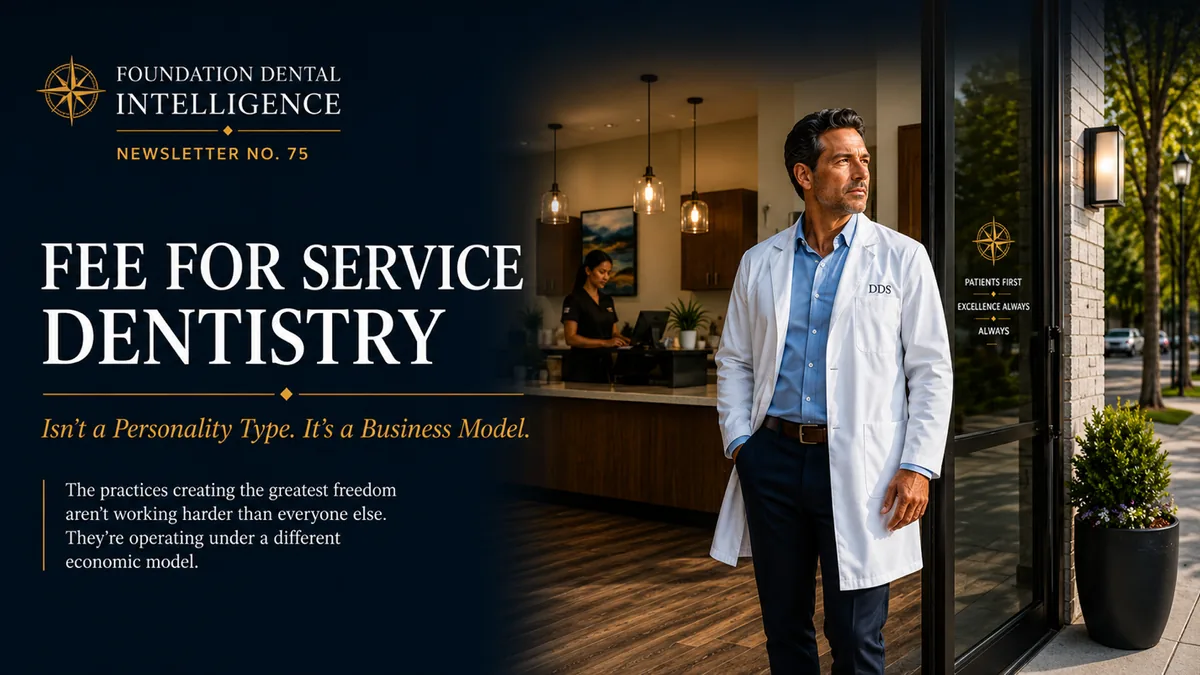
Newsletter #71 covered the insurance trap - the write-off math that erases revenue before it ever lands. Newsletter #72 made the case for EBITDA as the real scoreboard. Newsletter #73 described the ceiling most owners hit when the practice can only grow as fast as the owner can personally carry it. Newsletter #74 put you in a buyer’s chair and showed you what sophisticated operators actually evaluate. Newsletter #75 made the case that fee-for-service is a business model, not a personality type.
All of those newsletters were about one thing underneath: the difference between being paid for effort and being paid for ownership.
This one is where that finally becomes explicit. If you want a practice that pays you like an owner, you have to build something that behaves like one.
The Two Paychecks Most Dentists Never Separate
A dentist who produces $800,000 annually and takes home $280,000 feels successful. The number sounds right. The lifestyle reflects it. The practice is busy, the team is employed, the patients are loyal.
Run the actual analysis and a different picture emerges.
If that dentist were replaced tomorrow by an associate working at market compensation, what would it cost to replicate their clinical output? In most markets, somewhere between $180,000 and $220,000 annually for a competent associate working a full schedule.
That means the $280,000 in total compensation breaks down roughly like this: approximately $200,000 is clinician income - the fair market cost of the chair time - and somewhere around $80,000 is actual ownership return.
OWNER COMPENSATION BREAKDOWN | EXAMPLE |
Total Owner Compensation | $280,000 |
Less: Fair Market Clinical Compensation | ($200,000) |
True Ownership Return | $80,000 |
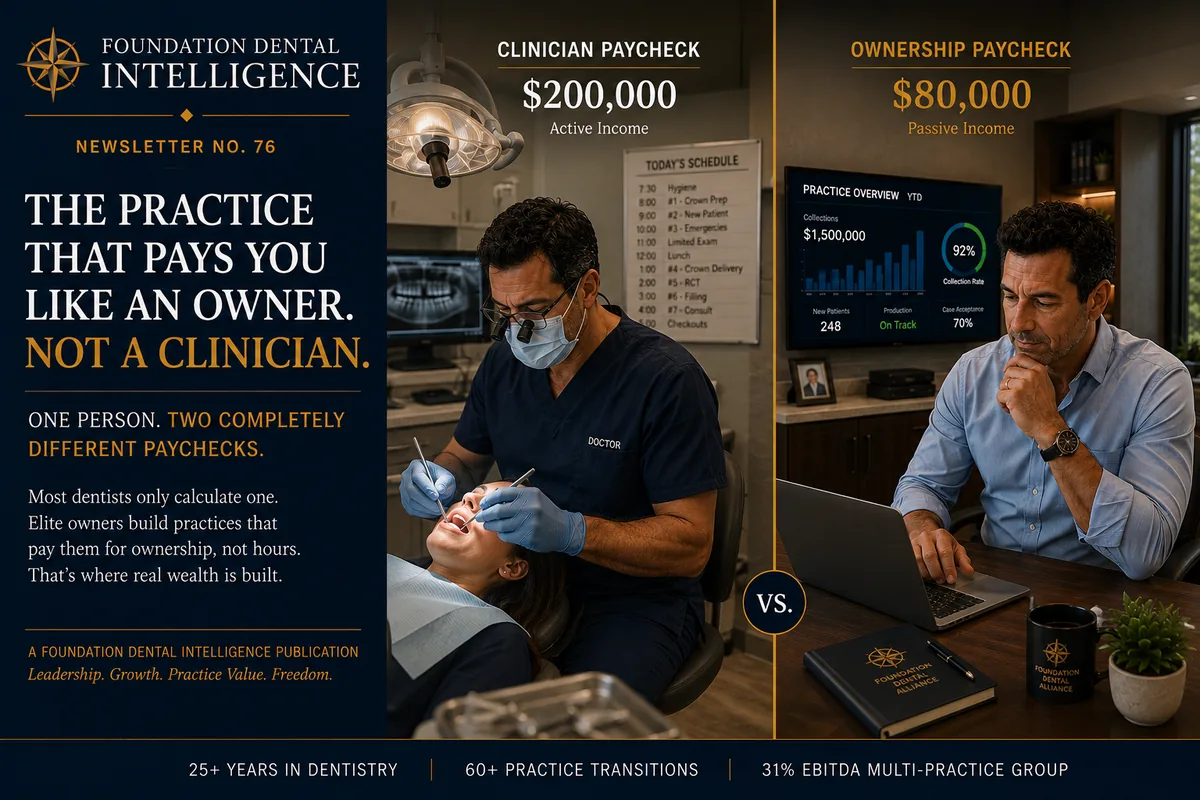
You earn one paycheck for doing dentistry. You should earn another for owning a business. The practices that create lasting wealth know the difference and build both.
Eighty thousand dollars. On a practice that produces $800,000.
That’s not a production problem. It’s a structure problem.
A practice that pays you like an owner separates what you earn for doing dentistry from what the business earns because you own it. Until you’ve seen both numbers, you don’t fully know what your practice is paying you. |
Most dentists have never separated those two numbers. The first time they do, they usually see their practice differently.
What I See Repeatedly
After participating in more than 60 practice transitions, I've stopped being surprised by one pattern that appears almost every time.
The dentist arrives at the negotiating table having worked exceptionally hard for 20 or 25 years. The practice looks healthy from the outside. Production is solid. Collections are reasonable. Patients are loyal. And the owner genuinely believes they’ve built something significant.
Then we run the actual analysis. We normalize the financials. We separate clinical compensation from ownership earnings. We look at what the practice would produce if the current owner stepped back entirely.
That moment, when a dentist sees their true EBITDA for the first time, is one of the most clarifying experiences in this entire process. Not because the number is always bad. Sometimes it’s better than expected. But because they’ve never had it calculated cleanly before. They’ve been flying on one instrument when they needed three.
I’ve met dentists who produce extraordinary dentistry yet feel guilty taking a long weekend because the practice seems to hold its breath until they return. They’ve built successful practices. They haven’t yet built businesses that can carry their own weight. That’s a difficult realization. It’s also one of the most important turning points in an owner’s career.
The ones who act on it early have significantly more options than the ones who discover it at the transition table.
My own experience reflects this directly. My highest-production years personally weren't my highest-income years. They were my most exhausting ones. Real freedom didn't come from producing more. It came when the systems were strong enough that other people could lead the practice, lead each other, and lead the work without me at the center of every decision. When that happened, we actually produced more as a practice, not less. But it was easier, not harder. Margins improved. The culture improved. The time I had with patients went from transactional to relational. That's what good structure actually buys you. Not less dentistry. A completely different experience of it.
Production is the Engine. Not the Finish Line.
The instinct, when margins feel thin, is to produce more. See more patients. Add more hours. Expand into another operatory. Bring in an associate to create more capacity.
Some of those things help. None of them fix the underlying issue.
If your production doubled tomorrow, would your life actually improve? Or would your stress simply double too?
That question usually reveals more than another production report ever will.
A practice structured around the owner’s clinical presence has a ceiling that volume can’t lift. The more it produces, the more it depends on the owner’s direct involvement to sustain that production. More output requires more of the same input. There’s no leverage in that model.
The practices that pay owners the most aren’t necessarily the highest-producing practices in their market. The defining trait isn’t volume. It’s the ratio between what the practice generates and what flows to the owner as a return on ownership rather than compensation for clinical effort.
That ratio is determined almost entirely by structure - not by production targets, not by marketing budgets, not by how many new patients walk through the door.
Structure determines margin. Margin determines what ownership is actually worth. |
Same Revenue. Different Ownership Experience.
Two practices. Both collecting $1.5 million annually.
Practice A runs on the owner. High PPO dependency, a schedule built around appointment density, the owner producing 85% of the dentistry through personal endurance. EBITDA sits around 12% - roughly $180,000 after everything is normalized.
Practice B runs on structure. Fewer patients per day, higher production per visit, a team that owns decisions rather than routes everything upward, a fee model with integrity intact. EBITDA sits at 28% - roughly $420,000.
The revenue gap between those two practices is zero. The EBITDA gap is $240,000. The valuation gap at a 7x multiple is $1.68 million. That difference is entirely structural.
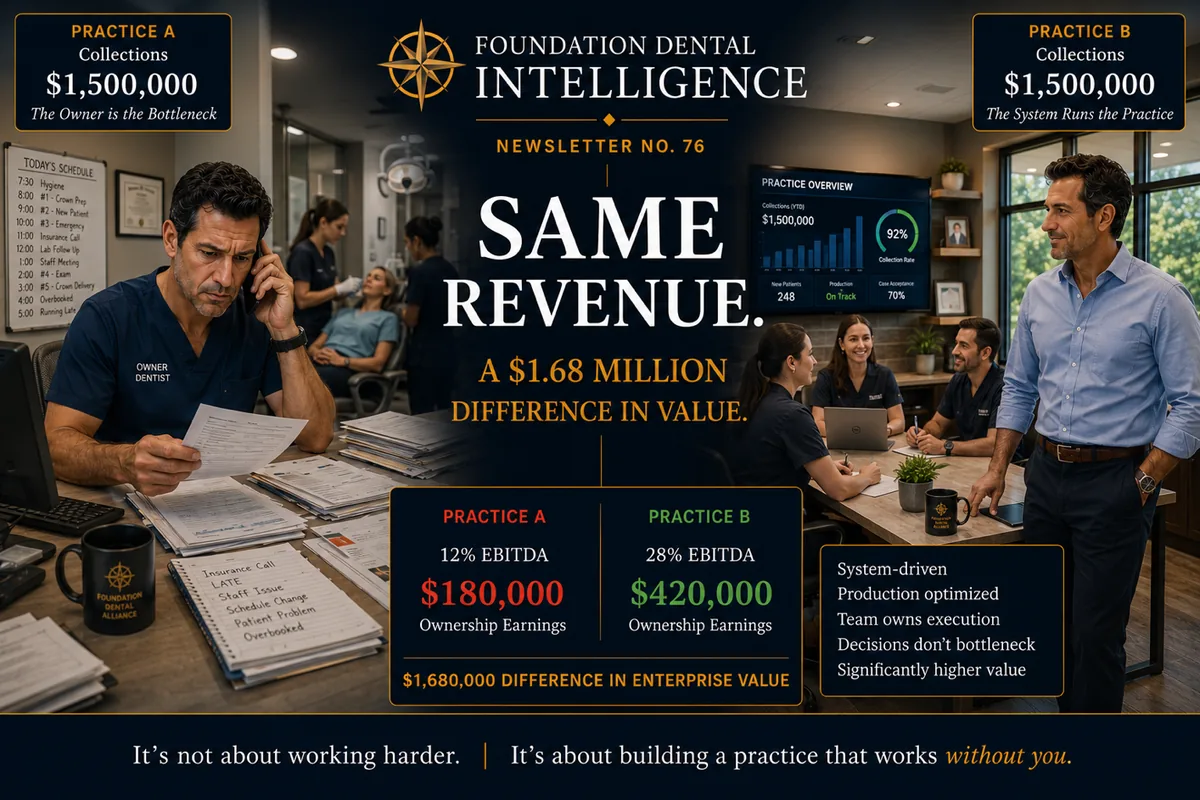
Revenue doesn’t determine practice value. Structure does. Two practices can collect the same $1.5 million, yet one is worth $1.68 million more because it converts production into ownership earnings instead of owner dependence.
Inside Foundation Dental Transitions, Brian Mans and I see this gap every time we sit down with a seller. The practices that command premium multiples weren’t cleaned up for sale. They were built correctly long before anyone thought about selling.
Income Isn’t Wealth. Production Isn’t Freedom.
Most dentists conflate terms that are actually very different scoreboards.
Production is revenue generated by clinical activity. Collections is what’s actually received. Income is what flows to the owner personally. Cash flow is what the business retains after expenses. Net worth is the accumulation of assets over time. Enterprise value is what the business would command in a transaction.
A dentist can score high on the first four and still not be building wealth in any meaningful sense. They’re earning well. They’re not compounding.
The decisions that improve enterprise value and net worth are often different from the decisions that improve monthly income. Sometimes they’re the same. Often they require a deliberate redesign of how the practice is structured - who does what, what gets documented, how decisions get made, what the fee model looks like, and whether the owner is still the load-bearing wall of the entire operation.
Optionality Is the Real Goal
Most dentists think about optionality only when a transition enters the picture. That’s too late.
Optionality isn’t retirement. It’s not an exit. It’s the ability to choose - to work because you want to rather than because the practice requires your presence to survive. To sell if the right offer appears. To stay if it doesn’t. To bring in a partner. To expand. To slow down. To hand more off. These are choices. Most dentists don’t have them.
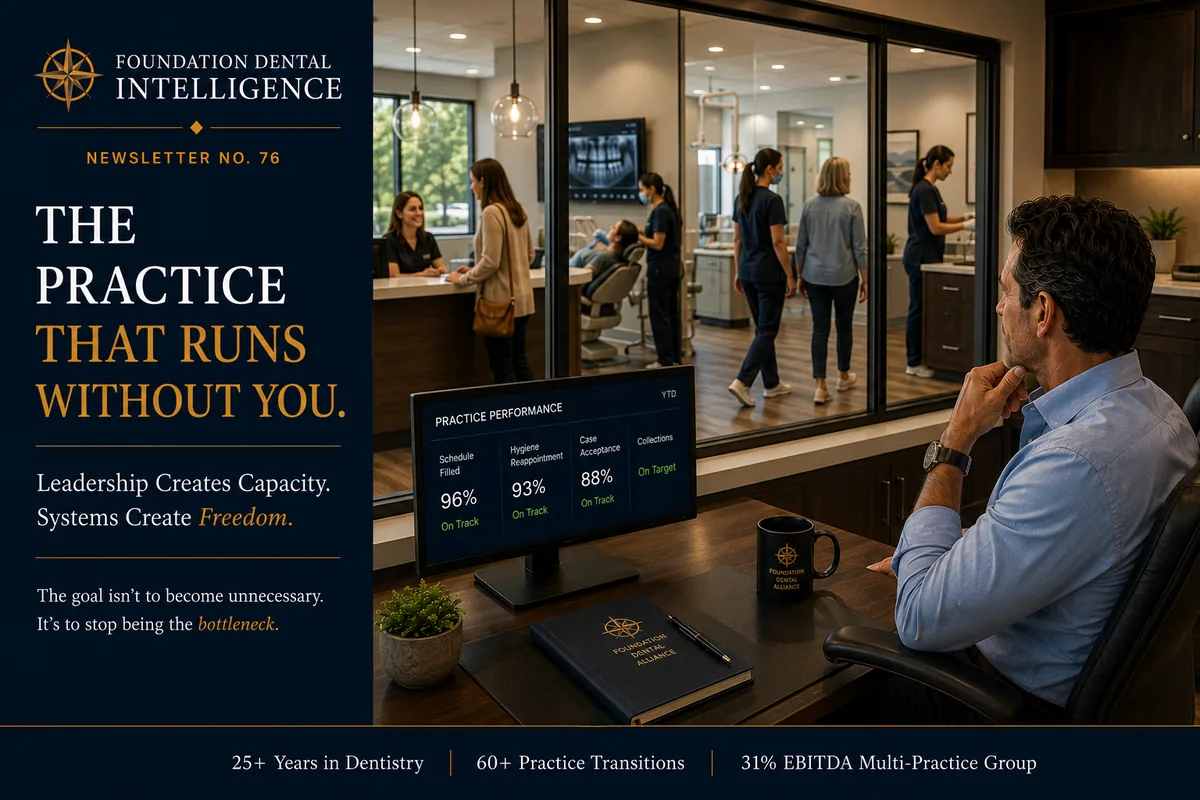
The goal was never to build a practice that demanded more from you every year. The goal was to build one that gave you more choices. That’s what optionality really looks like.
Freedom in dentistry is not a production target. It is a structural outcome you build on purpose.
The practices that create genuine optionality for their owners share a common architecture. Strong fee integrity. Overhead managed as a percentage of collections. A schedule designed around production density rather than appointment volume. A team that owns outcomes rather than waits for permission. Clinical systems documented well enough that a capable associate can execute without the owner physically present.
When those elements are in place, something shifts. The owner stops being indispensable and starts being valuable in a different way - at the strategic level rather than the operational one. That shift is what optionality actually feels like from the inside.
Inside the Foundation Dental Mastermind, this is the first calculation we work through together. Because until you see how much your practice actually pays you as an owner, every other decision is guesswork. You’re optimizing the wrong number.
The Four Shifts That Change Your Paycheck
The practices that move from clinician pay to owner pay almost always make four structural changes. Not all at once, and not on any fixed timeline. But the direction is consistent.
First, they separate clinical income from ownership earnings. They run the math honestly - what would I pay a full-time clinical replacement to do my dentistry at market rates, and what remains after that and after overhead as true business earnings? Until you know that number, you don’t know what your business is really paying you.
Second, they fix the economic model before adding more effort. An insurance-dependent, write-off-heavy, low-margin practice won’t begin paying the owner like an owner because production increases. If every extra unit of production enters a broken model, more work only creates more pressure. It doesn’t create more ownership. Owners who move into real ownership income fix the model first - fee integrity, payer mix, schedule design - and then decide whether more production even makes sense.
Third, they stop being the central processing unit. As long as every meaningful decision, exception, and problem still routes through the owner, the practice’s performance is tethered to the owner’s bandwidth. When the practice stops needing the owner to process every decision, clinical presence is no longer the only driver of value. The owner starts getting paid for what the business is, not just for what they personally do.

The practice becomes more valuable the moment it stops depending on the owner for every important decision. That’s when you’re no longer just running a practice. You’re building an asset.
Fourth, they design for transferable value years before any transition enters the picture. The owners who finish strongest thought like buyers early. They asked not only how much did we produce but what would a sophisticated operator see if they walked in today. Then they designed for that answer - and the result was a practice that paid them like owners now and commanded owner-level value later.
The Honest Question Worth Sitting With This Week
Not the production question. Not the new patient question.
The ownership question.
If you took yourself out of the chair entirely for six months and paid a competent clinical replacement to do your dentistry, would your practice still have meaningful earnings left after all real costs?
That number tells you whether your practice is paying you like an owner or like the most valuable employee in your own building.
If the honest answer is uncomfortable, that’s useful. It means the structure hasn’t been designed to separate those two income streams. It means the practice is probably paying the owner more like a skilled employee than like someone who built something of genuine enterprise value.
That’s fixable. It’s always fixable. But it doesn’t fix through more production. It fixes through deliberate structural redesign - the kind that takes time, requires specific decisions, and is almost always cleaner to build with people who’ve already made the same transition.
Production creates income. Structure creates ownership. Ownership creates optionality. And optionality is what gives you the freedom to decide what the next chapter looks like.
That’s what the best practices are really built to produce.

The practices that create the most freedom rarely produce the most dentistry. They simply convert what they produce into something far more valuable.
Frequently Asked Questions
How do I calculate my actual ownership return versus my clinician income?
Start with your total owner compensation for the last twelve months. Then research the fair market salary for a qualified associate in your market who could replicate your clinical output at your level of production and procedure mix. The difference between your total compensation and that market rate is your ownership return. In most practices that haven’t been specifically designed for ownership income, this number is surprisingly small relative to total take-home pay.
Can a smaller practice actually create more freedom than a larger one?
Yes, and this happens more often than most dentists expect. A practice producing $1.8 million with 28% EBITDA and low owner dependency creates more genuine freedom than one producing $3 million at 10% EBITDA with the owner at the center of everything. Freedom is a structural outcome, not a revenue milestone. The size of the practice matters far less than the design of it.
What EBITDA margin should I be targeting?
A well-structured practice should be generating at least 20% EBITDA after properly separating owner clinical compensation from ownership earnings. Practices with strong fee integrity and low owner dependency regularly achieve 28% to 31%. Below 15% almost always indicates a structural issue - usually PPO dependency, owner-centric production, or overhead that has grown with revenue rather than being managed as a percentage of collections.
Is this realistic in a competitive, heavily insured market?
Yes, but the path looks different depending on payer mix and market. The answer is rarely a sudden exit from all PPO plans. It’s usually a sequenced reduction strategy that builds fee-paying patient volume before reducing insurance dependency. The practices in competitive insurance markets that make this transition successfully almost always do it with a plan rather than a reaction.
How does this connect to what my practice would sell for?
Directly. A buyer’s offer is almost entirely determined by EBITDA, not revenue. The revenue gap between a 12% EBITDA practice and a 28% EBITDA practice can be zero. The valuation gap at a 7x multiple can exceed $1.6 million. That difference is entirely structural - not clinical skill, not market position, not patient relationships. Structure.
Where should an owner start?
Run the ownership return calculation described in the first question. Then pull your true EBITDA - not gross production, not collections, but normalized operating earnings after separating clinical compensation. Those two numbers together show you exactly where the structural work needs to start and how large the gap actually is between what you’re earning and what the business should be producing.
The Foundation Dental Newsletter publishes every Tuesday. If this reached you through a colleague and you’d like to subscribe, the newsletter is available on LinkedIn or you can reach out directly.
About the Author
Dr. Jim Arnold, DDS is the Founder and CEO of Foundation Dental Alliance, a leadership and practice development organization serving independent dental practice owners. With more than 25 years in dentistry, multiple successful practices, 31% EBITDA achievement, and involvement in more than 60 dental practice transitions, Dr. Arnold writes and speaks on practice leadership, operational excellence, enterprise value, and the future of independent dentistry. He is the host of the Foundation Dental Podcast and the founder of the Foundation Dental Mastermind and Luxury Dental Retreats.
Stay Connected
Websites
FoundationDentalAlliance.com
FoundationDentalMastermind.com
FoundationDentalTransitions.com
FoundationDentalNetwork.com
LuxuryDentalRetreats.com/dubai
Social Media
LinkedIn: linkedin.com/in/arnoldjim
Instagram: instagram.com/smilesbyarnold
YouTube: youtube.com/@DrJimArnold
Facebook: facebook.com/smilesbyarnold
Twitter/X: twitter.com/smilesbyarnold
TikTok: tiktok.com/@foundationdentalalliance
Publications
Foundation Dental Newsletter: linkedin.com/newsletters/foundation-dental-newsletter-7289675134649450496
Contact
Professional Email: drarnold@foundationdentalalliance.com
© 2026 Foundation Dental Alliance. All Rights Reserved.