Foundation Dental Intelligence
Newsletter No. 77
You Already Know What to Fix.
So Why Hasn't Anything Changed?
You already know what to fix. The question is why the practice hasn't changed. |
In more than 60 practice transitions, I've never sat across from an owner who didn't already know what was wrong with the practice.
Not one.
They knew the PPO write-offs were eating the margin. They knew the schedule was built around volume instead of production per visit. They knew which employee they'd tolerated too long, which responsibility should've been handed off two years ago, and which number they should've been watching. Some of them could recite the fix in more detail than I could.
They just hadn't done it.
That's the part nobody wants to talk about, because it's uncomfortable in a specific way. When you don't know something, there's an easy story. The book, the course, the consultant. When you already know and still haven't moved, the story gets personal. You start asking what's wrong with you.
Here's what I've learned after 25 years of watching intelligent, disciplined dentists sit on decisions they'd already made. The owner is almost never the problem. The structure around the owner is.
Where the Last Six Issues Left You
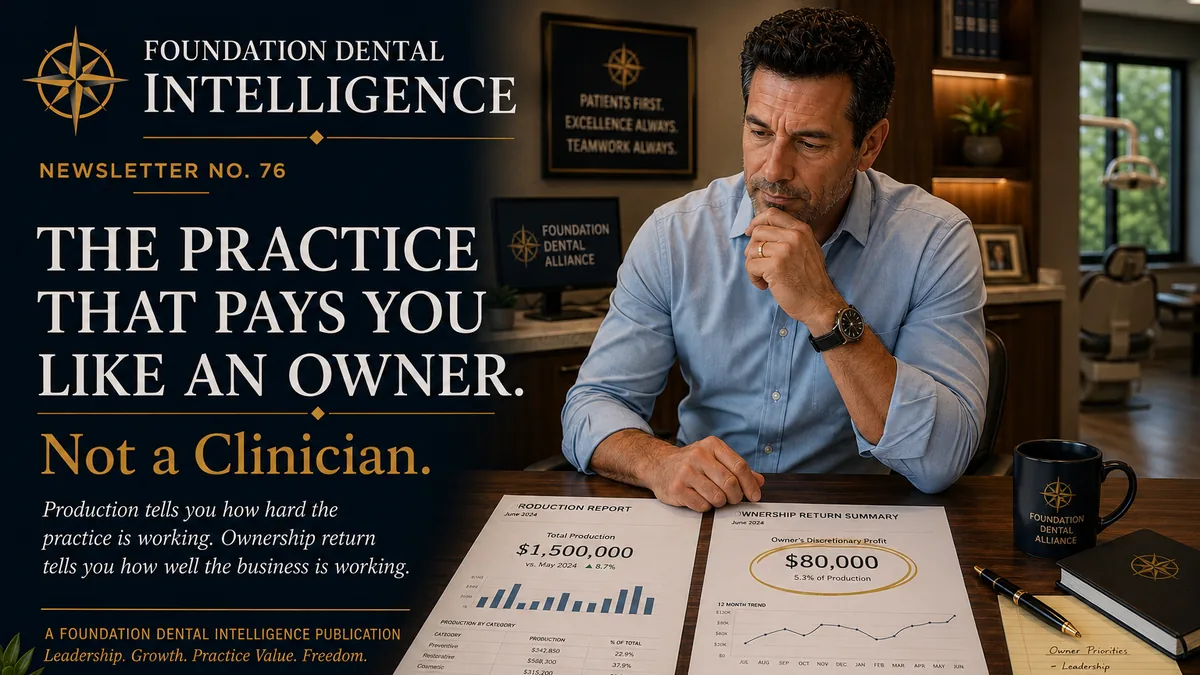
Newsletter #73 described the ceiling every owner-dependent practice eventually hits. #74 walked you through what a sophisticated buyer sees on day one. #75 made the case that fee-for-service is a business model rather than a personality. #76 separated what you earn for doing dentistry from what the business pays you for owning it.
If you've read all six, you have the entire diagnosis. You could probably teach it. Which leaves only one question worth asking. If the diagnosis is this clear, why hasn't the practice changed?
The Practice Bills You for Every Hour You Spend Fixing It
Most people miss this: the owner-dependent practice doesn't just resist change. It charges for it.
The Thursday morning an owner blocks off to rebuild the schedule, renegotiate a PPO contract, or finally fix the financial policy the team has struggled with for months has a price tag, and everyone in the building can see it. Four operatories sit dark. The front desk knows exactly what that block would have produced. The owner knows too, because the owner signs the checks that morning's production would have covered.
So the block gets moved. Then it gets shortened. Then a patient with a broken crown needs to be seen and the block quietly disappears. Nobody decided to abandon the project. The practice simply reclaimed the time, the way it reclaims every hour the owner tries to take away from the chair.
This is the structural trap underneath the execution gap. In a practice where the owner produces most of the dentistry, the owner's time is the most expensive resource in the building. Every hour spent working on the business is an hour of production the business doesn't get, and the business feels that loss immediately, in dollars, this month. The structural work might be worth far more over the next five years, in margin and enterprise value and freedom, but nobody deposits that money on Friday.
The cost is immediate and the reward is delayed, and both land on the one person who can least afford to stop producing.
The cost is immediate and the reward is delayed, and both land on the one person who can least afford to stop producing. |
Discipline was never going to win that fight. The math is rigged against it.
An owner-dependent practice doesn't just resist change. It bills the owner for attempting it. That's why intelligent dentists who know exactly what to fix keep not fixing it.
The Most Expensive Decisions Have No Deadline
A broken compressor gets fixed the same day. A hygienist resigns and the posting is up by Friday. A patient calls with a fractured molar and the schedule makes room. The practice is remarkably good at forcing action when the consequence is immediate.
The decisions that determine what the practice is worth in five years don't work that way. Nobody calls on a Tuesday to tell you owner dependency crept up again this quarter. There's no alarm when the practice becomes slightly less transferable, and no carrier sends a notice suggesting you finally calculate what its write-offs are doing to EBITDA. The important problems stay quiet for years, which is exactly what makes them expensive.
Urgency is built into clinical dentistry. Importance has to be created by the owner, on purpose, against a schedule that will never volunteer the time.
What I See at the Transition Table
The pattern I see repeatedly in transitions is an owner arriving with a list.
Sometimes it's literal. A folder of consultant reports, a marked-up operations manual, a spreadsheet modeling the fee-for-service conversion they'd priced out three years earlier. Sometimes it's just in their head. Either way, the list is good. The thinking is sound. The owner understood the practice better than any outside advisor could have.
And the buyer pays for none of it.
The buyer pays for what got done. Normalized EBITDA, owner dependency, systems that run without the seller in the building. A brilliant plan that stayed a plan is worth exactly nothing at closing, and the seller usually knows that walking in. That's what makes the conversation hard. They're not learning anything new. They're watching the cost of what they already knew.
Brian Mans and I see this often enough at Foundation Dental Transitions that we've stopped treating it as a knowledge problem. The knowledge was there for years. What was missing was a structure that made the work possible while the practice was still running.
It Cuts the Other Way Too
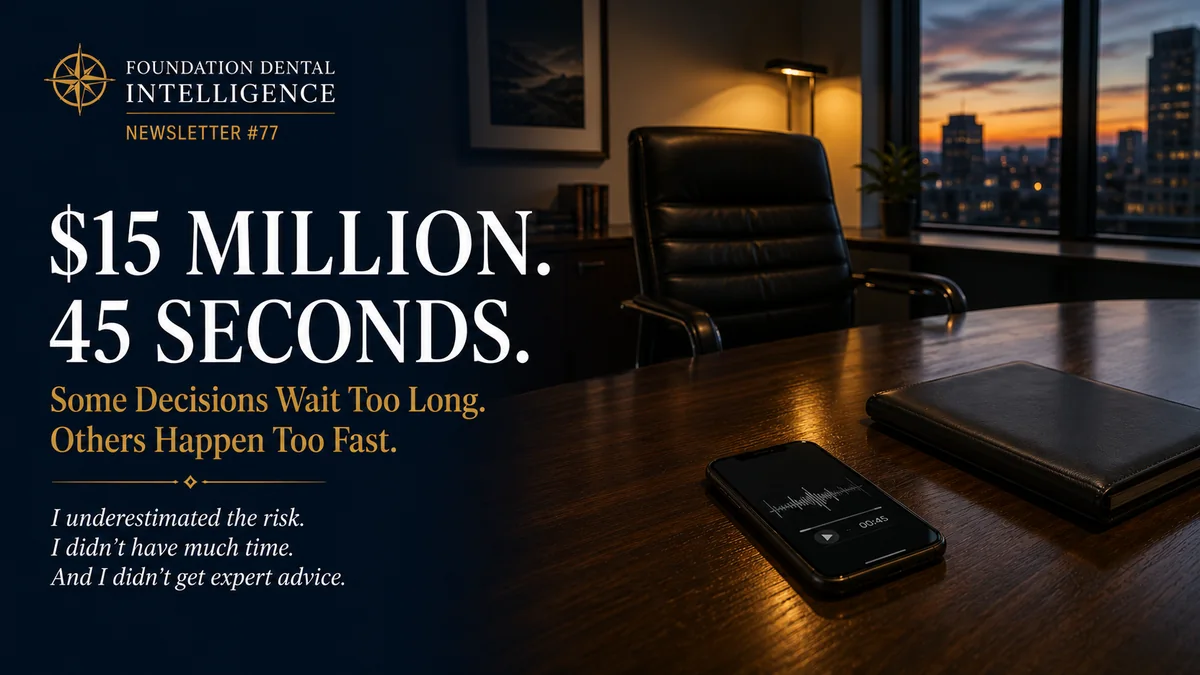
One decision, inside a structure that looked correct, cost $15 million in 45 seconds. |
I'd be dishonest if I framed this only as a problem of owners who move too slowly. I've made the opposite mistake, and it cost me more than any decision I ever delayed.
One decision, inside a structure that looked correct, cost $15 million in 45 seconds.
I underestimated the risk. I didn't have much time to decide. And I didn't get expert advice before I answered. Those three facts are the whole story, and I've had years to look for a more flattering version. There isn't one.
What strikes me now is that the fast mistake and the slow mistake come from the same place. In both cases the owner is deciding alone, inside a practice that leaves no protected time to think, with no one in the room who's already been through it. Sometimes that produces years of knowing and not doing. Sometimes it produces a 45-second yes. The structure is the same. Only the direction of the damage changes.
The owner who stalls for five years and the owner who says yes in 45 seconds share the same problem. Both are deciding alone, without protected time and without anyone in the room who's made the decision before.
Where Does an Owner Go to Be Challenged?
Dentistry has a standard answer for the execution gap, and most owners have paid for it at least once. Accountability. A weekly call. Someone to check whether you did the thing.
I've watched it fail for a specific reason. Accountability applies pressure to the owner. The structural trap applies pressure to the owner too, only harder, in real dollars, every single day. A phone call on Friday doesn't beat an open operatory on Thursday. The practice always wins that argument, because the practice is the one paying the mortgage.
The version that works asks a different question. You said this mattered, so what happened? Sometimes there's a legitimate answer. Sometimes there isn't, and knowing you'll have to give one changes behavior more than any reminder to work harder. Successful dentists are already working.
There's a bigger blind spot underneath that, and I underestimated it for most of my career. A dentist spends the entire day surrounded by people who need an answer. Patients, team members, vendors, associates. The owner becomes the answer, and that becomes normal. So where does the owner go to be challenged rather than admired or sold to? Who's already made the decision you're considering? Who sees something in your numbers that you don't? Who has enough credibility to say you're about to make a mistake and actually stop you? I wish I'd had more of that around the biggest decisions of my career. I would've made some of them differently.
The Least Comfortable Thing I Ever Did as an Owner
One of the most useful things I ever did as an owner was also one of the least comfortable at first. I became less available.
Years ago, when my wife and I were training for Ironman triathlons, there were Wednesdays when we were six hours into a training ride while the practices were open. I couldn't solve that day's problems, because I wasn't there. At first that felt irresponsible. Then the practices kept running. The team made decisions. Problems got solved. People developed judgment, because mine wasn't sitting down the hall as a substitute for theirs.

The practices kept running. The team made decisions. People developed judgment, because mine wasn't sitting down the hall as a substitute for theirs. |
My income didn't drop as I stepped back. Over time it went up, because the practices got more efficient and less dependent on me. Time away from the chair turned out to be some of the most valuable time I had, on one condition. It had to be protected. If I'd waited for the practice to hand it to me, it never would have.
What Actually Moves a Practice
Three conditions show up in almost every owner I've watched go from knowing to done. They're not complicated. They are hard to create alone.
Time the practice can't take back. A morning blocked inside the building is a morning the schedule will reclaim. A commitment made outside the building, with other owners, on a date the practice didn't choose, holds. The difference has nothing to do with discipline. The practice simply can't reach it.
People who've already done it. Every structural change in a practice, dropping a plan, hiring an associate, handing the morning huddle to someone else, feels riskier from the inside than it looks from the outside. Owners who've made the change can tell you what actually broke and what didn't, which shortens the distance between deciding and moving from months to weeks. That's proximity, and there's no substitute for it.
Decisions made before the pressure arrives. This is the one I learned the expensive way. The right moment to decide how you'll respond to an offer, an associate's resignation, or a carrier's fee cut is before the phone rings. Owners who've worked the decision through in advance, with people who've faced it, don't get 45 seconds to think. They've already thought.
Knowledge tells you what to change. Structure determines whether you ever get to. The owners who close the gap change the conditions the decision gets made in, not the strength of their resolve.
Where the Foundation Dental Mastermind Fits
This is why the Foundation Dental Mastermind exists, and it's the reason I built it as an annual membership. You don't need more of what you already have. The Mastermind changes the three conditions above: protected time the practice can't reclaim, a room of owners who've made the same decisions, and the perspective to decide before the pressure arrives, with faculty who've been through it. You don't leave with another idea you hope to get around to. You leave knowing what happens next. The room is kept small by design. If you've read this far and recognized yourself, the details are at FoundationDentalMastermind.com, and the next step is to Apply for Annual Membership.
One Question for This Week
It isn't the one you've been asking, and it doesn't require a list. You probably already have one.
What's the most important change in your practice that you've known you needed to make for at least six months? If the answer comes immediately, that's useful. Then the harder question, which is where on your calendar that work actually lives.
If there's no answer to the second question, you've found the real problem, and it's structural. It's easier to fix with people who've already fixed it. I'd rather you build that now than explain it to a buyer later.
Frequently Asked Questions
Why do dentists who know what to fix still not fix it?
Because in an owner-dependent practice, the owner's time is the most expensive resource in the building. Time spent working on the practice costs production immediately, while the benefit arrives a year or more later. That math defeats discipline almost every time, which is why the fix is structural rather than motivational.
Isn't this just a time management problem?
No. Time management assumes the time exists and the owner is misallocating it. In most owner-dependent practices the time gets reclaimed by the schedule the moment the owner tries to take it. The solution is protected time the practice can't reach, usually created outside the building with other owners.
What does it actually cost to keep not doing this?
It shows up in three places. Margin, because insurance dependence and volume-based scheduling stay in place. Enterprise value, because a buyer pays for what got done, never for what was planned. And optionality, because the owner stays load-bearing. Newsletter #76 covers the valuation math in detail.
Does bringing in an associate solve the execution gap?
Only if the structure is built first. An associate placed inside a practice that still routes every decision through the owner adds capacity without adding leverage. The owner ends up producing and managing. Structure first, then capacity.
How is the Foundation Dental Mastermind different from a consultant?
Good consultants add real value, and most owners I meet have already worked with one. What they usually walk away with is a plan, and the plan was rarely the missing piece. The Mastermind is an annual membership built around implementation sessions with other owners and faculty who've made the same decisions, on a schedule the practice doesn't control. The point is execution rather than more information. Details and the application are at FoundationDentalMastermind.com.
Where should an owner start this week?
With one decision you've already made and haven't executed. The date goes on the calendar before the practice can object, and one person outside your building hears about it and agrees to hold you to it. That's the smallest version of the structure this newsletter is describing.
The Foundation Dental Newsletter publishes every Tuesday at FoundationDentalNewsletter.com. If this reached you through a colleague, that's where you can subscribe.
About the Author
Dr. Jim Arnold, DDS is the Founder and CEO of Foundation Dental Alliance, a leadership and practice development organization serving independent dental practice owners. With more than 25 years in dentistry, multiple successful practices, 31% EBITDA achievement, and involvement in more than 60 dental practice transitions, Dr. Arnold writes and speaks on leadership architecture, practice systems, enterprise value, and the future of independent dentistry. He is the host of the Foundation Dental Podcast, the founder of the Foundation Dental Mastermind and Luxury Dental Retreats, and serves as Chief Dental Officer of Codent AI.
Stay Connected
Websites
FoundationDentalAlliance.com · FoundationDentalMastermind.com · FoundationDentalTransitions.com · FoundationDentalNetwork.com · LuxuryDentalRetreats.com
Social Media
LinkedIn: linkedin.com/in/arnoldjim · Instagram: instagram.com/smilesbyarnold · YouTube: youtube.com/@DrJimArnold · Facebook: facebook.com/smilesbyarnold · Twitter/X: twitter.com/smilesbyarnold · TikTok: tiktok.com/@foundationdentalalliance
Publications
Foundation Dental Newsletter: FoundationDentalNewsletter.com · Foundation Dental Blog: FoundationDentalBlog.com · Foundation Dental Podcast: FoundationDentalPodcast.com
Contact
Professional Email: drarnold@foundationdentalalliance.com
© 2026 Foundation Dental Alliance. All Rights Reserved.