Foundation Dental Intelligence
Newsletter No. 78
You Won the Time.
Now What Do You Fix First?

You did the hard part when you took the time back. The question is what you spend it on. |
Say you did it. You blocked the morning, you told the front desk the schedule doesn't get to touch it, and for the first time in a long time you're sitting down to work on the practice instead of in it.
Now what do you actually work on?
Newsletter #77 ended with a specific recommendation. Pick one decision you've already made, protect the time for it, and put enough structure around that time that Thursday morning can't take it back. There's a problem with that advice. You can win the time and still spend it on the wrong thing.
Most owners answer the question the same way. They pick whatever generated the most friction last week. The team member who caused a scene on Thursday. The hygiene opening that sat there all day. The patient complaint that made it to your cell phone.
Those are real. They're also the loudest things in the building, and loud has almost nothing to do with load-bearing.
The Loudest Problem Isn't Always the Biggest One
A practice generates noise in proportion to how visible a problem is, not how much it costs. That relationship is close to inverted, which is what makes this so hard to see from the inside.
The difficult employee is loud. Everyone talks about her, you think about her on the drive home, and she takes up more of your attention than anything else in the building. She may also be costing you very little in dollars.
The PPO contract is silent. Nobody complains about it, it never interrupts a morning, and it just removes a percentage of every dollar that comes through the door, quietly, for years. Newsletter #72 walked through exactly what that does to EBITDA when nobody runs the math.
Poor delegation doesn't produce a dramatic failure either. It produces a few hundred interruptions that each feel too small to be the problem. A weak financial policy never announces itself as a leadership issue. It shows up as inconsistent collections, uncomfortable conversations, exceptions, and a team that keeps asking the doctor what to do. And a schedule built wrong can look completely full.
So the owner who finally wins a morning spends it on the employee, feels better by lunch, and the practice is worth the same on Friday as it was on Monday.

A practice generates noise in proportion to how visible a problem is, not how much it costs. |
What Sixty Transitions Change About How You See a Practice
I've been involved in more than 60 practice transitions, and one thing that work gives you is a view most owners never get. A transaction forces somebody to look at the whole business at once, not just at what was difficult this month. Earnings, dependence on the doctor, team stability, hygiene, payer mix, systems, contracts, the schedule, and what happens when the person who built the place isn't standing in the middle of it.
What shows up over and over is that the problem list often isn't as long as it looks.
A seller will walk in with eight or nine things that have bothered them for years. Staffing turnover. Case acceptance. Hygiene reappointment. An associate who never ramped. Overhead that keeps climbing. Then you start pulling on them and several turn out to be the same problem wearing different clothes.
I've seen these show up together often enough to expect it. Where large cases only get presented by the owner, the associate tends not to ramp and case acceptance tends to stay flat, for the same reason. Where hygienists wait on the doctor for every perio decision and the doctor is in another operatory, reappointment suffers. And people who aren't allowed to decide anything have less reason to stay.
Several problems, one cause. The owner has usually been treating them as separate projects for years and making little progress on any of them, which is what tends to happen when protected time goes to symptoms.
The Question That Sorts Them
Here's what really matters. When several things in a practice aren't working, the useful question isn't which one bothers you most. It's this one:
If I fixed one thing correctly, which of the other problems would get easier or disappear on their own?
There's a companion question worth asking right behind it. What keeps recreating the problems I thought I'd already fixed?
Between those two, you can usually separate a recurring cause from a cluster of unrelated annoyances. Whatever the answers point at is the load-bearing problem. Everything sitting on top of it is a symptom, and symptoms are expensive to treat one at a time because they grow back.
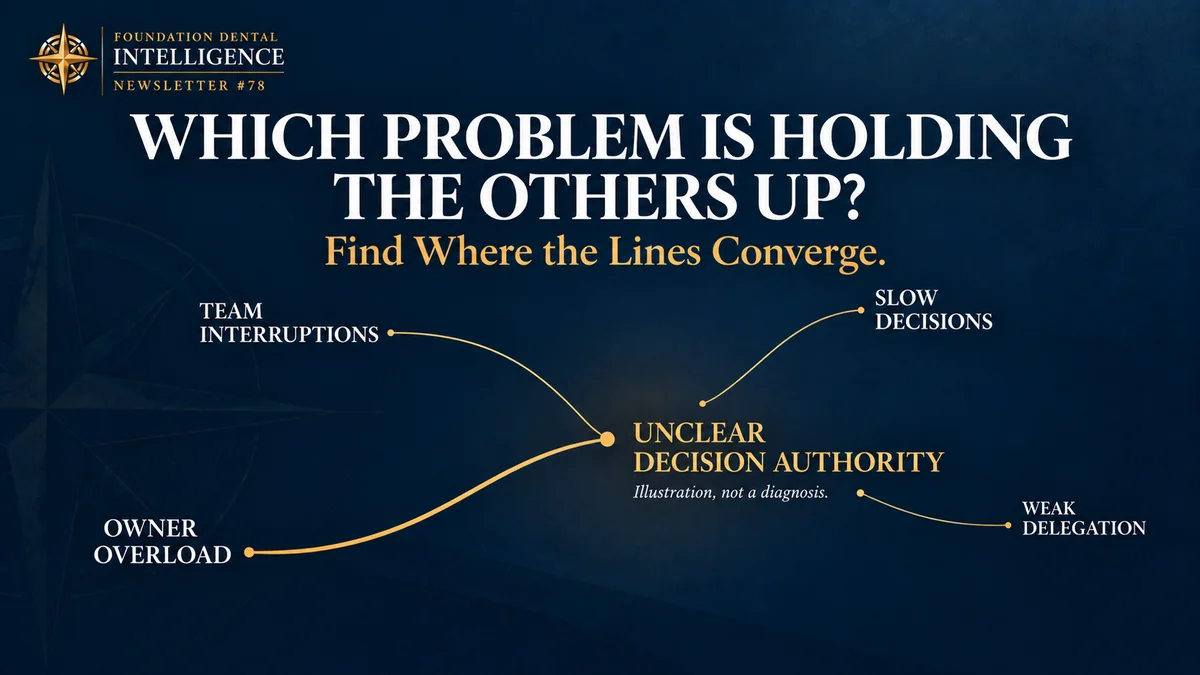
Several visible problems can share one underlying cause. The job is to find where the pattern keeps leading you back. |
Take an owner who gets interrupted twenty times a day. The obvious problem is the interruptions, so the obvious fix is a communication policy or designated question times. That might help a little. But why are people asking? If nobody knows who has authority to decide what, the interruption problem looks completely different. Clarify decision rights and you may reduce interruptions, speed up decisions, build confidence in the team, free the owner, and develop future leaders at the same time. One fix, five effects.
The test is harder than it sounds, because it requires honesty about causation rather than sequence. Two problems that showed up in the same quarter aren't necessarily related. A problem that's been there for eleven years and one that appeared last month may be the same problem.
Dentistry Trains Us to Treat What We Can See
There's a reason dentists are unusually susceptible to this, and it comes out of the training rather than any failure of judgment.
Dentists are excellent diagnosticians. That isn't the issue. Clinical diagnosis usually gives you a defined field of investigation, established diagnostic pathways, and a patient directly in front of you. The tooth hurts, and there's a sequence for finding out why. The radiograph shows pathology, and the differential is known.
Business problems don't stay inside one system. A single constraint crosses departments, people, incentives, economics, and years, and there's no established pathway that walks you from the symptom to the cause. So the diagnostic skill is real, and the terrain it was trained on is different.
The employee constantly asking for help may not lack initiative. She may never have been given authority. The schedule that keeps falling apart may not be a front-desk problem at all, but the absence of any rule for how time gets allocated. Weak collections may not be a collections problem, because the financial conversation is happening too late. Poor case acceptance may have nothing to do with communication skill if the practice is diagnosing treatment patients can't afford and haven't been given a reason to prioritize.
Every one of those has an obvious local fix that will produce a slightly better week and change nothing structural. That's where an enormous amount of owner time disappears, and the owner spending it usually believes they're finally working on the business.
A Quieter Week Is Not a Better Practice
Most operational fixes work. They just work at the wrong level, which is why activity is such a poor proxy for progress.
An associate brought into a practice where the owner still approves everything can create more work for the owner rather than less. Software installed on top of unclear accountability gives you better data about the same problem. Another employee added to a broken process gives you one more person inside a broken process. More marketing poured into a practice with weak case acceptance buys more opportunities to lose cases.
None of those decisions is wrong on its face. The question is whether any of them moved the constraint.
Symptoms are also more satisfying to work on, and that matters more than most owners admit. You can rebuild a schedule template on Thursday and see a different Tuesday. You can have a hard conversation with an employee and feel the relief by lunch. Structural work usually returns very little for months. To rebuild how decisions get made in a practice, you write protocols nobody asked for, train people who liked the old way better, and tolerate a stretch where things run worse before they run better. There isn't much of a Friday payoff in any of it.
An owner with one protected morning a month tends to choose the satisfying work, and tends to do it believing the practice is finally getting addressed.
Most operational fixes work. They just work at the wrong level, which is why activity is such a poor proxy for progress. |
The Question Underneath the Question
There's one more filter I'd run, and it's the uncomfortable one. What have you avoided because fixing it would require a harder decision than managing around it?
That's usually where the answer lives. The difficult employee keeps getting another conversation instead of a decision. The PPO gets complained about for years but never actually analyzed. The office manager is asked to lead and never given real authority. The owner says they want freedom while holding onto decisions someone else could make.
Those aren't knowledge problems, and no amount of protected time solves them by itself. They're decisions the owner has been paying a monthly premium to postpone.
Where the Foundation Dental Mastermind Fits
This is one of the reasons the Foundation Dental Mastermind isn't built around handing dentists more information. Most owners I meet already have more than they can execute. The harder work is deciding what deserves attention first, and this particular diagnosis is very difficult to run on yourself, because the symptom you're most emotionally invested in is rarely the one carrying the weight. An owner can bring ten problems into a session, and the value isn't an eleven-item action plan. Sometimes it's another owner recognizing that eight of the ten trace back to one thing nobody has dealt with. The Mastermind is intentionally kept small. Details are at FoundationDentalMastermind.com, and the next step is to Apply for Annual Membership.
The Morning You Already Protected
You did the hard part when you took the time back. Don't hand it to the loudest problem in the building.
Write down the three to five issues consuming the most attention right now. Draw a line from each one to what you believe is causing it. Look for where several of those lines converge, or where the pattern keeps leading you back to the same cause. That's where the morning goes. Sit with the answer longer than feels comfortable, because your first one will be whatever annoyed you most recently.
I'd tell you this gets easier with practice, and mostly it does. What doesn't get easier is looking at a list of eight things you've carried for years and admitting six of them were never really the problem.
Frequently Asked Questions
How do I find the load-bearing problem in my dental practice?
List everything that isn't working, then ask which single fix would make the others easier or unnecessary. Draw a line from each symptom to what you believe is causing it. Where several of those lines converge, or where the pattern keeps returning to the same cause, that's the constraint worth your protected time. If you rank problems by urgency or by how much they bother you, you get a different list, and usually the wrong one.
How do I know whether something is a root problem or a symptom?
Look for repetition and reach. A root problem shows up in several parts of the practice at once, wearing different clothes each time. A lack of decision clarity, for example, appears as interruptions, slow decisions, weak delegation, a frustrated office manager, and owner dependence. Five complaints, one cause.
Why does the loudest problem get all the attention?
Because visibility and cost aren't related in a practice. A difficult employee interrupts your day and may cost very little. A PPO contract never interrupts anything and can absorb a large share of your margin for years. Attention follows noise unless the owner deliberately redirects it.
What is one of the most common underlying constraints in an owner-led practice?
One I see repeatedly is decision routing. When every question, exception, and approval funnels back to the owner, it tends to produce symptoms across hiring, case acceptance, hygiene, and retention at the same time. It's also the one owners are least likely to name, because from the inside it feels like being needed rather than being a bottleneck.
Should I ignore urgent operational problems while I work on a larger one?
No. Patients need care, payroll has to run, and some things genuinely require attention today. The distinction is between what gets operational attention and what gets your protected strategic time. Those are two different budgets, and the second one is far smaller.
What if my practice really does have several unrelated problems?
It might. The point isn't to force everything into one explanation. It's to check whether several apparent problems share a cause before you build five separate solutions and spend a year on all of them.
How long does structural work take before I see anything?
Longer than symptom work, and that's the whole difficulty. To rebuild how decisions get made in a practice, you usually go through a stretch where things run worse before they run better. The payoff shows up in margin, transferability, and how much of the practice can operate without you, none of which appear on a weekly production report.
The Foundation Dental Newsletter publishes every Tuesday at FoundationDentalNewsletter.com. If this reached you through a colleague, that's where you can subscribe.
About the Author
Dr. Jim Arnold, DDS is the Founder and CEO of Foundation Dental Alliance, an interconnected platform serving dentists from dental school through retirement. He has 30 years of experience as a multi-practice owner, has built and led multiple successful dental practices, achieved 31% EBITDA, and has been involved in more than 60 dental practice transitions. He leads the Foundation Dental Mastermind and Luxury Dental Retreats, co-founded Foundation Dental Transitions, hosts the Foundation Dental Podcast, and serves as Chief Dental Officer of Codent AI. He publishes Foundation Dental Intelligence to help dentists lead stronger teams, build more profitable practices, increase practice value, and create greater freedom at every stage of their careers.
Stay Connected
Websites
FoundationDentalAlliance.com · FoundationDentalMastermind.com · FoundationDentalTransitions.com · FoundationDentalNetwork.com · LuxuryDentalRetreats.com
Social Media
LinkedIn: linkedin.com/in/arnoldjim · Instagram: instagram.com/smilesbyarnold · YouTube: youtube.com/@DrJimArnold · Facebook: facebook.com/smilesbyarnold · Twitter/X: twitter.com/smilesbyarnold · TikTok: tiktok.com/@foundationdentalalliance
Publications
Foundation Dental Newsletter: FoundationDentalNewsletter.com · Foundation Dental Blog: FoundationDentalBlog.com · Foundation Dental Podcast: FoundationDentalPodcast.com
Contact
Professional Email: drarnold@foundationdentalalliance.com
© 2026 Foundation Dental Alliance. All Rights Reserved.