Foundation Dental Intelligence
Newsletter No. 79
You Decided.
So What Changed?
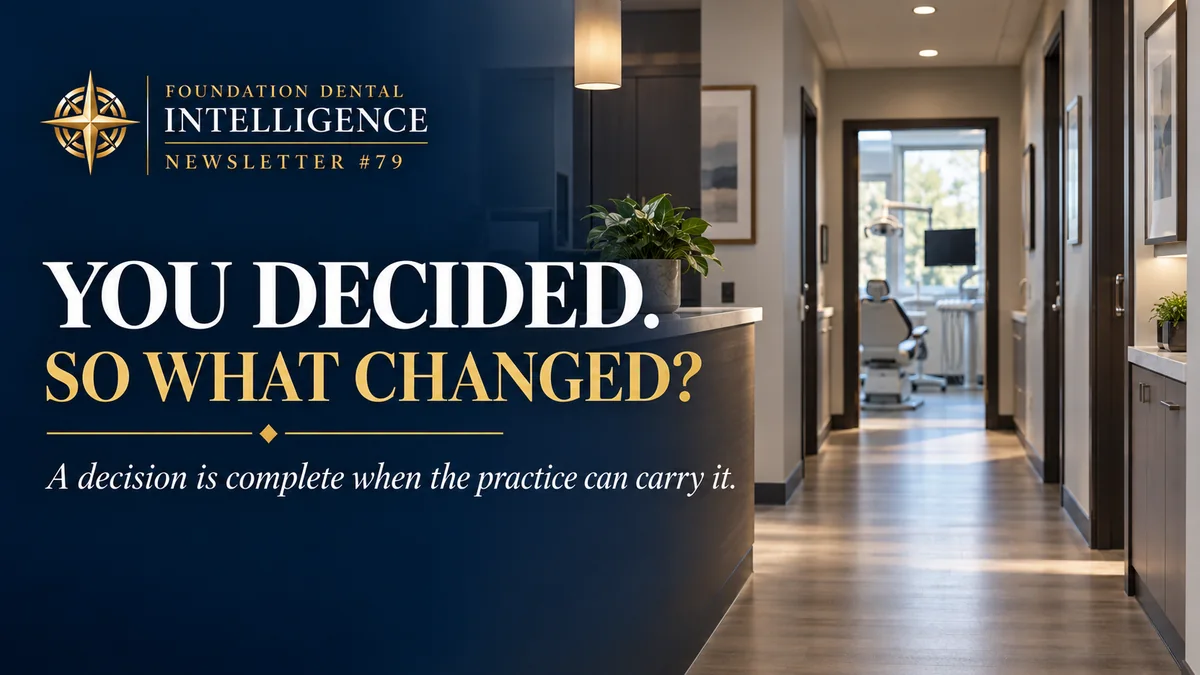
The relief of making a decision can arrive long before anything in the practice changes. |
Six months ago you decided your office manager would handle scheduling exceptions. You told her. You told the team. Everyone agreed it made sense.
Last Tuesday she stepped into your operatory and asked whether it was okay to move a crown seat to Thursday.
You answered in thirty seconds. A patient was waiting, the question was simple, and nothing about the exchange felt important.
It was. That thirty-second answer told the entire practice where authority still lives.
Most dentists can name a decision they made a year or two ago that the practice quietly undid. The decision was real. The reasoning was sound. The owner may even have followed through. The structure underneath it never moved.
Two Different Things Get Called Deciding
Dentistry uses one word for two very different acts.
The first is reaching a conclusion. You weigh the options, study the numbers, talk it through at home, and decide what should happen. That takes judgment and it often takes months. When the choice finally gets made, the pressure drops, the difficult conversation may finally happen, and everyone knows what the owner wants.
The second is changing what the practice does after your attention moves somewhere else. Authority sits with a different person. Questions follow a different route. The schedule, policy, role, or financial model supports a different default, and the old response is no longer the easiest one available.
Owners experience the first act as the decision, because that's when the uncertainty ends and the relief arrives. The practice only ever experiences the second.
A practice doesn't respond to your conclusion. It responds to how work actually moves through the building on an ordinary Tuesday.
Newsletter #77 examined why protected time keeps losing to the practice. Newsletter #78 focused that time on the load-bearing problem instead of the loudest one. This issue completes the argument, because finding the right problem and choosing what to do about it still isn't enough.
The Test That Matters
Most implementation advice adds accountability. Assign an owner, put a date on the work, define the measurable result, schedule a follow-up. Those practices help, and they can't carry a weak structure. A Friday accountability call doesn't change the fact that an open operatory will reclaim Thursday morning. A due date doesn't give an office manager authority the team has never seen her exercise. A metric doesn't fix a financial policy that already holds twelve exceptions and sends the thirteenth to the dentist.
One question reveals more than any of them:
If you stopped paying attention tomorrow, would the practice maintain the change, or would it return to the old way?
If the old pattern comes back as soon as you look away, the decision is still being held together by your attention. You may have produced compliance. You haven't produced a practice that can carry the change.
That distinction matters because owner attention is expensive. Anything depending on it becomes one more obligation the dentist keeps paying for. A structural decision changes the practice's normal behavior instead. The team knows who decides. Routine work follows the new path without a reminder. Exceptions stop reopening the whole question. The new response becomes easier and safer than the old one.
A decision becomes structural when the practice carries it without the owner's vigilance. |
Why Decisions Revert
Here's what really matters. When a decision doesn't hold, the same four gaps show up, and not one of them is about willpower.
Authority stayed where it was. The most common by a wide margin. You decided somebody else should handle a category of decisions, and you never removed yourself as an option. As long as asking you is available, asking you is faster and safer for the person deciding. Not out of deference. Out of ordinary self-protection, because being wrong alone is worse than being wrong with the doctor's approval.
The default didn't change. A decision that requires someone to remember it every time is a decision the practice will lose. If the schedule template still holds the old block structure, the old block structure is what happens on a busy Tuesday, whatever was agreed in the meeting.
Nobody defined the exception. Most reverted decisions die at the edges rather than in the middle. The team follows the new policy for ordinary cases and brings you the unusual ones, and within a few months the unusual ones are most of what you see. You're back in the middle of it while believing you delegated.
The consequence never changed. If deviating costs nothing and the old way is more comfortable, the practice drifts toward comfort. That isn't a character problem in your team. It's what any group does when two paths are open and one is easier.
You Delegated. Everyone Still Asks You.
Delegation exposes the difference quickly, because owners experience intention as action.
You tell the office manager she's empowered to handle these decisions. She agrees. The team hears it. For a week or two everybody tries. Then a patient requests an exception, a team member disagrees with her, and the schedule develops a problem nobody wants to own. Someone walks to the operatory and asks you, and you answer, because answering is faster than stopping to discuss decision rights.
The practice learns that delegation is real until the decision becomes uncomfortable.
The failure isn't follow-through. The old route stayed open. Nobody knows which decisions moved completely, which ones need consultation, or what happens when somebody dislikes her answer. Most of all, the team hasn't seen whether you'll back her reasonable judgment when doing that creates friction.
Real delegation becomes visible when the question reaches the right person without you redirecting it. It becomes credible the first time you decline to serve as the automatic appeal process. Until then, the office manager has responsibility and the dentist still has authority.
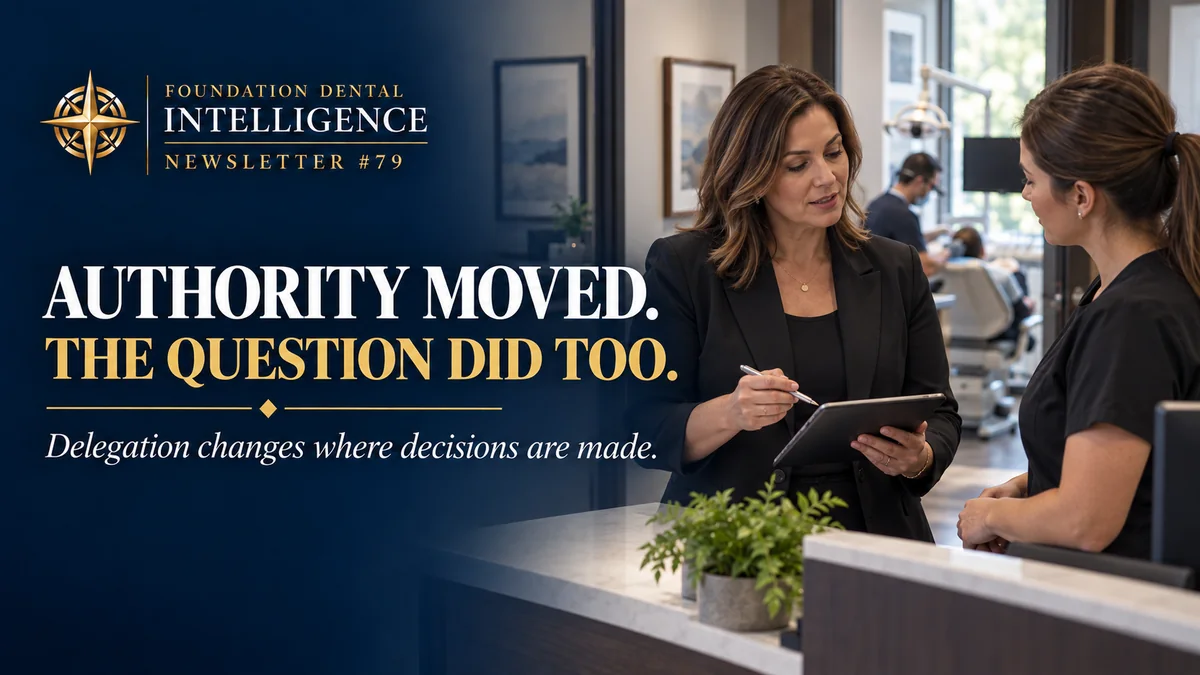
The practice believes authority has moved when the question stops traveling back to the dentist. |
You Decided to Leave a PPO. The Economics Stayed the Same.
A dentist can decide to leave a plan and still spend another year inside the same economic model.
The letter gets drafted. The effective date gets chosen. The team may even be enthusiastic. None of that determines what happens when patients call, when openings appear in the schedule, when the first uncomfortable financial conversation arrives, or when production looks soft for a month.
If the practice still runs on the same patient volume, the same scheduling assumptions, and the same way of presenting care, and still permits exceptions whenever the new policy gets uncomfortable, what's been built isn't a fee-for-service practice. It's a plan exit that needs constant personal enforcement. Newsletter #75 made the case that fee-for-service is a business model rather than a personality, and this is where that gets tested.
A plan exit is an event on a calendar. Structural change reaches into how the practice attracts patients, explains value, discusses money, schedules care, and measures success. The exit has a date. The real decision shows up in a few hundred ordinary interactions afterward, and it's taken hold when the team carries those without checking whether you still mean it.
You Replaced the Person. The Role Recreated the Problem.
Personnel decisions feel decisive because the change is visible. One employee leaves, another arrives, and the practice has clearly done something.
Then six months pass and the new person starts struggling in a strangely familiar way.
Across more than 60 dental practice transitions, I've seen how easily a role reproduces the problem assigned to the person who left. The role carries responsibility without authority. Two leaders give competing instructions. The measures don't match the actual work. No reliable path exists for settling exceptions. Replace the person and the role stays exactly as it was, so the next employee walks into the same conflict with a different name on the email address.
That doesn't mean every performance problem is structural. Some people are wrong for a role, and some employment decisions have to be made. The point is to examine what the position will demand from the next person before assuming the last one carried the whole problem out the door.
A sound personnel decision may include a termination or a reassignment. A complete one also changes the conditions that made failure predictable.
What Buyers Notice Before Owners Do
Transition work makes this unusually clear, because a buyer can't value intention.
A seller describes the practice as it's meant to run. The office manager owns scheduling. The associate presents cases. The financial policy is firm. None of those statements has to be dishonest for the practice to operate differently, and diligence is where that surfaces. The office manager owns scheduling and still clears anything unusual with the doctor. The associate presents cases except the large ones. The policy is firm until a longtime patient asks, and then it's firm again next week.
A buyer looks past the description and asks a practical question. What continues to work when this dentist is gone?
That's the structural test with financial consequences attached. Practice value follows what the business can repeat without the owner's attention, so if relationships, approvals, case presentation, and hard conversations all still route through one person, the practice can produce excellent revenue and remain difficult to transfer.
Owner dependence doesn't get created on closing day. It accumulates every time a dentist announces a change and then remains the mechanism that makes it happen. Implementation belongs inside the decision itself, because a choice requiring permanent vigilance is incomplete.

A buyer can't value intention. A buyer can value what the practice repeats without the owner. |
The Problem With Checking In
The standard response to a decision that didn't stick is to watch it more closely. A weekly check-in, a standing item on the huddle agenda, another report.
That often works, which is exactly why it can fool you. The change holds for as long as you supply the attention, so what looks like implementation is really a recurring obligation. Newsletter #77 made this point about protected time, and any system depending on the owner's attention eventually competes with patients, production, and the next urgent problem.
Constant supervision also hides the answer you need. Watch closely enough and you'll never learn whether the practice can hold the decision without you.
The better move comes after the authority, the pathway, the policy, and the exceptions have genuinely changed. Step back long enough to see what the practice does. Notice where questions travel. Watch which exceptions reopen decisions you thought were closed. Pay attention to the leader whose authority disappears when challenged and the system everyone follows until the schedule gets busy. None of that proves the original decision was wrong. It shows you where the old path is still easier.
What Changed by Friday?
A decision that's taken hold leaves evidence, and the evidence has to be specific.
Someone's job is different. A template is different. An approval threshold is written down instead of understood. A conversation that used to reach you now reaches someone who knows they own it. At least one thing the practice used to do is no longer available as an easy option.
The team understands, we discussed it, and I'll keep an eye on it all describe awareness or oversight. None of them changes how the practice operates.
If a week passes and the same questions route to the same people through the same policies, the practice is still running exactly as it was, and your confidence in the decision may be the only thing that changed. That's worth finding out early, because the meeting and the announcement cost very little next to two years spent believing the problem was handled.
Where the Foundation Dental Mastermind Fits
This work is difficult to evaluate from inside your own practice, because you're the variable you can't remove. You can't easily tell which changes are holding on their own and which are holding because you're still standing there. Other experienced dentists see the contradiction quickly, and they'll say it plainly. You describe the office manager as empowered, then list six decisions that still need your approval. You call the policy final, then explain the exceptions that have become the real policy. That kind of examination is uncomfortable, and it's most of how strategy becomes execution. The Mastermind is intentionally kept small. Details are at FoundationDentalMastermind.com, and the next step is to Apply for Annual Membership.
The Practice Has to Carry It
Three issues ago the problem was time. Then it was diagnosis. This week it's execution. You protected the time, you found the load-bearing problem, and you made the decision.
Choose the one you're most confident is already finished. Step far enough back from your own intention to see how the practice actually behaves, and find the moment where the old way can still get back in without resistance. That's the part that remains undone.
Treat the office manager's question about the crown seat as information rather than failure. It tells you the practice still believes that decision belongs to the dentist.
You don't need to make the decision again, and you don't need to supervise it forever. You need to change enough of the practice that supervision stops being the reason it works. When questions route correctly, the policy survives discomfort, the leader keeps authority under pressure, and the next employee doesn't inherit the last one's conflict, the decision has stopped living in the owner's head.
The practice is carrying it. That's when something changed.
Frequently Asked Questions
Why do changes in a dental practice revert after a few months?
Most changes revert because the decision was announced while the practice's normal operation stayed the same. Authority remained with the same person, the old default stayed easier, or exceptions kept reopening the decision. Once the owner's attention moves elsewhere, the practice follows the path that never closed.
How do I know whether a dental practice decision actually took hold?
Ask what would happen if you stopped paying attention tomorrow. Then look for specific evidence: a changed role, a changed template, a written approval threshold, a new decision route, or an old option that's no longer available. If the practice would return to the old behavior without your reminders, the decision hasn't taken hold yet.
Why does delegation keep failing in a dental practice?
Delegation commonly fails because the dentist remains available as the fastest and safest option. The team bypasses the new leader when a decision gets uncomfortable, and the dentist's answer overrides the authority that was supposedly transferred. Delegation holds when the new leader owns defined decisions and the dentist stops serving as the automatic appeal process.
Is this a follow-through problem?
Rarely. Most owners who make a decision are fully capable of executing it. The issue is that a decision requiring ongoing attention has created an obligation rather than a change. Discipline can hold something in place indefinitely and still can't make the practice carry it without you.
Does accountability still matter when implementing change?
Yes, as a measurement rather than a mechanism. Accountability reveals whether a new structure is working and helps catch problems early. What it can't do is substitute for authority, clear decision pathways, or policies that support the intended behavior on their own.
How long should a decision take to become structural?
The timing depends on the decision. You can change a template, a role, or an approval threshold quickly. Patient communication, leadership habits, payer mix, and owner dependence may take months to shift. The more useful measure is whether the practice relies less on the owner's attention as the new behavior establishes itself.
How does structural decision-making affect dental practice value?
Structural decisions reduce owner dependence and improve repeatability. Buyers and future leaders care about what the practice can keep doing without the current owner directing routine work. Revenue matters, and transferability depends on systems, authority, and behavior that survive the owner's departure.
The Foundation Dental Newsletter publishes every Tuesday at FoundationDentalNewsletter.com. If this reached you through a colleague, that's where you can subscribe.
About the Author
Dr. Jim Arnold, DDS is the Founder and CEO of Foundation Dental Alliance, an interconnected platform serving dentists from dental school through retirement. He has 30 years of experience as a multi-practice owner, has built and led multiple successful dental practices, achieved 31% EBITDA, and has been involved in more than 60 dental practice transitions. He leads the Foundation Dental Mastermind and Luxury Dental Retreats, co-founded Foundation Dental Transitions, hosts the Foundation Dental Podcast, and serves as Chief Dental Officer of Codent AI. He publishes Foundation Dental Intelligence to help dentists lead stronger teams, build more profitable practices, increase practice value, and create greater freedom at every stage of their careers.
Stay Connected
Websites
FoundationDentalAlliance.com · FoundationDentalMastermind.com · FoundationDentalTransitions.com · FoundationDentalNetwork.com · LuxuryDentalRetreats.com
Social Media
LinkedIn: linkedin.com/in/arnoldjim · Instagram: instagram.com/smilesbyarnold · YouTube: youtube.com/@DrJimArnold · Facebook: facebook.com/smilesbyarnold · Twitter/X: twitter.com/smilesbyarnold · TikTok: tiktok.com/@foundationdentalalliance
Publications
Foundation Dental Newsletter: FoundationDentalNewsletter.com · Foundation Dental Blog: FoundationDentalBlog.com · Foundation Dental Podcast: FoundationDentalPodcast.com
Contact
Professional Email: drarnold@foundationdentalalliance.com
© 2026 Foundation Dental Alliance. All Rights Reserved.