Foundation Dental Intelligence
Newsletter No. 80
The Most Expensive Forty Feet in Your Practice.
Get the next issue.
One signup. Everything we publish.

The case was accepted in the operatory. It went cold somewhere between the chair and the front desk. |
A patient sits in your chair, looks at the intraoral photo of the cracked molar, and says yes. She understands the problem. She agrees it needs a crown. She even asks how soon you can do it.
Then your assistant walks her up front, the front desk pulls up the treatment plan, reads her the patient portion, and she says she'll check her calendar and call back.
She doesn't call back. Nobody follows up for three weeks, and when someone finally does, she's decided to wait until after the holidays.
Nothing went wrong clinically. The diagnosis was right, the presentation was clear, and the patient agreed. The case died in the walk from the operatory to the front desk, which in most practices is roughly forty feet and is the least managed stretch of real estate in the building.
Accepted Isn't the Same as Scheduled
Most practices measure case acceptance as a single event. The patient said yes or didn't. That number hides the problem, because a yes in the chair and an appointment on the books are two different outcomes with a gap between them, and that gap is where a large share of accepted dentistry quietly disappears.
A patient can genuinely intend to move forward and still leave without an appointment. The barrier may be time, money, fear, or simply that the next opening is three weeks away and the urgency she felt in the operatory has faded before she reaches the parking lot. The American Dental Association's practice guidance on accepted treatment makes the same point: patients who make the next appointment before leaving are motivated to proceed, and longer delays make return less likely.
That distinction matters because the fix changes depending on where the breakdown happens. If the patient never understood the value of treatment, the clinical conversation needs work. If she said yes and the practice put six more steps between her and care, the handoff needs work.
Here's what really matters. A meaningful part of the unscheduled treatment report comes from that second category. It wasn't lost to a bad diagnosis or a weak presentation. It was lost during the handoff, and handoffs are operational problems with operational fixes.
Where the Case Actually Goes Cold
Walk the path a patient takes after saying yes, and the leak points are easy to see once you're looking for them.
The clinician explains the problem and the patient agrees. Then the clinician leaves to see the next patient, and the momentum leaves with them. The assistant finishes up and walks the patient out, but the assistant usually wasn't the one who made the case and may not be able to restate it in the patient's own terms.
At the front desk the conversation starts over. The patient is standing, holding a coat, thinking about parking, and hearing a number for the first time. The team member presenting it wasn't in the operatory, doesn't know what the patient was worried about, and is working from a printout rather than the conversation that produced it. The emotional context that made the yes possible didn't make the trip.
Then there's the calendar. If the next restorative opening is five weeks out, the practice has built a schedule that guarantees cold cases.
None of these steps is anybody's failure. Each is a reasonable thing for a busy team to do. Together they form a system that loses cases by design, and the problem is that nobody owns the whole path from yes to scheduled.
The emotional context that made the yes possible didn't make the trip. |
Two Kinds of Same Day
When people say same-day treatment, they usually mean doing the dentistry at the same visit where it was diagnosed. That's the standard worth building toward, and it isn't where most practices should start.
Same-day scheduling means no patient with accepted treatment leaves the building without an appointment. It's easier than same-day treatment, and it's where most of the leakage can be stopped.
Same-day treatment requires schedule capacity, material readiness, and a clinical team comfortable changing plans on the fly. Same-day scheduling requires none of that. It requires a handoff that preserves the patient's commitment and a front desk that treats scheduling as the default rather than an offer. Get the second one right first, because that's where the handoff fails and fixing it tends to create the conditions for the first.
One line matters more than the rest. Same-day treatment can sound like a production tactic, and it shouldn't be one. It means that when clinically appropriate care has been diagnosed, the patient understands it and wants to proceed, the financial arrangement is clear, and the schedule has safe capacity, the practice is prepared to begin rather than manufacturing a delay. Patient autonomy still governs the decision. Clinical judgment still governs what gets done. Some treatment needs lab work, preauthorization, medical clearance, or more time than exists that day. The point is to stop sending willing patients away when there's no clinical or operational reason to do it, and the strongest system makes it easy to proceed and equally easy to say not today.
If the patient is ready, are you ready? That's the standard.
Same-day scheduling is the first standard. Same-day treatment is the capability you build behind it.
Four Changes That Rebuild the Forty Feet
These do most of the work, and none of them requires new software or a consultant.
Hand off in front of the patient. Before the clinician leaves the operatory, they restate the diagnosis and the plan to whoever takes the patient forward, with the patient sitting there listening. Mrs. Jones understands that number 30 has a fracture and wants to take care of it. We have time this morning if she'd like to stay, and if not, let's find the first appointment that works for her. That thirty seconds puts the commitment on the record, gives the next team member the context, and tells the patient the practice treats her decision as settled. It isn't a script to memorize. It's continuity, and the patient should never feel that the clinical conversation ended and a different kind of conversation began.
Move the money conversation earlier. The worst place to present a fee for the first time is standing at a counter. ADA guidance recommends that financial details for extensive care be discussed privately, with clear financing policies and trained team members. If the arrangement is prepared before the patient reaches the front desk, with the insurance estimate, patient portion, and payment options ready, the front desk conversation becomes confirmation rather than negotiation.
Schedule before the patient stands up. In some practices the assistant books from the operatory. In others the front desk comes to the patient. Either way, the appointment gets made while the patient is still in the environment where she agreed to it, rather than after she's mentally left the building.
Hold capacity on purpose. A schedule packed from the first patient to the last looks efficient and can't absorb anything, including a patient who's ready today. Intentional near-term capacity gives the front desk a real date to offer while the patient's decision is still fresh. How much to hold and how soon depends on the practice, and it takes some adjustment to get right. What's consistent is that those blocks fill, and they fill with dentistry that already has a yes attached to it. Capacity isn't waste when it's designed.
What Same-Day Treatment Actually Requires
Once the handoff is fixed, the next step is being able to begin care the same day when it makes sense. That sounds simple until you try to make it reliable, and the practice needs more than an open chair.
It needs decision authority. If every schedule adjustment requires finding the dentist, the opportunity disappears while everyone waits. The people closest to the schedule need clear boundaries for what they can move, extend, combine, or protect without asking. Newsletter #79 covered why authority that stays with the owner defeats every decision built on top of it, and this is the operational version of that argument.
It needs the clinical setup to support it. Supplies, rooms, assistants, imaging, and procedure sequencing all matter, and you can't create same-day capacity by asking an already overloaded assistant to perform magic.
And it needs the team to decide before the day starts what the practice can absorb. That's the job of the huddle, and it's a different huddle from the one most practices run.
One Question for the Morning Huddle
Most huddles read the schedule aloud. This one asks a single question of it.
Which patients today could reasonably need additional treatment, and what would have to be true for us to take care of it today if they want to proceed?
Now the team is anticipating rather than reciting. Maybe the limited exam has enough space behind it to begin endodontic treatment if it's needed. Maybe the hygiene patient with the old fractured restoration can be seen by the doctor early enough that a same-day restorative opening stays possible. Maybe the new patient exam has no room behind it, so the team knows before the patient arrives that the goal is a clean handoff and a scheduled next visit rather than improvisation.
That's where same-day treatment becomes operational. You decide before the opportunity arrives what the practice can do with it.
Why Recall Calls Don't Fix This
The standard response to a long unscheduled treatment list is to work it. Someone gets assigned to call through the names, the team gets a script, and a campaign runs every quarter.
That recovers some cases, and it's worth doing. It's also the most expensive way to get that dentistry back, because by the time the call comes the patient has already decided, at least a little, that the problem can wait. You're no longer continuing a conversation. You're starting a new one with somebody whose urgency has faded and whose memory of the intraoral photo is gone.
Every case scheduled before the patient leaves is a case that never needs a recovery call. The front-end fix is cheaper than the back-end cleanup, and it doesn't depend on anyone finding a free Tuesday afternoon to dial through a list.
The Three Numbers Worth Watching
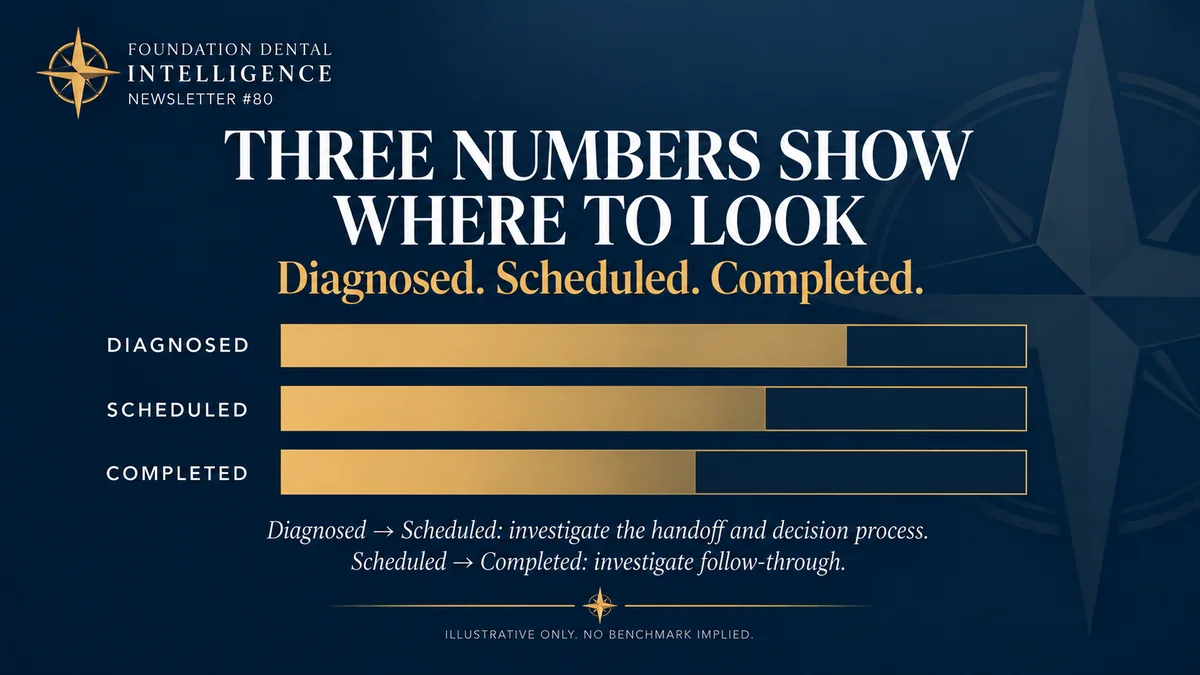
Most practices track case acceptance and production. Neither tells you whether the forty feet is working.
Diagnosed, scheduled, and completed are the three that do. Diagnosed is everything the doctor recommended. Scheduled is the share of that which left the building with an appointment. Completed is what actually got done. The gap between the first and second tells you where to investigate the handoff and the patient's decision process, since some patients appropriately decline, defer, or need more planning. The gap between the second and third tells you where to investigate cancellations, rescheduling, and follow-through, which is a different fix.
Pull those three for the last ninety days and look at them side by side. And don't measure this by how much dentistry got added to the schedule. A practice can raise same-day production and make the patient experience worse if the team turns rushed or financially tone-deaf. The better measure is whether the practice removes unnecessary friction after the patient has made an informed decision.
Most practices track case acceptance and production. Neither tells you whether the forty feet is working. |
Where the Foundation Dental Mastermind Fits
There's no universal same-day percentage I'd hand every dentist. A surgical practice, a general restorative office, and a pediatric practice don't share the same opportunities or constraints. The useful work is looking at your actual schedule and finding where willing patients are being slowed down by the practice itself, and that's easiest to do alongside owners who've already rebuilt their own handoff. They can tell you which scripts sounded natural to patients and which felt rehearsed, how they carved out held capacity without wrecking the schedule, and what the team pushed back on. That kind of practical exchange is a large part of what happens inside the Foundation Dental Mastermind. The Mastermind is intentionally kept small. Details are at FoundationDentalMastermind.com, and the next step is to Apply for Annual Membership.
What to Do This Week
Pick one day and track every patient who accepts treatment and leaves without it completed or scheduled. Don't judge the team and don't make it a contest. Just find out what happened. Did the patient need time? Was financing unresolved? Was there no capacity? Did the handoff lose the reason she'd just said yes? Could it have been done that day, and nobody considered it?
Then start with the in-front-of-the-patient handoff, because it costs nothing and your team will feel the difference in the first few days. Pull your diagnosed and scheduled numbers before you begin, and pull them again two weeks later.
The patient with the cracked molar did everything right. She listened, she understood, and she said yes. The practice just didn't carry that yes the forty feet to the front desk. Most offices have a few of those walking out the door every week, and the fix is sitting in the hallway.
Frequently Asked Questions
What is the difference between same-day treatment and same-day scheduling?
Same-day treatment means completing clinically appropriate care at the visit where it was diagnosed, when the patient wants to proceed and the practice has the time, team, financial clarity, and resources to do it safely. Same-day scheduling means every patient with accepted treatment leaves with an appointment on the books. Same-day scheduling is generally easier to implement and can prevent treatment from becoming unscheduled after a patient has already decided to proceed.
Why do patients accept treatment in the chair and then not schedule?
Usually because the commitment doesn't survive the handoff. The clinician who made the case leaves, the front desk restarts the conversation without context, the fee is presented for the first time at the counter, and the next available appointment is weeks away. Each step is reasonable alone. Together they let the urgency fade before the appointment gets made.
How do I reduce unscheduled treatment in my dental practice?
Fix the handoff before relying on recovery calls. Have the clinician restate the plan to the next team member in front of the patient, prepare the financial arrangement before the patient reaches the front desk, book the appointment before the patient stands up, and hold a small amount of near-term capacity so there's a real date to offer.
Should every patient who accepts treatment be treated the same day?
No. Clinical appropriateness, patient preference, complexity, staffing, financing, and informed consent all matter, and some patients need time to think or talk with a spouse. Same-day treatment is an option when the conditions are right, not a quota, and the best system makes it equally easy to proceed or to say not today.
What should the morning huddle cover for same-day treatment?
One question: which patients today could reasonably need additional treatment, and what would have to be true for the practice to take care of it today if they want to proceed? That identifies realistic opportunities, confirms whether capacity exists, and settles who can adjust the schedule before the day gets busy.
Which numbers show whether my handoff is working?
Track diagnosed, scheduled, and completed treatment separately over a rolling ninety days. The gap between diagnosed and scheduled points you at the handoff and the patient's decision process. The gap between scheduled and completed points you at cancellations, rescheduling, and follow-through. Case acceptance alone hides both.
The Foundation Dental Newsletter publishes every Tuesday at FoundationDentalNewsletter.com. If this reached you through a colleague, that's where you can subscribe.
About the Author
Dr. Jim Arnold, DDS is the Founder and CEO of Foundation Dental Alliance, an interconnected platform serving dentists from dental school through retirement. He has 30 years of experience as a multi-practice owner, has built and led multiple successful dental practices, achieved 31% EBITDA, and has been involved in more than 60 dental practice transitions. He leads the Foundation Dental Mastermind and Luxury Dental Retreats, co-founded Foundation Dental Transitions, hosts the Foundation Dental Podcast, and serves as Chief Dental Officer of Codent AI. He publishes Foundation Dental Intelligence to help dentists lead stronger teams, build more profitable practices, increase practice value, and create greater freedom at every stage of their careers.
Stay Connected
Websites
FoundationDentalAlliance.com · FoundationDentalMastermind.com · FoundationDentalTransitions.com · FoundationDentalNetwork.com · LuxuryDentalRetreats.com
Social Media
LinkedIn: linkedin.com/in/arnoldjim · Instagram: instagram.com/smilesbyarnold · YouTube: youtube.com/@DrJimArnold · Facebook: facebook.com/smilesbyarnold · Twitter/X: twitter.com/smilesbyarnold · TikTok: tiktok.com/@foundationdentalalliance
Publications
Foundation Dental Newsletter: FoundationDentalNewsletter.com · Foundation Dental Blog: FoundationDentalBlog.com · Foundation Dental Podcast: FoundationDentalPodcast.com
Contact
Professional Email: drarnold@foundationdentalalliance.com
© 2026 Foundation Dental Alliance. All Rights Reserved.