Foundation Dental Intelligence
Newsletter No. 70
The Practices That Scale Calmly Usually Schedule Differently.
Get the next issue.
One signup. Everything we publish.

Two practices. Similar production. Completely different experience.
Walk into the first one on a Tuesday afternoon and you feel it immediately. The front desk is managing three conversations at once. The clinical team is running behind. The doctor is 40 minutes late on a crown prep and two hygiene patients are waiting. Everyone is moving, everyone is capable, and everyone is exhausted. The schedule is full. The practice doesn't feel like it's functioning well.
Walk into the second one and the temperature is different. There's movement and activity, but there's also something that takes a moment to identify. Steadiness. The front desk is engaged but not overwhelmed. The clinical team is on time. The doctor finishes a procedure, has a few minutes, takes a breath. The schedule is equally full. The practice feels like it's functioning well.
The production numbers at the end of the month are almost identical. The experience of working in each practice - and receiving care in each one - is completely different.
The difference isn't the team. It's the schedule architecture.
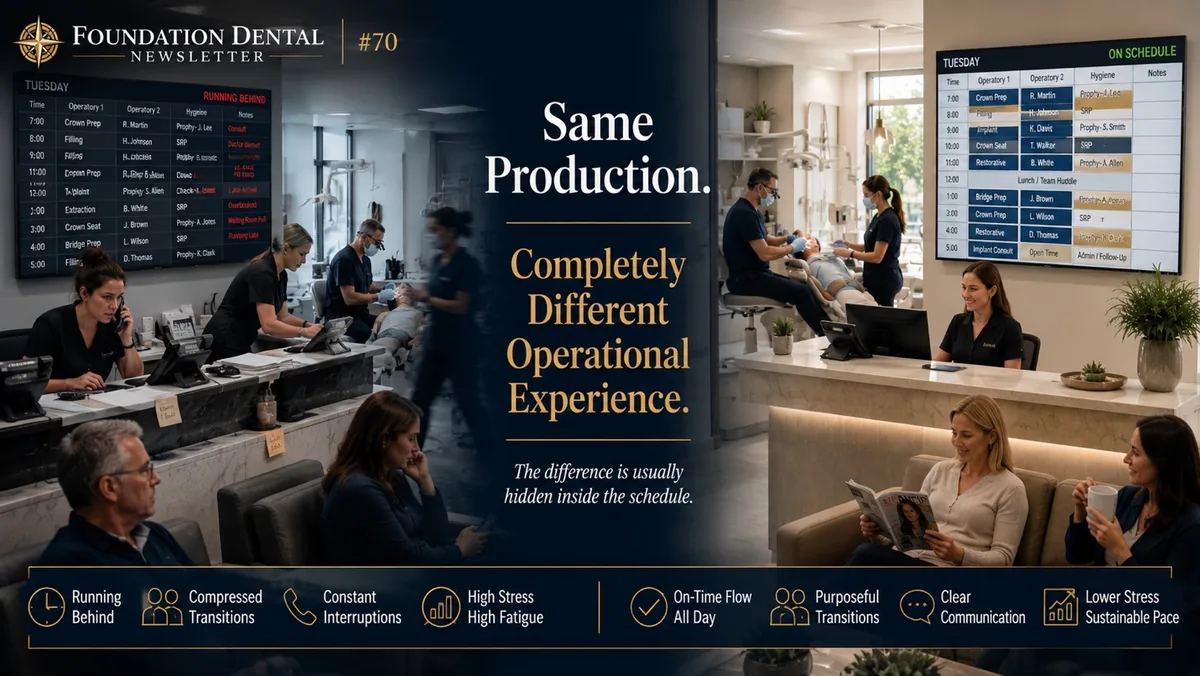
Two Practices. Same month-end number. One of them is destroying its team to get there.
Most dental practices don't look chaotic from the outside. The schedule is full. Production is respectable. Patients are being seen. From a distance, everything appears successful. But if you spend enough time inside practices, you start noticing something: some feel heavy all day long. Others don't. And the difference usually has very little to do with talent, technology, or how hard the team works.
More often than not, the difference lives inside the design of the schedule itself. Because the schedule is never just the schedule. It reveals how leadership thinks. It reveals whether the practice operates intentionally or reactively. Whether the organization protects energy, communication quality, and patient experience - or simply tries to survive the day without falling behind.
If you're asking how to schedule your dental practice so growth feels calm instead of chaotic, the answer lives in how you design the day - not in your software or your marketing.
The practices that scale calmly almost always schedule differently. Not softer. Not slower. Not less profitably. Differently.
SCHEDULING IS LEADERSHIP EXPRESSED OPERATIONALLY
This is the part most owners miss entirely.
The schedule is not an administrative function. It determines how the organization experiences time. It determines how energy moves through the building. It determines whether communication happens calmly or reactively. Whether leadership feels intentional or constantly interrupted. And ultimately it determines whether the practice can scale sustainably.
Many schedules are built around maximizing chair utilization instead of maximizing organizational effectiveness. Those are not the same thing. A packed schedule creates operational fragility when it constantly forces the practice into reactive mode. Because once the schedule loses breathing room, the entire organization begins operating emotionally instead of strategically.
The doctor feels rushed. Assistants begin compressing transitions. The front desk absorbs schedule instability. Treatment conversations become hurried. Patients feel subtle tension even when nobody says anything directly. Eventually the practice develops a culture of perpetual recovery instead of intentional execution. That's when teams start saying things like 'we're just trying to survive today.' Those phrases sound productive. They're actually signals that operational compression has become normalized.
The strongest operators don't obsess over squeezing every possible opening into the schedule. They obsess over protecting organizational function. That requires discipline because reactive scheduling frequently disguises itself as productivity. The calendar looks full. The pace feels intense. Everyone appears busy. But busy and effective are not interchangeable.
The schedule is never just the schedule. It reveals how leadership thinks. The design of the day quietly determines whether growth feels sustainable or suffocating.
CALM IS USUALLY DESIGNED
Some owners assume calm practices simply have easier teams, lighter schedules, or less pressure. That's almost never true. In many cases those practices are producing more than the chaotic ones. But they're producing through structure instead of emotional compression.
Stress compounds operationally. When one part of the schedule compresses, everything downstream gets harder. Assistants feel it first. Then hygiene feels it. Then the front desk absorbs it. Then patients experience it. Then communication quality suffers. Then leadership suffers. Then culture suffers. Because when teams spend all day recovering from preventable operational friction, they lose the emotional bandwidth required for great communication, connection, and patient experience.
That's why the best practices don't just protect production. They protect flow. And flow is not accidental. It's designed.
Calm environments also improve decision quality in ways that compound over time. When leaders operate in constant compression, they default toward short-term thinking - immediate reactions, emotional decisions, operational survival. When practices create intentional pacing, leadership regains the ability to think strategically. That affects everything: case presentation, treatment confidence, hiring, communication, growth planning. The organization begins operating proactively instead of defensively. And proactive practices create stronger patient experiences, which create more trust, which create better acceptance, which create healthier economics.
THE SCHEDULE IS THE CULTURE
Dentists talk about culture constantly. Very few talk about the fact that the schedule is one of the most powerful cultural forces in the entire building.
A chronically overbooked schedule teaches the team that recovery doesn't matter. A schedule that double-books complex procedures without buffer teaches the clinical team that production matters more than presence. A schedule that fills every available slot without strategic intent teaches everyone that volume matters more than sustainability. Those are cultural messages. They're delivered every single day, not through mission statements, but through what the practice actually asks people to do at pace, without relief.
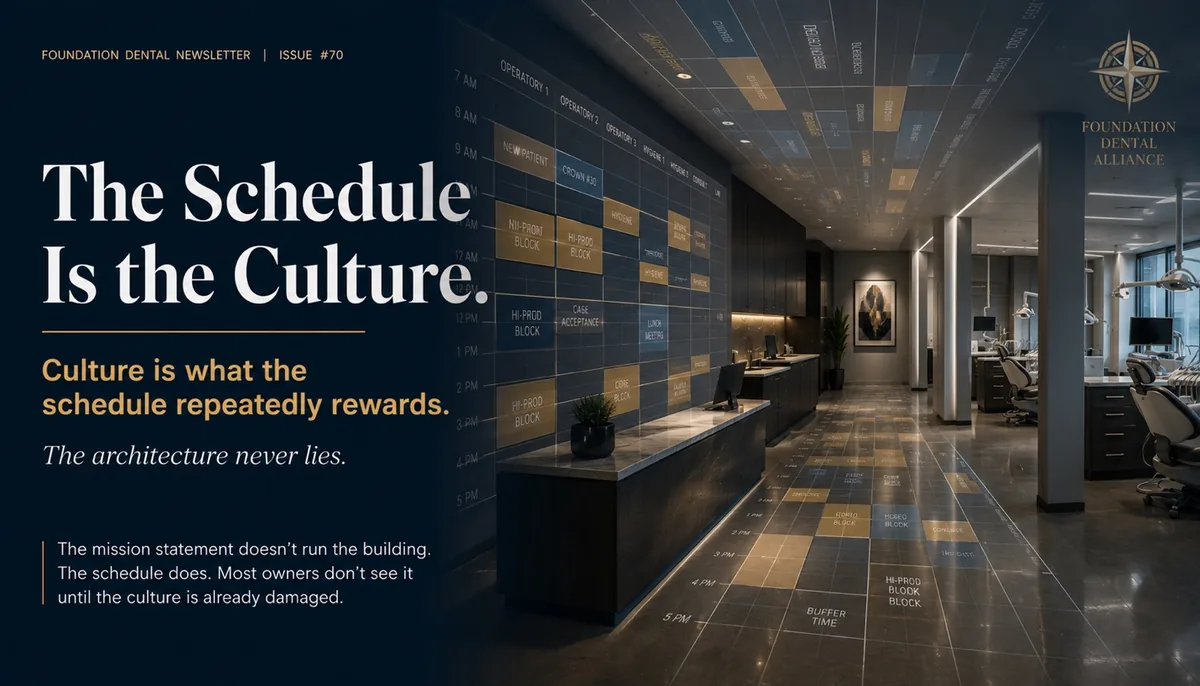
The mission statement doesn't run the building. The schedule does. Most owners don’t see it until the culture is already damaged.
Patients experience this before they evaluate the dentistry clinically. They notice delays. They notice rushed energy. They notice when communication feels fractured. They notice when team members appear overwhelmed. They notice when nobody seems fully present. And most of those breakdowns originate upstream in operational design rather than in personality or motivation.
A reactive schedule forces the entire organization into constant emotional transition. Nobody gets to reset fully. Nobody gets to prepare fully. Nobody gets to communicate calmly and consistently. Eventually the practice starts feeling transactional instead of relational. That matters enormously in fee-for-service dentistry because fee-for-service growth is tied to trust, certainty, and emotional safety. Patients don't simply buy dentistry. They buy confidence. And confidence is much harder to communicate when the organization itself feels compressed all day.
Culture is not what the wall says. Culture is what the schedule repeatedly rewards. A chronically overbooked schedule isn't just an operations problem. It's a culture problem.
HERE'S WHAT REALLY MATTERS
The practices that scale without chaos have made specific design decisions most others haven't. They share one philosophy: the schedule serves production goals and protects clinical and emotional capacity at the same time. Most schedules only do one.
The first decision is to schedule thinking and calibration before production. Most practices put production on the book first and ask where a morning huddle might fit. The best practices do the opposite. A real calibration - not a rushed announcement circle - where the day is previewed, roles are clear, and known problems surface before anyone is in a chair. That's not lost production. That's where calm comes from.
The second decision is to treat protected time as load-bearing structure rather than wasted opportunity. Buffer appointments. Open blocks held for same-day treatment integration. Transition time between procedures that allows the team to reset and patients to feel unhurried. Most practices treat these as inefficiencies. The practices that scale calmly treat them as structural requirements. Remove them and the schedule becomes fragile.
The third decision is about procedural sequencing. Complex restorative and implant work requires different cognitive focus than hygiene checks or simple restorations. Practices that schedule their highest-complexity procedures when clinical judgment is sharpest - typically the morning - and structure the afternoon for more manageable work tend to deliver better clinical outcomes and finish the day with a team that still has something left.
The fourth decision is about ownership. In most practices, the schedule belongs to whoever books the next available slot. In the best practices, one person - a scheduling coordinator or clinical director - owns the template, the booking philosophy, and the authority to protect both. When scheduling has a real owner with real authority, it stops being reactive and starts being intentional.
Open capacity on a schedule isn't laziness. It's leadership. Empty space today is what lets the practice say yes to the right things without paying for it in chaos.
MOST PEOPLE MISS THIS
There's a scheduling conversation that almost never happens in dental practices, and its absence explains most of the chaos that develops.
Nobody ever defines what a good day looks like.
Not what a productive day looks like - most practices have production targets. Not what a full day looks like. A good day. One where the doctor finishes on time, the team isn't running on fumes by 3pm, every patient felt attended to rather than processed, and the practice hit its number without anyone sacrificing their dignity to do it.
That definition rarely exists explicitly. So the schedule gets built to hit the number without a shared design for what the experience of achieving it should feel like.
Here's a diagnostic worth running. Ask yourself honestly: if you had to be away from the practice for 30 days, what would actually happen? Not what you hope would happen. Not the best-case scenario. What would actually happen to daily production? Would small operational decisions stall because nobody has authority to make them without you? Would the same kinds of breakdowns that happen on your busiest days happen every day?

The discomfort that question creates isn’t a people problem. It’s a design problem. And it’s solvable.
If that question creates discomfort, the discomfort is pointing at a design problem. The practice's ability to function calmly without you in the center of every decision - including scheduling decisions - starts with the architecture of the day itself.
If that question creates a knot in your stomach, that's your psychology and your schedule telling the same truth.
THE SCHEDULING CONVERSATION MOST PRACTICES ARE AVOIDING
A lot of dental practices are running a schedule designed for a smaller, simpler version of what the practice has become.
What worked at $800,000 in production doesn't scale cleanly to $1.5 million. The same slot lengths, the same booking logic, the same buffer philosophy that functioned when the practice was quieter breaks down as volume increases. The team that handled the old schedule with reasonable ease starts struggling with the new one. And the owner, watching strong production numbers, doesn't immediately connect the team's deteriorating experience to a scheduling architecture problem.
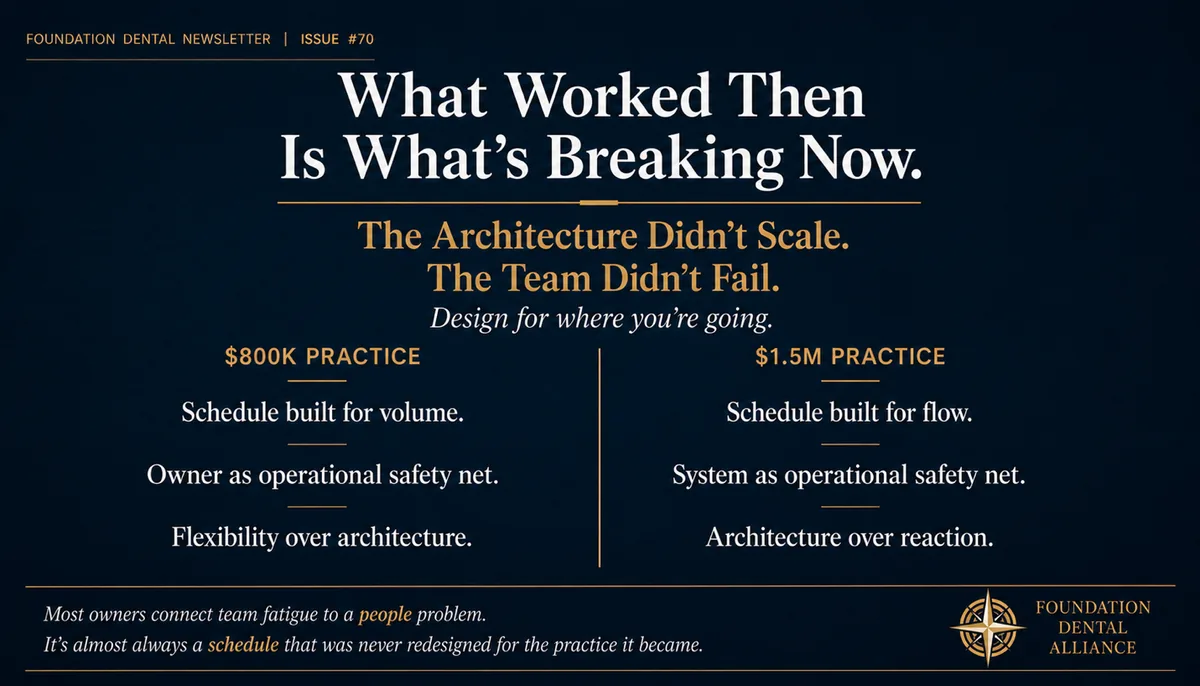
Most owners connect team fatigue to a people problem. It’s almost always a schedule that was never redesigned for the practice it became.
The conversation that needs to happen is one most owners resist because it feels like it will cost production. And in the short term, intentional scheduling design sometimes does mean slightly less chair time in certain slots. More buffer. Fewer back-to-back complex cases. Protected transition time.
What practices almost always discover when they actually redesign the schedule with intention is that production holds or increases. Case acceptance improves when patients aren't rushed. Same-day treatment capture goes up when the schedule has room for it. The team stays functional through the afternoon and doesn't make the kind of tired errors that consume time and trust.
The practices that scale calmly didn't get lucky with their teams. They designed a schedule their teams could actually sustain. That distinction becomes more important as the practice grows, and more expensive to ignore the longer it's deferred.
A schedule designed for an $800,000 practice doesn't scale cleanly to $1.5 million. Most owners connect team fatigue to a people problem. It's almost always an architecture problem.
WHAT THIS CONNECTS TO
Newsletters #68 and #69 were about owner psychology and operational dependency - what happens after you hit your number, and why the practice still runs through you even when you think you've stepped back.
The schedule is one of the most concrete expressions of both problems. A schedule that requires the owner to manage exceptions, rescue overruns, and personally absorb the consequences of poor sequencing keeps the owner in the center of operations. A schedule designed with intention - clear ownership, protected time, production architecture that matches clinical reality - gives the practice the ability to run without the owner managing its consequences every day.
The decision to redesign a schedule is also one of the most accessible authority transfers available. Giving a scheduling coordinator real ownership over the template and the booking philosophy - with explicit authority to protect both - is exactly what the last several newsletters have been describing in operational terms.
Inside Foundation Dental Mastermind, scheduling architecture consistently produces some of the most immediate and visible results. Not because it's a new idea, but because most practices have never had an explicit conversation about what the schedule is supposed to accomplish beyond filling chairs. When that conversation finally happens, the changes tend to be significant and fast. And the practices on the other side of it don't just produce more calmly. They operate more calmly. That difference compounds.
If you want help redesigning your schedule architecture with peers who have already done it, this is one of the first operational moves we make inside Foundation Dental Mastermind.
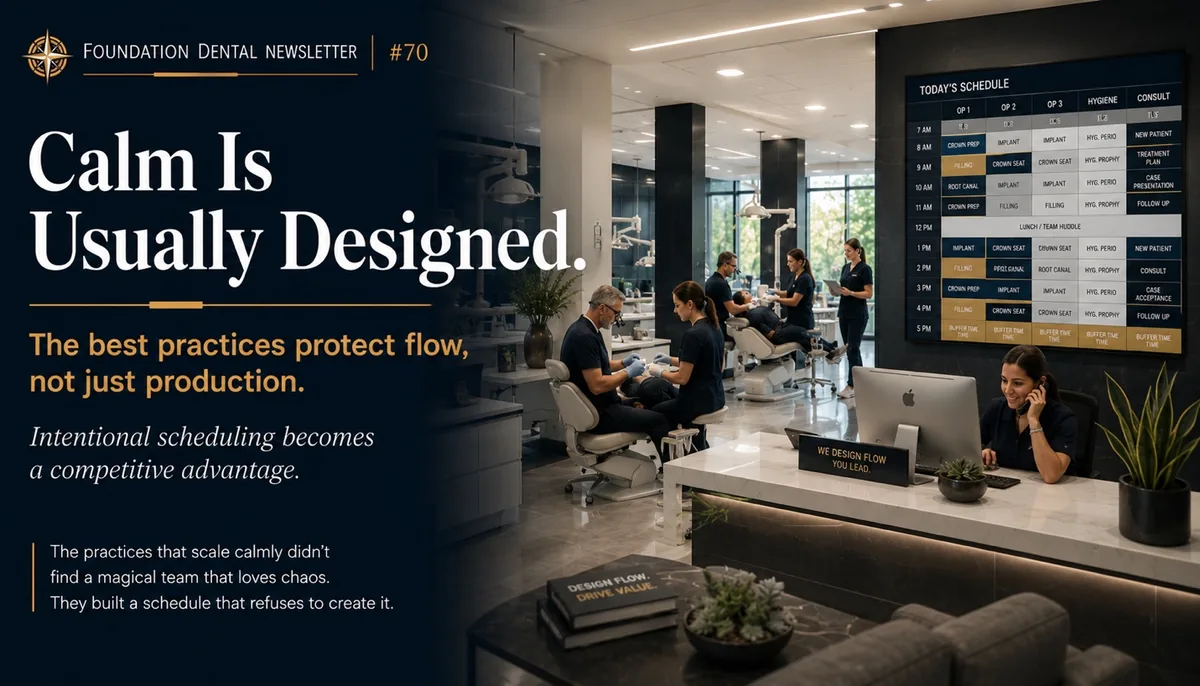
The practices that scale calmly didn’t find a magical team that loves chaos. They built a schedule that refuses to create it.
Three moves worth making in the next 30 days.
First: audit your days, not your month. Look at the last ten clinical days and identify which ones the team left with energy versus which ones left them depleted. Compare the actual schedules side by side. Calm and chaotic days have visible patterns once you look for them.
Second: protect one block before fixing everything. Choose one piece of thinking or calibration time - a real morning huddle, a mid-day reset, one weekly hour with your emerging leader - and treat it as non-negotiable for a month. Watch what changes.
Third: define a good day explicitly. Ask your team what a great operational day actually looks and feels like. Write down the answers. Then ask what the schedule would have to look like for that kind of day to be possible consistently. Those answers are the design specifications you've been missing.
The practices that scale calmly didn't find a magical team that loves chaos. They built a schedule that refuses to create it.
EXTRACTABLE TAKEAWAY
Most scheduling problems are not really scheduling problems. They are operational leadership problems expressed through time compression, reactive decision-making, and organizational friction. A dental practice that feels chaotic despite strong production has almost always normalized a schedule built to fill chairs rather than protect the people carrying them. The fix isn't more motivation or more hiring. It's a design conversation the practice has never had.
Until you decide what your days are for and design the schedule around that answer, growth will always feel like something that happens to you rather than something your practice is built to carry.
FREQUENTLY ASKED QUESTIONS
How do I know if my dental schedule architecture is the problem?
If your team regularly finishes the day depleted despite hitting production targets, if the same types of delays repeat weekly, if case acceptance plateaus despite strong new patient flow, or if you're personally absorbing schedule exceptions daily - these are scheduling design signals. The issue isn't performance. It's the template.
Won't adding buffer time reduce my dental practice production?
Short-term, intentional buffer may slightly reduce raw chair time. In practice, most offices find production holds or improves - same-day treatment capture goes up when the schedule has room for it, case acceptance improves when consultations aren't rushed, and clinical quality holds through the afternoon when the team isn't depleted by 2pm.
Who should own the schedule in a growing dental practice?
One person with both clinical understanding and production awareness should own the template, the booking philosophy, and the authority to protect both. When scheduling is a shared responsibility with no single owner, it defaults to whoever books the next available slot without strategic intent. That's how intentional schedules become reactive ones.
About the Author
Dr. Jim Arnold, DDS is the Founder and CEO of Foundation Dental Alliance, a leadership and practice development organization serving dentists from graduation through retirement. He has 30 years of experience as a multi-practice owner and has been involved in more than 60 dental practice transitions. He leads the Foundation Dental Mastermind and Luxury Dental Retreats, and hosts the Foundation Dental Podcast. He also publishes the Foundation Dental Newsletter and Blog weekly, focused on leadership, practice design, and long-term sustainability in dentistry.
Stay Connected
Websites
FoundationDentalAlliance.com
FoundationDentalMastermind.com
FoundationDentalTransitions.com
FoundationDentalNetwork.com
LuxuryDentalRetreats.com/dubai
Social Media
LinkedIn: linkedin.com/in/arnoldjim
Instagram: instagram.com/smilesbyarnold
YouTube: youtube.com/@DrJimArnold
Facebook: facebook.com/smilesbyarnold
Twitter/X: twitter.com/smilesbyarnold
TikTok: tiktok.com/@foundationdentalalliance
Google Business Profile: tinyurl.com/2t3chcv6
Publications
Foundation Dental Newsletter: linkedin.com/newsletters/foundation-dental-newsletter-7289675134649450496
Contact
Professional Email: drarnold@foundationdentalalliance.com