Foundation Dental Intelligence
Newsletter No. 74
What a Buyer Sees When They Walk Into Your Practice.
Get the next issue.
One signup. Everything we publish.

Two practices. Same city. Same specialty. Same revenue. Same EBITDA on paper. Completely different valuations at the transition table.
The difference wasn't in the numbers. It was in what the numbers were built on.
A dentist in his early fifties sat across from me not long ago with no interest in selling his practice. The practice was growing. The team was stable. He enjoyed what he did. Retirement wasn't on his radar.
Then he asked a question that changed the conversation.
"Out of curiosity, what would a buyer think of my practice today?"
That's a completely different question from how most owners evaluate their operations.
The owner sees today's schedule. The buyer sees the next decade. The owner sees what the practice produced last month. The buyer sees what it will likely produce after the current owner leaves. The owner sees familiarity. The buyer sees risk.
Not risk in the traditional sense. Dependency.
That's what sophisticated buyers are looking for. Where does decision-making live? Who holds the relationships? How much of the production depends on one person? How transferable is the success?
Those questions matter more than most owners realize. In fact, they often matter more than the numbers themselves.
Two practices can collect the exact same amount of money and command dramatically different valuations. Same city. Same specialty. Same revenue. Same EBITDA. Different value.
Why? Because one practice is a business. The other is a job with employees.
Most owners never notice the difference because they're too close to it. They're standing in the middle of the machine every day. The buyer isn't. The buyer is looking at whether the machine runs without the person who built it.
That's a completely different lens. And it's one every owner should learn to use, even if they never intend to sell. Because the same characteristics that create enterprise value also create freedom. The same characteristics that attract buyers also reduce stress.
That's why this conversation matters. It's not about selling. It's about building something worth owning.
The First Thing a Buyer Notices
Most dentists assume a buyer starts with financial statements. That's not usually what happens.
Sophisticated buyers begin forming opinions long before they open a spreadsheet. They notice the team. They notice the energy. They notice how people communicate. They notice whether systems are visible. They notice whether patients appear confident and comfortable. They notice whether leaders are actually leading.
Great businesses feel different. Walk into a truly exceptional practice and there's a level of consistency that's hard to miss. Phones are answered similarly. Patients are greeted similarly. Problems are handled similarly. Team members know what to do without checking upward first. There's alignment. Not perfection. Alignment.
The opposite is also true. Walk into a practice where everything depends on the owner and it becomes obvious surprisingly fast. Every question funnels to one person. Every decision funnels to one person. Every exception funnels to one person.
If your team says 'let me ask the doctor' twenty times a day, that's not a communication pattern. That's a valuation issue.
That may feel normal when you're living inside it. To a buyer, it feels dangerous. Because if one person is carrying everything, what happens when that person leaves?
That's the question they're asking before they ever open a spreadsheet. |
The Owner Dependency Trap
Most practices don't become owner dependent on purpose. They become owner dependent because the owner is competent.
When you're good at solving problems, people bring you more problems. When you're good at making decisions, people stop making decisions. When you're willing to step in, people become comfortable stepping back. Over time, the owner becomes the answer to everything.
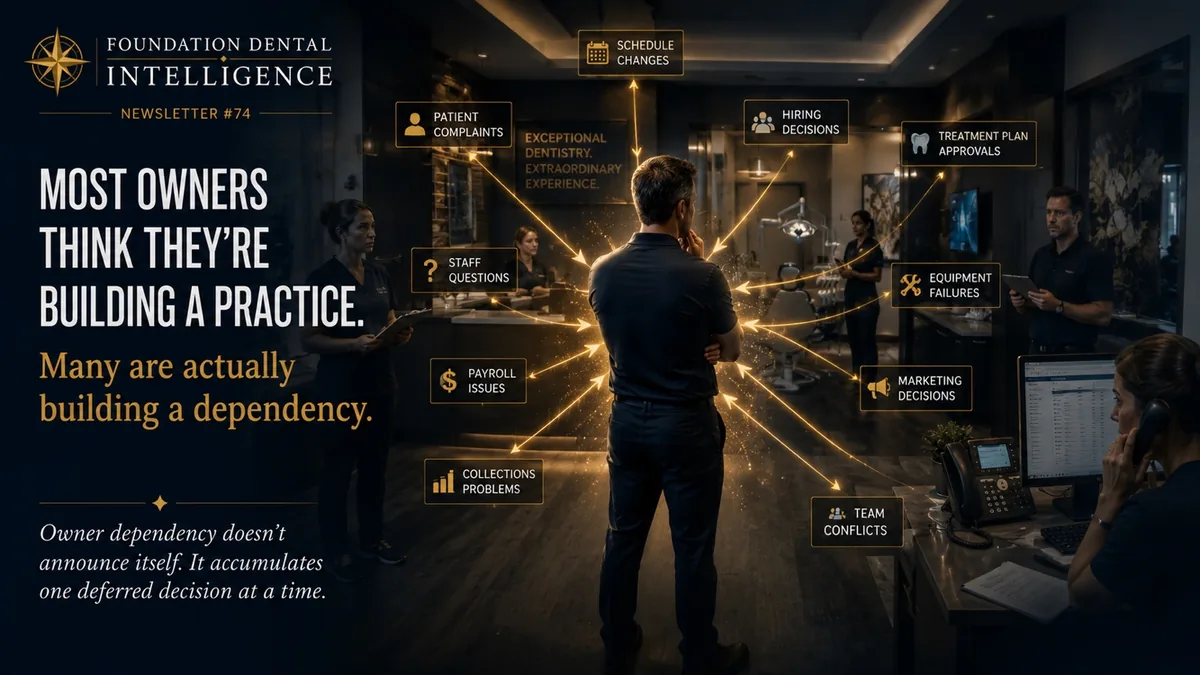
Owner dependency doesn’t announce itself. It accumulates one deferred decision at a time.
That feels productive. It feels responsible. It even feels necessary. Until it doesn't.
The challenge is that owner dependency creates invisible ceilings. Growth slows. Leadership stalls. The practice becomes constrained by the bandwidth of a single individual. Eventually, the business can only grow as fast as the owner can personally absorb complexity. That is the ceiling most owners never see until they try to step back and realize the practice can only rise as far as they can personally carry it.
That's a difficult way to scale. It's also a difficult asset to sell.
A buyer doesn't want your stress. A buyer wants your systems. That distinction is where value is either created or discounted. |
What Buyers Love
Buyers love predictability. Not because it's exciting. Because it's valuable.
The market doesn't pay a premium for effort. It pays a premium for predictability. Buyers aren't evaluating how hard you've worked. They're evaluating how reliably the business will perform after you're no longer standing in the middle of it.
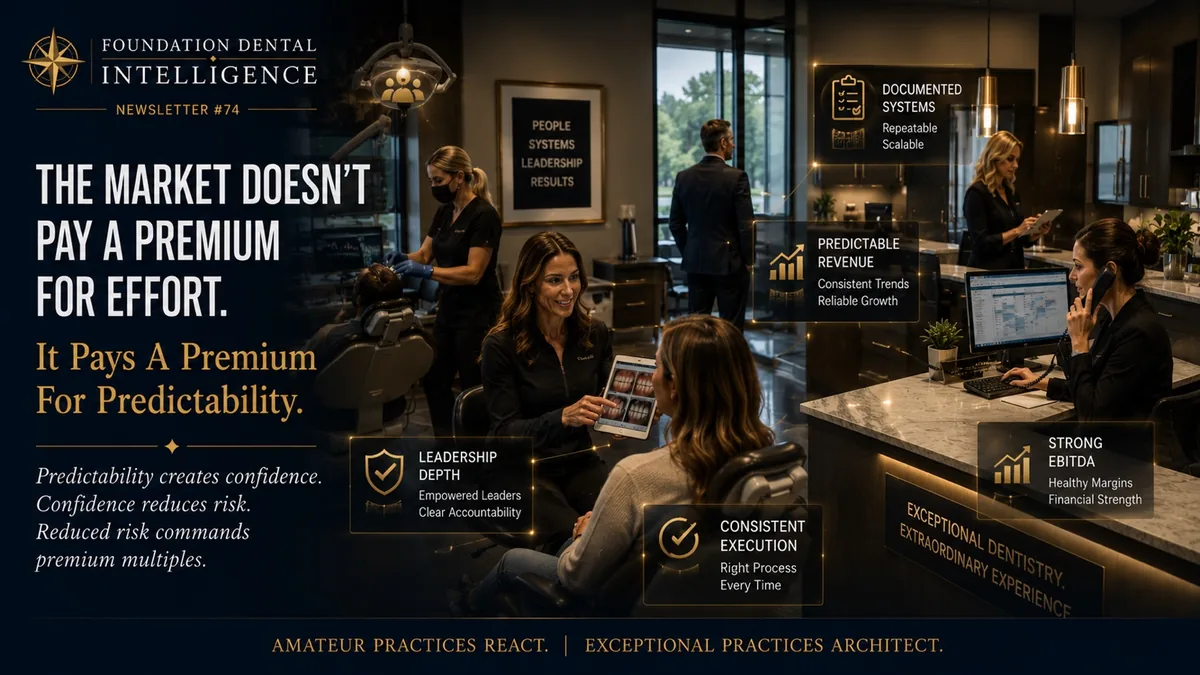
Predictability creates confidence. Confidence reduces risk. Reduced risk is what commands premium multiples.
Think about the practices you've seen that seem to run smoothly no matter what's happening. The doctor takes vacation - the office performs. A manager leaves - the office adjusts. A hygienist retires - the office continues. Those organizations aren't successful because they're lucky. They're successful because they've built operational resilience.
They've created systems that survive individual circumstances. That's what buyers pay premiums for. Not because they're impressed. Because they're confident. Confidence drives valuation.
The Culture Question
One of the most misunderstood components of enterprise value is culture. Many owners think culture is soft. Many buyers think it's critical.
The reason is simple. Culture predicts behavior. Behavior predicts performance. Performance predicts outcomes. A toxic culture eventually shows up in turnover. Turnover eventually shows up in production. Production eventually shows up in financial performance. Everything is connected.
Strong cultures create stability. Stable teams create consistency. Consistent execution creates predictable outcomes. Predictable outcomes create value.
When buyers evaluate teams, they're not simply looking at credentials. They're looking at retention. They're looking at engagement. They're looking at leadership depth. They're looking at whether the culture belongs to the organization or to one charismatic individual. Those are very different things.
Systems Create Confidence
One of the easiest ways to identify a mature organization is to examine what happens when something unexpected occurs. A patient complaint. A scheduling disruption. A staff absence. A difficult conversation.
Organizations with mature systems respond consistently. Organizations without systems improvise. Improvisation feels flexible - until it becomes expensive.
The practices commanding premium valuations aren't winging it. They've documented what matters. They've trained around what matters. They've measured what matters. As a result, outcomes become more predictable. Predictability becomes valuable. Value compounds.
Inside Foundation Dental Transitions, Brian Mans and I see this consistently during due diligence. The practices that close fastest at the strongest multiples almost always have one thing in common - the systems work whether or not the owner is in the building. |
What the Numbers Don't Tell You
Financial statements are important. They're just incomplete. Numbers tell you what happened. They don't always tell you why it happened. A buyer wants both.
I've looked at two practices with remarkably similar financial performance. Both showing $1.5 million in collections and a similar revenue mix. On paper, identical. But one sustains a 26 to 28% EBITDA margin because it runs on systems. The other struggles to stay above 15% because it runs on one person.
The practice running on systems received stronger buyer interest and ultimately achieved the better outcome. On paper, most owners would have expected the revenue leader to win. Buyers saw it differently.
That's the gap most sellers don't see coming. They've spent 20 years building something real and valuable, and they find out at the negotiating table that the market values transferability over history.
The Strange Thing About Buyer Thinking
Something interesting happens when owners begin viewing their practice through a buyer's eyes.
They often become happier owners.
Not because they're planning to sell. Because buyer thinking forces you to build differently.
Buyers like documented systems. Owners like fewer emergencies. Buyers like leadership depth. Owners like taking real vacations. Buyers like transferable relationships. Owners like not carrying the emotional weight of every patient interaction. Buyers like predictable performance. Owners like predictable performance too.
The same characteristics that increase enterprise value usually increase quality of life.
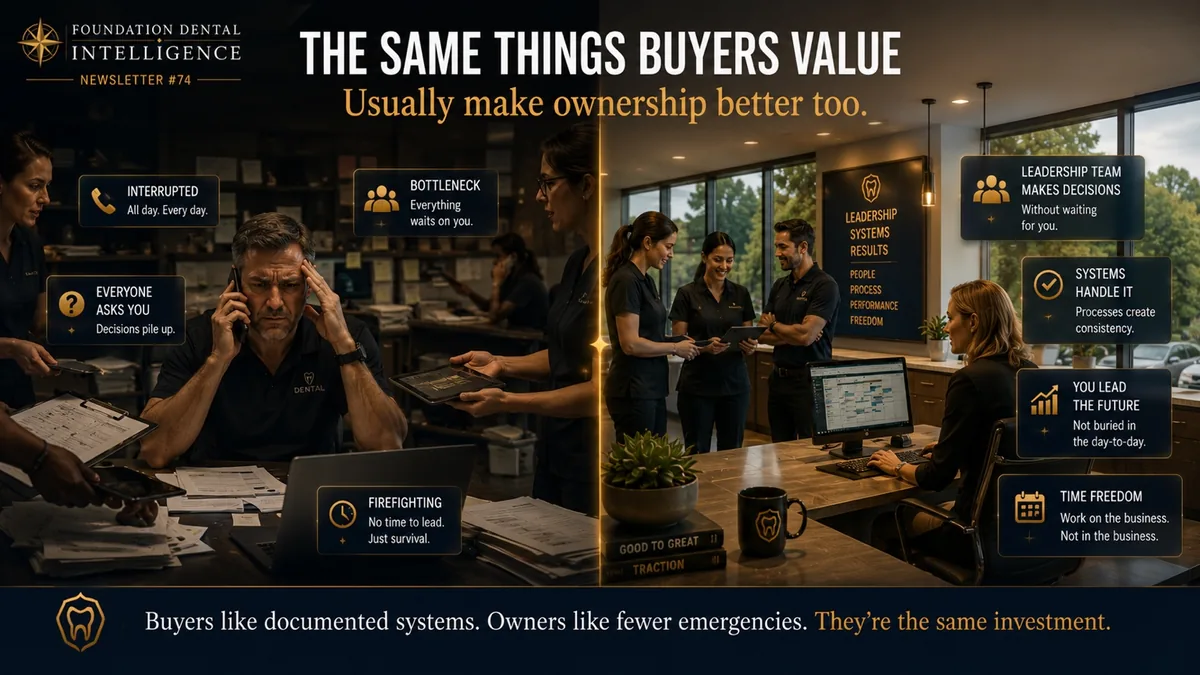
Buyers like documented systems. Owners like fewer emergencies. They’re the same investment.
That's why the best time to think like a buyer isn't five years before a transition. It's now. |
The Freedom Connection
This is where the conversation becomes personal.
Because the characteristics that create enterprise value also create owner freedom. The owner who can take a week off without anxiety. The owner who isn't involved in every decision. The owner who has developed leaders who actually lead. The owner who trusts systems because the systems are real.
That's a different experience of ownership. Most owners think they're building a practice. Many are actually building a dependency. The ones who figure that out early enough to do something about it end up building something different entirely.
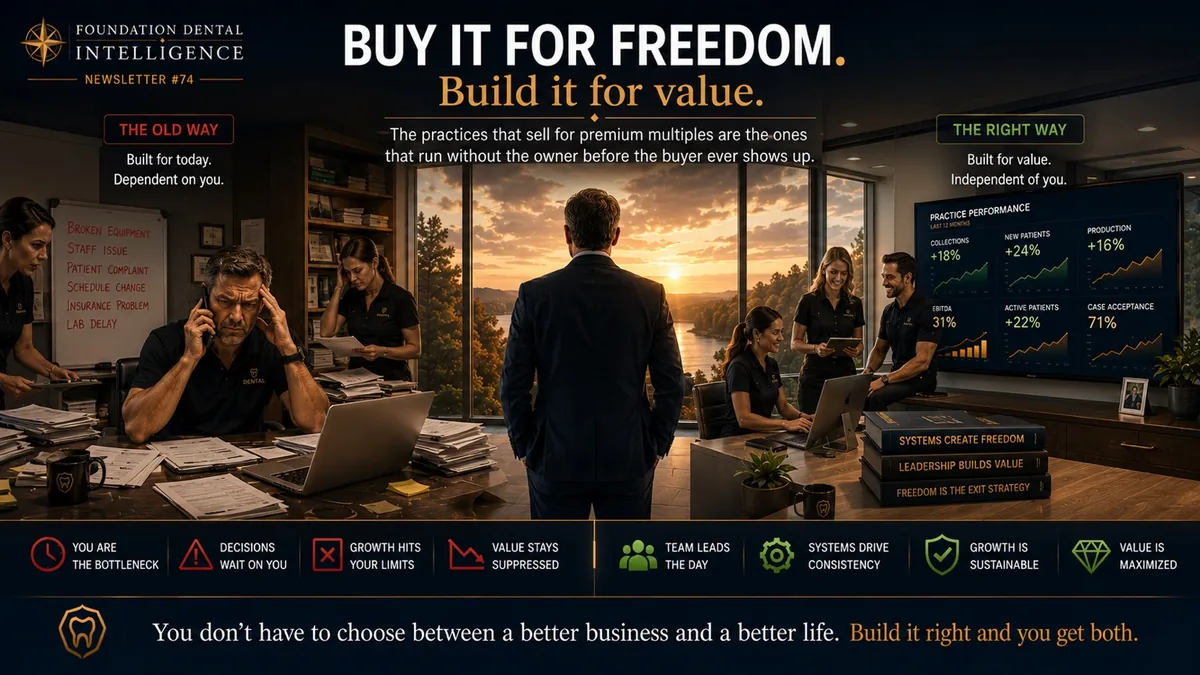
You don't have to choose between a better business and a better life. Build it right, and you get both.
Many dentists assume freedom comes after success. In reality, freedom often creates success, because a practice that doesn't depend on you can finally grow beyond you. When owners stop doing everything themselves, they create space for other people to grow. When other people grow, the organization grows. When the organization grows, value grows. Everything reinforces itself.
This is one of the core shifts we work on inside the Foundation Dental Mastermind - building practices where leadership is distributed and owner freedom is a design feature, not an accident.
The Question Every Owner Should Ask
If a sophisticated buyer walked into your practice tomorrow, what would they see?
Not what would they hear. Not what would you tell them. What would they actually observe?
Would they see a leadership team making decisions? Would they see systems that hold their standard without the owner present? Would they see a culture that belongs to the organization rather than to one person?
Or would they see an exceptional dentist holding everything together through effort alone?
That's an uncomfortable question. It's also an incredibly valuable one. Because it reveals exactly where the real opportunities exist - and almost always, the answer points at something fixable.
What the Most Valuable Practices Have in Common
By the time a sophisticated buyer is asking hard questions, most of those ceilings have already been built. Those ceilings weren't created at the transition table. They were built slowly over years of owner dependency that felt productive in the moment. The owners who come out strongest aren't the ones who started thinking about this at the transition table. They're the ones who started thinking about it years earlier.
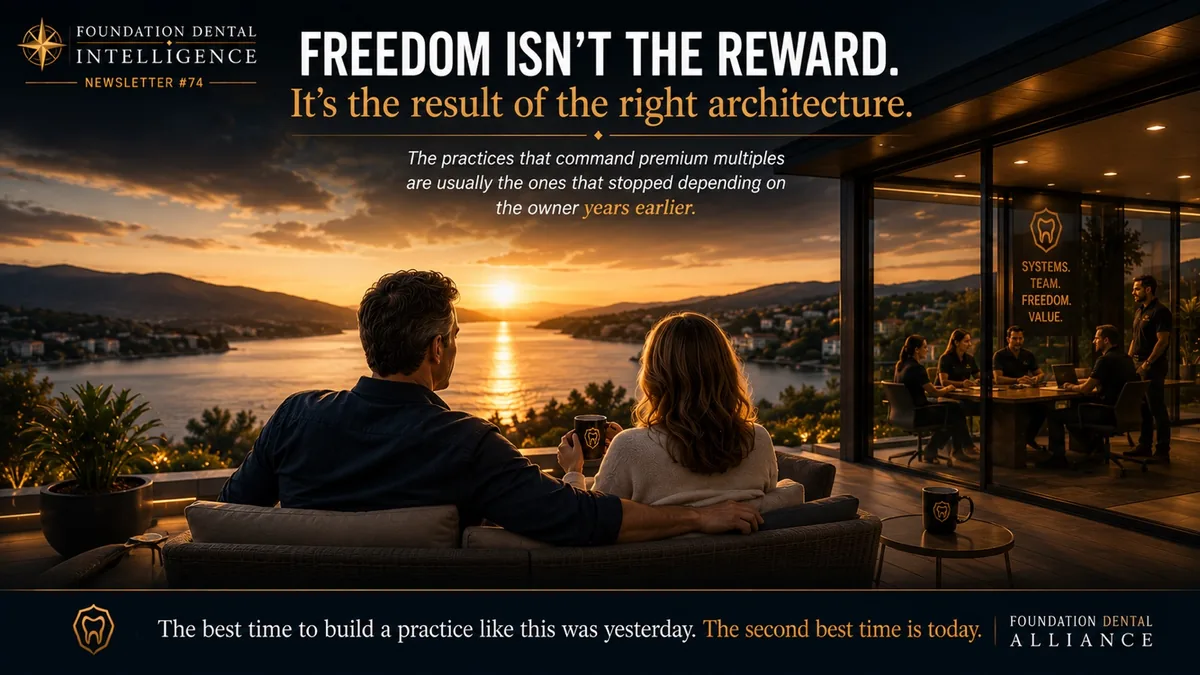
The irony is that the most valuable practices are rarely built for sale.
They're built for sustainability. They're built for leadership. They're built for freedom. They're built to perform whether the owner is present or absent.
Buyers simply recognize the value that was created long before the transaction entered the conversation.
That's what sophisticated buyers see when they walk into the right practice.
The better question is whether you're seeing it too. Because the practices that create the most freedom, the strongest valuations, and the greatest long-term impact are almost always built years before anyone starts talking about a transition. |
Frequently Asked Questions
How early should I start thinking about what a buyer would see in my practice?
Now, regardless of your timeline. The practices that command premium valuations have almost always been operating at a high structural level for years before a transition enters the conversation. Buyers can see the difference between a practice that was hastily prepared for sale and one that was built correctly from the beginning. The former gets discounted. The latter doesn't.
Does my practice need to be fee-for-service to sell well?
No. But the revenue model affects the valuation conversation significantly. Fee-for-service practices with strong EBITDA margins carry different value characteristics than heavily PPO-dependent practices. A buyer evaluating a PPO-heavy practice is pricing in the margin compression and the work required to improve it. That comes out of the offer.
What's the single highest-impact thing I can do to improve what a buyer sees?
Reduce owner dependency. Not because you're planning to sell - because it makes the practice more valuable and easier to own right now. A practice where the team makes decisions, where the systems are documented, and where the revenue doesn't depend entirely on the owner's presence is a better practice in every dimension. If you want a place to start, pick one decision category this month - schedule management or financial exceptions, for example - and write a simple protocol that lets your team handle 80 to 90 percent of those situations without you. That one exercise reveals more about your structural vulnerabilities than any production report.
How do buyers evaluate team quality?
Tenure, capability, and decision-making authority. A tenured team with clear roles and documented accountability is a significant positive. High turnover, ambiguous roles, and a team that routes everything through the owner is a discount factor. Buyers are acquiring the team as part of the asset. They want to know what they're getting.
What does a strong EBITDA margin signal to a buyer?
Operational efficiency and pricing integrity. A practice generating 28% EBITDA is telling a buyer that it collects what it produces, that its overhead is managed, and that its fee structure isn't being eroded by excessive write-offs. That's a fundamentally different conversation than a practice at 12% EBITDA generating the same top-line revenue. The multiple applies to EBITDA, not revenue. That math matters enormously.
The Foundation Dental Newsletter publishes every Tuesday. If this reached you through a colleague and you'd like to subscribe, the newsletter is available on LinkedIn or you can reach out directly.
About the Author
Dr. Jim Arnold, DDS is the Founder and CEO of Foundation Dental Alliance, a leadership and practice development organization serving independent dental practice owners. With more than 25 years in dentistry, multiple successful practices, 31% EBITDA achievement, and involvement in more than 60 dental practice transitions, Dr. Arnold writes and speaks on leadership architecture, practice systems, enterprise value, and the future of independent dentistry. He is the host of the Foundation Dental Podcast and the founder of the Foundation Dental Mastermind and Luxury Dental Retreats.
Stay Connected
Websites
FoundationDentalAlliance.com
FoundationDentalMastermind.com
FoundationDentalTransitions.com
FoundationDentalNetwork.com
LuxuryDentalRetreats.com/dubai
Social Media
LinkedIn: linkedin.com/in/arnoldjim
Instagram: instagram.com/smilesbyarnold
YouTube: youtube.com/@DrJimArnold
Facebook: facebook.com/smilesbyarnold
Twitter/X: twitter.com/smilesbyarnold
TikTok: tiktok.com/@foundationdentalalliance
Publications
Foundation Dental Newsletter: linkedin.com/newsletters/foundation-dental-newsletter-7289675134649450496
Contact
Professional Email: drarnold@smilesbyarnold.com
© 2026 Foundation Dental Alliance. All Rights Reserved.