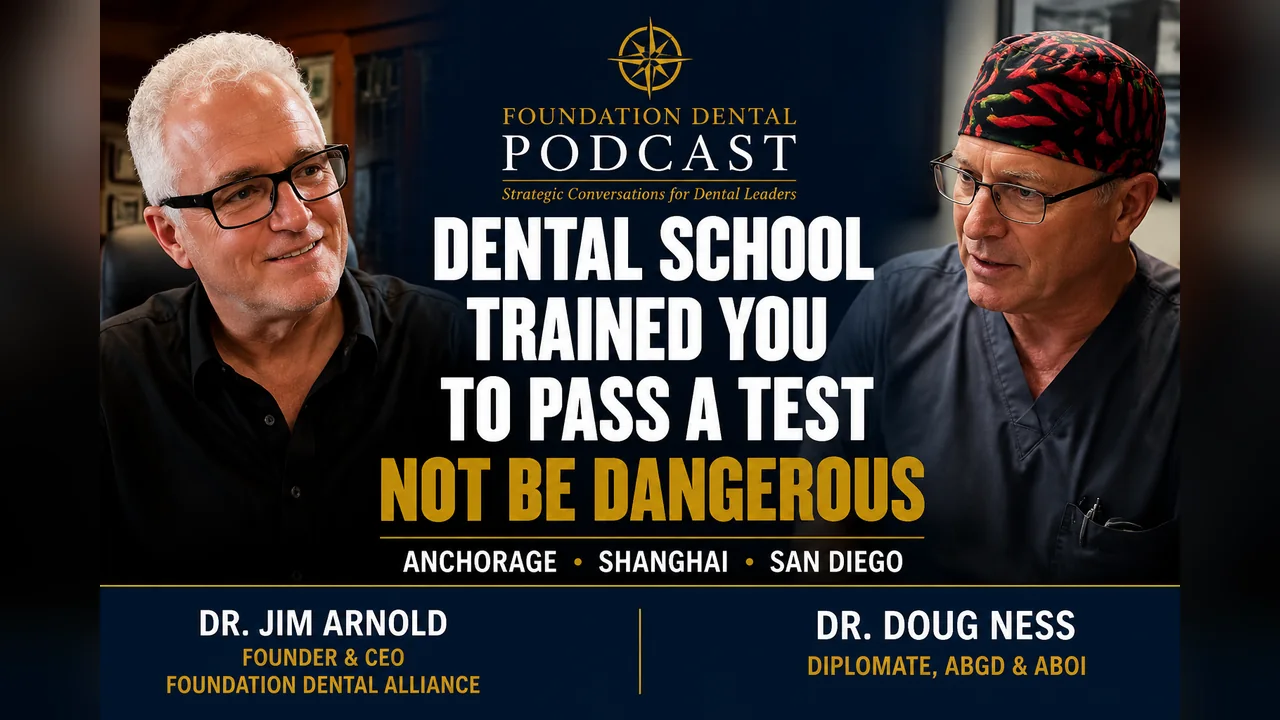
Foundation Dental Podcast
Dental School Trained You to Pass a Test, Not Be Dangerous
With Dr. Doug Ness, Diplomate, ABGD & ABOI
Get the next conversation.
One signup. Everything we publish.
 Coming Soon
Read the full transcript
0:00And today's guest is doctor Doug Ness, a clinician, educator, global practitioner whose career has taken him from Anchorage, Alaska to high level interdisciplinary practice in Shanghai, Beijing and Chengdu. Doctor. Ness has practiced in some of the most advanced clinical environments in the world, treating VIP patients with complex full arch implant, prosthodontic, orthodontic and cosmetic cases. And he also began teaching dentists more than twenty years ago as a lecturer for progressive orthodontic seminars. He was a very versed doctor to register for our luxury dental retreat in Puerto Vallarta earlier this year, where he brought tremendous insight and connection to the group. He was awesome, awesome to have there. And he also brings unique blend of global perspective, clinical depth, and real world experience. And so I'm super excited for you to hear this conversation.
0:54He's gotta be one of the most interesting dentists in in all of dentistry. So thanks for being here, Doug. I appreciate it. I'm very happy to be here. Thanks for that glowing bio. I'll do my best today to try to live up to that that that high bar. I don't know. You know what? I I swear that the for me, the best part of doing a podcast is on the front end, just doing the research and learning about, like, you and some of my other friends. You know, I have so many friends in the industry who you know, I knew, like, bits and pieces and, like, wow. They're really cool. They're really successful. They're really smart. But when you really roll up your sleeves and do the research, it's remarkable what you find out.
1:34And what I found out about you, Doug, was that you are far too humble, my friend. You are doing amazing things and have been for a long time, and you're just one of those guys who's never gonna settle for mediocrity. And I I have a lot of respect for that mentality. I appreciate it. I've just I don't know. I've always been that way whether it's or you could call it self deprecating or, sarcastic or I don't know. That's just as long as I can remember. As a kid, I was always I was definitely the nerd bookworm, growing up. I'm I was so nerdy when I was a kid. I I had a set nerdy were you? I was so nerdy. My bedroom, I had a set of encyclopedias.
2:18I had a Britannica my mom got me years ago in my room, and I and I if I was bored, I I wouldn't read novels. I read encyclopedia stuff. Oh, man. I was not the, you know, I would do PE, but I was never athletics weren't, like, the super thing. You know? And it was I was okay. That was not my forte. It was it was more knowledge and and learning and then the bookwork, math and science, and his history was a big thing I enjoy. I still enjoy that. You know, I'm not gonna lie, Doug. The the fact that you had the entire Encyclopedia Britannica lined up in your bedroom, it doesn't surprise me even a little bit. It's that is that is you to the core, my friend.
2:59We're talking elementary school time. I mean, it's like it was it was that was nerdy. That's Nothing has changed. Nothing has changed over the last fifty years. So So now it's all here. Right? It's all here. Yeah. That's right. Absolutely. It's a little easier to haul around with us. So, you know, Doug, one thing that strikes me as really interesting about you is, you know, the majority of dentists, like, never even practice outside of their own county. Yet you've been in Anchorage, Alaska, all over China. Now you're in San Diego. So what is it about you that refuses to just follow the kind of standard dental career path? Like, what why did all of this crazy stuff happen? I don't know. I think probably comes a lot when I was younger.
3:47Again, growing up, I I loved history. I loved geography. I loved I loved the other. I loved what was foreign versus your little LA suburban lifestyle. I always loved Asian culture. I don't know what it was. Maybe watching old Hollywood movies. You know? I was the I like the I like the old, you know, movie about Marco Polo or something going or the movies about the Crusades and, you know, medieval times, and I would just always you know, and I dream about those things and enjoy those, and I just so opportunities would arise to that you know, I didn't travel as growing up, we weren't you know, we were middle class. We didn't what these people do now, know, we didn't do international trips. I think I went to Canada once as a kid.
4:37That was international was all we do. Otherwise, it's, you know, road trips in The States. So, you know, my information at Beyond Our Borders was was what I could read about. You know? So I think, I've just always kind of had a little wanderlust. And so when I was in college, music was a big part of my life since elementary school. In our in our school system and our church, music is an integral part of developing the whole person, I think. And music education was big, so I was always in choirs and bands. And so and carried that into college. And in college, the director was cool. He liked a good vacation. So we did tours. We went to, first time I went to Hawaii was in a corral tour, went back east, DC, Boston one year.
5:29And then the last year I was in college, we went to an Asia trip. So we went to Seoul, Korea, Tokyo, and Hong Kong, And that blew my mind. That was just that kinda set me off. You know, I'd never left the continental, you know, the continent. So, I think and then I went off to to dental school. Mhmm. And then, our at Loma Linda back in in the eighties, they had and, of course, it's part of the Seventh day Adventist Church, and we have a huge worldwide network of hospitals and clinics in countries all over the world and for the last, you know, century. And so Loma Linda had relationship with the church, and, they developed this externship program. So some of a lot of the medical hospitals and clinics in different countries, Africa's big and Asia and, more of the some a lot of third world countries, they would have hospitals or medical clinics.
6:37And a lot of times, they had dental clinics within those hospitals. And so those clinics would take on an extern, which would have been a be a third year. It would between the third and fourth year in that summer, that ten week period when you would normally be in summer quarter in school, if you were ahead in your requirements, you could apply for this program to spend your summer overseas in a clinic. Interesting. And so I applied, that year, and I got, selected to go to Taiwan. And so I spent in '19 so it would have been 1988. I spent the summer in Taipei, Taiwan in our hospital there, and I worked in a dental clinic. And that was a blast. The people I met, the friends I met, still today, actually, that's over.
7:24I met my ultimately, wife. I met her there. She was my, assistant, and she was a nurse in the hospital. And so that was unexpected. That certainly wasn't part of the plan for that trip. But Mhmm. That certainly changed the trajectory of my life in a in a infinite number of ways. Wow. But, what was really cool is, you know, your third year dental school, you're kinda learning procedures, working on real people. But, you know, every step of the way, you gotta ask permission from your professor, you know, to prep the tooth, to fill it, and all that stuff. Well, when I went there, the director's like, here's your room. Here's your assistant. Call me if you need me. So I was literally working like an associate, and I hadn't even finished dental school.
8:11So I had ten weeks where I could really do all kinds of stuff. And and the assistant clinic director was, good at, surgery, and he was doing he was a general dentist, but he was doing all the third molar surgeries in the clinic. And so I would look over the shoulder with him, and he'd give me tips. And then the case came up, and I I'd go do it. If if I got stuck, I could call him. You know? And, but that never happened. And so I really when I came back in the fall to school, my senior year, I was just ripping procedures. In fact, I finished I finished my requirements in about early November. So there was a couple of us that were so far ahead that the school to keep us working in the clinic, they actually paid us Nice.
9:02Little sweets. Well, I can tell Doug. I I've got paid very little in dental school. I got paid to be an instructor in the freshman clinic, and I got paid to bus tables at a a banquet center. And and so I have lots of great stories about that, but I'm guessing you made a couple bucks more than I did. No. Not not really. Like like, we were our our clinic the the the procedures are on a point system, like, one point per surface of a filling and then 10 points for a crown. And these senior these advanced status seniors, they call this, there was just a handful of us, and they, paid us a dollar a point. So I don't know. You know? We might make $3,400 a month, you know, which was in the eighties, it was probably, you know, a little bit of spending money.
9:53But it was mostly to keep us there and keep us working through and generating revenue for the school too, until, but the craziest thing about that is I I almost still didn't graduate. Even though I was done six months early, there was one procedure. The, I had to do a 300 bridge for the test, the proficiency, we call it, and I couldn't find a patient that needed one. Oh, boy. That's so stressful. Until, like, I think one of my classmates had one extra. And I borrowed their patient, and it was like, I didn't finish till May, like, three weeks before graduation. I was sweating for six months. I was like, this is nuts. I would go to the I would go to the screening, office and look at charts every day, and I had to find one, and it was it was crazy.
10:41Doug, I remember when we were getting ready for our, state board exam, we all tried to get two patients for every single thing we had to do, and then we paid them. We they had to show up to get paid. And, you know, for the most part, we were pretty fortunate. And with everybody trying to get two people for everything, if somebody, like, struck out, it there was always somebody else's patient who was there ready to get paid. You know? Oh, yeah. Yeah. $50 to come in and get your stuff done for free Seemed to work out. But going you know, moving forward to Anchorage, you know, I think when when I heard that you practiced in Alaska, like, in my mind, it was like a northern exposure, a a small frontier outpost.
11:22But you and I via text yesterday, you confirmed that it's actually kind of a major medical hub with a lot of dentists and specialists, the whole nine yards. What what was that actually like? Well, Anchorage and I I took that job with because my roommate and I at dental school just got this Alaska bug, and we just were talking about it. Hey. We're dreaming about it. Again, more of that wanderlust going on. And so my second year we have a month break between spring quarter and summer quarter. We have the month of June, basically. And so we planned this trip. My after I finished my second year studying for the National Board part one, we drove from Southern California all the way up past Anchorage.
12:07And we did that route all the way through Canada. We tent camped along the way, and, it was crazy even but we met people that invited us to back in the day, you felt safe. You know, they invited us to spend the night at their house so we didn't sleep every night on the ground, but it was it was thirty days and 10,000 miles. We knocked out. It was crazy. And my my roommate would would drive, and I would study the Kaplan review book. You know? I remember those. Yeah. I have a picture I have a picture of us sitting out at Denali National Park with Mount McKinley in the morning right behind me, sitting on a bench studying the Kaplan books. You know? Crazy back then.
12:50And I and it went on being free like that. I went back and I killed that test. I just I crazy. And but, anyway, we we always said, hey, man. It would be great. If an opportunity to open up, gonna go back and work there, you know, maybe a couple years. You know? My first job, my roommate was a year ahead of me. He found a he found two opportunities. He ended up taking one in this remote island in this little clinic, But he had this opportunity in Anchorage from a group of, it was a big group of, well, three doctors. They're all Loma Linda grads, and they were always recruited alumni. And so he passed on that, and they were still looking for an associate a year later.
13:32So when I was, starting my residency at Emory, I I called up there. You know, my roommate gave me their contact, so I checked and we started talking during the fall of, my residency. And then I decided I had to make I had to get the license. So to do the license, you had to take a jurisprudence exam. I had the Western Regional practical. Mhmm. But Alaska made you take a little 20 question jurisprudence test in person. Wow. You couldn't do it by mail. Had to go and sit in, so I planned a trip where I had to sit with one of the board members in his office, in his waiting room, was, you know, just taking this test. And then I also made a trip to Anchorage to meet with these partners, and we spent the weekend.
14:20I did it in February. I figured if if I can handle the dead of winter and like it, then I'll probably survive because I came from Southern California, which is room temperature every day. You know? Right. Of course. So but I think, you know, I got a little bored with perfect weather all the time. I wanted a little change. So, we hit it off that weekend, and they offered me a position. They waited for me till I finished in July, and they paid for my move up there. And I got a you know, I got, got the movers. Oh, we drove up. My dad and I drove. We didn't we got a I got U Haul, and we drove the L Can, and we drove again, and we went up there.
15:04And, I was there for two years. And, Anchorage is, is about 300,000 now in the surrounding area. It's the main city of the whole state. About half the population lives there. So because it's so remote and because it's, an oil town historically, a lot of Texans, a lot of people went up there working from Texas to develop the oil fields in Alaska. So they wanted the niceties of Dallas and Houston. So over the last fifty years, they brought know, they've got performing arts center. They got sports teams. They've got all the amenities of a million plus city, medical center, level one trauma centers. You know? So plenty of dentists, actually, almost no different than most major cities. Probably, we had 200 dentists. We we had one dentist for 1,500 people.
15:57It wasn't scarce. But then outside of Anchorage, it gets real remote real fast. Okay. But you were in Anchorage for two years, and, so you got exposure to a lot of different things. Did you start doing some specialty work at that time? Yeah. Because of my GPR. I mean, my GPR in Atlanta was very well rounded. Spent oral surgery, anesthesia, medically compromised patients. Emory University was the transplant center in the Southeast, so we were always working on pretransplant patients, very sick people with kidney failure, cirrhosis, you know, a lot of things to consider. So, I always say that GPR was the best thing that happened to me and the worst thing. And because when I was in dental school, I was gonna be a specialist.
16:50I was figuring I was gonna do something, but I could never really decide which which lane to take. Right. You wanted to do all of them. I know you. You wanted to do every single one of them. And so I'll take a GPR and said maybe I'll figure it out then. And then the GPR just kinda made it worse because I figured out I had the skill set and the brainpower to do 90% of the procedures. And so I I I guess I just like the variety. And so I spent two years in Anchorage to your contract. At the end of that, the guys didn't want me to leave, and they offered me a partnership. And I was like, oh, and I'm happy where I was.
17:28I they're all friends. And to this day One thing that that jumps out at me, you know, when you talk about your GPR and you're not doing what you wanna specialize in in in everything, and we'll talk later about your, you know, rise as sort of a super GP. But just to just to come look at the global thing. I talk a lot about, like, lifelong learning and always wanting to grow, always wanna expand, always be better than we are today, you know, 1% daily. But you, my friend, have dual board certifications, a mastership, an MBA. And, I mean, you're already operating at such a high level. Like, why do you always feel the need to pursue even more training? And beyond that, like, what's next?
18:17I don't know. I suppose, you know, if I psychoanalyze myself, I've always had a bit of an inferiority complex, I think, where I'm never, you know, never good enough where I always wanna it's a combination. I am insatiable in my education. Like, when I got out, even after residency, I would do you know, from my first year in practice as an associate, I would do a hundred plus hours a year Mhmm. In CE. Yeah. And the and the in the early nineties, that was the beginning of some of these longer continuums that were coming out. I mean, you before the eighties, you maybe had pinky, and that was about it. You know? But Progressive Ortho, Doctor. McGann had developed this eighteen month program. I thought, well, let me take that.
19:03And he taught it like a residency, I mean, from ground one. I mean, we were taught he would try to follow the standards of, you know, the specialty because he didn't want his students getting in in trouble. So, you know, I ended up growing with that company, and I ended up he asked me to he asked me to a few years in with when I got enough experience in my practice, you know, asked me to teach for him for and we I did that for a couple years. Nice. But, you know, I found I've I've found satisfaction, and I love the treatment planning and kind of being the quarterback as a general dentist. We're kind of in control of that whole case. And whether I did every step of the procedure or not.
19:50But I did have the skill set in most cases to do virtually everything. That's amazing. Because I in my residency, the in the VA, I had the VA part was great because we had a a prosthodontist and a periodontist, and it was small. Only two residents in that facility, just me and another GP resident. So we had you know, I wanna do this soft tissue graft. Hey. Periodontist, schedule him. Dentures, I learned so much in the the GPR. I I always recommend, senior dental students if I say, you know, do it because, you know, take the extra year. It's gonna pay off. It'll be like, when you get done with that, you'll have three to five years of work experience, and you'll know more. It it allows you to just gel everything together and treat treat a patient from start to finish, which is hard to do in dental school.
20:40Right. Absolutely. Especially when you're waiting twenty minutes just to have somebody check off your steps so you can move on to the next step. It's it's very inefficient. But I I always looked at the GPR as kind of the best of both worlds, and that you had the ability or the opportunity to do a lot of extra clinical work, have a little bit more freedom and autonomy, but also still have that safety net there for things that you weren't a 100% confident in yet. But I can imagine coming out of a GPR like that being so much better prepared to be out in practice and to be doing things, you know, basically without a safety net. And and that's exciting, man. Good for you. Yeah.
21:18I was always the you know, there was a when I joined that group, you know, the the senior the founder, he was 24 older than me. Second guy was probably 20. The third partner was he's twelve years older than me. So, generationally you know? And I was the guy with the new you know, I'm the new guy at a residency. I got all this knowledge. And I was actually, they were asking me questions. You know? Latest technique on something, materials. You know? I had a lot of value in the practice. You know, really some really tough case, you know, and they just run by you know, the collaboration. I love the group practice model where you can just the camaraderie. Yeah. Most of us are in our own little silo as a solo practice, you know, one or two, and you don't have that mix of knowledge anymore like you do in a hospital setting.
22:08And doctors, that culture is kinda great because it just stimulates knowledge and circulates the knowledge, and we can't lose that when we leave. Huge, especially in dentistry of an industry that can be feel very fragmented. I think that way too many dentists feel like they're all alone. They're out on an island. You know, they're they're the only ones experiencing yeah. All the things that we experience that nobody else can really understand. And, you know, to to be in a group practice, to be in a GPR, to have spent that time in Alaska, and then ultimately, to move on to China, you know, where you practice clinically in Shanghai, Chengdu, Beijing. I mean, what the heck drew you then from Alaska to China? That just seems like such a huge departure.
22:56And, again, just another, you know, place of kind of adventure, I guess, on your path. Well and and while I don't, I I am a a person upbringing, you know, as a man of faith, and and I believe, yes, we can set a general direction for our lives, but there's many, many forces beyond our control that ends and the positive ones, you know, if you let God lead you, even you're not constantly just thinking on those terms. But I look back in my life, and like I said, I didn't pick I selected my three my three countries I wanted to go to. Taiwan was on there. I got my it was my first choice because I wanted to go to East Asia. I got selected there.
23:44Did I think I would meet the person that I'd fall in love with? No. I mean, come on. Yeah. Now but those relationships started there in that, you know, twenty five years you know, fast forward to that was about 2010. I had sold my practice in Anchorage. '90 in '99, I left the group and moved across town and opened a solo practice because I wanted to do more complex stuff. That practice is more of a general family practice, you know, doing your basic stuff. Not a lot of big prosthetic cases coming out. I'd kinda grown kinda felt I was outgrown. I wanted to do more cosmetic and and implants. And just the market, that part of town wasn't there. Yeah. I love those guys. That was one of the hardest things I ever do to leave that family that I see every weekend anyway at church, so they were still tight.
24:42Right. At the next nine years building a a more comprehensive practice. But by myself, I had an associate for a while. Mhmm. But then we eventually sold that practice. It was time to just, I think my wife was getting tired of winters. We wanted to do something different. It was just time to move. Yeah. And but I sold the practice and worked back for a year and a half. Then after that, 2010, I had chronic back pain a lot, and it was tough. And I decided I took a year off, and I just started to feel better. So I took that year off and, you know, trying to figure out what's next. I go, well, I have a California license. I we could come, you know, look for something down here.
25:27My kids are in high school right in middle of high school, mind you, so that is a fact. That's a tough time to move wherever. You know, they've got well established social circles and everything. But a a friend of ours that has a, at the time in Taiwan had a small implant company, dental implant company, and she was trying to grow and looking for investors. And she she was looking in China for investors. These, this one guy was an owner of a dental laboratory, and and what people a lot of people don't know the scale of dental laboratory work in China, which they work for the entire world, a lot of these offshore labs are in China. They're massive. They've got thousands, not hundreds of lab technicians, thousands of lab technicians.
26:17Wow. That's totally She this relation she had this relationship with this this lab owner. He had a medium sized lab of 2,000 lab techs, just a just a average one. And she was trying to talk to him about investing in her company. It didn't that didn't go that didn't go her way. But in the conversation, he was asking her. He says, you know, the next big business thing at the time, so that was about 2009, 2010. China was opening up, as far as, private business, the health care sector, the medical sector was starting to really take off. And he felt, hey. Private dental clinics are really where it's at in in a foreign and international type western style will be attractive to the upper class in China.
27:11And so he he was asking her, hey. Do you know any dentist from America or Europe that could come and kinda be the director of this clinic? And she's like, yeah. As a matter of fact, I do. And she introduced us, my wife and I, because my wife's an integral in the administration of clinics. She's been in dental marketing and admin, for since we met, obviously, and has worked up as a nurse and a dental assistant, orthodontic assistant, and then got into marketing and management and practice. So they actually came over, sent that that founder, he sent his, general manager and his CFO to The States. They were gonna they were gonna buy some US labs. They were on a tour of shopping around for that, and they circled back up to Anchorage to visit us.
28:02And after a couple days visiting with us, and they gave me an offer, and I said, how would you like to come and run this clinic for us? And I'm like, well, I'll consider it. Anyway, we decided to take it we decided to take a flyer there. We thought worst case, we got a one year contract, and we'll move back to The States. And at least we can say we lived in China for a while. Okay. Cool. So you were in that setting. It was a large multi dentist clinic. And how did that environment shape kind of the interdisciplinary approach that you've had in your career? Well, I had a lot there was a lot of challenges. I mean, the dentistry at the time, so that's fifteen years ago now.
28:47Mhmm. The average dental skill in the Chinese dentist was was not where we are. So And I did a lot of teaching, mentoring. They were very good students. I could show them, and they could bring up their skills pretty quick, which is good. They I really I learned I had never seen clinics so big than there other than a dental school here. They do dentistry on a scale we can't imagine because they have five times the population we have too. But, you know, clinics with, you know, fifteen, twenty, 50 operatories are not uncommon in the major cities. Just it's just it blew my mind. And, you know, like, dental hospitals, but private businesses. And over there, most of the dentists are associates. They're employee dentists, because there's no bank financing for dental clinics like we are used to here.
29:48It's all private equity money. It's all family, you know, pooled investment money. It's all nondentist investors doing this as a business. In our in The States, we can't do that. Most states, that's illegal. You've gotta have a a dentist as part majority owner or or major. So it's a different world. It was just Mhmm. The the the differences and these clinics were on a scale, and they were gorgeous. I mean, honestly, I've never seen anything so pretty. I've never seen a clinic as beautiful Wow. Some of the stuff they are. I don't think most people would guess that. The the stuff they're doing here now is nice Yeah. In The States. And and we've had nice clinics, but it it's, it's just on a different scale.
30:33And today Sounds like it. It's it's it's crazy what they were doing. And now that that's become the trend in a lot of countries, just really turn up the Mhmm. The decor and the, you know, and the appearance and the that that Yeah. You know, it's nice to have the best of all worlds, you know, high-tech, high touch, beautiful, comfortable, all that kind of thing. And, you know, it's kind of the same thing when it comes to treatment. I know that from previous conversations and just from the the research I did into you, Doug, like, you do implants, ortho, endo, cosmetics, and you do them all at a really high level. Like, was it intentional to, like, do all of those things and and get so good at them?
31:16Or I mean, was it shaped by your early environment? I mean, why like, again, most people, they pick, like, one or two things, and they really focus on them and they get good at them. But you've, like, focused on so many things and taken them all up to a high level. Yeah. I you know, the GPR kinda sent me on a path, I think, of you know? And then I started I I like I said, I my first, I'd say, five years out, I was really diligent. I would make sure I'd read, like, two hours a week, read journals, you know, scientific literature. I'm not so good at that now for many several years. But early on, I did that, and I I was hitting, like, a hundred hours of CE in some format, whether it's correspondence or live, you know, whatever was available back in the day.
32:04Mhmm. Mhmm. And I was just pretty insatiable on that. And then I and the first big project was, you know, I I I became a partner. I didn't go back to school like my wife wanted me to to go back to residency. So I did ortho by a continuum first, and that program really impacted my whole career because every patient case I saw ortho then. It could be ortho can benefit almost every adult debilitated dentition case except if you're gonna take it all out and do, you know, implants. But Sure. It's if you're if you're saving the teeth, a lot times ortho, it it it really helped me raise my level of treatment planning, which made me more interested in the prosthetic parts. I love doing these cases.
32:50They were, like, just always, like, big puzzles to me. Case cases that had perio and missing teeth and and and crowded and ortho you know, malocclusions and and and TMJ dysfunction. I started doing that in the late nineties. And so I would just find the right mentor with implants. One of my best friends who actually moved was in dental school. He actually did training with Bob James down at Loma Linda in implants, one of the pioneers in The US on implant surgery. And, he he took an implant path for his advancement early in his career. So and his his neighborhood market was more conducive, and he was doing that. And when I was ready to do get into implants, I would do the prosthetics. He would do the surgeries for me.
33:41Mhmm. And he was just across town. And then when I had a patient, I felt like, hey. You know what? Let me do the cases. So eventually, I would do it, and he would over so over the shoulder me, you know, and, watch me do the surgeries. And so for me, my implant training was a little different. I didn't go to these big continuums, which they didn't really exist. There was the AID maxing courses. That was about it. But I had, like, one on one mentorship for a couple of years with implants. And Yeah. It would have been probably the second half of the nineties. You know? And then I just started building on that. And so implants just raised understanding implants raised my awareness level, kept me interested in comprehensive dentistry, I think, is the best way to call it, but I am, comprehensive dentist, I would say.
34:35And then I started getting all these hours. You know? I said, well, I got a fellowship in the AGD. And I said, well then I found out about the board certification in general dentistry. I said, oh, I'll just I always like those I always like those challenges. So I go, well, I'm doing all this CE anyway. I might as well have a end goal. And that was super rewarding. And then, when I got enough under my belt with implants, I joined the AID. I did their maxi course. Had the cases. You know? I said, oh, let's work toward fellowship and then eventually board certification. So since I didn't you know, I think part of it is, like, there was something missing in me that I didn't choose a specialty.
35:18In fact, it was I always kinda beat myself up about it. It's like, ugh. You know, I should've remember at the start of this interview, I said, I know you. You wanted to do every specialty, and now you just confirmed it. You just confirmed it. Like, you know, you you you do all the training it takes to become as good as a specialist even though you didn't go back So to school for another couple of that's awesome. But looking at your time in China, I mean, obviously that's a really unique experience, unique situation. What did you learn during your time in China that you still use with patients today in Southern California? Well, since I'm not fluent in Chinese You're not? Okay. No. I'm surprised.
36:04I'm surprised you didn't become fluent while you were there. Oh, like, that's the one thing I can't seem to master. Everything in dentistry, trivia, I'm great at. History. I know my history. But language is just I just goes in one ear and out the other. It's just I don't know. I'm missing the gene or something that you know? So I became so used to working with through an interpreter, whether my my assistant or I had a one clinic, I had a junior doctor that was with me all the time presenting, translating, or my wife, you know, some sometimes she would translate. And so coming back here, when I bought this practice here in San Diego, it's predominantly Hispanic. The patients are probably, on any given day, 80 to 90% Hispanic, and half of them don't speak really any English.
37:00So getting, you know, getting consent, explaining treatment, I'm at a loss there again. But you know what? I'm surrounding myself with bilingual English Spanish people. So, I don't I'm for me, I know some people you know, to work through an interpreter can get frustrating or, you know, it just doesn't feel natural. But Yeah. He whatever like, it's just totally second nature for me. I don't think of to just sit there and be quiet, let them do their thing or do something. Boy, you know what? That's so interesting. Like, that is such a great answer because I never really thought about that. Of course, you were through in with interpreters while you're there. I do know in my research of you and your practice that you have a lot of different languages being spoken into your office.
37:46Right? Yeah. Yeah. Do you have interpreters for all these different languages? Or or how do do that? There just happens to be the teammates. The team players that are in there are bilingual. We have, you know, Tagalog. And, one of my dentists who's, a Mexican, he he speaks Spanish, but he spent before his dental school, he spent a year in Port in Brazil, so he learned Portuguese. So, San Diego has a a cohort of Portuguese immigrants too. Interesting. That doesn't come up as often, but it's and, again, it's all I I just embrace it, the the the multicultural. So I would just like I said, I love to travel, the wanderlust since I was a kid, and it just it just fits me. I don't I don't mind being the guy sitting there.
38:35I don't know what's going on. I I spend my entire marriage that way when when we go visit. And my my my mother-in-law, father-in-law, you know, they didn't speak English, and I get really good at charades. You know? So, you know, I You know what, Doug? It's it's interesting. You know, thinking about how you communicate with your patients and how at ease you are with that situation, it kind of gives me a little bit of clarity on the reviews that I read about you. Because I read a lot of reviews from your patients, and they do. They specifically mentioned humor, connection, clarity. So when it comes to your communication style with patients, is it just who you are or was it something intentional that you've kind of developed?
39:20Because not everybody has those soft skills as we both know. And if and what your patients are saying about you means you're communicating in just the right way. I'll tell you what. I I would say I'd I'd bring it back to my two of my favorite partners in the first practice. The same partner really taught me how to be an empathic care provider. And he was we had kind an open bay clinic, and he was the next two operatories so I could watch him. His number one thing, he's the guy he could give the he the painless injection, and he just knew when to touch the shoulder, when to look him in the eye, and how to talk to him. And and he was just he was just a master at I mean, he he's a he's a super naturally empathic person and a man of faith and a guy I respect.
40:12He's really my second dad, and we you know, and really was a father figure to me. Yeah. And I love him to death, and we still are in touch. But I think he got me started on really how to really connect on the human level with the patient that you are about to operate on while they're awake, and they are aware of everything that's going on. I think as dentists, we have that edge on our surgeon colleagues where they're working at they see people in pre op and maybe in post op in the office and but not when they're going to sleep or they're all asleep. They can do whatever they need to do, you know, and and rough or smooth or whatever. You know?
40:56And but that's Right. That's a really good point, Doug. Every every nanosecond in general dentist, I mean, the patient is aware of everything that's going on. So I think we're we have to be on with that empathy, really, every minute. And I can get fatiguing, I think. Because at the same time, you've gotta be laser focused on the minutiae, what you're doing with the operation. But at the same time, you gotta have an awareness. There's nobody else caring about what the what the patient is feeling. Yeah. Or at the OR where the surgeon can just sit there and operate, and the anesthesiologist take care of the rest. You know, it it's interesting, Doug. I think that too many people wonder why being a dentist can be incredibly rewarding, but super kind of stressful and anxiety producing at the same time.
41:39And we both know a lot of it has to come down to, you know, dental school. You don't learn a lot about communication and leadership and running a business, that sort of thing. But when you talk about like just being exhausted at the end of the day, when you talk about the effort that goes into communicating with possibly dozens of people every day, people who have anxiety and all that sort of thing. You know, you've been doing this for decades now. You know, surgery, teaching, leadership, all that. Like, do you, Doug Ness, protect your energy and, like, ensure your longevity. Because again, I always used to say five years as a clinical dentist was like twenty years of a lot of other professions. I don't know.
42:24I mean, do you feel that way? And and again, just how do you protect your energy and go home feeling good and not completely depleted? That's a good one because I think now I have a better handle on it. Two years ago Yeah. Not so much. But now and I can definitely attribute it to part of it is is is meeting you and meeting the being part of that first luxury retreat with Jeff. I've tried to follow those principles all this year, and it's, you know, I was already exercising the last five years, but, know, with a trainer and but Yeah. If I blow off a day here, there's no big deal. You know? I I've really been determined this year a lot more just like I know you have.
43:14And that's I I I think keeping your nutrition and exercise is super imperative, and I think the spiritual aspect for anybody that's working at a high level, not just dentistry, I think that's super important because Mhmm. Those things easily fall by the wayside when you get focused on life, trying to provide for your loved ones, trying to make your business run. Those definitely sap the energy out of me. And I, you know, and I had colleagues that were super high producers and got off on the wrong foot with other, you know, addictions and Yeah. And ended in suicide and stuff. And I in in my town up in Anchorage, a couple of docks, you know, I myself, early on, I I let the fact that I was pretty good, I won't say, you know, pretty good at a lot of things, I got ahead of my skis and some things.
44:07And Yeah. I made some mistakes and, you know, ended up, that I regret. But in reflection, maybe I had to go through it to learn because I'm a little thick headed, and I had a lot of problems. Think that's really I think that's really insightful. You know? I mean, you said a bunch of things there, but, you know, first of all, yeah. I mean, unfortunately, dentistry has historically been in top two or three in terms of substance abuse, divorce, suicide, all that kind of stuff. And a lot of it does come back to the skills that we didn't learn in dental school, and then we get thrust out into the world, and we're expected to kind of magically learn all of this where the reality is we're either trial and error in it, maybe we find mentorship, you know, maybe we never figure it out and it creates a great deal of stress.
44:54And, you know, when you look at all of that and you think about the continuing education and all the ways that you wanna learn and grow and all that sort of thing, I think that sometimes the personal life stuff gets kind of pushed to the side, you know, whether it's, you know, body, mind, spirit, all that sort of thing. And, you know, that segues right into what I wanted to ask you about next was just, you know, you were the first dentist to sign up for a luxury dental retreat, You know? And you came to Puerto Vallarta. I knew it. I mean, that it's it's a cool thing. And and, like, what you just said, you're like, hey, man. This year has been a big year of growth, and I've been trying to find that balance and trying to kind of be healthier and, you know, body being balanced in business.
45:38So Yeah. For you, Doug, what what made you say yes? You know, like, I mean, this crazy new concept, a luxury down retreat. Why did you why did you say yes, and why did you come there? That was interesting. I would say that would have been, so we did that in February of this year. So it would have been, I started inquiring probably the fall. Yeah. You did. It was about a year ago. Yep. So, yeah, right about a year ago, maybe a little bit more. And I don't know. I was at a point where just something was just internally. I didn't know what it was. Something just wasn't clicking with me. I was not feeling as positive even though everything around me you know, business was had been for several years, been doing pretty real steady.
46:26Schedules were full. We added two associates that year. I mean, we ramped up. I was working less. Mhmm. I didn't realize how much less till we did the stats recently. I was like, wow. As far as what piece of the pie was my contribution, it's gone. But, anyway and I don't know. And it just popped up on my feet, and I thought this is an odd concept. But what just you know, we all go for CE courses. They go in nice places and luxury, but you're you're like, okay. You use that as the as kind of the catch and the whole thing. Gotta investigate this, and then go to the website. And the way you described, I think, you know, you had several potential meetings.
47:09And the one with Jeff, I'm glad you were able to pull that one off because that one appealed to me the most. You know, Doctor. Garg's great. I know him. Yeah. I'm sure I can learn a lot from him. And the other ones were kind of clinical. Doctor. Rasner, I know him. I've been reading him since I got out of dental school, reading his dentistry today articles. Me too. Me too. Kind of a hero, and he's he figured out how to make bread and butter dentistry in any town USA make it work, you know, at a high level. And I'm like so people that find him on Instagram now, I'm going, well, that guy, I've been that guy's been a giant for thirty, forty years.
47:47So I know. Right? He's amazing. Like you just discovered him. It's just kinda funny, but I you know, I read Jeff. I didn't know Jeff. I'd never heard of him, but I read your byline on him, and I'm like, it just spoke to me about, you know, he was getting deep into just the internal thoughts we might have about our own being and what you know, how we're feeling about ourselves and and how to kinda realign those things so that we are, you know, mentally healthier and really systematic about how we carry on our twenty four hour day. And I was never that way. I'm not I'm still it's still hard for me. It's foreign to me to be that methodical. I I I'm not perfect like you guys by any means.
48:32I'm just like Oh, brother. We're I'm far from perfect. I can promise that. I'm on I'm on the path. I mean, I'm just but but Good. You guys spoke to me a lot, then and then we had a little interview, and then we talked with Jeff a little bit. And I was like, I don't know why I wanna do it. And my wife was crazy. I was gonna to describe what I wanna do and how much it's gonna cost, and it's gonna be for how I mean, that was Yeah. But you know what? She I don't know why. She just said, okay. Which I was like, what? No push. But I was like, if you feel like you need that, I was like, wow. Okay.
49:06This is the planets are aligning because I was not expecting that response from her. That's awesome. And, you know, I we went. We had a blast. I met, you know, the your the other attendee, you know, Hassan is still a friend, and we connect. We're we still talk regularly and Yeah. Share ideas and, share struggles. And so that's been unexpected blessing. I mean, I thought, oh, I'd be done and go and go about my life. But Yeah. Actually, keep in contact with you and Jeff and and and the others, you know, has been really beneficial for me this year. It's Good. Good. Wanna carry on. I do wanna I I hope you I was following your your posts of of doing the Dubai thing. I just couldn't make it this year.
49:56But, if you do it again, I'm gonna see if I can twist my wife's arm a little more. I wouldn't mind beating those guys again. Well, you know what? Or do it somewhere else, but, you know, Dubai is fine. You know what what's interesting, Doug, is we went to Dubai in August, and it actually exceeded my expectations in that, you know, I've been talking with you about my vision for this for about a year, and then you experienced it for a few days in Mexico. And, you know, I'm really passionate about the education space. I'm passionate about small group dynamics where people can really open up and be real and talk about the things that you can't really do in a room of a 100 or a thousand people.
50:35And We got real. We got real. We did. Exactly. And and, you know, to do it in a luxury environment where everybody's really comfortable, I I think it it helps us let down our guard a little bit. You know, when you've got chefs preparing great food and when you've got the small group of of kind of like minded people who all, like, give a shit about you. You know? Everybody wants eat one another to succeed. And and for you, like, that kind of environment, did that make it easier for you to open up and and get real growth, do you think? I think so. You know, once you know, because, the stuff I shared with you guys, I only my wife knows and my therapist.
51:18I mean, you know, you know, it was I was like, but it didn't take long, really, after that first maybe first afternoon, evening, maybe the morning, I knew the stuff Jeff was getting into. I I knew I could trust you guys. Yeah. Confidence to open up. And so we got some deep stuff that and then Jeff did too. I was surprised. Oh, man. I was like, he shared what with us? Wow. I'm like so for the for the leader to feel safe enough to you know? Because he had no obligation to, you know, do that. And I was like, holy cow. But You what? So He felt some therapy from that too, I think. You know? Oh, absolutely. And I think it's important, you know, in any position of leadership or when you're bringing a small group together, like, if you're not willing to walk the walk, you know, if you're not willing to be vulnerable, then you can't expect that from an attendees.
52:16And and let's be honest, that kind of authenticity and vulnerability just they make you more credible. And and, you know, you could be more comfortable in a space like that where you can have those real conversations and realize, oh, man. Like, I'm not the only one dealing with this crap. Like, there are other people dealing with it too. And it kind of for me, you know, whether I'm an attendee at something or organizing something, there's always something refreshing about that kind of a a room. It's it's it's crazy. And the stuff he got into and only only the, you know, dentists that have got a few decades in, you know Yeah. Have, you know, twenty plus years. You know, you've really got enough under your belt, and you've you've had some successes and some low points and, challenges.
53:07I think you you you can't sure. You can be empathetic at any step in your career, but you can't really know and really step in our shoes. Yeah. I think that was beneficial. And it just you just got me thinking about, you know, there's a guy, last year well, there's a a German dentist who has a big implant, bone grafting mentor, doctor Zastro, who is well known in Europe and a little bit here. Young guy seems like I I've just seen videos of him, but, I mean, he took his life last year. It's He had everything. You would see big company, International Training Institute, entrepreneur. And it's like, what? I'm just thinking. I just flashed in my head. Like, what if he what if he had the opportunity to come on a retreat like that and spend time with Jeff?
53:59And and maybe even while everybody thinks he's got everything all figured out, maybe there's some there there was obviously something missing in his life. Maybe the spiritual, maybe, you know, something that could've turned him to choose another path. And I just got you know? So you've you guys you you have the potential there to to to really change lives, I mean, in in dramatic ways. You know? Yeah. And just to to have but you gotta you gotta know it's true. You gotta have the small group. You need those people in the group. You gotta know you gotta be able to trust that they're gonna contribute, and they're gonna they're gonna keep things themselves, and they're gonna they're gonna maintain that trust. Well But with the big group, you don't know who you got.
54:48Right? You hit the nail on the head. And and, you know, we've all had successes and failures and and had to overcome challenges. And it doesn't really matter what you do. It could be any profession. But because we're in dentistry, it we're all very relatable. Like, we we get it. And it's refreshing to be in a small room where people get it, and you can talk about anything, and you can feel that sense of safety and trust and get, like, real feedback, you know, that that has a value. Because you and I both know that you can learn as much from those challenges as you can learn from people's successes. So, you know, when any of us goes through a really low period in life, you know, sometimes that pain, you know, the the challenges become someone else's path, you know.
55:31When you're able to share authentically about those things that you were able to overcome, it gives other people the the clarity and the confidence that they can too. And and so, Doug, for you, was there a moment during the retreat where you just thought, man, this is exactly what I needed right now? Oh, I would say the first evening even. Yeah. First to introduct him when he was just kinda giving the overview of what we're gonna cover over the week, and I was like, oh, this this I need to hear this stuff. So no. I no. I that's and and and that's why by the time, you know, the I think the second evening or whatever, felt confident enough to share that kind of stuff.
56:12You know? Good. Getting you know? And then the and the stuff he got me writing, you know, and journaling was just like, I go back and look at his still, and I'm like, wow. I mean, I opened up, you know, about family or about Mhmm. My kids or something. I was like, I hadn't put it on paper, you know, those things. And and it was it was definitely it was powerful. It it it stimulated me enough to carry on and keep that change going. And so the the Japanese habit working on those habits regularly, you know, this year. And I you know, I think my my business, my relationship with my employees, sometimes I they might debate whether I come in I'm coming happy all the time, but I try really through possible.
56:56You can't be happy all the time. It's just But I think I've made condition. I made some inroads on that and and and trying to, be a little less, I don't wanna say emotional, but just snappy with my responses sometimes. You know? Yeah. Just be on vacation with them. Yep. And, at home, my my relationship, my wife has got I it's definitely bet better this year. It's really good this year. And I I think there's a certain amount of that weekend that contributed to that. So, no, I had I had great value out of it. I mean, you know, you can never it's hard to justify an an expensive weekend like that in any other way, but it's just it's just a feeling. It's it's totally subjective.
57:44I can't quantify it. Well But I look forward to you having a a reprise or maybe do something on this hemisphere with those guys. I don't know. You know what? I have good news for you. I well, a lot of good news. But one of them is, yeah, we're actually going back to Dubai in May, and we have four speakers. Have this time around Arun Garg is joining us. Oh, cool. Yeah. And he's gonna get into some really cool stuff. Know, obviously he's a world class implant surgeon and Of course. You know, he's written textbooks and all that sort of thing. He'll get into that some, but he's gonna talk a lot about entrepreneurship and, you know, having multiple streams of income and that sort of thing and just relationships in the business.
58:28And then Jeff Busky is coming again. So he'll be a third time third time speaker, and he's gonna do his thing on body being balanced in business and go beyond that also. Elijah Desmond is gonna talk about increasing the value of your practice and profitability, and then ultimately preparing yourself for a great transition, not only to get the most money, but to have the best partnership or, you know, I I guess, purchaser possible as you transition to that stage of your career. And then I'm gonna be talking about a lot of things. I'm gonna be talking a lot about burnout and how you get through that. I'm gonna talk about, you know, leadership and communication. And so it it's pretty exciting, Doug, not only to go back to Dubai because I'll be honest, our trip in August was life changing for all of us.
59:16Everybody there, like, five days of, like, real connection, kinda like what we had in in Puerto Vallarta, but, like, just an even higher level of experiences and, you know, incredible meals and, obviously, the great education. It was I was about to say it was once in a lifetime, except I'm excited to say I'm gonna go back again in May and, you know, with I mean, really three of my best friends. You know, Arun, Jeff, and Elijah are very important in my life and, you know, to to get to spend that quality time together. And last this past August, Steve Rasner was with us. He was not able to make the dates that we selected in May, so Arun Garg stepped up and he's gonna be with us instead.
1:00:01So, anyway, you have another opportunity when you're when you're Do do you have the date set? May 12 through seventeenth, actually. Oh. So Right right after six months. Right between our birthdays. So my wife Well, spouses are welcome to come. Spouses Both both Steve and Jeff last time? Both Steve and Jeff brought their spouses last time, and I I know at least a couple of the guys who signed up are are talking about bringing their spouses too. So, you know You've some people signing up already. So you see Oh, yeah. Oh, yeah. Definitely. And and we haven't really even started talking about it. No. It'll be it'll be good. So, you know, Doug, you're somebody who decided to take that plunge. And, you know, for Dennis hesitating because of the the time it'll take away or the cost, what would you tell them about the return on investment?
1:00:53Well, I I I don't know that you can ever count it in in monetary things as, you know, like a marketing budget, and you can you can dollars in, dollars out in the expectation. It's more of, what value do you put on your education or your physically spending time at the gym, your physical health. How do you measure return on investment on being healthier and having better lab results and being stronger and you know? Yeah. Truly, how many more years you can add to it? I think your retreats are more along that vein that I would say it's gonna help you because your practice is a super important part of your life until you retire or whatever. And and me, I don't even know when that would ever be.
1:01:42I'm gonna cut in for a second because you went to the, retreat in Puerto Vallarta, which was all about body being balanced in business. That was all about finding that balance. Dubai is much more focused on the business side and being way more profitable while you also get all of those other benefits. So, you know, again, Arun Garg has 50 businesses and does a lot of incredible things at very high levels and has figured that out to be very profitable in practice, to be very profitable with all of his other ventures. And, you know, Jeff, as a result of his frameworks and systems that he teaches to Dennis has been incredibly successful in that he went from a million dollars a year to 4.3 on a three day work week, just his own And Elijah, again, as I mentioned, is focused 100% on profitability and those levers that lead to greater valuation.
1:02:39And so when you talk about return on investment, yeah, absolutely. You're gonna get healthier. You're get happier. You're really still gonna get better. No question. But by god, you are going to 10 times or a 100 times your actual monetary return on investment. When else can you go to Dubai for $10,000 for five days, have all these incredible life changing experiences, build these incredible relationships, and get monster massive monetarily returns. I mean, it's it's there's never been anything like this, truly. I I think that that makes a lot of sense. So I think what I was was gonna say too is that with those people talking about your business, but I think, you know, Arun, you know, I can't even get my brain around barely running this business, but, you know, multiple cracks in multiple businesses is, to not necessarily emulate that, but to kinda get a little taste of what's the secret sauce with him that he can do that and Jeff too.
1:03:38I after hearing Jeff this year, I'd love to let him get into the nitty gritty of how the mechanics of how he does that implant practice. Mhmm. That's when I got a million questions for him because I'm in that phase of I want to ramp this up to where I'm 70 and can exit and what's the best modality. I'm getting different ideas to different people. I I I'm I'm in that phase of life where I need to Well maybe map that out. And, I if I can surround myself with the right mentors and give me their advisers, I mean, these are some of the top guys in the our field. I think I think that it's important at any stage of your career to surround your people yourself with people like that and opportunities to have that one on one.
1:04:22By the way, in Puerto Vallarta, like, Jeff had us, like, running from a to b to z, like, all day long, and we did all the things that were important that, you know, we could do in, you know, two and a half, three days together. But in Dubai, I mean, we're doing, like, four hours of conversational education in the morning. Like, I I'm in control of this. This is these are my events. I have set the itinerary and the expectation of our speakers and our attendees because we are going halfway around the world. And it's not all gonna be, like, sitting there, like, talking about how to cut a crown prep or, you know, whatever. We wanna get maximum value during those morning sessions that then at noon when we break for lunch and then go into our VIP VIP activities and are shuttling around Dubai in a Mercedes Sprinter, those conversations continue while we're having these cool transformational kind of experiences together.
1:05:20And then, you know, we're taking that into these Michelin star dinners, and those conversations are what add so much value. It's not just sitting in a a classroom taking notes. It's, like, taking all of that in and then continuing the conversation throughout with more time. I remember, Doug, one afternoon in Dubai in August, we were all in the pool just talking about stuff. I think we had a five hour conversation and it was remarkable to hear Steve Rasner and Jeff Buske talking about their practices and what they're doing and some of the education that they've been through like at a very, very high level. And so it was it was great. And and frankly, you know, I had a $4,000,000 practice fee for service, 31% EBITDA.
1:06:06And I enjoyed getting up and speaking about my stuff because, know, everybody in that room had so much fun. Yeah. Well, you you you can learn a lot for sure. Anyway, at any rate, I'm just super excited that you were able to come in to Mexico. I know at some point you'll come to another one, whether it's Dubai or another one, but there there are a lot of opportunities. That's what I've built, a community. I've got 21 people on faculty now. I've got 16 on my advisory board. I've got 28 trusted partners. We have an entire ecosystem now, Doug, where the the Foundation Dental Mastermind is now the execution engine of that ecosystem, and that starts in January. And tell you what, we're covering the six pillars of dentistry every single week, and there's gonna be accountability.
1:06:56I'm not one of those guys who says, hey. Yeah. We'll go do this stuff and see you. It's every week. It's like, what did you do this past week to, like, stick to your plan? And so we've got it all laid out in such a way that that our incredible faculty can add, like, niche expert guidance in in kind of all the all the things. So I'm super excited about that. And to throw in some luxury dental retreats, that'll be super fun too. So what we're building is something that is it's it's extraordinary. So I'm excited. Well, I admire that. That's that is something. You're you're definitely full energy. I don't know the heck of kind energy. So for you, Doug, you know you trying to tweak this thing.
1:07:40You know what? And and that's all you gotta do. You know? I I wanna tweak a lot of things right now and make make an impact based upon the relationships and my knowledge and experience, everything that I've done over the years too. But You've a lot to share. You've got a ton of details that, you know I know it's in you. You wanna get it out, and you want a medium to do it. And I can see you're you found it. So Absolutely. You know, whether it's a newsletter or blog or a podcast conversation, there are just a lot of ways now to communicate with the world and, you know, to get get the message out in as many channels as you want as you're able to get them out, and then to have opportunities whether it be in person or online to continue that.
1:08:19Look. When you got gray hair like we do, you know, we've been around. We have a certain level of wisdom and, legacy. And, you know, when looking into the future and that next generation, you know, I'm I'm building and it sounds like you wanna build something similar, something that I wish I had twenty five years ago. You know, a framework that I guess strategic framework and guidance I trust to, you know, either start or scale or transition. Like, no matter where you are in your career, you know, we're guys who have kind of been there and done everything, and we can provide that knowledge. You know, meet dentists where they're at from graduation to retirement such that they get to fast track their success. And so for you, you know, what did younger dentists really need to hear right now that nobody told you early in your career?
1:09:09I mean, like, we come out again without a lot of knowledge about communication leadership or running a business, but what do what do they really need to learn when they come out of school that you just didn't know right out of school? Oh, well, I think if you're if you're going into your practice, you know, if you're not being an associate, if you're going straight into buying a practice or something, you need to spend time you need to block time to work on your business, not just it's very easy to just work in your business. Yes. That's what we do. But if you have to now whether that's that's probably extra hours, that's what the entrepreneur does. He doesn't have a nine to five job.
1:09:53It's true. You don't get to turn it off, but, you gotta block time to work on your business. Mhmm. And that's where it always been a challenge for me as a you know, I've been blessed, and I have a spouse that takes a lot of that off my shoulders so I can really just charge ahead into patient care. But there's times where we gotta have a powwow, and we gotta plan, and we gotta set the directions. And I I think, yeah, the younger the current generation now getting out of school. I mean, you watch these posts, and you kinda go they're, like, going zero to a 100. They're going to it's like, now this is a $2,000,000 practice. It's, like, average. I'm like, what? I mean Yeah.
1:10:36They make it look look how we did this. This is you know, and I'm I'm doing this million dollar build out or $2,000,000 build out, and they just they're in debt up their eyeballs. I'm like like I'm like, wow. These Yeah. These kids, quote kids, are are something else. But then I just thought before we got on the phone, you know, on the on the podcast, I was like, wait a minute. They're benefiting from all of our knowledge that we've That's been right. Them. That has been concentrated into the Internet and into your little phone, into a little video. They're just getting mainline this Yeah. Best of the best information that we had no access to when we were getting out of school. It was a lot harder to have that access.
1:11:19Doug, you know, you talked about continuing education. I'll tell you this. From o one to o five, I was doing between two hundred and fifty and four hundred hours of CE every year. I was spending between a $102,100,000 dollars a year dragging my team all over the country to go through every hands on continuum and every other thing. And it was effortful. It was expensive. And I look now at the opportunities for learning and growth that don't necessarily require that kind of commitment because it's all condensed. It's consolidated. And that's what compresses time. Those conversations, those opportunities, those mentorships just make it so much easier to be successful now than when we were right out of school. It's and for me, even at 60 now, it keeps it keeps it exciting.
1:12:08I'm as excited about what we're able to do, and I'm ignorant a lot. The tech I I feel like I'm you know, early in my career, I was ahead of everybody. I knew everything. Yeah. I was like the guy that knew it. I was, like, the resource. Now I'm like, I gotta be a student again. I I need to find some some youngster to teach me how to do this digital printing or to do this other stuff. It's like Yes. And I wanted to ask you about that. I mean, obviously, we were both practicing way before CBCTs were out, and now you actually teach CBCT. So how do you integrate new tech with without feeling like you're losing out on fundamentals? You know, I I'd say the tech is just it's a tool, and it just allows you to provide you know, it's it's just been this missing link.
1:12:59I mean, I'm sure Jeff could tell you. He's he's much more fully digital than I am. I'm I'm still on the path. But Yeah. He has an amazing practice and is is really a hell of a clinician who's up on everything. Right. It's it's there are more tools. CBCT just allows you to, you know, really see what you know, when when you go from especially the more you take CBCTs, it's a two edged sword. The the the like, there's an old adage. The less you know, the more everything looks normal. Good point. That's excellent. It's like the more you know, now you're like, oh, okay. Now I know there's another problem. I need to address it. So it's amazing how many FMXs all do, and everything looks good.
1:13:47The APCs look great. And then, maybe they need an implant, so I take a CBCT. And I now the whole head, I gotta I I scroll back through all those teeth, and I go almost every patient has some abscess on a tooth that didn't show because of the bone layers on a two d film didn't show. But it's clear as damn, the CBCT, and I go, missus Jones. You know what? You need an you need a root canal. This this space next to here, there's an abscess of the tooth right in front of them. We need to deal with that. It's like, it blows my mind. I think CBCT is the is the Panorex of the twenty twenties. Yeah. Kinda I needs to be the norm.
1:14:26The Pano of the sixties, it's and it's technology that's that's here to stay, and it it it really if you have a pan machine, trade it in, get time to buy a new one. One thing I I learned early on, and an old dentist told me that, the the best investment that pays for itself the fastest is radiology equipment in the dental office. Yeah. Oh, absolutely. You're and you're not operating it, you know, you don't need to turn the screws. You you can delegate that, and it's making money for you and giving you information. You know what? And, Doug, I think that information I think that information, you know, the incredible, you know, clarity and and precision of what we can look at today, to me, that's part of what makes it, I think, easier to be a super GP maybe than ever before.
1:15:24You know, those tools make it easier to do a really good job at things that maybe you're not doing every single day. But, like, you're one of those super GPs and there seems like there are more of them all the time. Do you think that's gonna be the future or do you think you're a shrinking breed? No. I think that's gonna be the future because I think the technology allows I'm I'm not sure the the right word, but, lesser larger strata of you know, our classes all have skill sets. You know? We all we all have the minimum skill set, but there's people that rise above, have just you you knew the guy in your class that just had the best hands or the best most artistic or whatever.
1:16:11I think technology allows guys that maybe aren't so skilled, allows them to raise their bar to get closer to the guy Yes. To get that leader. Maybe you'll never quite be there in that particular, avenue of dentistry, but the technology allows I think it it lifts all the boats, I guess. Yes. Right. And it helps and it certainly helps more patients. It helps us deliver more care, better, faster, less expensive. Yes. I'm looking at the AI stuff we're looking at now. Just, you know, AI receptionists, AI treatment counselors. You know, they're gonna kinda instead of your staff, you know, making phone calls, they're gonna be automated text and and reminding patients of their treatment. Doug, Doug, you're amazing. That is that's CodeN AI. I know I've shared Oh, yeah.
1:17:02Yeah. I'm gonna look into that one. It's it's exactly what it is. And the good news is it's a fifteen minute demo, and it takes them less than an hour to download with your office manager. Like, literally, you don't have to do anything. They download it, set it up, it set it, and forget it. Where literally, whether you have a forty percent, sixty percent, or eighty percent case acceptance rate, when when the AI tool, is unbelievably personalized to the patient, their exact situation because it integrates with the PMS system and knows everything that you've put in, knows about the patient. All of the messaging is personalized at that level. And you know why? One of the reasons why it's so good is, you know, Janet Chen, the CEO and founder of the company, you know, is Harvard Business School grad and built it with a bunch of her Harvard Business School professors.
1:17:51But one of the earliest partners in that is Sam Altman, the OpenAI founder. Really? Yes. So he is involved in this project, which is why it is so it's one of the reasons why it is absolutely extraordinary. So I would I would suggest, Doug, that you find fifteen minutes before your vacation. Fifteen minutes so that the team can have it set up and have it operating before you even get back. Because the average practice has lifted their case acceptance between 1030% within thirty days. Financially, it's just it's a tsunami of additional revenue. So at any rate monthly are they on a monthly monthly There's no monthly fee. It you pay nothing. You pay nothing unless it recaptures treatment for you. And then it'll be 10% of the treatment that's recaptured.
1:18:44So, like, look, if you're not gonna do that 200,000 model. That's a different revenue model. Oh my god. Exactly. Because that's how confident they are that it works. They don't have to they don't have to say, hey. It's gonna cost you $5,000 a month or whatever. It's like, no. You pay nothing unless it actually works for you. It's extraordinary. So you'll have to hear it straight from the horse's mouth sooner rather than later. Well, I mean Yeah. Because again, it's it's crowded week, but I think it's okay when I get back. I mean but we have some AI we're obviously looking at on the reset because for us, the volume of calls we get because we're a lower fee practice, high volume, the volume of calls when I talk to even any people who have these new AI companies, they're talking about hundreds of calls a month.
1:19:29We get 5,000 calls a month. Well, here's the beauty, Doug. The the AI tool does it all in the background. While your team is attending to everything that's going on in front of them and right now in real time That's what I mean. It's doing it all on an exact cadence and find following an exact psychological kind of, I guess, strategy, and it's why it's so successful. And guess what? The patients can then schedule their appointments directly or they can call the office. But the point is they wouldn't be calling the office without this expert treatment coordinator who's following up with them. I'm fascinated. I do. I'm definitely gonna be looking into that. And we're we're we're going back and forth trying to just find a time and and so I can do that.
1:20:15But yeah. No. I mean so those tools, it's just applied to dentistry. I mean, just, again, allow it just keeps me excited about, what's next, you know, here, what we can provide. And and and also to make the day fun here. I I don't I mean, I like golf, but I don't like it that much that I'm gonna go every day. No. Man, when you've got perfect weather every day, I mean, it is not that much of a novelty. I can play anytime. But I stay you know, that's I just I honestly, for me, I think the work, dentistry keeps me young. That that's good. I I I and I've honestly, I've never been happier in the and I'm not doing veneers all day in Beverly Hills.
1:21:04Right. Right. Bread and butter stuff for people that cannot necessarily afford care, and it's been soup it's rewarding for me every day. And then What's cool, Doug, is you've you've not just practiced in three different areas. I mean, like, Alaska to China to San Diego area, but you've had an impact everywhere you've gone. Practicing three totally different ways, three totally different models. Yeah. Yeah. Yeah. When you look at that and when you look at when you do hang up your handpiece and stop practicing, like, what kind of impact do you hope to leave behind? Well, I just hope that every day I made at least one person better off than they were before they met me, you know, that I can I would have made their day a little bit better?
1:21:57That's really what I try to go in that room every time. You know, I I always when I do a consult, I mean, I just open it up with, how can I be of service to you today? You know? I just I just opened myself up, and it just tell me. Even though I already know why they're there, you know, I want them to articulate it. You know? And because maybe the staff didn't get it right in the appointment. You know? I'll hear from them, and then we can start a conversation. I just, I've always kinda been that way. And and, and my staff always tell me how much they wanna get me out of the room because I like to talk because I'll find some commonality and, oh, we'll start talking about some you know?
1:22:40They like sports. They like cards or what their work is. You know? I like to try to find a connection. That's one of the things that makes a successful dentist successful successful is finding that common ground, you know, being relatable on some level. And when you have thousands of patients, it's not always easy. But when you can when you can find that little even if it's just a little sliver of common ground, to have something that you can talk about not only puts them at ease a little bit more, you know, it takes their mind off of whatever anxiety they have related to treatment, but it also makes them like you. And guess what? People say yes to people they like much more frequently. For sure.
1:23:17So I I mean, I think it's a a skill set that is a lot of times underappreciated, but you know what? It's it's trainable. I think that those the people who don't have those soft skills coming out of school, they can learn them. You know, you just have to find the right place and the right mentorship to learn those things because it make a big impact, and it makes it easier for patients to get the care that they need. You know, people make good decisions when you're an effective communicator. When you're a shitty communicator, like, they're not likely to say yes, and they're not gonna get what they need. I think that, yeah, the young guys I mean, if you can before you take on a position as an associate somewhere, I think it'd be good if if they let you just shadow those shadow that doc you're thinking about going into, you know, and see what the environment is in that practice before you say yes to the job and see how he is with patients.
1:24:12Because you you need not just a job, you need a mentor, and you can get the wrong one. Yeah. When I when I was thinking about dentistry, I visited a few offices, and some of the guys I talked to, man, they were, like, old guys and just depressed and moody, didn't like it's like, they didn't like what they're doing. I'm like, wow. Do I really wanna do this? Oh my god. You know? So even a job interview, they may dangle a bun you know, a great deal in front of you, but I think the young young young guys and gals should do a little more investigation. You know? Obviously, you're gonna read their reviews and all, but spend some time, and they should be willing to do that.
1:24:53I mean, we let let any dog wants to come and shout at me, I don't charge. I'm just coming here and see what we do. That's awesome, Doug. That's huge. I want you to know I would wanna know like, I went up to meet these guys in Alaska, you know, and we spent a weekend like we did in Puerto Vallarta. I spent a whole weekend not really in their office at all, in their homes. The one guy, he's a pilot. He took we went out and looked at glaciers, and he took me out of his Cessna. We went out, and I was like, oh, this is so cool. But I got to know these guys at a personal level, and they were all rock stars in their own right.
1:25:29Just super genuine, just awesome people. I didn't tell you. You know, like, the the one guy I learned how to talk to patients and be empathic, my other partner, he was really good about numbers early on, which is a new concept. Now it's not. But then, you know, revenue and dollars per chair and and double booking on how to have them how to flow between chairs. And he was just a master of being super efficient. And so I would just watch him, and I would just try to copy him every year. He was he was kinda my big brother, so to speak. And I would just see what he did last year and say, I'm gonna try to do that and Yeah. Schedule like his.
1:26:07And so early on, I just if you if you can surround yourself with good mentors at any age, in any stage in your career, you know, there's always gonna be, you know, it's gonna be beneficial. It's gonna take you to that next level. That's right. I always even tell my kids, you know, when you get discouraged, you didn't win the race or you didn't you didn't make as much as you think you're doing or you didn't get the grade. I go, you know what? There's always gonna be somebody faster. There's gonna be somebody slower. There's always gonna be somebody smarter. Somebody more people are gonna be dumber. There's always gonna be somebody richer. But you know what? More people are gonna be poorer than you are.
1:26:47So you're you're never gonna be on top. You're always gonna be on the path. Yes. You're on the you're on the road with everybody else, and you're headed somewhere. Hopefully, you've got your spiritual life set that you have a direction as well, not just make because making money on itself is is empty. Yes. That's right. Meaningless. So, whatever you need you need to fill that bucket. You need to fill your spiritual bucket. But we're all on the path. We don't nobody's got it figured out as I'm I can surely attest to it. You know? Well, you know what, Doug? And I they think that's a really important point. It's like no matter how good you are at what you do, no matter how successful you are, or how new you are, how where you are in your journey, there's always somebody doing what you want to do.
1:27:32And early in my career, I started to find those people. I sought them out. And at one point, I had 17 mentors on my list, and I wanted to learn very specific things from each of them. And you know what's awesome? Probably 15 of them are part of my faculty now. And then a lot of the newer young guns, but it's like I brought all of them together so that through the mastermind, everybody has a path and they can jump in wherever they're at. It's all about elevating your game. Whether you're here, here, or here, there's always another level. And so bringing these icons together to share their decades of knowledge and wisdom is just like this massive, like, opportunity, and and I love that.
1:28:14I just love that. And for me to get to spend time with them and continue to elevate my game and get better at everything that I wanna be good at, it's just it's really inspiring, isn't it? Just to be around people like that. Totally. And I I never get tired of that. Yeah. At a c course, you know, I just never know who you're gonna meet. That's right. Hear their story and just go, wow. You know, a little bit, a little snippet. It's just like, wow. Okay. That's You can look at that. You can that's what I needed to hear at that moment, maybe. You know? You just never know. Well, you know what's funny is, like, whatever the message is, you know, even if you just take two pearls away from that, you know, those are two pearls that help guide you on your path, like, to that that next step and then that next step and that next step.
1:28:56You just have to keep taking those steps. And, you know, so in in the kind of spirit of taking those steps, Doug, you have mastered dentistry. You still have more to learn, more growth, but you you have reached a level of mastery with all of your certifications and fellowships and whatnot that very few like reach. You have confidence when you step into the room that you can handle pretty much any situation with a patient. So, you know, if if somebody listening to this, whether they're 30, 40, 50, 60, whatever their age is, what what would their next step be or their first step along that path to feel as confident and as competent as you do and you are? Well, as a dentist, I would say well, if you're if you're not out of school yet, strongly consider doing if you wanna be a general dentist, strongly consider doing an AEGD or GPR.
1:29:57Do a fifth year. Mhmm. That will be life changing for you. And I know anybody that's done it will probably agree with me. But if you don't have that opportunity because there's not an there's not enough spots, not enough programs for everybody Yeah. And you're not one of the guys that's going to specialty, We're in an age where education is so the modalities of education Yeah. So vast from online. I mean, be like you and I, we're BSE junkie from your first step out of dental school. Get your diploma. Next week, you're gonna take another course. Set a budget. I mean but a lot of it's not you know, it's it can be hundreds of dollars a year if you do a lot of there's some amazing stuff on webinars and online.
1:30:42You know? Pick a topic. Don't try to do it all, you know, or, you know, create your own curriculum. You know? Maybe you wanna this month, I wanna study, you know, pain control. Next month, I wanna study endo. You know? But, also, have some longer reaching goals where you're gonna do some continuums. Maybe you want I wanna get better. Most of all of them, I hear every young dentist say, endo is a weak link. Endo and ortho, they don't know anything about. Endo, they they just they just they're afraid of it. They they had some mishaps. But there's some great stuff out there. I've been great courses. Find to continue build a base. You know? Find those courses that are all out there where you can master molar endodontics and understanding it more.
1:31:28And and say, hey. I'm gonna take this year. I wanna get better. I'm I'm doing the anteriors. I wanna I wanna start doing bicuspids. And by year out, I wanna be doing, you know, molars on, you know, teenagers and people in their twenties that aren't too crazy. And that's what I that's kind of a path I set for my young associates. You know? And then next year, maybe I wanna do implants. The problem is everybody wants to get out and do implants. Yeah. You know, it's like, you need you need the basics too. They don't get enough experience in surgery and extractions. You need to learn how to take a tooth out better than before you learn how to put it in. The problem with technology, we were on that a few a little while ago.
1:32:08It does make raise everybody's level, makes things, quote, easier. Yeah. I'm a firm believer that you need to have really high skill level in the analog version of doing things. You know, making impressions, crown press, freehand surgery, and developing those skill sets. Because what happens when the power goes out? All the fancy equipment you got and your patient's open. You gotta finish the case. What are you gonna do? You're gonna freak out and go, oh, I can't do it. You know, I don't have a guide. I don't have a surgical guide. Now what do I do? You know, the you know, I put the guide in, but now I can't get the handpiece in and the guide. Oh, okay. A lot of those things that you you've gotta get your muscle memory and your brain working on just the analog way.
1:33:01What we do, they're not they're not gonna replace us that quick, I think. We're still gonna be surgeons. Surgeons need to be good at surgery. And Mhmm. And you just gotta do that repetition. You know, there's so many opportunities now. You can go overseas and go to, you know, third you know, South America, Mexico, do some of these hands on things, do place a lot of implants or do a lot of extractions. You know, there's opportunities out there, but just set your curriculum. Set you did four years in the dental school trained you, and I teased my associates. They trained you to pass a test and to not be dangerous. They basically gave you the key to unlock the door to the knowledge. They didn't give you all the knowledge.
1:33:45So true. You how to learn. They taught you how to be to do the basic half a dozen procedures we do or whatever it is. That's just that's like the pedestal. Now now you gotta build that whatever that structure is you wanna build, and that's gonna take your entire life, that's that's now for you to design. Absolutely. Done for you. But so that's a little daunting when you think about it like that, but that's really kinda where we're at. Well, Doug, you've you've just done it right. I mean, you've taken you've you've you've done a lot, you know, and everybody chooses their path. Everybody has a different vision. And the beautiful thing about dentistry, one of the many beautiful things is you can pick and choose what you decide to do.
1:34:26You can when you practice 50 different ways, and you can do a million different procedures or just focus on one or two. And that's it's a beautiful thing. And Doug, man, you you're a real inspiration. And I think that people are really gonna enjoy hearing your story. You know, I really appreciate you sharing that with us. And, you know, for anybody who wants to reach out to you, like, if they wanna come and spend a day in your office, like, learn learn some stuff from you or just, like, pick your brain on some of these experiences, what's the best way for somebody to reach out to you? Well, you can reach me through my practice website. It's, w w w crown dental n c Okay.
1:35:09National city dot com. You can reach my personal email, drnessak@Gmail.com. A k for Alaska. I just have never let that go. I was just gonna ask about that. The postal postal code for postal abbreviation for Alaska. Yeah. People never know what that is, but I don't know. Yeah. I know. My head thirty years ago. I when emails are just coming around, what should I be? You know? I love it. Just never let it go. Yeah. You can reach for a bit. I'll make sure that's in the show notes because I I do think that people will want to just hear more and, you know, just ask ask for questions about different parts of your path and your journey. And so so again, Doug, just thanks for sharing all this insight, all your knowledge, your experience, and and just being so honest and transparent about about all of it.
1:36:01I I know our listeners are gonna enjoy hearing it. And hey, man. I appreciate you, my friend. And hopefully, I'll get to see you again one of these days really soon. Oh, you will. You will. You definitely will. Next year, we'll we'll do something for sure. Awesome. Well, hey, listeners. If you enjoyed this edition of the Foundation Dental podcast, I'd encourage you to like, comment, subscribe, and we'll see you again next week. Have a great day, everybody. Alright. Awesome. Yeah. Hey. That was fun.
