Foundation Dental Intelligence
Blog No. 56
Architects Over Brokers. Why Brian Mans.
Why institutional fluency and transition architecture matter when the stakes are highest.
Get the next article.
One signup. Everything we publish.
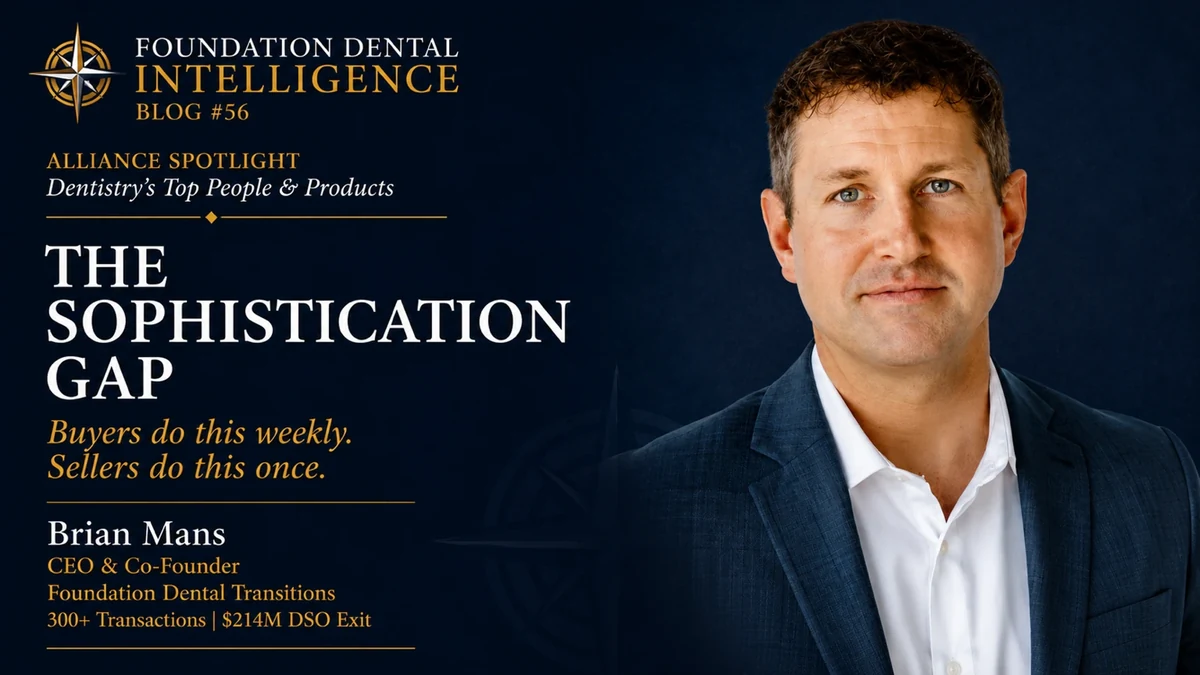
Brian Mans spent more than a decade on the buy side of dental acquisitions before co-founding Foundation Dental Transitions, and that experience shapes how he represents sellers today. Dr. Jim Arnold profiles the colleague who sat across the table from him before they became partners.
There is a moment in a practice transition that most dentists don’t anticipate. It isn’t the first conversation about selling, the valuation estimate, or even the letter of intent. It is the realization that the people across the table may have done this hundreds of times, while you may be doing it once.
That difference matters. A dentist can spend thirty years becoming an excellent clinician, building a team, developing patient trust, and creating a valuable practice without ever becoming fluent in institutional acquisitions. The buyer doesn’t have that limitation. Their team can include analysts, attorneys, operators, finance professionals, and acquisition leaders who evaluate transactions for a living.
The gap isn’t intelligence. It’s repetition.
Brian Mans has spent much of his career inside that repetition. He worked on the acquisition side of dentistry for more than a decade, later helped build Elite Dental Partners from an early organization into a 114-practice platform, and has personally led more than 300 transactions across 26 states. Today, he is Co-Founder and CEO of Foundation Dental Transitions.
Those numbers establish experience, but they aren’t the most interesting part of his story. What matters is what that experience taught him about how institutional buyers think, where they find risk, which terms matter after closing, and why a dentist can receive an impressive offer and still end up with an outcome that doesn’t fit the life they wanted.
That is why Brian’s perspective deserves attention.
Why Do Most Sellers Never See the Experience Gap?
Most dentists aren’t unprepared because they failed to do their homework. They’re unprepared because this isn’t their profession.
The dentist knows how to diagnose, treat, lead a team, manage a schedule, make payroll, invest in technology, develop associates, and care for patients. An institutional buyer knows how to evaluate EBITDA, provider concentration, quality of earnings, integration risk, capital structure, employment commitments, governance rights, and post-close exposure.
Those are different forms of expertise.
A seller may look at an offer and see the headline number. A buyer may be evaluating where risk can be shifted, where performance can be conditioned, how much equity stays exposed, and which obligations continue after closing. Neither side has to be dishonest for the imbalance to matter. The buyer is protecting its capital. The dentist needs someone protecting the dentist.
Brian learned that from the inside.
What Did Brian Learn From the Buyer’s Side First?
Brian’s acquisition career included time at Heartland Dental, where he joined the affiliations team and was eventually given a 26-state acquisition territory. From there he helped build Elite Dental Partners. Across that career he worked on more than 300 personally led transactions in 26 states, including thousands of individual practice valuations.
That repetition matters because it creates pattern recognition. Brian has seen how different practices are evaluated, where buyers become uncomfortable, which problems create diligence friction, and which risks change the way a transaction is structured.
Sellers often hear the buyer’s questions without understanding what sits behind them. Why are they asking about the associate agreement? Why do they care how much production belongs to the owner? Why does payer concentration matter? Why are they studying real estate terms? Why do they want to know who makes operational decisions when the doctor is away?
Those aren’t random diligence requests. They’re attempts to understand whether the economics the buyer sees today are likely to remain after ownership changes.
Brian spent years asking those questions from the buyer’s side. Now he uses that pattern recognition for the seller.
What Did Elite Dental Partners Add?
Buy-side experience alone would make Brian useful. Building and exiting an organization added something different.
Brian joined Elite Dental Partners in its early stages, as the second person on the team, and helped grow it to 114 practices across multiple states before a 2018 recapitalization valued at $214 million, a little over 14 times EBITDA.
That figure needs context. It is part of Brian’s company history. It isn’t an expected dental-practice multiple, and it should never be used as one.
The significance is what Brian learned while helping build something that would itself eventually be evaluated by sophisticated capital. A larger organization has to withstand scrutiny in a way that a good story can’t solve. Earnings have to be credible. Systems have to repeat. Leadership has to exist beyond a founder. Growth has to be believable. Integration has to work.
Brian has seen valuation from both directions. He has evaluated practices as a buyer, built an organization through acquisitions, lived through an institutional recapitalization, and later moved to the seller’s side of the table.
That full lifecycle changes how you look at a transaction.
Is Price the Only Part of the Outcome?
Dentists understandably focus on purchase price. I did too. It is visible, easy to compare, and usually the first number everyone talks about.
But two offers with similar headline economics can create very different lives after closing.
One may require a longer employment period. Another may have more rollover equity. A third may make more of the economics dependent on future performance. Governance, restrictive covenants, real estate, clinical expectations, compensation, and culture all affect what the seller is actually agreeing to.
The highest offer is therefore not automatically the best outcome. That isn’t an argument for accepting less money. It is an argument for understanding what the money requires from you.
For one owner, immediate liquidity may be the priority. Another may care deeply about maintaining autonomy. Someone else may be comfortable with rollover equity but unwilling to accept a long clinical commitment.
A good transition starts by defining what the owner actually wants before buyers begin defining the choices.
My Relationship With Brian Started Across the Table
Brian and I didn’t begin as partners. He was on the acquisition side when the organization he represented approached my practices.
We were sitting across from each other.
I asked a lot of questions because I was trying to understand the people, the organization, what they believed, what would happen to my associates, and whether the promises being made before closing would still matter afterward. Brian never treated those questions as an inconvenience.
That stayed with me.
Years later, after my own transition story became far more complicated than either of us could have predicted, the experience took on a different meaning. Brian understood the institutional mechanics because he had lived inside them. I understood the emotional and clinical side because I had been the owner.
That is part of why we eventually built Foundation Dental Transitions together. Brian sees where a buyer may find risk, how terms interact, and where negotiating position can erode. I feel the questions that are harder to put into a spreadsheet: what happens to the team, whether the owner still recognizes the practice after closing, and whether the next chapter is actually one the dentist wants.
The two perspectives are different. They are better together.
The Objection: Isn’t “Transition Architecture” Just Better Marketing for Brokerage?
That is a fair question. There are excellent dental brokers, investment bankers, attorneys, accountants, and M&A advisors doing serious work for sellers. Changing the name doesn’t change the service.
If an advisor lists a practice, introduces buyers, compares offers, and coordinates closing, then calling the work architecture doesn’t make it more sophisticated. The difference has to appear in the process.
A broader transition process begins before launch. It asks whether the owner should sell now at all. It looks at owner dependence, quality of earnings, leadership depth, associate agreements, real estate, payer concentration, and the owner’s objectives before a buyer starts controlling the timeline.
It also examines what remains after closing. How long will you work? What happens to your equity? Who controls clinical decisions? What happens if the organization is sold again? What commitments survive the transaction?
Those questions affect life after closing. That is where the distinction becomes real.
When Is the Right Answer to Wait?
Owners often assume that once they begin exploring a transition, the process should move toward a sale. I don’t believe that.
If the economics aren’t ready, the structure is wrong, leadership is too dependent on the owner, or the seller hasn’t decided what life after closing should look like, waiting can preserve more value than rushing.
Time can allow an associate to take more responsibility. It can give the owner room to improve reporting, clean up agreements, reduce dependence, or clarify real estate. Preparation creates more choices. Urgency usually removes them.
Brian’s acquisition experience makes him comfortable telling an owner when a practice isn’t positioned as well as it could be. That matters because the advisor shouldn’t benefit from urgency more than the seller does.
Are Competition and a Buyer the Same Thing?
Finding a buyer isn’t the same as creating a strong negotiating position. One interested organization gives the seller an option. Several qualified organizations evaluating the opportunity inside a controlled process can give the seller choices.
Those choices are useful because buyers differ in more than price. They differ in culture, employment expectations, equity structures, governance, growth strategy, integration style, and how they view the seller after closing.
A thoughtful process helps an owner compare those differences rather than simply react to whichever offer arrives first. Brian understands how institutional buyers evaluate opportunities because he spent years doing exactly that.
That knowledge is useful when deciding how a practice should be positioned, when buyers should receive information, and where the seller still has room to negotiate.
Does Culture Belong in the Conversation?
Culture is difficult to put into a valuation model. That doesn’t make it soft.
A buyer cares about team stability because turnover creates operating risk. The seller cares because those people may have helped build the practice for twenty years. Those views aren’t in conflict.
A transition that damages the team can damage performance. Patient relationships can weaken. Associates can leave. Employees can become uncertain. The new owner can inherit an organization that looked stable on the financial statements and feels completely different six months later.
Brian has seen enough transactions to understand why continuity matters to buyers. I have lived enough of the seller’s experience to know why it matters personally.
Both belong in the transaction.
The Decision Is Bigger Than the Closing Table
The night before I sold my practices, my daughter looked at me and asked a simple question: “Dad, are you sure?”
That question had nothing to do with the EBITDA multiple. It was about identity.
My practice had been part of our family for years. My team mattered. My patients mattered. My reputation was tied to it. Selling was financially important, but the financial part wasn’t the only thing being transferred.
I understand that question differently now than I did that night. A dental practice transition can change your balance sheet. It can also change your role, your identity, your relationships, your time, and what the next chapter of your career feels like.
Brian Mans understands the spreadsheet. He also understands that somebody has to live with what the spreadsheet creates.
That is why his experience matters to me, and it is why Foundation Dental Transitions was built around more than finding a buyer.
A dentist who has spent decades building a practice deserves representation that understands both sides of the table.
Frequently Asked Questions
Who is Brian Mans?
Brian Mans is Co-Founder and CEO of Foundation Dental Transitions. His background includes time at Heartland Dental and more than a decade on the dental acquisition side overall, more than 300 personally led transactions across 26 states, and helping build Elite Dental Partners to 114 practices before its 2018 recapitalization.
Why does Brian Mans’s buy-side experience matter to a dental practice seller?
It gives him firsthand knowledge of how institutional buyers evaluate earnings, provider dependence, risk, terms, and future obligations. That helps a seller understand what the organization across the table is evaluating before agreeing to a structure.
Did Brian Mans help build Elite Dental Partners?
Yes. He joined as the second person on the team in its early stages and helped grow it to 114 practices before a $214 million recapitalization at a little over 14 times EBITDA.
Does the highest purchase price always create the best transition?
No. Purchase price matters, but employment terms, rollover equity, earn-outs, governance, restrictive covenants, real estate, culture, and the seller’s post-close role can materially change the outcome.
What is the difference between brokerage and transition architecture?
The difference has to show up in the work. A broader transition process begins before buyer outreach and considers preparation, financial analysis, buyer fit, structure, culture, risk, and the owner’s objectives after closing instead of focusing only on listing and completing a sale.
Is a 14x EBITDA multiple something a dental practice seller should expect?
No. That figure describes Elite Dental Partners’ own corporate recapitalization, not an individual practice sale. It should be read as part of Brian’s company history, not as a benchmark for what any one practice will be worth.
How does Foundation Dental Transitions decide when a practice is ready to sell?
By looking at owner dependence, quality of earnings, leadership depth, associate agreements, real estate, and payer concentration before a buyer sets the timeline, and by being willing to recommend waiting when preparation would protect more value than a quick sale.
About the Author
Dr. Jim Arnold, DDS is the Founder and CEO of Foundation Dental Alliance, a leadership and practice development organization serving dentists from graduation through retirement. He has 30 years of experience as a multi-practice owner and has been involved in more than 60 dental practice transitions. He leads the Foundation Dental Mastermind, Luxury Dental Retreats, co-founded Foundation Dental Transitions, and hosts the Foundation Dental Podcast. He also publishes the Foundation Dental Newsletter and Blog weekly, focused on leadership, practice design, and long-term sustainability in dentistry.
Stay Connected
Websites
FoundationDentalAlliance.com
FoundationDentalMastermind.com
FoundationDentalTransitions.com
FoundationDentalNetwork.com
LuxuryDentalRetreats.com/dubai
Social Media
LinkedIn: linkedin.com/in/arnoldjim
Instagram: instagram.com/smilesbyarnold
YouTube: youtube.com/@DrJimArnold
Facebook: facebook.com/smilesbyarnold
Twitter/X: twitter.com/smilesbyarnold
Publications
Foundation Dental Newsletter: linkedin.com/newsletters/foundation-dental-newsletter
Contact
Professional Email: drarnold@foundationdentalalliance.com