Foundation Dental Intelligence
Blog No. 66
You Built a $20 Million Asset.
Get the next article.
One signup. Everything we publish.
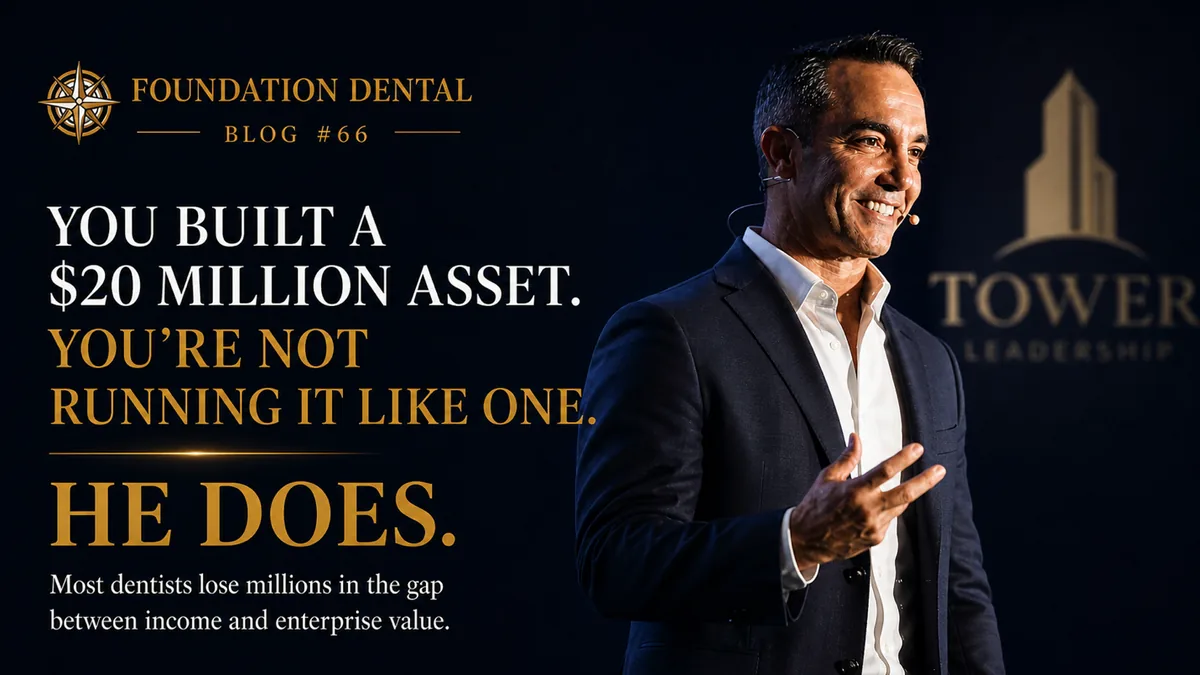
Most dentists will make a $10 million mistake in their career. Not because they're careless. Not because they're bad at business. Because nobody ever told them the difference between what their practice earns and what their practice is worth.
Those are not the same number. Not even close. And the gap between them is where most dental careers quietly end in a place their owners never planned to be.
I've been in dentistry for over 25 years. I've personally walked more than 60 practice owners through transitions. I've sat across the table from doctors at the most consequential moment of their professional lives, and I can tell you with certainty: the ones who came in understanding enterprise value walked out with options. The ones who didn't left money on the table they'll never get back.
I've seen the look when the number comes back lower than expected. It's not confusion. It's not anger. It's realization. Realization that the last 20 years were built on something that doesn't transfer the way they thought it would. I've sat with that look more times than I'd like to count. It's the reason I take this conversation seriously.
Most dentists are taught how to produce dentistry. Very few are taught how to build enterprise value.
That's not my line. It belongs to Eric J. Morin, MBA, Founder and President of Tower Leadership. And I'd argue it's the most important sentence in the dental industry right now.
Why I'm Writing This
I don't write about other people's work very often. When I do, it's because I believe the work is doing something the industry needs and isn't getting anywhere else.
That's what Eric Morin has built with Tower Leadership.
I've spent significant time studying what he's done, his books, his programs, his frameworks, his track record, and what I keep coming back to is this: he identified a structural gap in how dentists are advised and built an entire ecosystem to close it. Not a coaching program. Not a consulting firm. An ecosystem.
That matters, and I'll explain why in a minute. But first you need to understand where this man came from. Because the origin story explains everything.
He Never Practiced Dentistry. That's Exactly the Point.
Eric Morin didn't come up through the dental industry. He came up through the United States Navy.
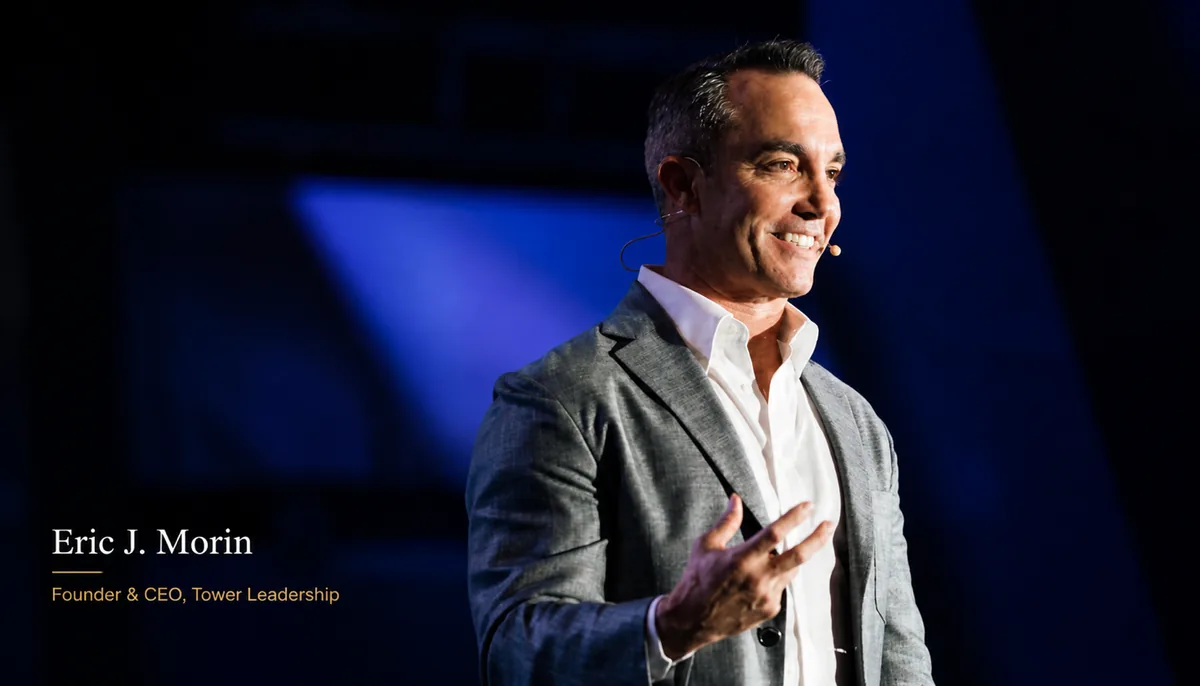
He didn’t learn to do dentistry. He learned how to value it.
From 1996 to 2000, he served as Aviation Ordnance Logistics personnel aboard the USS George Washington during Operation Southern Watch, the campaign enforcing the Iraqi no-fly zone. He was 19 years old. He was leading a 30-member team accountable for over $100 million in live ordnance assets. His accuracy rating as Logistics Manager was 99%. He made E-5, Petty Officer Second Class, in two and a half years.
In the Navy's structured advancement system, that pace means one thing: this person performs at a level that cannot be ignored.
When Eric talks about discipline, accountability, and leadership being the multiplier on everything else, he isn't quoting a framework. He's reporting back from four years where getting it wrong had consequences measured in lives. That formation is the operating system everything else runs on.
After the Navy, Eric’s first real laboratory in dentistry came through helping build
and scale his own dental practice from the inside. He entered the industry
without clinical training, without traditional dental assumptions, and without the
baggage of what everyone said was supposed to be possible. Family Dentistry at
Seven Hills in Acworth, GA grew from a single-doctor startup into a multi-doctor,
multi-million-dollar practice within three and a half years. That experience
became the proving ground for much of what he teaches today.
Capital allocation. Leadership infrastructure. Accountability. Organizational
structure. Practice value. The role of the owner. Those ideas were not developed
as theory. They were tested inside a real operating business.
Then Eric spent time in the financial services world, including Northwestern
Mutual and DDS Financial, where he saw another side of the problem. Dentists
were being told to pull profits out of their practice, diversify into outside
investments, and treat the business mostly as an income engine. The advice
sounded responsible. The math told a different story. That is the path that
eventually led to Tower Leadership in 2017.
The $20 Million Conversation Nobody Was Having
Here's the number that changed how I think about this.
A dental practice generating $5 million in revenue with $1 million in EBITDA would require approximately $20 million sitting in an investment account at 5% returns to replicate that same annual cash flow.
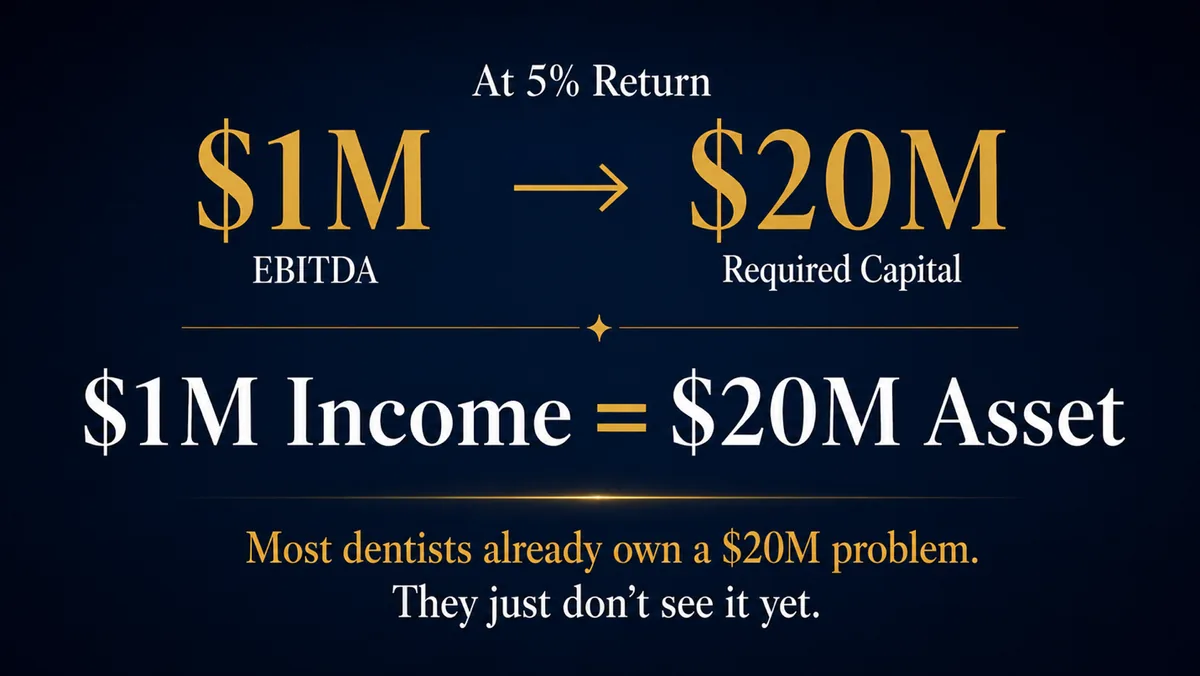
Most dentists already own a $20M problem. They just don’t see it, yet.
Twenty million dollars. Most dentists don't have $20 million. Most dentists will never accumulate $20 million through conventional savings and investment strategies. But a significant number of them already own the asset that generates the equivalent.
The practice isn't a job that happens to pay well. It's the most powerful wealth-generating asset most dentists will ever own.
The standard financial advisory playbook says: take your profits out, diversify into markets, build a portfolio outside the practice. That advice sounds responsible. The math doesn't support it. You're pulling capital out of your highest-performing asset to fund lower-returning ones.
Eric Morin has been saying this for nearly a decade. Tower Leadership exists to help dentists internalize it before the window closes.
Eric Morin isn’t just helping dentists grow practices. He’s helping them understand what their practice is actually worth before someone else defines that number for them.
What Buyers Actually See - And What Most Owners Miss
I've been involved in more than 60 dental practice transitions. Here's what I know about how sophisticated buyers evaluate a practice.
They don't walk in asking how busy you are. They ask something much simpler: what happens when the doctor isn't here?
That question tells them everything. If the answer is uncertainty, the value drops. If the answer is stability and predictable systems, the value increases. The practices that command premium valuations aren't perfect. They're predictable. And predictability is built long before a transition conversation ever starts.
Buyers don't just buy your production numbers. They buy how predictable those numbers are without you.

This is the question that every buyer asks before they name a number.
That's the insight Tower Leadership operates from. Most dental consultants optimize production. Tower Leadership engineers transferability. Those are fundamentally different objectives and they produce fundamentally different businesses.
A practice can have $3 million in production and be worth very little on the open market. A different practice with $2 million in production, built with the right infrastructure, leadership depth, and margin quality, can be worth significantly more. The difference isn't the revenue. It's the design.
What Tower Leadership Actually Does
Tower Leadership is not a consulting firm in the conventional sense. It is a high-
level advisory and implementation firm built for dental practice owners who need
more than advice.
The firm typically works with growth-minded practices above approximately $1.8
million in annual revenue, with an average client practice around $3.9 million.
These are often owners with an associate, owners preparing to bring on an
associate, multi-location practices, or practices operating from larger facilities
with clear aspirations for growth.
Tower’s clients are usually not looking for surface-level improvement. They are
trying to build a stronger business, not just a busier one. That means looking
beyond production and collections and evaluating the practice through the lens of
profitability, leadership, operational structure, financial clarity, and long-term
enterprise value.
Tower’s work begins with diagnosis. Where is profit being lost? Where is the
owner still carrying too much of the business personally? Where is leadership
weak? Where is capital being misallocated? Where is the practice growing in
revenue but failing to build value? From there, Tower helps design the path
forward and supports the execution through advisory, on-site consulting,
financial guidance, leadership development, team training, KPI tracking, and
operational implementation.
The distinction matters. Tower does not simply tell practice owners what is
wrong with the business. It helps them understand what needs to change, why it
matters, and how to execute it. Clients average approximately 25% revenue
growth in their first year, compared to an industry baseline closer to 3%. More
than 84% stay for multiple years. Average retention is 4.7 years.
If you want to know whether a consulting firm is actually delivering, look at retention. Nobody stays 4.7 years on average unless the results are real.
Tower Leadership operates on an ascending model built around where a practice
is today, what the owner is trying to build, and what level of sophistication the
business now requires. Over time, the firm developed four core tiers: Momentum,
Mastery, Multiplier, and Exponential. Each tier reflects a different stage of
practice growth, organizational complexity, leadership maturity, and enterprise
value potential. The structure was not created as a generic product ladder. It
came from years of pattern recognition across dental practices where the same
constraints tend to appear at similar stages of scale.
Some owners enter the ecosystem through a Focus Day, where Tower works
directly with the doctor to understand the practice, the owner’s goals, the
financial picture, and the operational realities of the business. Others enter
through the Foundation Workshop, a two-day, MBA-style intensive designed to
help owners step outside the daily demands of the practice and begin seeing the
business through a more strategic lens. In both settings, the objective is not to
force the owner into a predetermined program. The objective is to understand the
business with enough clarity to determine what the next stage actually requires.
From there, Tower develops a strategic blueprint based on the practice’s current
size, leadership structure, financial performance, growth capacity, and long-term
objectives. That blueprint may point toward advisory work, on-site consulting,
leadership development, financial infrastructure, KPI management, recruiting
support, billing support, or a combination of several disciplines. The program tier
provides the operating structure, but the scope of work is shaped by the actual
needs of the practice.
That distinction matters. A practice preparing to bring on an associate does not
need the same architecture as a multi-location group. A doctor trying to move
from $2 million to $5 million faces a different set of constraints than an owner
preparing for larger-scale enterprise value creation, succession, or eventual
transition. The program architecture exists to meet the owner where they are,
then help the business grow into the next level without outgrowing its leadership,
systems, or financial discipline.
What No One Else Is Doing at This Level
I want to be direct: there's nobody doing exactly what Eric Morin is doing at the level he's doing it.
The conventional dental consultant teaches you how to make more money. The conventional financial advisor teaches you how to save and invest what you make. The conventional broker helps you sell when the time comes. Each of those is a real service. None of them answers the question that actually matters: what is your practice worth as an enterprise, what drives that value, and how do you engineer it before the conversation with buyers ever starts?

Income is visible. Value is engineered.
Eric's third book, Beyond the Big Payday, is the most urgent piece of work in his catalog right now. It's not a retirement planning guide. It's a manual for reading your business like a sophisticated buyer reads it - understanding what drives multiples, why clean monthly financials and defensible EBITDA and a true Quality of Earnings are what sophisticated buyers actually evaluate, and how to find smarter paths to liquidity that don't require surrendering control.
Do not trade your greatest asset for a smaller future.
That's the central warning in the book. Seven words. Worth sitting with.
Why Atlanta in November Matters
On November 13th and 14th in Atlanta, Eric Morin is hosting the Tower Impact Summit 2026. I'm going to be there.
This isn't a CE event. It's not a sit-and-listen dental conference. It's two days built around one question most dentists never seriously ask themselves: what is your practice actually worth, and what could it become?
The speaker lineup tells you everything about the level of conversation: Tim Tebow, Jesse Itzler, Eric J. Morin, Brian Colao, Matt Ornstein, Dr. Anushka Gaglani, Amol Nirgudkar, Dr. Abhishek Nagaraj, Dr. Mary Pham.
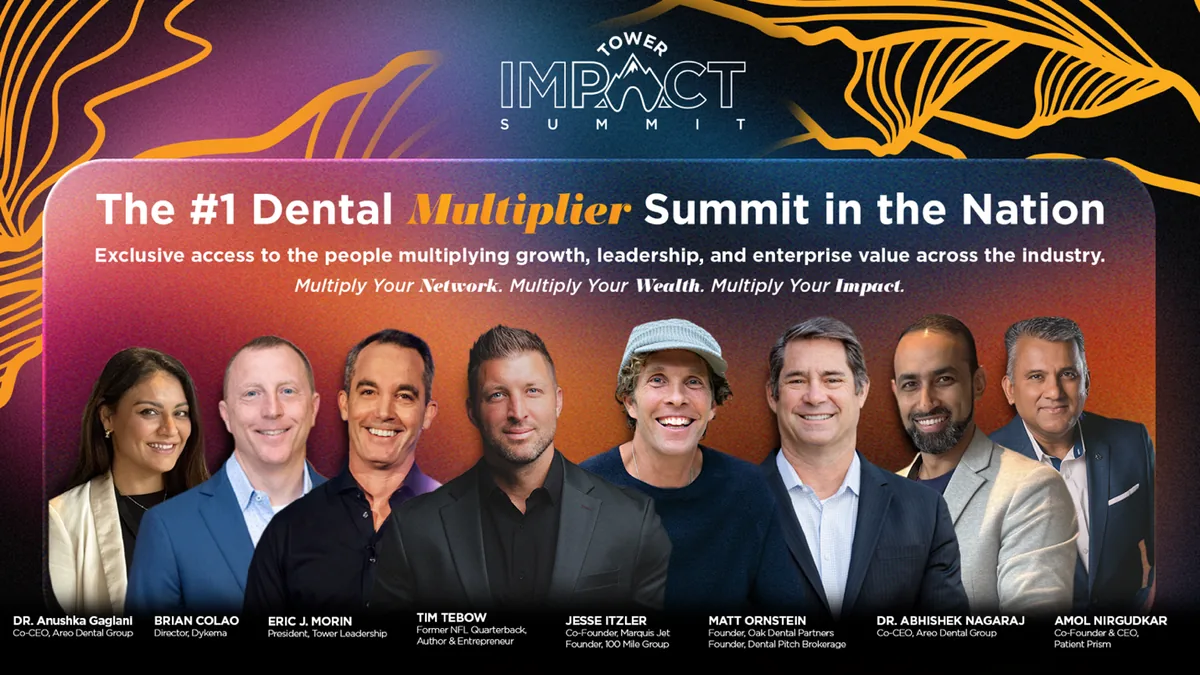
If you want to understand enterprise value at the highest level, this is the event.
That's not a dental industry lineup. That's a deliberate signal. The dentists who need this conversation aren't going to get it from a standard CE format. They need to be in proximity to people who think at a different level, across industries, across business models, across the entire arc from leadership to enterprise value to legacy.
I'll be at the Tower Impact Summit because I believe the most dangerous thing in dentistry right now isn't DSO pressure or staffing challenges or reimbursement compression. It's the information asymmetry between what sophisticated buyers know about practice value and what most practice owners know. Events like this one close that gap.
Use my promo code ALLIANCE30 for 30% off at checkout. Register at TowerImpactSummit.com/general-register.
Atlanta. November 13th and 14th.
The Question Worth Sitting With
If you sold your practice tomorrow, would you know what it was worth to a sophisticated buyer? Not what your accountant thinks. Not what a broker told you last year. What a buyer with full information and a real capital stack would actually pay for the enterprise you've built?
Most dentists can't answer that question. And the ones who can't answer it are the ones most likely to leave significant money on the table, whether they sell or not.
You don't build enterprise value by accident. You build it by treating the practice like the asset it actually is.
The practices that create freedom later are the ones that were built for it from the beginning. That's what Tower Leadership teaches. That's what Eric Morin has spent his career building toward. And that's why I think what he's doing matters enough to write 2,000 words about it.
Most dentists build something they have to keep working in. A few build something that can outlive them. That difference is designed.
If this made you think, send it to someone in dentistry who needs to hear it.
FAQ
What is dental enterprise value and how do I build it?
Enterprise value is what your practice is worth to a sophisticated buyer as a business, not just as a collection of production numbers. You build it by engineering predictable cash flow, reducing founder dependence, building transferable leadership infrastructure, and managing capital allocation intentionally rather than reactively.
What does Tower Leadership actually do for dental practices?
Tower Leadership works with growth-minded dental practice owners to build
stronger businesses through Strategy, Capital Allocation, Organizational
Structure, and Leadership. The firm typically works with practices above
approximately $1.8 million in annual revenue, with an average client practice
around $3.9 million, and focuses on helping owners build practices that are more
profitable, more structured, more scalable, and less dependent on the doctor’s
daily involvement.
Who is Eric Morin and why should dentists pay attention to him?
Eric Morin is the Founder and President of Tower Leadership, a Forbes speaker, and the author of three books on dental wealth and enterprise value. He came to the dental industry from the U.S. Navy and financial services, not from clinical practice, which gave him the outsider lens to see what everyone inside the industry had stopped questioning. He founded Tower Leadership in 2017 and has since built one of the most comprehensive dental advisory ecosystems in the country.
What is the Tower Impact Summit?
The Tower Impact Summit is Tower Leadership's annual two-day flagship event in Atlanta, designed for dental entrepreneurs, DSO executives, and practice owners who want to build enterprise value and think beyond linear growth. The 2026 edition runs November 13-14 in Atlanta and features Tim Tebow, Jesse Itzler, Eric J. Morin, and several other national speakers and operators.
How is building enterprise value different from just growing production?
Production growth is linear. Enterprise value is what a buyer will pay for your business based on EBITDA quality, transferability, leadership depth, and organizational infrastructure. You can have a $3M production practice worth very little on the open market, or a $2M practice worth significantly more, depending entirely on how it's built and run.
About the Author
Dr. Jim Arnold, DDS is the Founder and CEO of Foundation Dental Alliance, a leadership and practice development organization serving dentists from graduation through retirement. He has more than 25 years of experience as a multi-practice owner and has been involved in more than 60 dental practice transitions. He leads the Foundation Dental Mastermind, Luxury Dental Retreats, and hosts the Foundation Dental Podcast. He also publishes the Foundation Dental Newsletter and Blog weekly focused on leadership, practice design, and long-term sustainability in dentistry.
Stay Connected
FoundationDentalAlliance.com
FoundationDentalMastermind.com
FoundationDentalTransitions.com
FoundationDentalNetwork.com
LuxuryDentalRetreats.com
LinkedIn: LinkedIn.com/in/ArnoldJim
Instagram: Instagram.com/SmilesbyArnold
YouTube: YouTube.com/@DrJimArnold
Facebook: Facebook.com/SmilesbyArnold
Twitter/X: Twitter.com/SmilesbyArnold
TikTok: TikTok.com/@FoundationDentalAlliance
Google Business Profile: tinyurl.com/2t3chcv6
Professional Email: drarnold@FoundationDentalAlliance.com