Foundation Dental Intelligence
Blog No. 65
How to Build a Decision Rights Map for Your Dental Practice.
Get the next article.
One signup. Everything we publish.

At some point in building my practices, I started noticing something I didn't have a name for yet. Good people were still walking decisions to me that they were fully capable of handling. Not because they were lazy. Not because they lacked confidence. Because nobody had ever told them they were allowed to decide.
So everything defaulted to the same place. Scheduling conflicts. Supply approvals. Patient complaints. Financial exceptions. All of it found its way back to me.
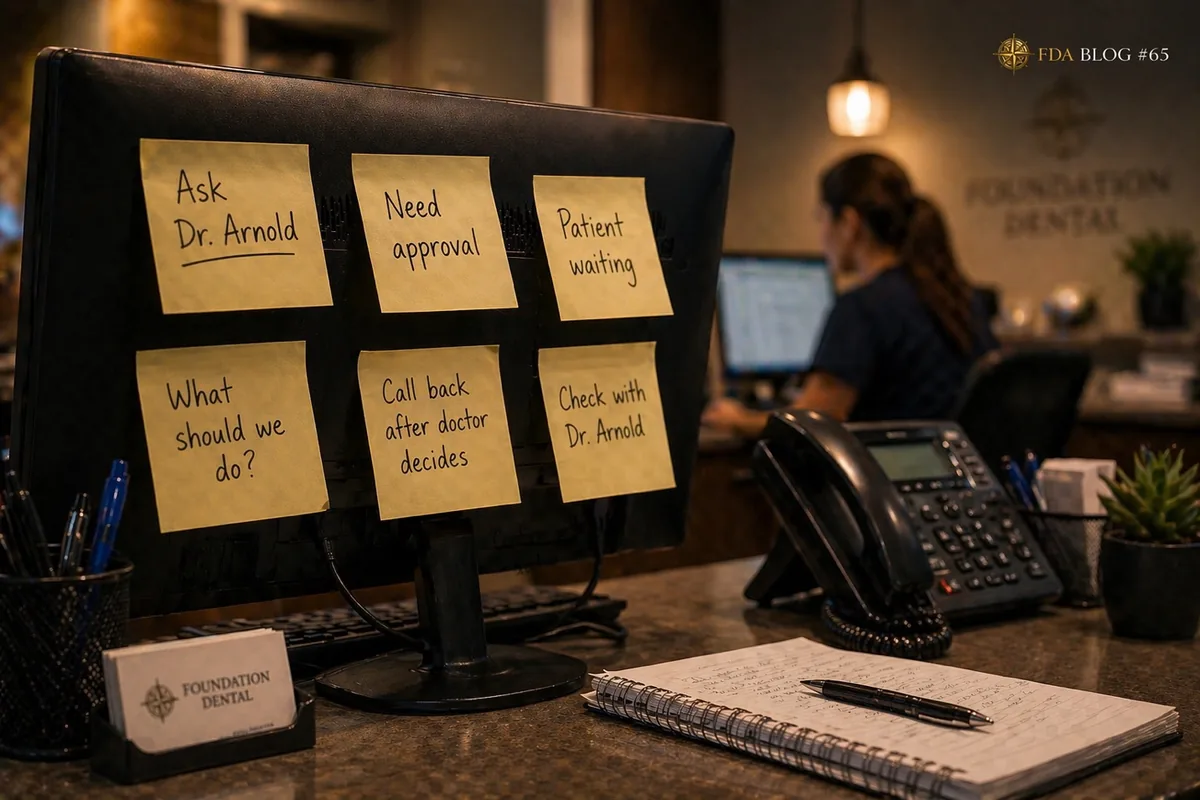
Every unanswered question has one exit point. You.
That's not a team problem. That's an architecture problem. And architecture problems don't fix themselves with more conversations.
What a decision rights map actually is
It's a one-page document that answers one question for every major category of decision in your practice: who owns this?
Not a policy manual. Not a flowchart on the wall. A living document that matches how you want the practice to actually run. At its simplest, the map answers three things for every decision category - who decides, what they can decide on their own, and when the doctor must be involved.
Most practices never write this down. They rely on habit, seniority, and whoever has been around longest to keep things moving. That feels efficient until you try to step back - or until the person who holds everything together isn't there for a day.
A practice that runs without you doesn't have fewer decisions. It has fewer decisions that need you.
The real problem most owners never name
Every time you answer a question that someone else could have handled, you're not just solving a problem. You're training your team to stop thinking. You signal - without meaning to - that their judgment can't be trusted. Over time, you don't create a high-performing team. You create a team that's skilled at one specific thing: getting your approval before moving forward.
That team looks engaged. It's actually dependent.
Most owners assume this is a capability problem. So they train more, communicate more expectations, hire differently. None of that fixes it. Because the problem isn't capability. It's ownership. Nobody actually owns the decisions - so everything escalates.
I've been involved in 60+ dental practice transitions. Buyers see this pattern immediately. If every decision still travels to the doctor, the practice is worth exactly what the owner is worth. And the owner won't be there after the sale.
The three decision lanes
The most practical way to build a map is to sort every recurring decision in your practice into one of three lanes.
Lane one is full team autonomy. These are decisions the team member makes entirely on their own - no reporting, no approval, no waiting. Routine schedule adjustments within defined parameters. Standard supply orders. Rescheduling a patient who called in. The team member closest to the work owns it completely.
Lane two is recommendation plus confirmation. These decisions require input from a second person before action - not the doctor, but a lead. A discount request above a certain dollar amount. A patient complaint with any escalation potential. A team scheduling conflict involving multiple people. The assigned lead recommends, a quick confirmation happens, and it's resolved without touching you.
Lane three is genuine doctor involvement. This list is shorter than most owners expect when they actually sit down and define it. Most owners discover they're involved in decisions they were never actually required for. Clinical decisions above a defined risk level. Legal or compliance exposure. Hiring and termination. Major vendor contracts. If it requires your specific judgment, authority, or accountability - it belongs in lane three. Everything else doesn't.
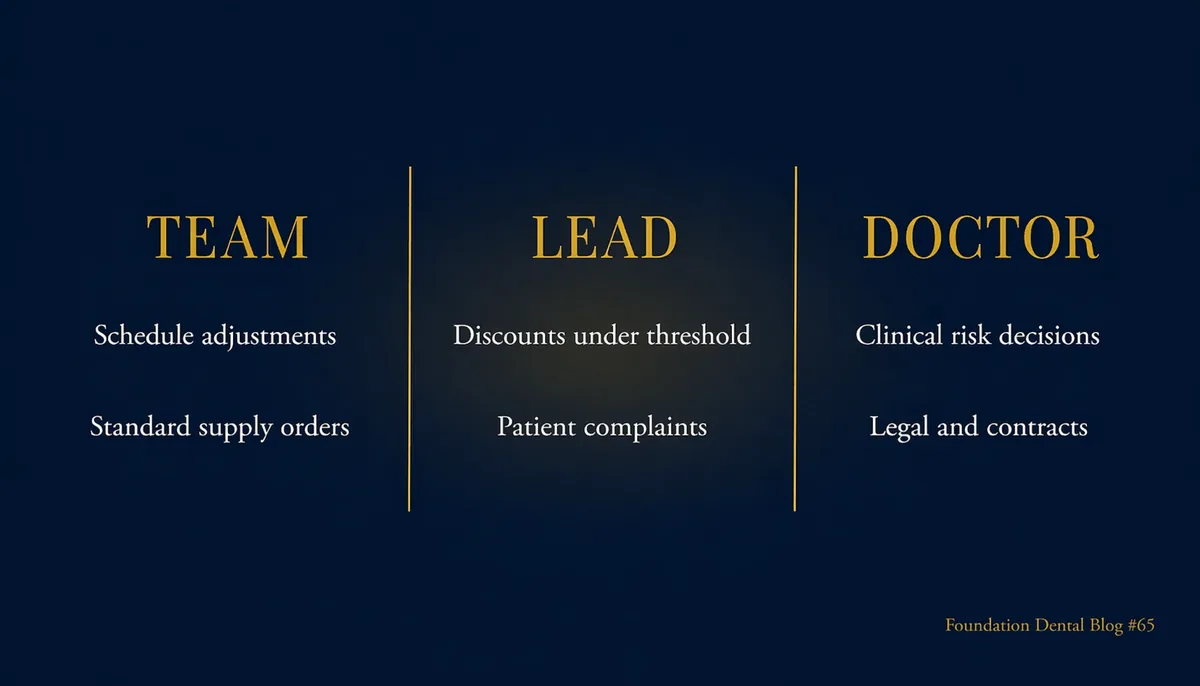
Three lanes. One rule: every decision has exactly one owner.
Your team wasn't waiting for training. They were waiting for permission.
How to build yours - the actual process
Start with a decision audit. For the next seven days, keep a simple log of every non-clinical decision that reaches you. Every time someone says 'can I ask you something,' write down the category. Scheduling. Patient finances. Supply issues. Team conflict. HR questions.
You're not looking for one-off scenarios. You're looking for patterns. By the end of a week you'll see three to five categories that repeatedly pull you in. If the same type of decision reaches you more than once a week, it doesn't have a home yet. That list is your starting point.
Then sort it. For each category, ask one honest question: if I weren't in the building, who should own this? Not who usually asks me about it. Who should own it if the practice were designed the way you want it to run.
Assign one owner to each category. Not shared. Not 'we'll decide together.' One person. Shared ownership in a dental practice is a polite way of saying nobody owns it. The person whose name is on a category is the person responsible for the outcome.
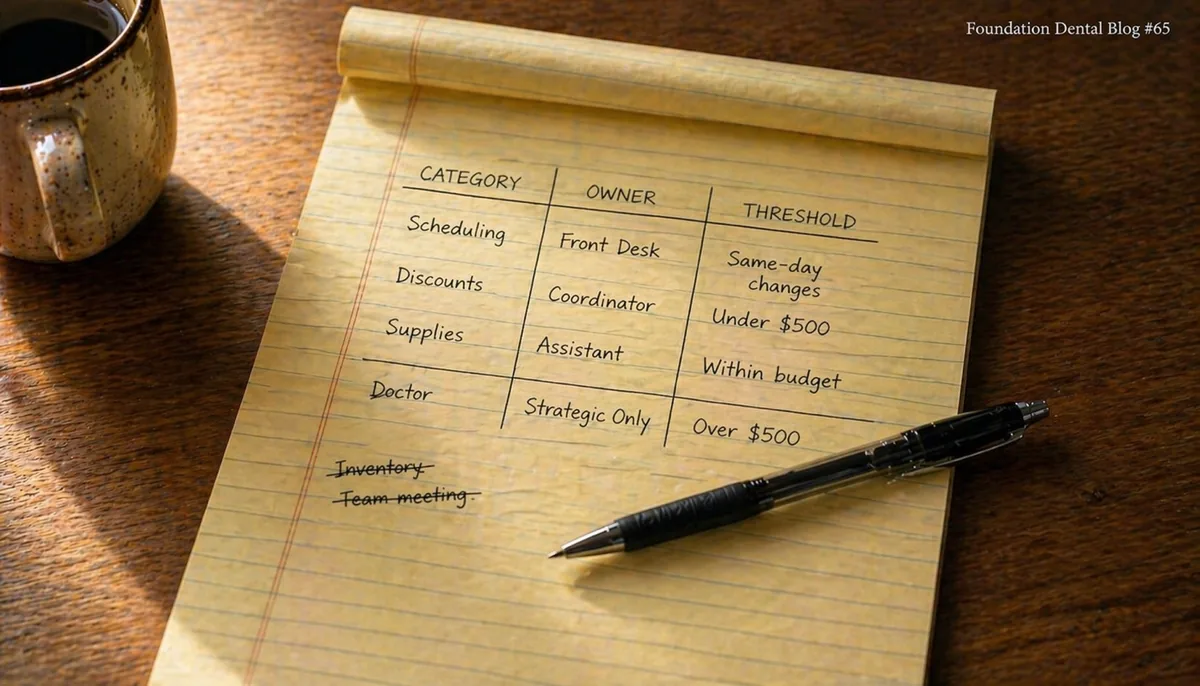
One page. Every category. One name on each line.
Define the thresholds. 'Use your judgment' sounds empowering. It's also how people end up stuck, because they're never sure if they're about to cross a line. For each category, answer three questions: up to what dollar amount or risk level can this be decided without you, what must be documented when this decision is made, and what specifically triggers looping you in. Clarity beats volume. If the rules are simple enough to remember, the team will use them.
Then put it on one page. Three columns - category, who decides, when the doctor is involved. If it takes more than one page, it will live in a binder and nobody will look at it.
The part most owners get wrong
They build the map and undermine it within a week.
When a team member makes a decision you would have made differently - and they will - the instinct is to correct it. To explain what you would have done. To quietly take the next one back. Every time you do that, you're training the team that the map doesn't mean anything. That the real rule is still to get your approval.
The map only works if you hold yourself to it as strictly as you hold the team. That means accepting decisions you disagree with, as long as they're within the authority the team member was given. It means asking 'what did you decide?' instead of 'what should we do?' It means not being the first person to solve a problem in a lane you already assigned.
Run the 30-day test on one lane. Pick one category where you're tired of being the answer key - scheduling, patient finances, or supplies. For thirty days, refuse to be the first problem-solver in that lane. When someone brings it to you, ask three questions: what have you already tried, what do you recommend, and what would you do if I weren't here? Then let them do it unless there's legal or ethical risk.
By the end of thirty days you'll know whether the bottleneck was the team - or the design you put them in.

Same people. Same capability. Different structure.
What changes after six months
The volume of decisions that reach you drops significantly. The team starts correcting each other based on the map - not punitively, but based on shared clarity. New team members onboard faster because the decision authority is explicit from day one.
The deeper shift is in how your role feels. You stop being the answer to every question and start being the person who built the system that answers them. That's the difference between owning a practice and being owned by one.
And when the practice goes to transition - whether that's five years from now or twenty - the map is part of the evidence that this practice holds without the owner. That evidence is worth real money. Buyers don't just look at production. They look at what happens when the doctor isn't in the room. Durability commands a premium. Dependency doesn't.
If decisions keep finding their way back to you, it's not because your team can't handle them. It's because the system still requires you. Fix the system. Or accept that everything will continue to depend on you.
Stop being the answer key for every problem in your practice.
Frequently Asked Questions
How long does it take to build a decision rights map for a dental practice?
The audit takes about a week if you do it honestly. The map itself - categories, owners, lanes, thresholds - can be written in a single working session once you have the audit data. Most owners spend more time debating than building. Start with the five decisions that reach you most often and work from there.
How do I know which decisions to keep and which to assign?
Keep anything with legal exposure above a defined threshold, clinical decisions above a defined risk level, and hiring or termination. That's a shorter list than most owners assume. Everything else should have a name on it that isn't yours.
What if my team makes a decision I disagree with?
If it's within their defined lane and doesn't create legal or clinical risk, let it stand. Then debrief it - not to correct, but to build judgment. The first few times will feel inefficient. That friction is the system working. Teams that never make decisions never develop the judgment to make better ones.
How does a decision rights map affect practice value at transition?
Directly and significantly. Buyers price in operational dependency when they evaluate a practice. A practice that runs on the owner's presence is worth less than a practice with codified decision authority. The map is evidence - not just a management tool. It's one of the fastest ways to move from average valuation to premium valuation.
Is this the same as an org chart or a policy manual?
No. An org chart shows reporting lines. A policy manual shows rules. A decision rights map shows who decides what. You can have both of those and still have every decision defaulting to the doctor because nobody ever mapped the authority explicitly. The map fills that gap.
About the Author
Dr. Jim Arnold, DDS is the Founder and CEO of Foundation Dental Alliance, a leadership and practice development organization serving dentists from graduation through retirement. He has more than 25 years of experience as a multi-practice owner and has been involved in more than 60 dental practice transitions. He leads the Foundation Dental Mastermind and Luxury Dental Retreats, and publishes the Foundation Dental Newsletter and Blog weekly.
Stay Connected
FoundationDentalAlliance.com
FoundationDentalMastermind.com
FoundationDentalTransitions.com
FoundationDentalNetwork.com
LuxuryDentalRetreats.com/dubai
LinkedIn: linkedin.com/in/arnoldjim
Instagram: instagram.com/smilesbyarnold
YouTube: youtube.com/@DrJimArnold
Facebook: www.Facebook.com/smilesbyarnold
Twitter/X: www.twitter.com/smilesbyarnold
TikTok: www.tiktok.com/@foundationdentalalliance
Google Business Profile: tinyurl.com/2t3chcv6
Foundation Dental Newsletter: linkedin.com/newsletters/foundation-dental-newsletter-7289675134649450496
Professional Email: drarnold@foundationdentalalliance.com