Foundation Dental Intelligence
Blog No. 73
The Outsider Who Saw Dentistry More Clearly Than Dentistry Sees Itself.
Get the next article.
One signup. Everything we publish.
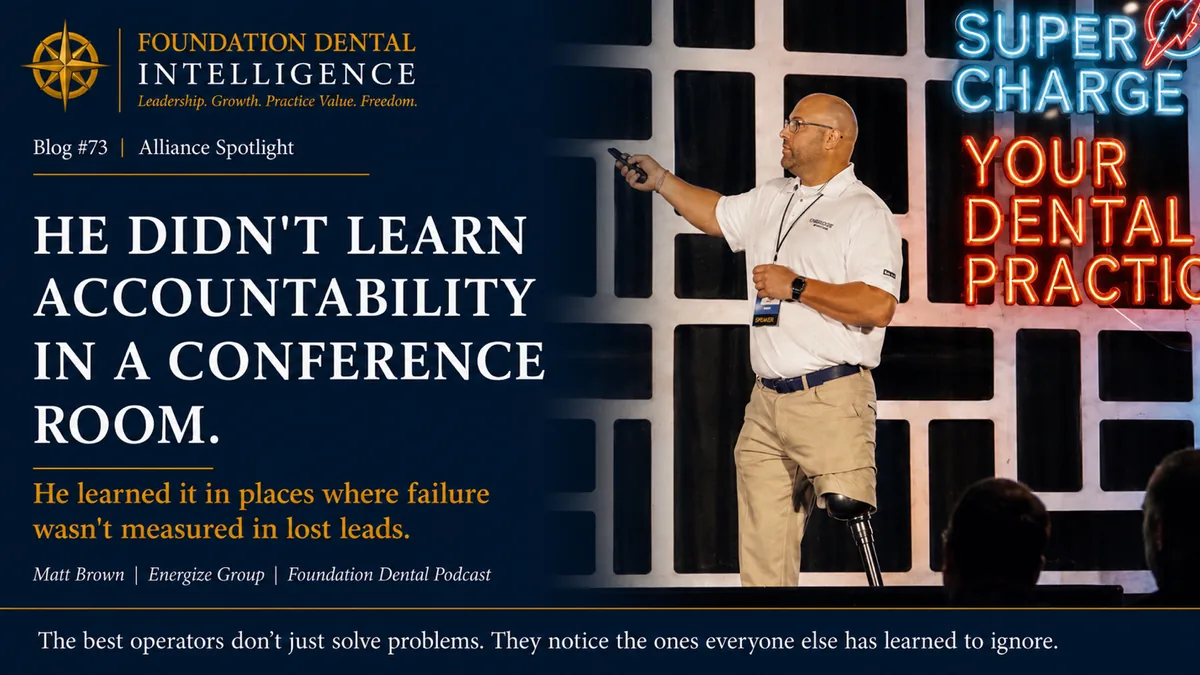
A government contractor took part of Matt Brown’s leg back. That isn’t a metaphor. It actually happened.
Matt had already lost his left leg above the knee to bone cancer. He’d survived the diagnosis, come through the amputation at Duke, spent seven months in a wheelchair, and worked his way through what should have been a straightforward rehabilitation process inside the VA system. When he arrived for what should have been a routine prosthetics appointment, he assumed the hardest part was behind him.
It wasn’t. A technician took his leg to the back, worked on it for a few minutes, and carried it out with the wrong ankle attached. The newer component was gone. The VA hadn’t paid the vendor’s invoices, so the vendor had taken it back.
Brown sat in that office and repeated it to be sure. They were repossessing his ankle. He didn’t scream. “When I say furious,” he said later, “I should really say determined. That was it. It was on. The VA just crossed the line.”
Most people would have walked out angry. Matt Brown walked out with a mission.
The reason I begin here has nothing to do with prosthetics. It has everything to do with perspective. What followed that moment - the documented failures, the network of 80 veterans, the Congressional testimony, the policy changes - isn’t primarily a healthcare story. It’s a story about what happens when a system fails the person inside it, and what someone with the right background decides to do about that.
Matt Brown is the co-founder and CRO of Energize Dental Marketing. That’s the least interesting thing about him, and he’d tell you so before you finished asking. His operating system was built long before dentistry entered the picture, and the places where it was built explain almost everything about how his company runs - including why the front desk of a dental practice matters to him far more than most owners expect.
The Parachute Either Opens or It Doesn’t
Matt enlisted in the Army in 2009 and landed at Fort Bragg with the 82nd Airborne as a paratrooper and parachute rigger. That second job title matters more than it sounds. A rigger packs and maintains the equipment that keeps other soldiers alive. There is no partial credit. The pack either opens or it doesn’t. Somebody lands or they don’t. There is no version of that work where you hand the problem off at the moment of failure and explain that conversion was the other person’s responsibility. That standard gets into a person and doesn’t come back out.
He went on to earn SOCP certification as an Army Combatives Instructor. There’s a real difference between performing under pressure and teaching someone else to do it. An instructor has to take intuitive competence and break it into steps another person can actually execute. That’s a systems skill, and it surfaces consistently in how he coaches dental teams today. He served with Long Range Surveillance units in the Maryland National Guard through his honorable discharge in 2015.
The military didn’t teach him marketing. It taught him that outcomes are downstream of systems, and when a system fails, a real person pays for it. He evaluates practices the same way he once evaluated equipment: not by effort or intention, but by whether the system consistently produces the outcome it was designed to produce.
The Mat Before the Company
Before Energize existed, Matt was building Team JBM Wilmington, the first traditional Gracie-lineage Brazilian Jiu-Jitsu academy in the area, founded at the end of 2012 under Professor Brian McPherson. It grew to roughly 350 members in under two years.
A BJJ academy doesn’t grow on ad spend. People don’t stay because they saw a clever post. They stay because the relationship holds and because they’re genuinely changing. The product is transformation over time, and transformation requires trust to persist past the point where it gets uncomfortable.
Most of the principles visible inside Energize today were tested on those mats first. Ryan Raybould, who would become his co-founder and CEO, came out of that same world. Their partnership is older than the company.
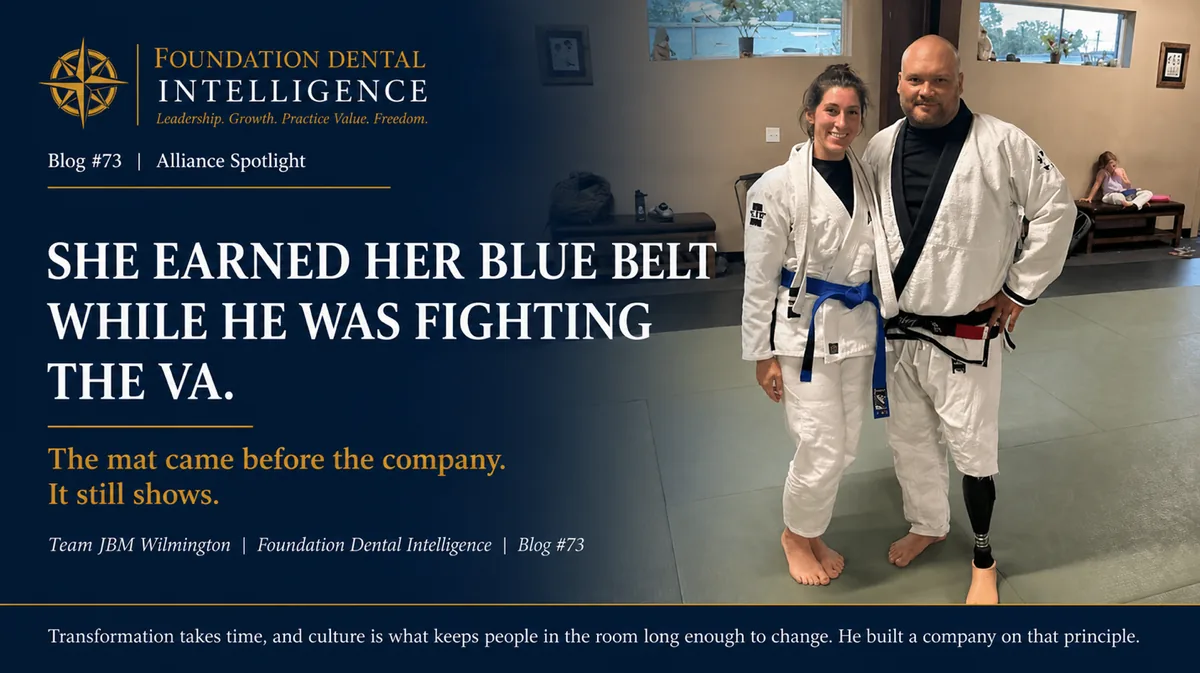
Jayne Brown earned her BJJ blue belt while her husband was fighting the VA from a wheelchair. The mat came before the company, and the principles built there - transformation over time, trust that has to be earned before it holds - define Energize.
Dentistry Is Braver Than Dentists Realize
One of the strongest moments in our podcast conversation came before we were ten minutes in, and I’ve been thinking about it since.
Matt said dentistry is one of the bravest professions in the world. That’s a meaningful claim from someone who spent years jumping out of airplanes in the dark. His reasoning isn’t sentimental.
Military missions include intelligence. You know something before you take the risk. Dentists commit to a training pipeline that takes years before they truly understand the life they’re choosing. They graduate carrying hundreds of thousands in debt, often with almost no formal education in leadership, communication, accounting, or business. Then they buy or build a practice - typically another million or more - before they have any real equity, before anyone’s helped them hire a team or manage a schedule or make payroll or handle the 40 things that have nothing to do with clinical skill and everything to do with whether the practice survives.
Most dentists have been inside that for so long they’ve stopped noticing how heavy it is. The outsider sees the courage they’ve forgotten they’re carrying. Sometimes it takes someone who wasn’t trained to think like a dentist to remind the profession that what feels normal from the inside might look extraordinary from the outside.
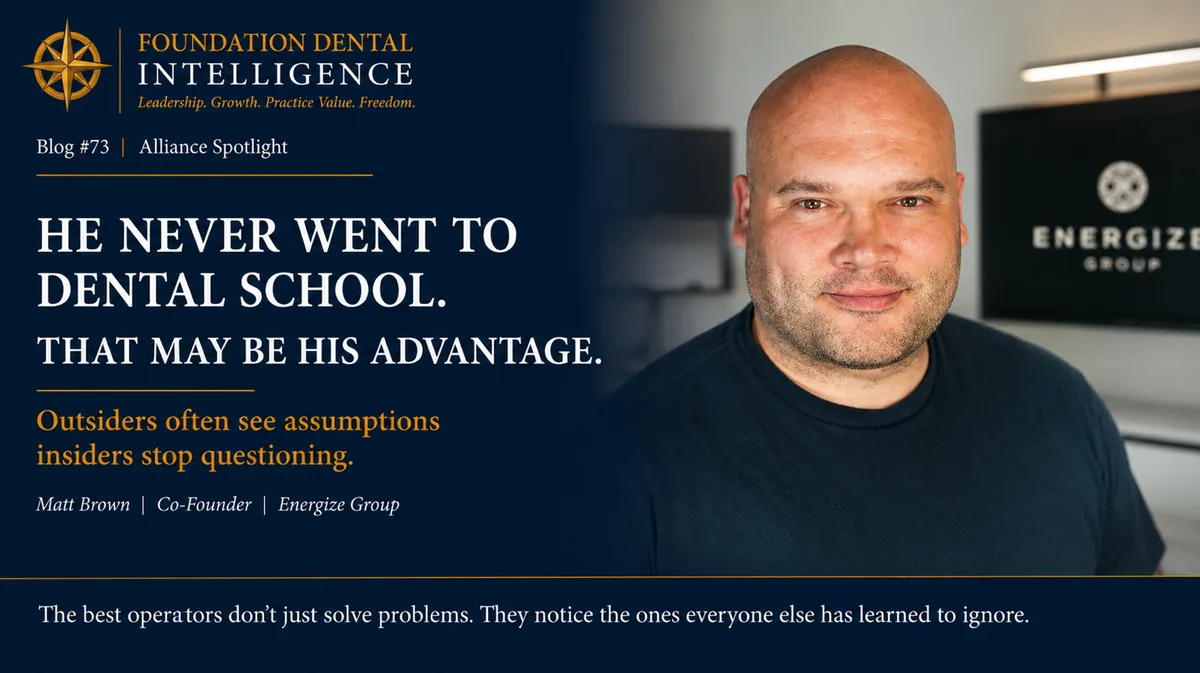
Matt Brown never went to dental school. He spent six months sitting at dental front desks instead, watching what actually happens when a patient calls or walks in. He didn’t have any assumptions, and that’s why he saw things that most of us never do.
The Diagnosis and the Choice
In May 2021, Matt was diagnosed with bone cancer. A routine-seeming injury turned into an X-ray nobody expected. Forty percent of his femur was involved. His doctor at Duke didn’t soften it.
His surgeon presented two options: limb salvage, which would preserve the leg structurally but restrict his mobility permanently, or amputation. He asked one question. Could he still wrestle and do jiu-jitsu with his kids if they went the salvage route?
The answer was no.
“Cut it off,” he said.
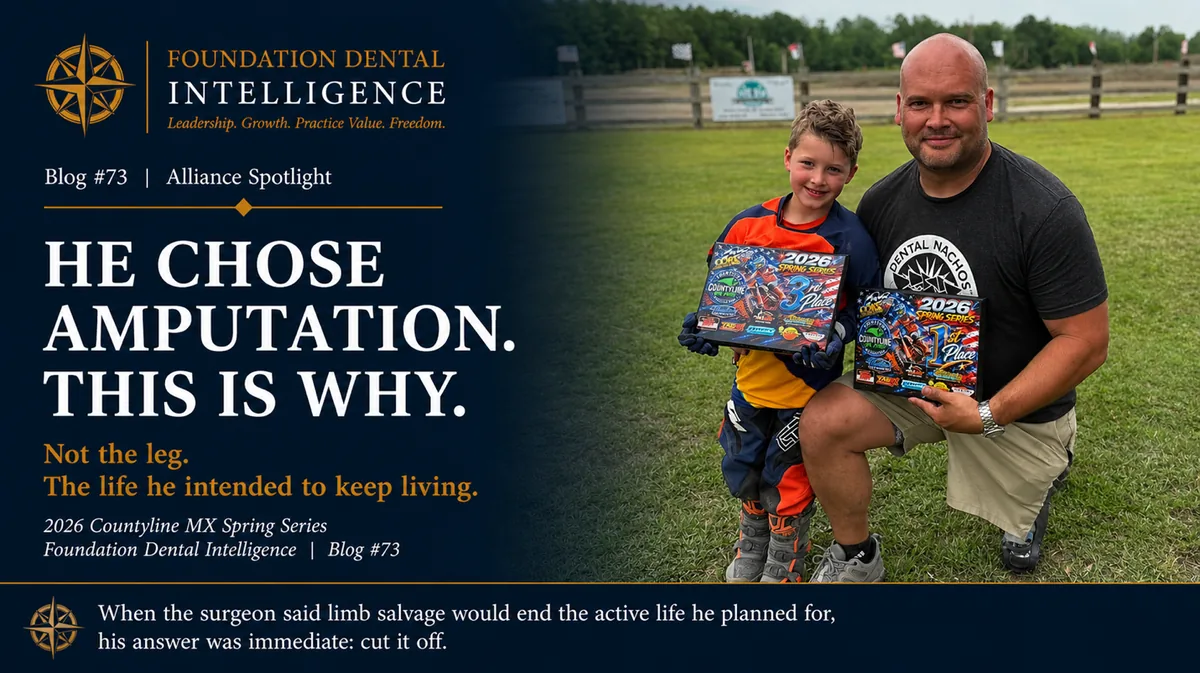
He chose amputation because he live (and still lives) a very active lifestyle. He chose the life that he still intended to live.
He wasn’t choosing amputation because he wanted to lose his leg. He was choosing the life he still intended to live. He refused to protect the appearance of wholeness by surrendering the function that actually mattered to him. On August 1, 2021, he underwent an above-the-knee amputation at Duke. He spent the next seven months in a wheelchair. He was also still running Energize during this - four employees with mortgages depending on the company staying functional. He took sales calls from a hospital room with a digital background loaded so prospects couldn’t see where he was.
He’s been open about how hard those months were, and he talks about it on purpose so other veterans know they’re not alone. “It’s okay to break and cry,” he says. “As long as you’re moving forward, even a centimeter a day, you have not quit.”
The VA Fight
After the amputation, Matt entered the VA prosthetics system. What followed was more than two and a half years of failed sockets, expired purchase orders, contractor disputes, and a communications infrastructure that simply didn’t function.
For those seven months in the wheelchair, the phone system at his local Wilmington VA was so broken he couldn’t reach the prosthetics department remotely. So every Thursday, he loaded the wheelchair into his truck, drove to the facility, unloaded himself, and sat outside the prosthetist’s office until someone came out. “Where’s my leg at, bro?” That was the whole conversation. Then he drove home and came back the following Thursday.
The repossession came in September 2022. A contractor took back a prosthetic ankle component because the VA had repeatedly failed to process the vendor’s payment requests. He later said those four words under sworn Congressional testimony, and they land the way four words can land when they describe something that shouldn’t be possible.
“I had a body part repossessed.” - Matt Brown, sworn Congressional testimony, November 20, 2024
By October 2022, he’d identified exactly what he needed: the Quattro variable volume socket, built for active amputees whose residual limb changes throughout the day. The VA initiated the purchase order. Then it quietly expired in the queue before anyone completed it. He found out the order had lapsed more than a year after it was placed.
Matt stopped treating it as his problem alone. He built a WhatsApp group, adding veteran amputees he met in waiting rooms. The group grew past 80 people, all waiting on prosthetics inside the same broken system. He wore a hidden camera for two years and documented everything, drawing on a surveillance background the VA was not prepared to face. He got the full record to an organization called the Independence Fund, which escalated it to the Undersecretary of Health and triggered a federal medical inspector’s investigation. He sat in meetings with regional leadership and walked them through patient names from his list, one by one.
He was introduced by Congressman David Rouzer and testified before the House Veterans Affairs Subcommittee on Health on November 20, 2024. During the hearing, Congressman Morgan Luttrell - Marcus Luttrell’s brother - leaned in and told him the two most capable people in the room were the two of them, and to hold it together and tell his story.
Changes followed. The Quattro socket arrived in May 2024, after more than two and a half years. Within three months, Matt had lost 35 pounds and was back on the mat.
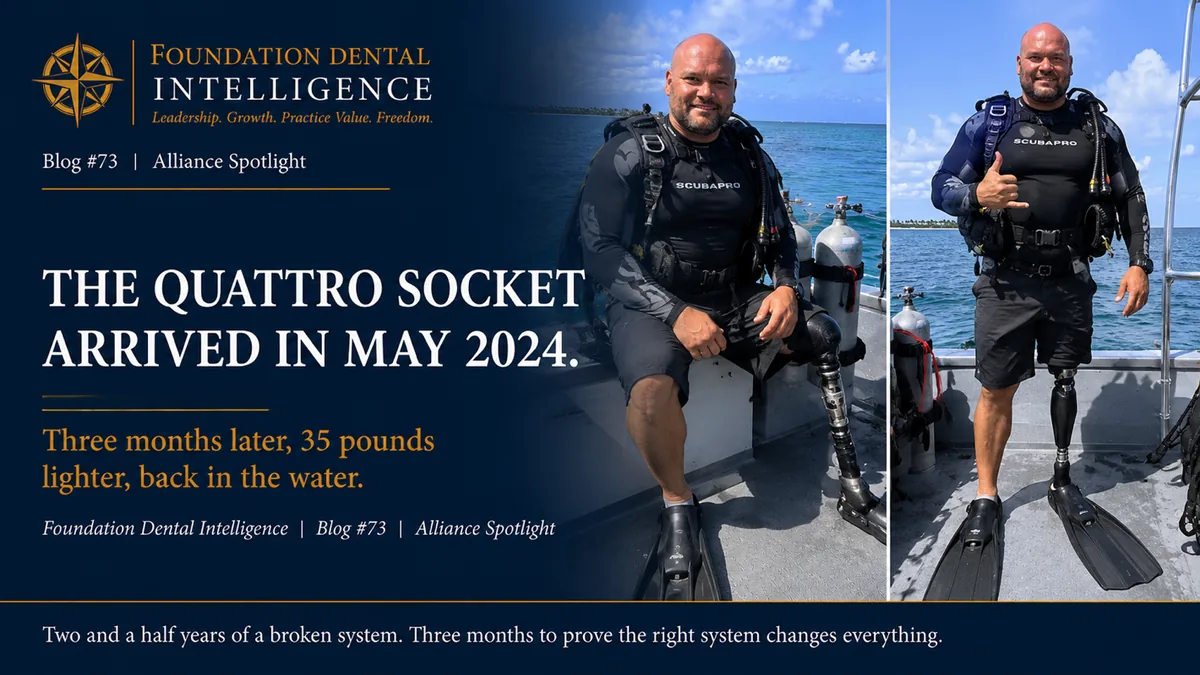
The Quattro socket arrived in May 2024 after more than two and a half years of documented system failure. Three months later, 35 pounds lighter, back in the water. The right system changes everything. That’s not a tagline. It’s his LIFE.
The Veterans SPORT Act, which his advocacy helped set in motion, was favorably reported by the Senate Committee on Veterans’ Affairs in March 2026. A fight that began with a man sitting in a lobby asking for a status update is now changing federal policy.
“There’s no such thing as recreational prosthetics. It’s just prosthetics for enabling what everyone else gets to enjoy as normal life.” - Matt Brown, sworn Congressional testimony
What Those Failure Modes Have to Do With Your Front Desk
Here’s the bridge, and it isn’t forced. The exact failures that kept Matt in a wheelchair for seven months are running inside dental practices right now.
A phone that doesn’t get answered. A request that ages out in a queue. A patient who reaches out once, hits friction, and disappears without anyone noticing. Accountability distributed across enough hands that nobody actually owns the result. Matt has been on the receiving end of every one of those. He knows what it costs when a system built to help someone simply doesn’t respond.
That’s why, before Energize runs a single campaign, the team audits the practice’s actual capacity: operatories, scheduling, clinical capabilities, the genuine ability to absorb what a campaign would generate. He’s pulled implant marketing from clients because the practice didn’t have a CBCT on site. His reason was plain. “I’m not sending people to you. These are humans.” An agency officer walking away from billing revenue on an ethical principle isn’t something you see often. That story travels inside dentistry in ways no advertisement ever will.
He didn’t build the call center as a growth tactic. He built it because he has personally felt what it costs when the system doesn’t pick up. So when he tells a practice owner the front desk is leaking revenue, he isn’t running a pitch. He’s diagnosing a failure mode he knows from the inside. Nobody experiences your intentions. They experience your systems.
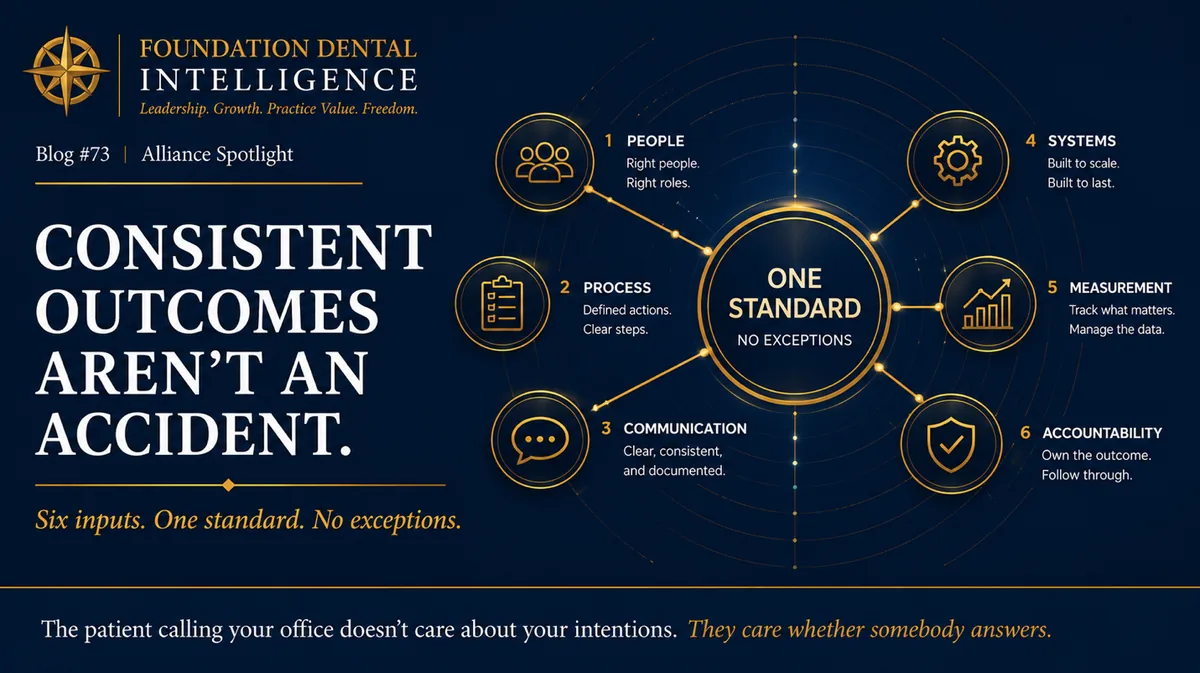
People, Processes, Communication, Systems, Measurement, Accountability. Every input converges on one standard with no exceptions. That's what “accountability drives growth” means when it’s built into the architecture instead of printed on a banner.
What Energize Group Actually Is
The company started on a wakeboarding trip. Matt learned that his uncle, a dentist, was paying approximately $1,200 a month for what amounted to a basic website. The pattern was immediately recognizable: a dental premium attached to a generic service, with no accountability for the outcome. He called Ryan Raybould from the drive home. They met the following Saturday. Energize Group was founded on August 19, 2019, on roughly $600. No investors. No outside capital.
The positioning is direct. You come to Energize to buy revenue. That’s the stated premise, and every engagement is anchored to a financial outcome rather than a deliverables list. Patients don’t experience marketing departments or scheduling departments separately - they experience the whole practice, and a gap anywhere in that experience is a gap in the result. The piece that closes that gap is the integrated call center: every lead the campaigns generate gets intercepted before it reaches the practice’s front desk, with average five-minute response times and hours that extend well into the evening, when patients are actually making decisions. The company serves hundreds of practices nationwide.
Energize is a Dental Intelligence Diamond Certified Partner. Its clients average around $2.75 million in annual production against roughly $1.1 million for the industry - external benchmarks, not self-reported figures, and that sourcing distinction matters when those numbers come up.

Those benchmarks on the banner are external data, not internal claims. Matt Brown built a company where the numbers either hold top under audit or the don’t. They do.
Most people still describe Energize as a marketing company. The more accurate description is a dental growth operations partner - a firm that takes accountability from the first moment of attention through the booked appointment, the treatment conversation, and the collected dollar. Most firms won’t go there. They won’t staff and operate a call center, won’t get on a plane to coach a team in person, and won’t put their numbers up for external audit. Energize will, and that’s the whole distinction.
Dental Unfiltered and the Decision That Defines It
Most people treat Dental Unfiltered as a content channel. Matt describes it as something more deliberate: a platform designed from the start to condition the dental market toward clearer thinking before practitioners ever reach Energize. Every new client arrived carrying assumptions that required work to shift before any growth work could begin. A podcast that did that work at scale - and did it with enough credibility to be taken seriously - was more valuable than any ad campaign.

Past 190 episodes across a three-show network and not a single sponsor. That decision costs real revenue, but it also gives them the credibility that they’ve earned.
The sponsor-free stance is the mechanism that makes it work. “You cannot buy Dental Unfiltered,” he says. He doesn’t say the word Energize on the show, doesn’t run the logo, and the moment the show becomes an advertisement it loses the one thing that gives it value: trust. That choice costs meaningful revenue. They make it anyway because trust compounds in ways advertising never does.
The show operates as a three-network feed, zero sponsors. His book, Dental Unfiltered’s Guide to Being a Badass Practice Owner, follows the same logic: indexed by topic like a field manual, with a QR code at the end of each chapter linking to the matching podcast episode. Not a philosophy book. A tool.
What He Sees That Most Dentists Miss
Before Energize built anything, Matt spent roughly six months sitting at dental front desks - every Monday, across multiple practices - watching how the office actually ran. He wasn’t analyzing campaigns. He was studying what happened when a patient arrived or called, and where the process broke.
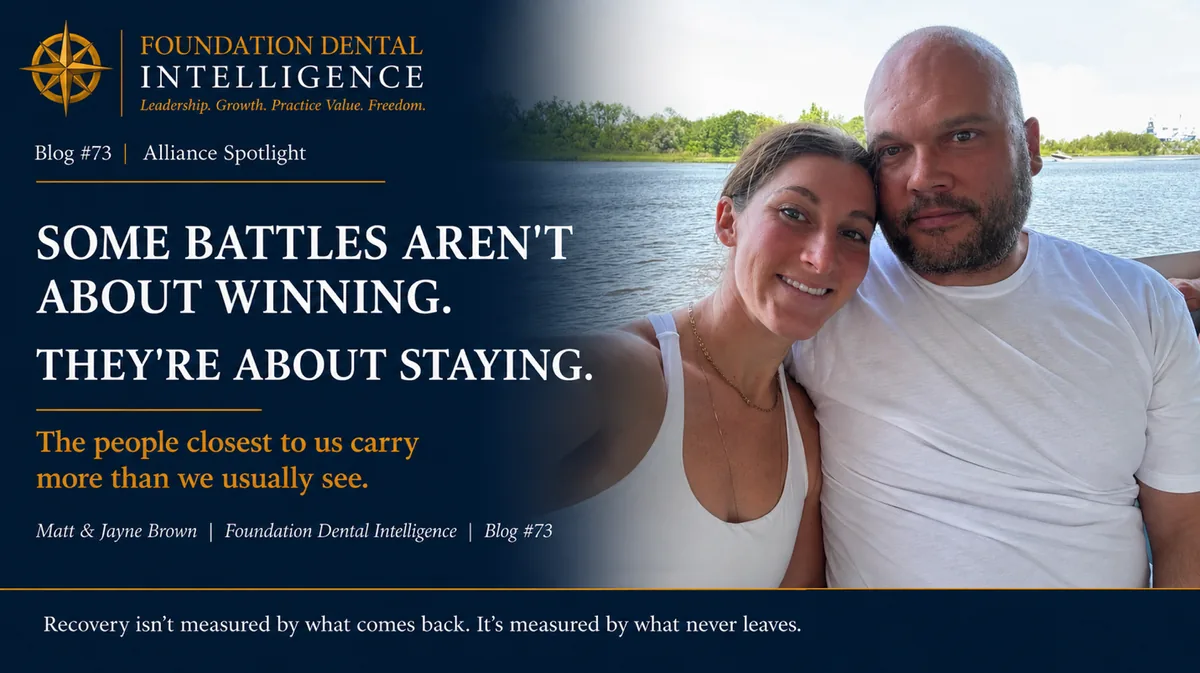
Matt’s wife, Jayne trained through his recovery and earned her BJJ blue belt while he was fighting the VA from a wheelchair. Two and a half year, and she never left his side. Recovery isn’t measured by what comes back. It’s about what never leaves.
His conclusion hasn’t changed. “That poor woman has two screens in front of her, twenty tabs open, six pieces of software, an angry patient’s head floating over those two screens, and the phone going off. She is the air traffic controller of that practice.” The most important employee in the building isn’t the owner or the office manager. It’s the person at the front who decides whether anyone makes it to the chair.
Two convictions from that time shape how he coaches now. The first: all patients have dental anxiety. Not some of them - every person who reclines in a dental chair is in a position of surrender, and designing care around that as a universal changes everything about how cases get presented. “It’s easier for me to get over jumping out of an airplane than going to the dentist,” he says. He’s been trained to manage one of those. Nobody trains patients for the other. If that’s true for a combat-trained operator, consider what it means for the person in your chair today.
The second conviction: communicate the human detail before the clinical one. The patient isn’t focused on the X-ray. They’re thinking about the wedding in May, the food they haven’t been able to eat comfortably, or the smile they stopped showing people. Connect there first and the clinical conversation lands in a completely different place. Lead with the chart item and you’re often connecting to nothing the patient recognizes as their own life.
Clinical Bravery
One question Matt uses consistently with practice owners is what he calls clinical bravery. He asks them to rate themselves on a scale of one to ten: one is a doctor so risk-averse about liability that profitable procedures get referred out reflexively; ten is reckless, lacking the self-awareness to recognize the edge. Both ends hurt the practice and, more importantly, the patient.
His preferred answer is a six, seven, or eight. That range signals a doctor who keeps the productive cases in-house rather than sending them to specialists unnecessarily, while maintaining enough self-awareness to know the limits. It also signals a practice that can actually absorb what a growth campaign creates - because generating demand a practice can’t ethically fulfill isn’t growth, it’s a problem wearing growth’s clothes.
This question surfaces early in how Energize evaluates new clients. It also explains the capacity audit before any campaign runs, the CBCT standard for implant marketing, and the willingness to walk away from billing revenue when the practice isn’t ready. Clinical bravery isn’t just a coaching concept. It’s a filter.
Why This Is Also an EBITDA Conversation
I look at almost everything through valuation, and there’s something worth naming for owners thinking about where the practice goes long term.
In more than 60 transitions, the practices that command the strongest multiples usually aren’t the ones generating the most dentistry. They’re the ones with systems that don’t require one person’s extraordinary effort to hold the schedule together. Predictable revenue through designed infrastructure is worth more to a buyer than the same revenue held together through will. Buyers pay for the system. They discount the heroics. A growth partner that owns the pipeline from first contact through the booked appointment, and benchmarks outcomes against external data, contributes directly to that kind of durability. At the multi-location level, it’s not a line item. It’s an enterprise value conversation.
Buyers will tell you they want growth, but what they’re actually paying premiums for is reliability. A practice where inquiries convert consistently, follow-up happens by design, and treatment gets presented in terms patients recognize as their own lives is fundamentally less risky than one producing the same revenue through a single person’s exceptional effort. Lower perceived risk translates to higher perceived value, and that’s what drives stronger multiples - not just stronger production numbers.
What This Means for You on Monday
You don’t need a new vendor to act on what Matt has learned. You just need an afternoon.
Pick a week. Block a couple of hours and sit at your own front desk without announcing it. Don’t bring a clipboard. Just watch what actually happens. Listen to how calls get answered and what gets said when a new patient hesitates. Watch the handoff from the operatory to the front. Notice how often patients leave without a scheduled next step, and without anyone planning to follow up.
Then pull your data and look honestly at two things: unanswered calls over the last 30 days, and unscheduled treatment over the last 90. Put those two numbers next to each other. They’ll show you exactly where your system is failing the people inside it.
Most owners who go through that exercise discover they don’t have a marketing problem. They have a conversion problem. And a conversion problem isn’t solved by generating more attention at the top of the funnel. It’s solved by owning what happens to the attention you already have.
If, after that audit, you decide you do need more demand, go build it. But build it knowing that the gap between the inquiry and the booked appointment is the same gap Matt Brown spent two and a half years trying to close from a wheelchair in a VA lobby. The system either responds or it doesn’t. You built the system.
Final Thought
There’s one question that explains almost everything about how Energize Group is built. How much of it is actually an attempt to build the kind of system Matt wished had existed when he needed one himself?
The call center that catches every lead before it can expire. The ethical audit before any campaign runs. The in-person coaching visits. The podcast with no sponsors so the advice stays uncompromised. None of it is marketing strategy. All of it is what happens when a person who has personally experienced what it costs when systems fail the people inside them spends his professional life building systems that don’t.
He came into dentistry as an outsider with no credential and no reverence for the assumptions the profession has learned to live with. He sees the front desk the way an operator sees a critical node. He sees dental anxiety as universal rather than exceptional. He sees the gap between the inquiry that arrives and the appointment that gets booked as the same gap that kept him in a wheelchair for seven months.
Most people who encounter Matt Brown in dentistry see a marketing entrepreneur. That’s accurate, and it’s incomplete. He’s a systems operator who has applied the same standard to every arena he’s entered - packing parachutes at Fort Bragg, documenting VA failures with a hidden camera, carrying veteran cases to a Congressional hearing, and now building growth infrastructure for dental practices. The arena keeps changing. The standard doesn’t. Systems matter because people live inside them. The patient calling your office doesn’t experience your intentions. They experience what actually happens when their call arrives. The parachute either opens or it doesn’t.
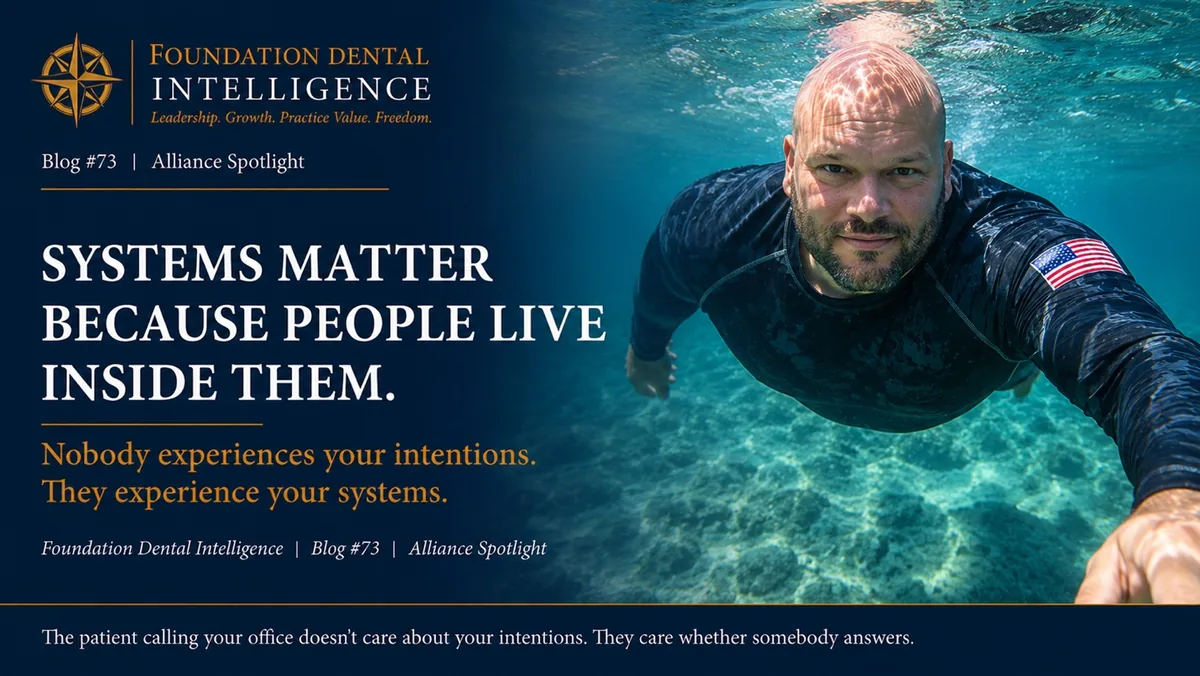
A veteran, an amputee, a Congressional witness, and now one of the most accountable operators in dentistry. The arena keeps changing, but the standard doesn’t. Nobody expediences your intentions. They experience what happens after their call arrives.
Hear the full conversation with Matt Brown on the Foundation Dental Podcast, available now on YouTube at youtube.com/@DrJimArnold and on all major podcast platforms.
About the Author
Dr. Jim Arnold, DDS is the Founder and CEO of Foundation Dental Alliance and Chief Dental Officer of Codent AI. He has 30 years of experience as a multi-practice owner, has been involved in more than 60 dental practice transitions, was a DSO executive, and achieved 31% EBITDA in a private practice group. He leads the Foundation Dental Mastermind, Luxury Dental Retreats, co-founded Foundation Dental Transitions, and hosts the Foundation Dental Podcast. He also publishes the Foundation Dental Newsletter and Blog weekly, focused on leadership, practice design, and long-term sustainability in dentistry.
Stay Connected
Websites
FoundationDentalMastermind.com
FoundationDentalTransitions.com
LuxuryDentalRetreats.com/dubai
Social Media
LinkedIn: linkedin.com/in/arnoldjim
Instagram: instagram.com/smilesbyarnold
YouTube: youtube.com/@DrJimArnold
Facebook: facebook.com/smilesbyarnold
Twitter/X: twitter.com/smilesbyarnold
TikTok: tiktok.com/@foundationdentalalliance
Google Business: tinyurl.com/2t3chcv6
Publications
Foundation Dental Newsletter: linkedin.com/newsletters/foundation-dental-newsletter-7289675134649450496
Contact
Professional Email: drarnold@foundationdentalalliance.com
Alliance Spotlight: Dentistry’s Top People, Companies and Products
© 2026 Foundation Dental Alliance. All Rights Reserved.