Foundation Dental Intelligence
Blog No. 69
What Gerritt Cora Figured Out About Full-Arch Dentistry Before Almost Everyone Else.
Get the next article.
One signup. Everything we publish.
Most dental practices are solving the wrong problem.
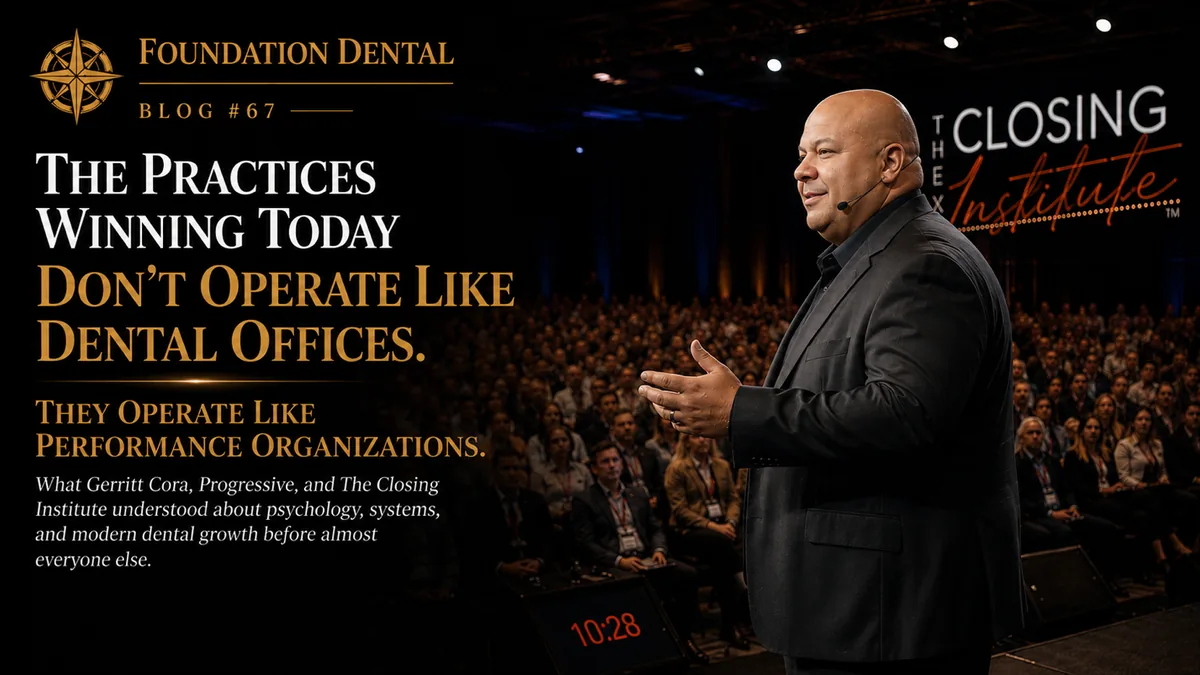
That's the first thing I thought after spending quality time with Gerritt Cora recently. Not because I heard some revolutionary marketing tactic. Not because of celebrity speakers. Not because of ads.
Because underneath everything Progressive Dental Marketing and The Closing Institute have built, there's a much deeper understanding of what actually drives growth in modern dentistry. And most of the profession still hasn't fully caught up to it.
What caught me off guard was how casually he talked about the early days - not with nostalgia, and not with any particular drama about how far things had come. Just a matter-of-fact acknowledgment that the model took time to prove itself, and that the proof came one room at a time. That kind of long-game thinking is rare. And it tells you almost everything about how he thinks.
I've been in dentistry for 30 years. I've built practices, led teams, navigated more than 60 practice transitions, and spent years watching practices try to grow in every imaginable way.
Most people think the practices struggling with growth need more leads, more traffic, more ads, more marketing, more visibility. Most of the time, they don't.
They need better production architecture.
That's the real conversation.
WHAT MOST PRACTICES GET WRONG FIRST
What became clear during our conversation is that Gerritt identified the real bottleneck in full-arch dentistry long before most of the industry did.
It wasn't clinical skill. It wasn't marketing. It wasn't even lead generation.
It was what happened between patient interest and patient certainty.
Most practices were still thinking transactionally. Progressive and TCI were building operational systems around psychology, responsiveness, leadership structure, communication, and trust. That's a very different conversation.
Today, Progressive and The Closing Institute operate inside one of the most influential growth ecosystems in implant and full-arch dentistry, serving over 1,000 practices. That kind of trajectory doesn't happen because somebody figured out better Facebook ads.
It happens because somebody identified the real bottleneck before almost everyone else did.
And the bottleneck wasn't marketing. It was conversion. Leadership. Systems. Psychology. Certainty. Team structure. Speed. Culture.
Most implant practices don't have a lead problem. They have a certainty problem. That distinction changes everything.
THE BOTTLENECK NOBODY NAMES
Ask most dentists why they aren't producing more full-arch cases and you'll usually hear the same answer: 'We need more leads.'
Maybe. But I've seen enough practices to say this confidently - many already have enough opportunity sitting right in front of them. The infrastructure underneath the opportunity is just weak.
A patient finally builds enough courage to inquire about implants, full-mouth reconstruction, cosmetic dentistry, sleep treatment. The lead comes in. And then the process starts breaking down almost immediately.
Slow response times. Disconnected communication. Weak handoffs. Uncertain treatment coordinators. Doctors carrying the emotional burden of every conversation.
Eventually the patient says: 'I need to think about it.'
And the practice assumes the problem was marketing.
No. The problem was architecture.
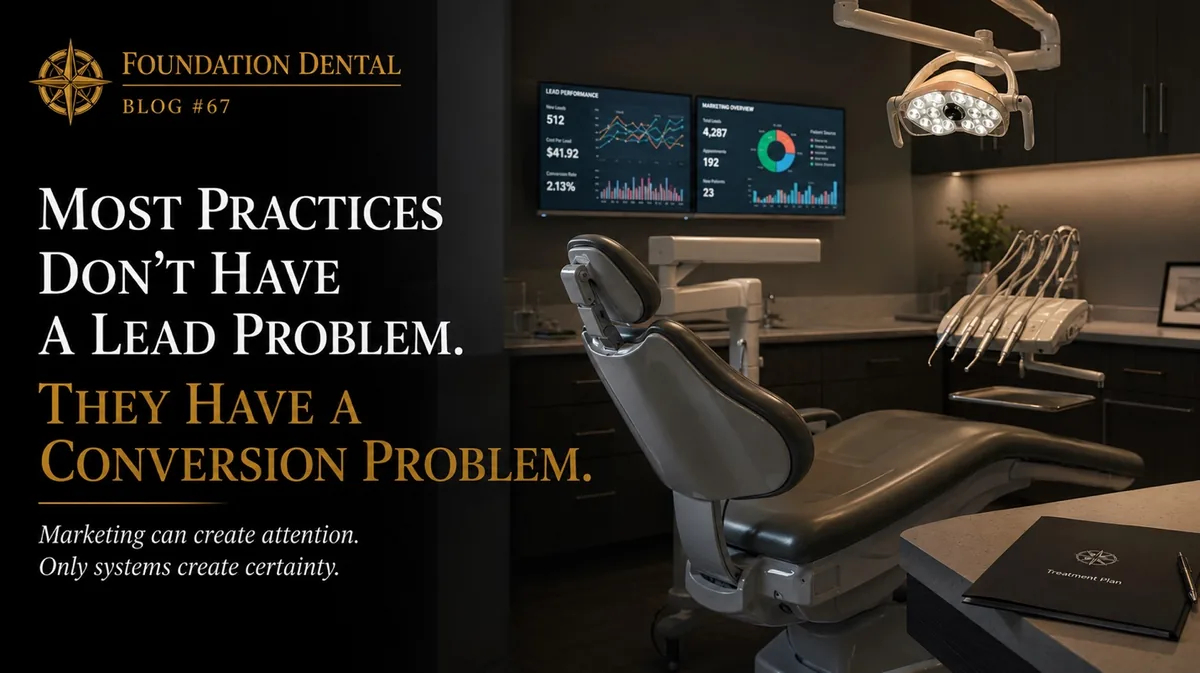
The lead came in. The infrastructure wasn’t ready for it. That’s not a marketing problem.
That's what Gerritt and Progressive figured out earlier than most. Growth in dentistry is rarely constrained clinically. It's constrained structurally.
WHAT GERRITT FIGURED OUT EARLY
Here's what really matters: most marketing companies generate leads, most coaching companies train teams, and Progressive built an integrated feedback loop between both sides simultaneously.
That integration is what most people miss.
Some practices are spending six figures on marketing while operating consultation systems that quietly destroy trust every single day. The ads work. The phone rings. And then the infrastructure collapses under the weight of the opportunity.
Because the same organization attracting high-value implant patients also understands exactly what must happen operationally, psychologically, and structurally inside the consultation to convert those patients into committed cases.
When close rates improve, they know which patient types are converting best. When consultation friction appears, they can identify where the breakdown occurs. When patient psychology shifts, the messaging adapts. The feedback loop stays live.
That's difficult to replicate. And it's one of the biggest reasons the organization gained traction so aggressively within the full-arch space.
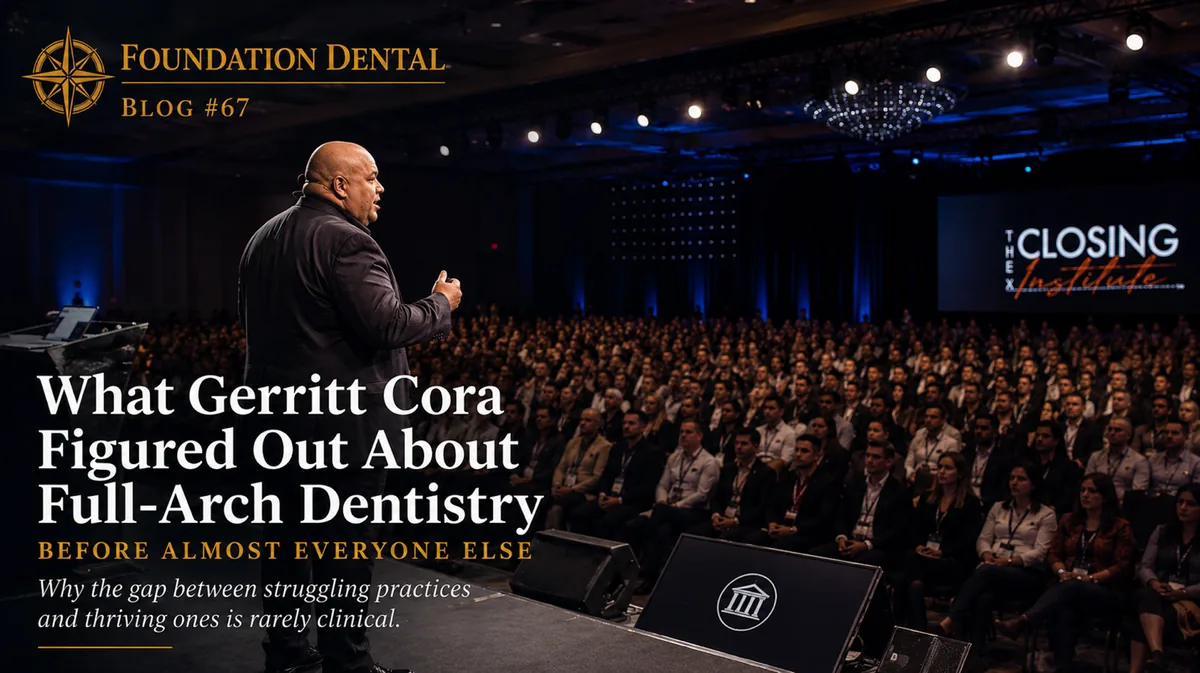
Most organizations generate leads or train teams. Progressive built the loop that connects both and kept it live.
Eventually every growth conversation becomes a systems conversation.
HERE'S WHAT REALLY MATTERS
If the doctor is spending emotional energy trying to close every case, the doctor eventually becomes the bottleneck. Not because they aren't capable. Because that structure doesn't scale.
The three-role system inside TCI reflects this directly. Patient Advocate, Doctor, Treatment Coordinator - each role owns a different part of the patient journey.
The doctor establishes trust, diagnosis, and clinical certainty. The treatment coordinator carries the operational and financial conversation forward. That distinction protects the doctor's authority while creating significantly more consistency inside the consultation process.
The practices that committed fully to this framework saw 210% increases in full-arch production in a single year. Treatment coordinators evolving into six-figure producers. General dentistry practices repositioning into dominant implant centers in their local markets within twelve months.
These aren't outlier results held up as marketing claims. They're what the system produces when a practice actually commits.

Systems create predictability. Predictability creates trust. Trust closes cases that pressure never could.
THE ROLE STRUCTURE THAT CHANGES EVERYTHING
The highest-performing practices understand something that most owners never fully confront: the doctor cannot be the infrastructure. The systems must become the infrastructure.
That's the shift.
Once a practice accepts that, everything starts changing - communication, leadership, hiring, training, accountability, patient experience, production consistency.
The practices scaling fastest right now are not clinically different. They're structurally different.
That's a more uncomfortable conversation because it forces owners to confront leadership capacity instead of blaming external factors. But it's also empowering. Because systems are buildable. Leadership is learnable. Culture is shapeable. And momentum can be created intentionally.
The doctor cannot be the infrastructure. The systems must become the infrastructure. That's the shift.
WHAT PATIENTS ARE ACTUALLY DECIDING
The psychology side of this becomes important in high-value dentistry.
I've spent a lot of time thinking about why patients move forward with large treatment decisions. After years of watching these conversations happen, I've become convinced that many practices misunderstand what patients are actually deciding.
Patients considering $30,000 to $60,000 treatment plans aren't simply making financial decisions. They're making identity decisions. About confidence. About aging. About health. About self-worth.
The logical objections matter. Of course they do. But the emotional certainty underneath those objections matters even more. That's where many consultations fail. Not because the dentistry is weak. Because the patient never emotionally arrived at certainty.
Gerritt talks about this through the lens of strategic empathy.
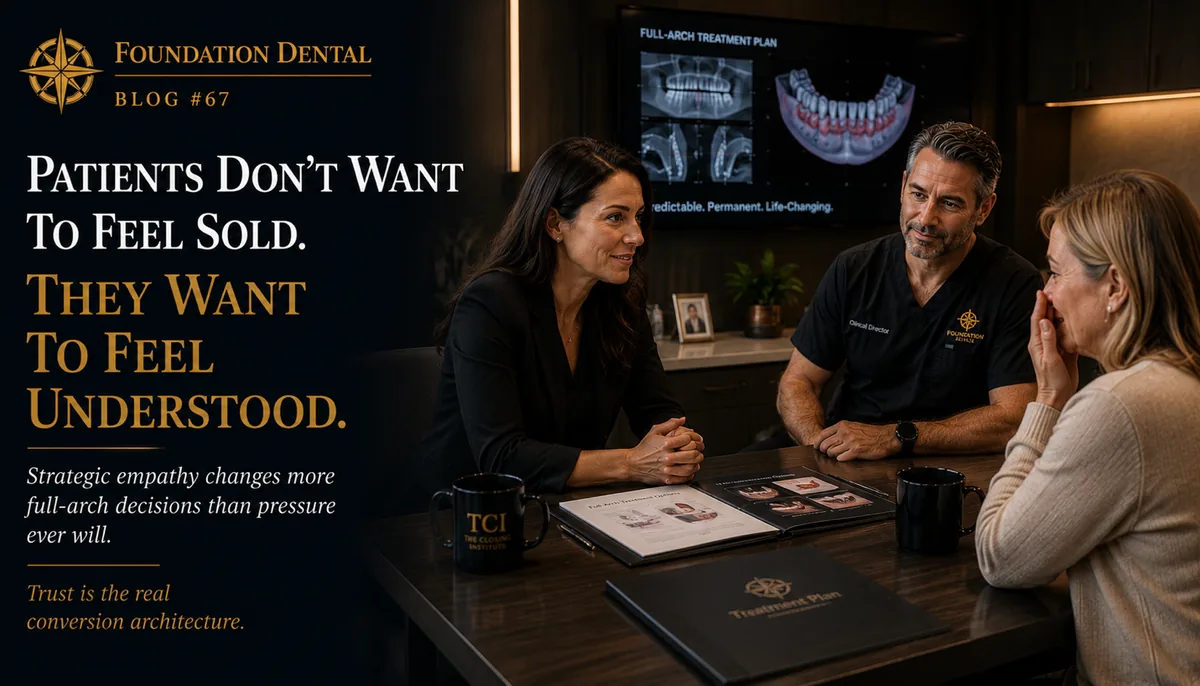
The best consultation rooms don’t feel like sales environments. They feel like the place where a patient finally decided to trust someone.
Not pressure. Not manipulation. Not scripted tactics. Strategic empathy. Understanding what the patient is actually feeling underneath the objection. Fear. Embarrassment. Financial anxiety. Doubt about whether they deserve this.
He brought in Chris Voss - the former FBI hostage negotiator who coined the term strategic empathy - to reinforce this exact point. A patient finally working up the courage to inquire about a $40,000 full-arch case isn't waiting to be impressed. They're waiting to feel understood. Gerritt told me their internal data shows a sixty-second response time versus a five-minute response time can produce nearly four times the result on identical leads. Same marketing. Same opportunity. Different infrastructure.
The highest-performing practices understand that patients don't want to feel sold. They want to feel understood.
And here's the frame Gerritt uses that I think genuinely matters: if you believe your treatment changes lives - and the clinical evidence in full-arch dentistry is clear that it does - then helping a patient move through fear and uncertainty responsibly isn't manipulation.
It's service.
RUN WITH THE RUNNERS
One concept Gerritt discussed that resonated deeply was 'Run with the Runners.'
Simple phrase. Powerful truth.
He traces it back to his grandfather and brother - a developer who was well known locally, passed away young, and left behind a philosophy his family kept repeating: get with people who are going after things. Run with people who are moving fast and you can't stay mopey. You can't hang around hustlers who are chasing goals and be a Debbie Downer. They won't associate with you. The environment itself does the work.
That's one of the biggest reasons I built Foundation Dental Alliance, Foundation Dental Mastermind, and Luxury Dental Retreats. Because proximity matters. The room matters. I've watched dentists completely recalibrate their thinking simply by spending time around higher-level operators, elite clinicians, strategic thinkers, and entrepreneurs operating at a different standard. Not because somebody handed them a secret tactic. Because exposure changes ceilings.
Once somebody sees what's actually possible, the old limitations stop feeling permanent.
And that's part of what Progressive and TCI understood early. Transformation isn't just clinical. It's psychological. That applies to patients. It applies to teams. It applies to practice owners too.
The right environment doesn't just transfer information. It recalibrates identity.
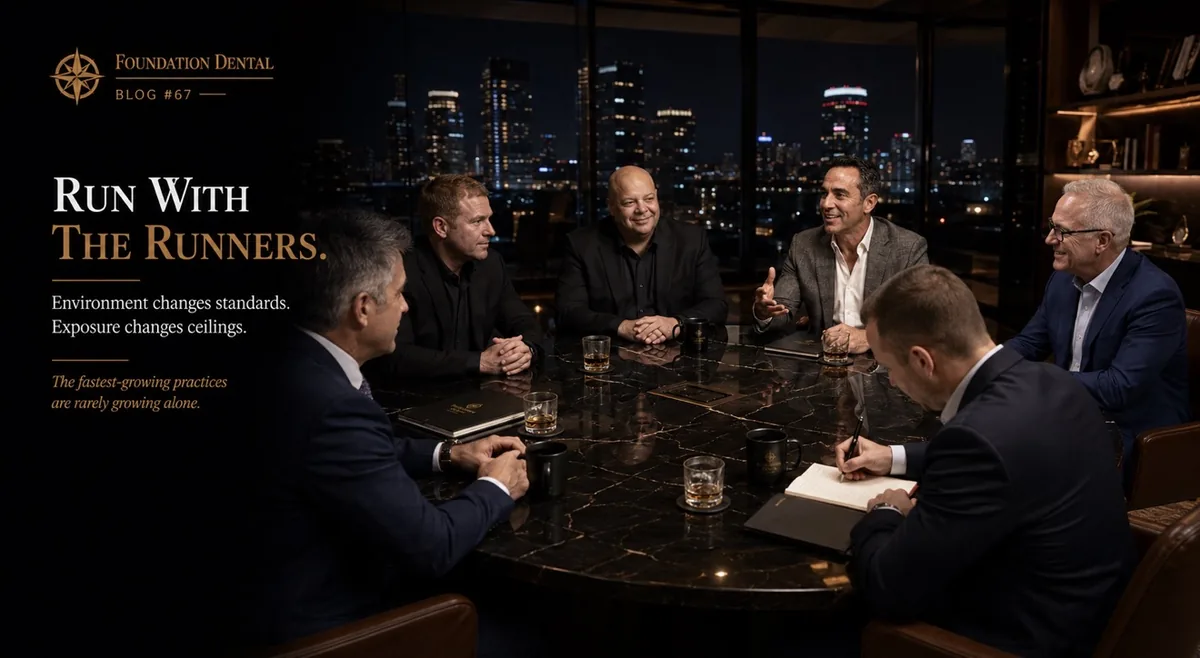
The fastest-growing practices are rarely growing alone. Environment changes standards. Exposure changes ceilings.
Exposure changes ceilings. Once somebody sees what's actually possible, the old limitations stop feeling permanent.
WHY THIS CONNECTS TO EVERYTHING ELSE
Many dentists today are privately exhausted. Some are financially successful while emotionally burned out. Some built practices that consume them instead of practices they own. Some feel trapped operationally. Some feel disconnected from the profession they once loved.
That's not really a dentistry problem. It's a leadership and systems problem.
The best organizations distribute ownership emotionally across the team. They create leaders. They create buy-in. They create standards. They create alignment. That's what sustainable growth actually looks like. Not chaos. Not dependency. Not heroics. Alignment.
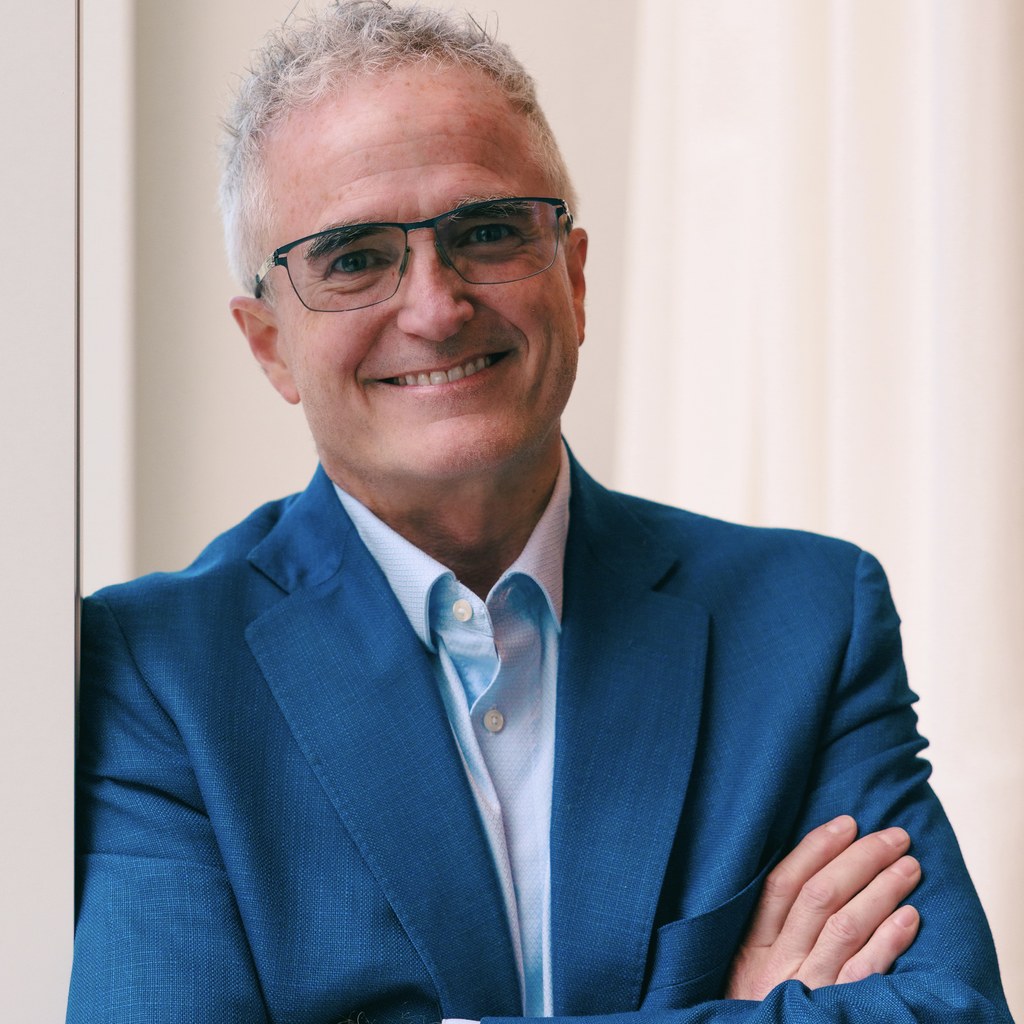
One thing that came through clearly during our conversation was how Gerritt talks about Bart Knellinger, the President and CEO of Progressive Dental. They've been best friends since childhood, growing up together in Palm Harbor, Florida long before any of this existed. Gerritt is direct about it: Bart created the opportunity, and he's never lost sight of that. 'No matter where the business goes,' he told me, 'I'm always grateful to Bart for creating that opportunity for me and my family.'
That kind of founding loyalty is rare in business, and it shows up in how the organization operates. Sustainable companies are almost never built on isolated talent. They're built on aligned leadership, long-term trust, and shared standards compounded over years. You can feel that throughout Progressive and TCI.
Two childhood friends from Palm Harbor, Florida. Bart Knellinger and Gerritt Cora built Progressive Dental Marketing and The Closing Institute into one of the most influential growth ecosystems in full-arch dentistry - one room at a time, over sixteen years.
The practices best positioned for the future aren't the ones generating the most leads. They're the ones building operational systems that consistently create trust, certainty, responsiveness, leadership, emotional connection, team accountability, and differentiated patient experiences.
That's where enterprise value comes from now. Not just production. Predictability.
Patients experience the world differently now. They make decisions differently. They evaluate trust differently. They consume information differently. The practices thriving over the next decade will understand that deeply.
Clinical excellence still matters tremendously. But clinical excellence alone is no longer enough.
BOTTOM LINE
Most dental practices don't have a marketing problem. They have a production architecture problem.
The practices that solve that first will continue separating themselves from the rest of the industry over the next decade. I've watched it play out too many times to think it's accidental.
After everything I've seen in this industry, I've developed a clear sense for who the real builders are. The people whose work compounds. The people solving deeper problems. The people building things that are difficult to replicate because they understand the architecture underneath the outcome.
Gerritt and Bart built something the industry increasingly cannot ignore: an ecosystem where marketing, psychology, leadership, responsiveness, consultation structure, and operational systems all reinforce each other simultaneously.
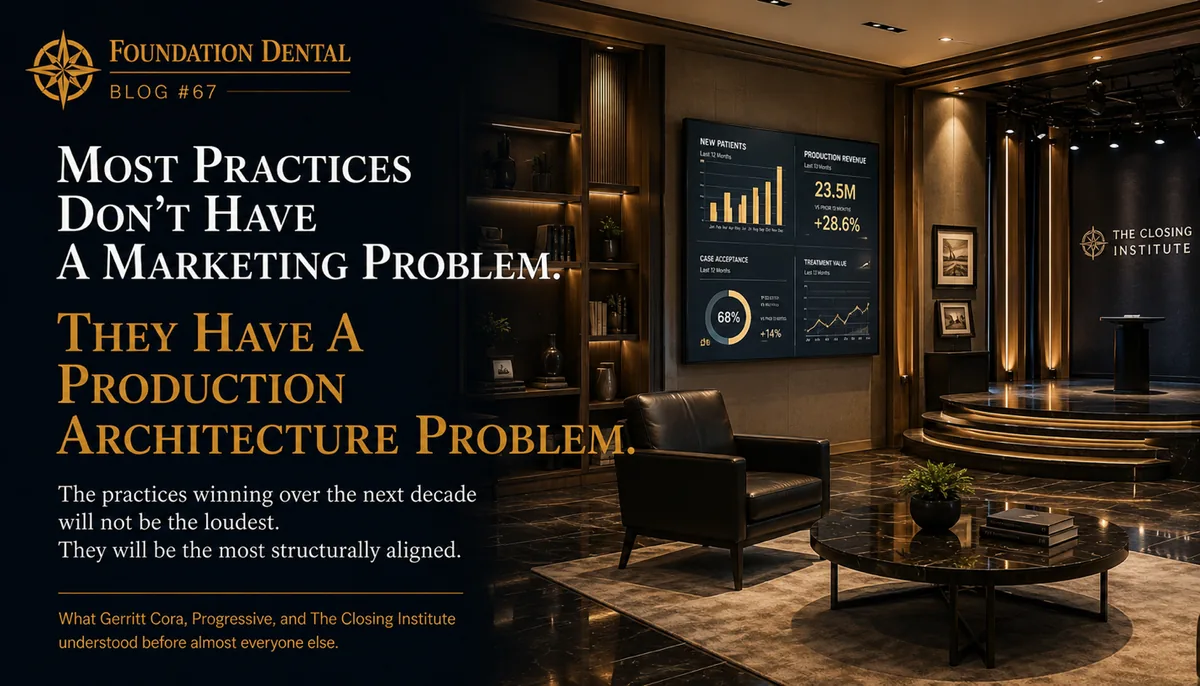
The practices that solve this first will keep separating themselves from everyone else. That’s not a prediction. It’s a pattern.
If you're serious about understanding where full-arch dentistry, patient psychology, and production architecture are heading over the next decade, it's worth paying close attention to what Progressive Dental and The Closing Institute are building.
Their upcoming Full-Arch Boot Camp on July 24-25, 2026 at Loews Arlington in Texas is designed for practices ready to close that gap between marketing and infrastructure. And if systems, leadership development, and consultation architecture are where your head is, The Closing Institute's event on November 13-14, 2026 belongs on your calendar.
The future of dentistry doesn't belong to the practices making the most noise. It belongs to the practices building the strongest foundation. They don't wait for the walkers to catch up. And the practices that run with them don't either.
Connect with Gerritt Cora, Bart Knellinger, and the Progressive Dental team at ProgressiveDentalMarketing.com and TheClosingInstitute.com. Hear the full conversation on the Foundation Dental Podcast.
About the Author
Dr. Jim Arnold, DDS is the Founder and CEO of Foundation Dental Alliance, a leadership and practice development organization serving dentists from graduation through retirement. He has 30 years of experience as a multi-practice owner and has been involved in more than 60 dental practice transitions. He leads the Foundation Dental Mastermind, Luxury Dental Retreats, co-founded Foundation Dental Transitions, and hosts the Foundation Dental Podcast. He also publishes the Foundation Dental Newsletter and Blog weekly, focused on leadership, practice design, and long-term sustainability in dentistry.
Stay Connected
Websites
FoundationDentalAlliance.com
FoundationDentalMastermind.com
FoundationDentalTransitions.com
FoundationDentalNetwork.com
LuxuryDentalRetreats.com/dubai
Social Media
LinkedIn: linkedin.com/in/arnoldjim
Instagram: instagram.com/smilesbyarnold
YouTube: youtube.com/@DrJimArnold
Facebook: facebook.com/smilesbyarnold
Twitter/X: twitter.com/smilesbyarnold
TikTok: tiktok.com/@foundationdentalalliance
Google Business Profile: tinyurl.com/2t3chcv6
Publications
Foundation Dental Newsletter: linkedin.com/newsletters/foundation-dental-newsletter-7289675134649450496
Contact
Professional Email: drarnold@foundationdentalalliance.com