Foundation Dental Intelligence
Blog No. 70
The Schedule That Lies to You Every Day.
Get the next article.
One signup. Everything we publish.

The schedule looks fine.
That's what makes this problem so expensive.
The chairs are full. The hygiene column is moving. The phones are ringing. The team is busy. The doctor is working hard.
Then the month ends.
And somehow the production number comes in short. Again.
The schedule didn't fail you visibly. It failed you quietly, the way a slow leak does. Not a blowout. Not a crisis. Just a steady drain that compounds week after week until the gap between effort and results becomes impossible to ignore.
Most owners assume they have a marketing problem. Others assume they need more patients. Some blame cancellations. A few blame staffing.
Those issues exist. They matter. But they're often not the real problem.
The real problem is that the schedule was never intentionally designed around what the practice is actually trying to produce.
The Short Answer Most Owners Need to Hear
Most practices don't have a production problem. They have a scheduling architecture problem.
Working harder doesn't solve an architecture problem. Design does.
What Is the Schedule Actually Designed to Do?
Ask most teams why the schedule exists and you'll hear some version of the same answer. To book patients. To keep the day organized. To avoid gaps. To manage flow.
Those answers aren't wrong. They're incomplete.
The schedule is not primarily an administrative tool. It's a financial tool. Its job is to convert clinical capacity into production.
Revenue flows through it. Profitability flows through it. Case acceptance flows through it. EBITDA flows through it.
Practice value flows through it too - though most owners don't think about that connection until they're close to a transition.
Once you understand that, scheduling stops being a front-desk conversation and starts becoming a leadership conversation.
The Day I Realized the Schedule Was Running the Practice
There were periods during my ownership career when I thought we had a production problem. We didn't. We had a schedule problem.
We had enough patients. We had enough demand. We had enough diagnosed treatment.
One of the biggest surprises of my ownership career was discovering that diagnosed treatment usually wasn't the constraint. Demand wasn't the constraint. Capacity wasn't the constraint. The constraint was often the way time had been organized years earlier and never questioned again.
That's a difficult realization because it removes most of the convenient explanations. Once you see it, you stop asking why production is missing and start asking whether the structure itself ever had a realistic chance of delivering the target.
What we didn't have was a schedule designed around what the practice needed to produce.
That realization changed everything. I stopped looking at the schedule as a record of what was happening and started looking at it as the mechanism creating what was happening.
The schedule wasn't documenting reality. The schedule was creating reality.
Everything changed for me once I understood that distinction.
Every day, the template was determining what was possible before the first patient ever arrived.
The schedule isn't reflecting the business. The schedule is the business.
Every day the template decides what’s possible before the first patient arrives. That’s not logistics. That’s architecture.
The Metric That Tells the Truth
Most practices track annual production. Many track monthly collections. Very few track production per clinical hour with real discipline.
That's unfortunate, because production per hour is often the most honest metric in the practice. It removes the comfortable noise. It doesn't care how busy everyone felt. It doesn't care how many patients were seen or how packed the schedule looked on Tuesday.
It simply asks: what was each clinical hour actually worth?
I've seen practices collecting well over $2 million annually that felt like a war zone every single day. The doctor was exhausted. The team turned over regularly. When you looked at the numbers, production per hour was remarkably low because the practice was running on raw effort - bouncing between chairs, reacting to whatever the schedule sent next. Then you look at a fee-for-service practice doing $1.5 million. The day feels calm. The doctor stays in one operatory doing comprehensive dentistry. Team tenure is stable. Production per hour is often double the high-volume practice, and profitability is significantly stronger.
Same industry. Different architecture.
If a practice needs to produce $1.5 million annually and has 1,800 clinical hours available, the schedule must support approximately $833 per hour. That's not motivation. That's math. And math doesn't care about good intentions.
Production goals that never get translated into production-per-hour requirements are simply wishes with spreadsheets attached.
Most owners know their annual production target. Very few have translated that target into a per-hour requirement and then looked honestly at whether the current template can deliver it. That translation is where scheduling becomes financial architecture instead of logistics.

Production goals that never get translated into production-per-hour requirements are simply wishes with spreadsheets attached.
What's the Difference Between a Full Schedule and a Productive One?
A full schedule means the appointment blocks are occupied. A productive schedule means the right procedures are in the right blocks, in the right sequence, with the right time allocated.
Those are completely different things.
I've seen packed schedules underperform for years. I've also seen practices that appeared less busy outperform them dramatically. The difference wasn't effort, talent, or demand. The difference was design. One schedule evolved accidentally. The other was built intentionally.
Several structural problems live in the gap between them. Appointment blocks set years ago and never updated to reflect actual procedure times. Short-notice openings filled with low-production appointments because something is better than nothing. Hygiene columns running independently of doctor availability instead of feeding into same-day treatment decisions. New patient appointments without adequate time for a thorough exam and a real treatment conversation.
None of those are staff failures. None of them are patient failures. They're design failures that repeat every single day because the template that created them has never been reviewed against a production target.
Activity is not productivity. A packed schedule can easily create the illusion of momentum while it quietly caps your upside.
A schedule built around accommodation eventually conflicts with a practice built around intentional growth. At some point you have to decide which objective is actually running your business.
The cost of choosing wrong is a six-figure leak.
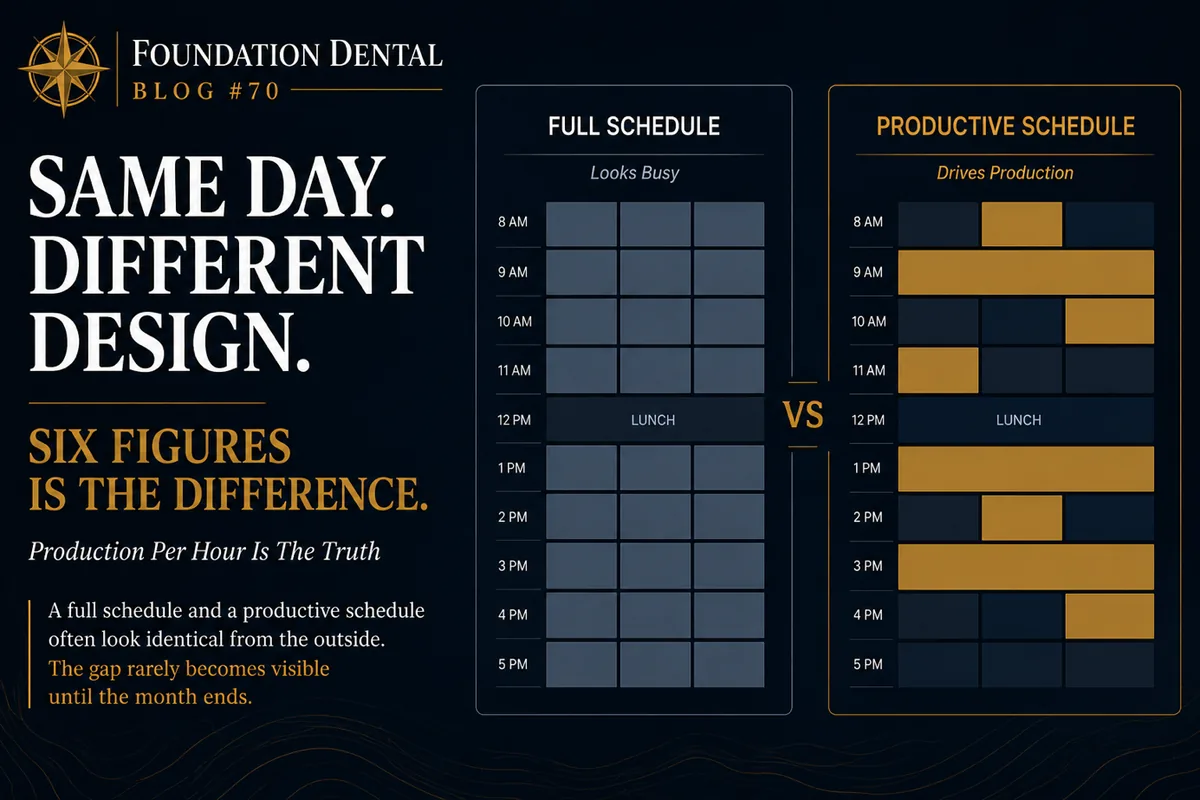
A full schedule and a productive schedule look identical from the outside. The gap rarely becomes visible until the month ends.
Why This Is Especially True for Fee-for-Service Practices
If a practice is fee-for-service, or working toward reducing insurance dependency, the schedule isn't a separate problem from the positioning. It's the same problem.
FFS positioning means production comes from case depth - from patients who accept comprehensive treatment, from the value the team creates per appointment rather than from volume. And a schedule designed around volume directly undermines that model.
I've watched practices make a genuine commitment to fee-for-service. They do the work. They build patient relationships. They improve case presentation. They develop real diagnostic language. The production still doesn't reflect it, because the schedule never changed. There's no structural room in the new patient appointment for the exam experience FFS requires. There's no breathing room in the hygiene column for the doctor to sit down with a patient and actually talk through what they need.
Many successful fee-for-service practices eventually learn to protect capacity differently. Doctor time becomes intentional. Treatment blocks become intentional. The practice begins focusing on production density rather than appointment density.
Appointment density measures activity. Production density measures effectiveness. The economics of fee-for-service demand that distinction.
This is one of the reasons many successful fee-for-service practices feel calmer. The calm isn't accidental. It's architectural. The schedule has been designed to support the type of dentistry the practice is trying to deliver rather than forcing that dentistry into a template built for volume.
The schedule either supports the clinical model the practice is trying to build or it fights it. There is no neutral position.
Why Accommodation Eventually Becomes Expensive
Patient experience matters. Relationships matter. Flexibility matters. I've built practices around those principles for more than 25 years and I'm not arguing against any of them.
The problem appears when accommodation becomes the governing philosophy of the schedule rather than an intentional exception within it.
Every exception feels harmless in isolation. A preferred appointment time. A special request. A block adjustment. A compromise. Individually they don't matter much. Collectively they can reshape the economics of an entire practice.
Architecture is what you repeat, not what you intend. When exceptions become normal, they stop looking like decisions and start looking like reality. That's how schedule drift happens. Nobody decides to create an inefficient schedule. It happens one accommodation at a time, until five years later everyone wonders why the practice feels busy but never gains momentum. The answer is usually sitting in the template.
Most practices never make these tradeoff decisions consciously. That's why schedule reviews aren't corrective - they're preventive. Drift is natural in any system without deliberate leadership. Schedules are no different.
Most scheduling problems aren't scheduling problems. They're leadership problems expressed operationally - decisions nobody made consciously, accumulating until the system produces results nobody wanted.
Why Schedule Architecture Affects Practice Value
This is the piece most owners don't consider until they're close to a transition - and by then it's late to do much about it.
When a buyer evaluates a practice, they're evaluating predictability. They want to know whether the production will hold without the selling doctor heroically holding it together. Predictability doesn't come from activity. It comes from systems that consistently produce desired outcomes, independent of any one person.
Buyers don't pay premium multiples for effort. They pay premium multiples for predictability. Predictability comes from systems. The schedule is one of the most visible systems in the entire practice.
This is one of the first things we look at inside Foundation Dental Transitions when we're evaluating whether a seller's numbers are actually transferable. A schedule that relies on the owner's constant presence and energy might produce strong numbers today. It also signals risk. If the owner steps back, gets sick, or sells, does the day still work?
After more than 60 practice transitions, I can tell you with confidence: practices that command the strongest valuations rarely have the most patients. They have the most predictable production. And predictable production almost always traces back to a schedule that was designed rather than inherited.
The schedule is financial infrastructure. It determines production capacity before the first patient arrives on Monday morning - and it influences practice value more directly than most owners realize.
How Do You Start Redesigning a Schedule Around Production?
The sequence matters. Most practices approach scheduling problems by adjusting what already exists. The more effective approach is to work backward from the target.
Start with the annual production goal - not last year's number, the actual target the practice needs to hit to fund its obligations and generate the margin the owner needs. Translate that into a weekly target, then a daily target. Translate the daily target into a production-per-hour floor based on planned clinical hours.
Now look at the current template against that floor. Block by block, appointment type by appointment type. Which blocks consistently meet the floor and which ones drag it down? Where does the schedule structurally lose production - not because patients cancel, but because the design itself limits what's possible?
That review typically reveals three or four structural problems that explain most of the production gap. Blocks that chronically underperform because procedures have always been underallocated on time. Same-day treatment capacity filled reactively instead of planned proactively. Hygiene columns measured by appointments completed rather than by treatment diagnosed and scheduled forward.
Once the redesign is done, the schedule needs a defined review cycle. Minimum annually. Quarterly if the practice is actively growing. The schedule that fits the practice today won't fit it in 18 months if the practice is doing its job.
Frequently Asked Questions About Dental Practice Scheduling and Production
How do I know if my schedule is limiting production? If the practice consistently misses financial goals despite strong demand, adequate diagnosed treatment, and a busy team, the schedule deserves serious investigation. Compare production per hour against the floor your annual target requires - that comparison usually tells the story quickly.
What is production per hour and why does it matter? Production per hour measures the value generated during each clinical hour. It's a structural diagnostic, not just a performance metric. It tells you whether the schedule can realistically support production targets - something total monthly production numbers can't reveal on their own.
Should every dental practice use the same scheduling template? No. Scheduling architecture should reflect the practice's goals, business model, procedure mix, and patient experience strategy. A fee-for-service practice and a high-volume PPO office need fundamentally different designs.
What's the relationship between scheduling and EBITDA? Direct and significant. Production per hour determines how efficiently clinical capacity converts into revenue. Inefficient conversion means more overhead consumed per dollar produced, which compresses margin. A well-designed schedule doesn't just improve gross production - it improves the ratio of production to cost, which is where EBITDA actually lives.
Why do fee-for-service practices often schedule differently? Because their economics rely more heavily on comprehensive treatment, relationship-based care, and production density than pure appointment volume. The schedule has to support that model or the positioning doesn't hold financially.
How often should a dental practice schedule be reviewed? At minimum annually. Growth, staffing changes, treatment mix shifts, and business goals all change over time. The schedule should evolve with them - not through incremental accommodation, but through deliberate review against current production targets.
Bottom Line
The production number is important. The collection number is important. The EBITDA number is important. But every one of those outcomes is downstream from a system that most owners rarely examine.
The schedule.
That's why this isn't really a scheduling conversation. It's an architecture conversation.
The schedule you're running today is either aligned with your financial objectives or it isn't. Most owners never stop long enough to determine which one is true.
I've seen the pattern repeatedly across more than 60 practice transitions and throughout my own ownership career. The practices that consistently hit their targets aren't necessarily working harder. They aren't necessarily seeing more patients. They aren't necessarily operating in better markets. They're operating from schedules that were intentionally designed to support the outcomes they want.
If you can't change how your time moves inside your own building, you don't own a practice. You own a job that happens to have your name on the door - and a treadmill you can't figure out how to step off.
Most owners spend years trying to improve production. Far fewer spend a day examining the system that determines it.
That's why the schedule may be the most expensive thing in your practice that nobody is paying attention to.
If you want another set of eyes on whether your schedule is lying to you or supporting you, that's one of the first conversations we have inside Foundation Dental Mastermind.
About the Author
Dr. Jim Arnold, DDS is the Founder and CEO of Foundation Dental Alliance, a leadership and practice development organization serving dentists from graduation through retirement. He has 30 years of experience as a multi-practice owner and has been involved in more than 60 dental practice transitions. He leads the Foundation Dental Mastermind, Luxury Dental Retreats, co-founded Foundation Dental Transitions, and hosts the Foundation Dental Podcast. He also publishes the Foundation Dental Newsletter and Blog weekly, focused on leadership, practice design, and long-term sustainability in dentistry.
Stay Connected
Websites
FoundationDentalAlliance.com
FoundationDentalMastermind.com
FoundationDentalTransitions.com
FoundationDentalNetwork.com
LuxuryDentalRetreats.com/dubai
Social Media
LinkedIn: linkedin.com/in/arnoldjim
Instagram: instagram.com/smilesbyarnold
YouTube: youtube.com/@DrJimArnold
Facebook: facebook.com/smilesbyarnold
Twitter/X: twitter.com/smilesbyarnold
TikTok: tiktok.com/@foundationdentalalliance
Google Business Profile: tinyurl.com/2t3chcv6
Publications
Foundation Dental Newsletter: linkedin.com/newsletters/foundation-dental-newsletter-7289675134649450496
Contact
Professional Email: drarnold@foundationdentalalliance.com