Foundation Dental Intelligence
Blog No. 71
The ADA President Who Saw Four Patients a Day and Outproduced Everyone Around Him.
Get the next article.
One signup. Everything we publish.
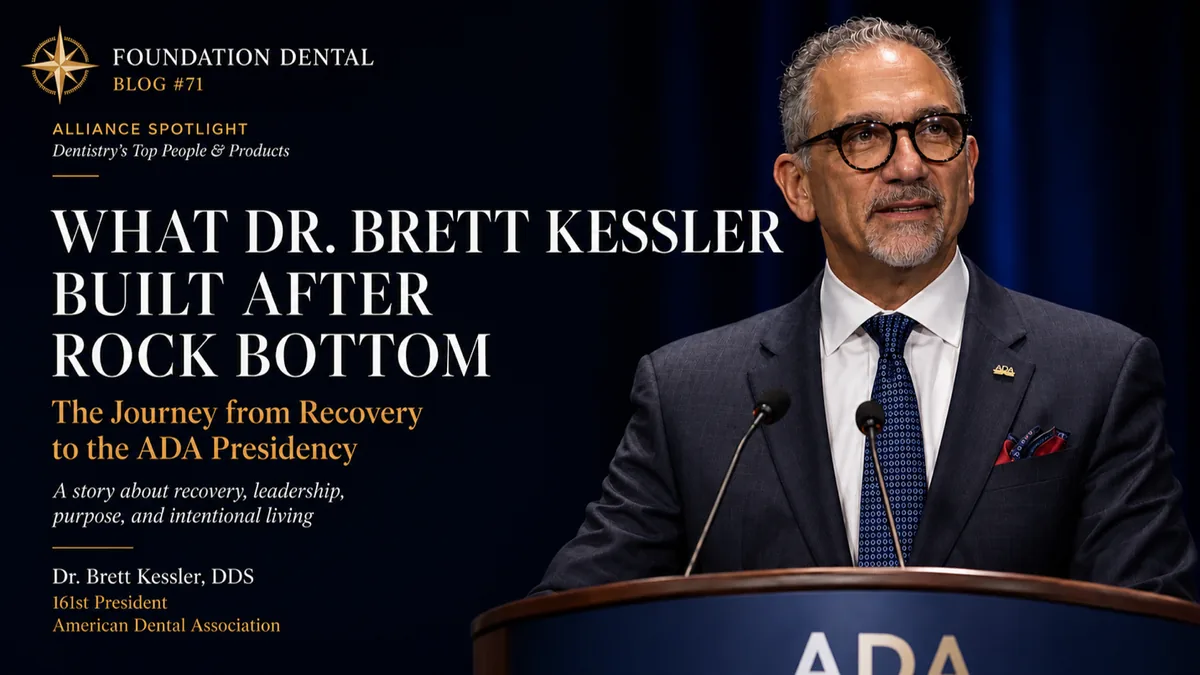
There’s a moment in Dr. Brett Kessler’s story that I keep coming back to.
It’s October 2025. He’s the outgoing President of the American Dental Association. In a few hours he’ll deliver his final address to the House of Delegates - the culmination of a presidential year that included the most aggressive political assault on community water fluoridation in modern U.S. history, the mid-term resignation of the ADA’s executive director, a management system rollout that cut revenue, 225 days on the road, and 18-hour days that never quite ended.
Before the address, he gets up before dawn and runs to the Lincoln Memorial.
That’s how he processes things at scale. On the road. Moving forward. Alone with the weight of what just happened and what comes next.
I’ve been an Ironman triathlete. I understand what it means to do the hard thing before anyone’s watching, in the dark, when nobody would know if you didn’t. That discipline doesn’t show up on a resume. It shows up in the person you become over time - in how you handle years like the one Brett just had.
I’m sitting down with Brett this Wednesday on the Foundation Dental Podcast. Before that conversation happens, I want to introduce him to this community properly. Not with a press release. Not with a credentials list. With the story that actually explains who he is.
Before the Titles
On paper, you could introduce Brett Kessler a hundred different ways. 161st President of the American Dental Association - the youngest to hold that title in decades, the first dentist from Colorado to hold it at all. Past President of the Colorado Dental Association. ADA Golden Apple Award winner, the organization’s highest honor for Outstanding Leadership in Mentoring. Five-time Ironman triathlete including back-to-back finishes at the World Championship in Kona. Clinical faculty at the University of Colorado School of Dental Medicine. He’s presented at Harvard’s leadership class, delivered commencement addresses at dental schools, testified before the United States Congress on behalf of the ADA.
All of that is accurate. None of it is the center of the story.
The center is a single moment: a 29-year-old dentist sitting in front of a blank page, nine months sober, asking himself whether he wanted to live at all - and quietly deciding that if he stayed, he was going to become someone entirely different.
He went to the University of Iowa as a biomedical engineering student, planning on medicine. He tore up his medical school application at the mailbox. A friend in dental school pointed him toward dentistry. He enrolled at the University of Illinois Chicago, graduated in the top 20% of his class in 1995, and met his wife Gina in their first year - she’s now an orthodontist and practice owner, and they’ve been together since dental school. He completed his GPR at Northwestern Memorial Hospital in Chicago, then followed Gina to Michigan for her orthodontics program at the University of Michigan.
That’s where the wheels came off.
He’d entered dental school with a substance use disorder and graduated with a worse one. Michigan is where it became unmanageable. He’d heard during his residency about a confidential wellness hotline every state had for dentists - get help while protecting your license. He made the call. He entered treatment. He walked out convinced he didn’t have a problem. Fourteen months later, after relapsing and hitting his absolute bottom, he went back. He was 29, contemplating whether he wanted to live at all, let alone practice dentistry.
He’s been sober since October 21, 1998. He knows the date. He always knows the date. Twenty-six years later, to the exact day, he was installed as the 161st President of the American Dental Association.
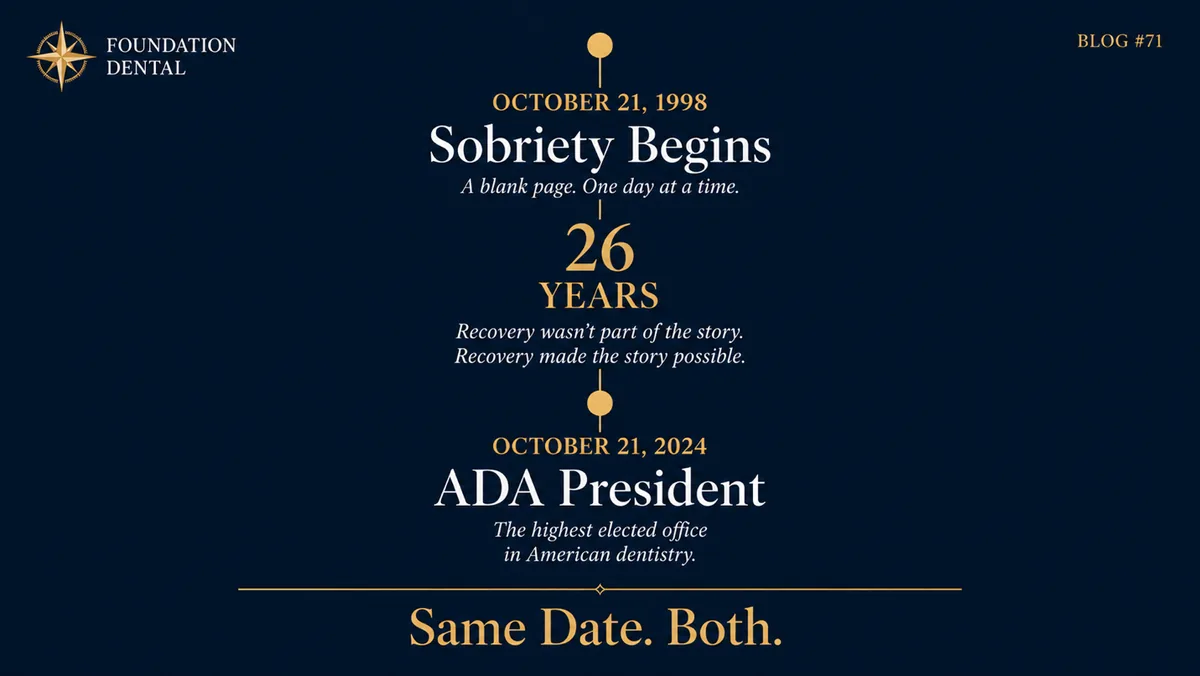
October 21, 1998. October 21, 2024. He knows the date. He always knows the date.
The Blank Page
Nine months into sobriety, Brett was sitting in front of a blank page with no map and no guarantee. Someone handed him Stephen Covey’s Seven Habits. The idea that a life could be designed rather than simply survived landed hard. He started writing - not goals, not resolutions, not a list of things to accomplish. He wrote the practice he wanted to build, the man he intended to become, the husband and father he hoped to be. He wrote it in the present tense, as if it had already happened.
Almost everything came true.
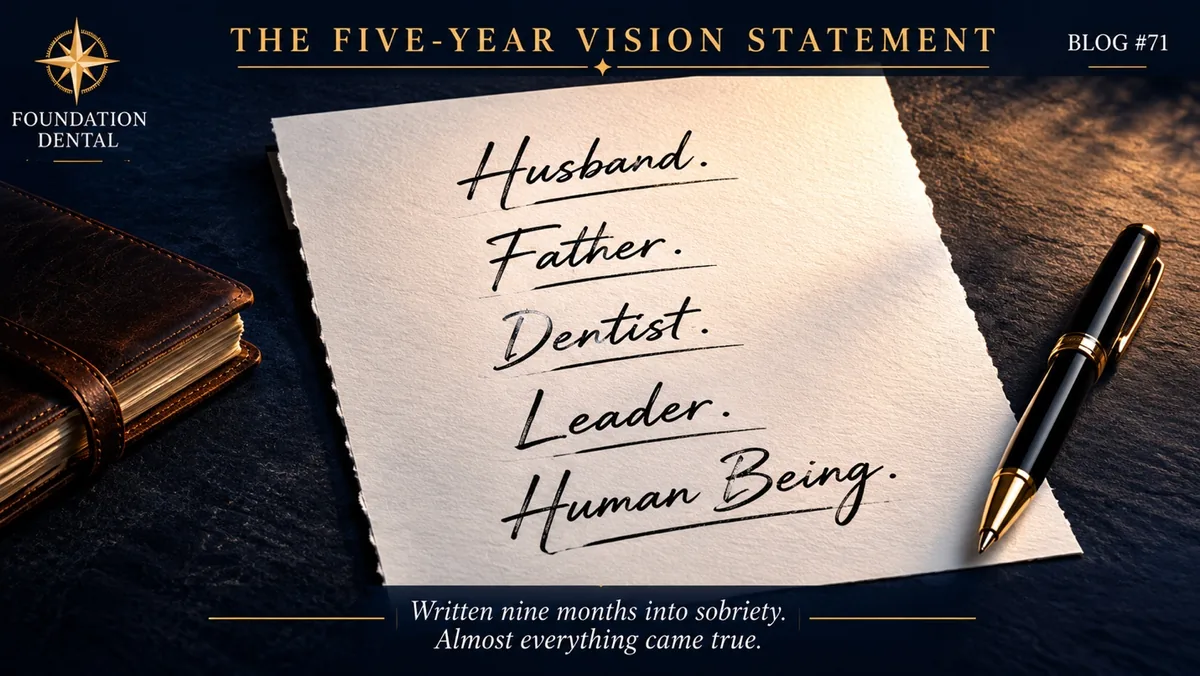
Written nine months into sobriety. Almost all of it came true.
That exercise became a five-year ritual. Every five years, the same blank page, the same question: if your life were as good as it can possibly be five years from now, what would that look like? He writes the answer as if the life described has already happened, with specificity - what he’s doing, who he’s with, what he values, what kind of leader he’s become. Then he goes out and lives into it, one small move at a time.
This is the part of his story I find most relevant to the dentists in this community - not the ADA presidency, not the Ironman finishes, not the Congress testimony, but this. Brett was 29 years old, newly sober, with nothing obvious going for him and everything still to lose. He could have waited until things were more stable, until the path was clearer, until the future looked more certain. Instead he sat down and wrote the beginning of the life he intended to build. Most dentists I know are still waiting for conditions to improve before they’ll do that same exercise. Brett did it at rock bottom.
The blank page isn’t something to fear. It’s an invitation. Brett has proved that every five years for nearly three decades.
The discipline of recovery - accountability, reflection, honest inventory, daily practice - became the engine of everything that followed. He doesn’t separate his sobriety from his leadership philosophy. They’re the same practice.
“I dove into my recovery and 25 years later, I still value it as the most important thing in my life. Without it, I would have nothing.”
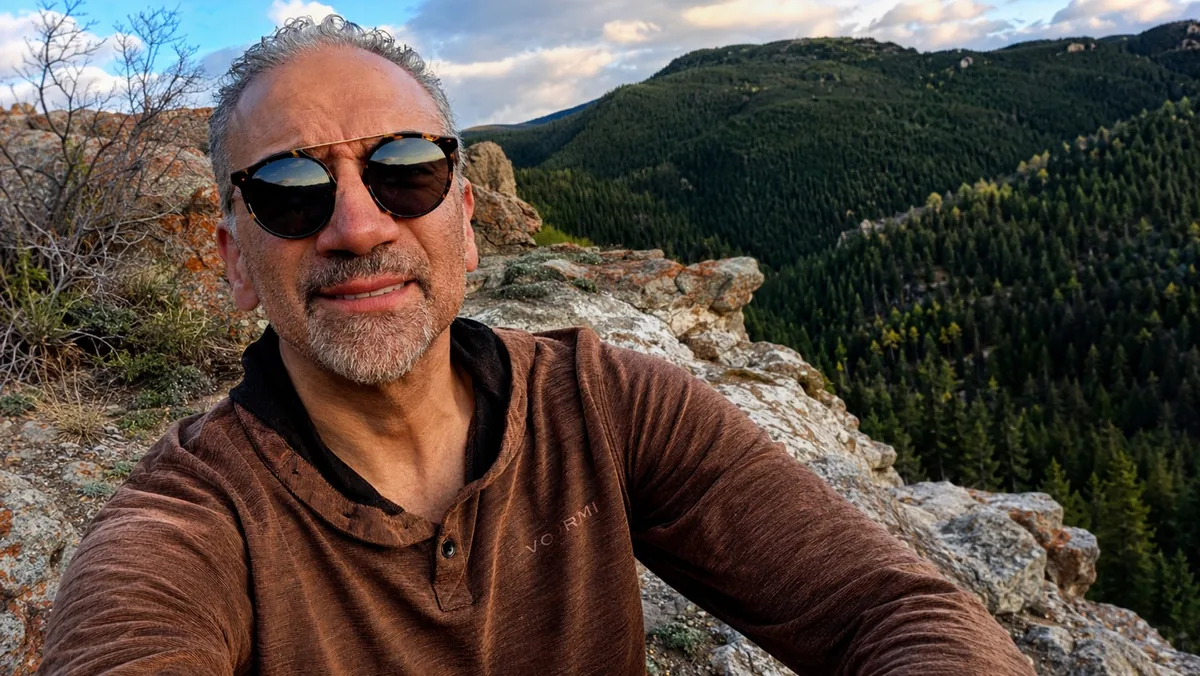
Recovery wasn’t the end of the story. It was the beginning.
The $250,000 Education
His first major clinical test in Colorado came early. He took an associate position at a high-end fee-for-service cosmetic practice in downtown Denver and bought in at the one-year mark. Something had been signaling wrong from nearly the beginning. What he found was a values mismatch - different definitions of honesty and integrity. He got out. He lost approximately $250,000 in his fifth or sixth year of practice.
He got back his ability to sleep at night. He considers it a fair trade.
That decision became the first proof of the person he’d written about in his vision statement. It also made integrity expensive, which is the only way it becomes non-negotiable.
Values become expensive - then you find out whether they’re real.
Brett found that out at 30 and built everything that came after on that foundation.
I’ve made similar decisions in my career. The ones that cost you something real are the ones that tell you who you actually are.
What He Built in the Wrong Neighborhood
Town Center Dentistry and Orthodontics - Denver, CO | 2003-2018 | 100% Fee-for-Service
He hired a business coach and wrote a business plan more than eighty pages long - so detailed it specified the color of the carpet. He walked it to banks. Every banker flipped straight to the financial projections page and ignored the rest. The business plan was for him, not for them. One banker believed in him.
In 2003, he opened Town Center Dentistry and Orthodontics in Stapleton - a Denver neighborhood that lenders and colleagues almost uniformly told him was wrong for a fee-for-service practice. He saw something they didn’t. He ran that practice for fifteen years seeing four to six patients per day, generating three to four times more revenue per patient than insurance-based practices nearby, bringing in eight to ten new patients per month rather than a hundred. The practice grew by going deep, not wide.
He wasn’t really building a fee-for-service practice. He was building a relationship-based practice. The financial model simply reflected the strength of those relationships.
His recurring lecture to senior dental students at the University of Colorado is built around a single question: how do you sell a solution to someone who doesn’t realize they have the problem? His answer is the Pankey co-discovery process - trust built through time, honest diagnostics, and a patient who’s been given the mirror before the treatment plan appears. That’s not a clinical technique. It’s a philosophy of relationship that applies equally to a patient conversation, a leadership challenge, and a vision statement. Brett knows that because he’s tested it in all of those contexts.
This is the same argument I made in Newsletter #71 about insurance architecture - that the real cost of PPO participation isn’t the write-off percentage, it’s what the model teaches the practice to become. Brett built his entire practice on the opposite principle, in a neighborhood where nobody thought it would work, and ran it successfully for fourteen years before selling it.
5280 Magazine Top Dentist - Every year since the list’s inception in 2005
Sobriety House to Congress
U.S. Congressional Testimony on Behalf of the ADA - October 2007
After getting sober and settling in Colorado, Brett partnered with Sobriety House - a Denver treatment center serving the homeless population. If participants stayed in the program and followed the rules, Brett fixed their teeth for free. He called them “my Sobriety House people.” He reached out to the Metro Denver Dental Society looking for volunteer dentists. They didn’t send him a list. They put him on a committee. That committee led to a board seat. The board seat led to a local television segment about methamphetamine and oral health, which he’d been treating at Sobriety House. That went to CNN. The ADA called.
In October 2007, nine years sober, Dr. Brett Kessler testified before the United States Congress on behalf of the American Dental Association on the oral health impact of methamphetamine addiction. He had once been contemplating whether he wanted to live. He was testifying before Congress for his profession.
He calls it a fairy tale scenario. It’s the right word. But fairy tales have to start somewhere, and his started at rock bottom with a blank page and the decision to write the beginning. You have no idea where the small, right thing you do next week might lead.
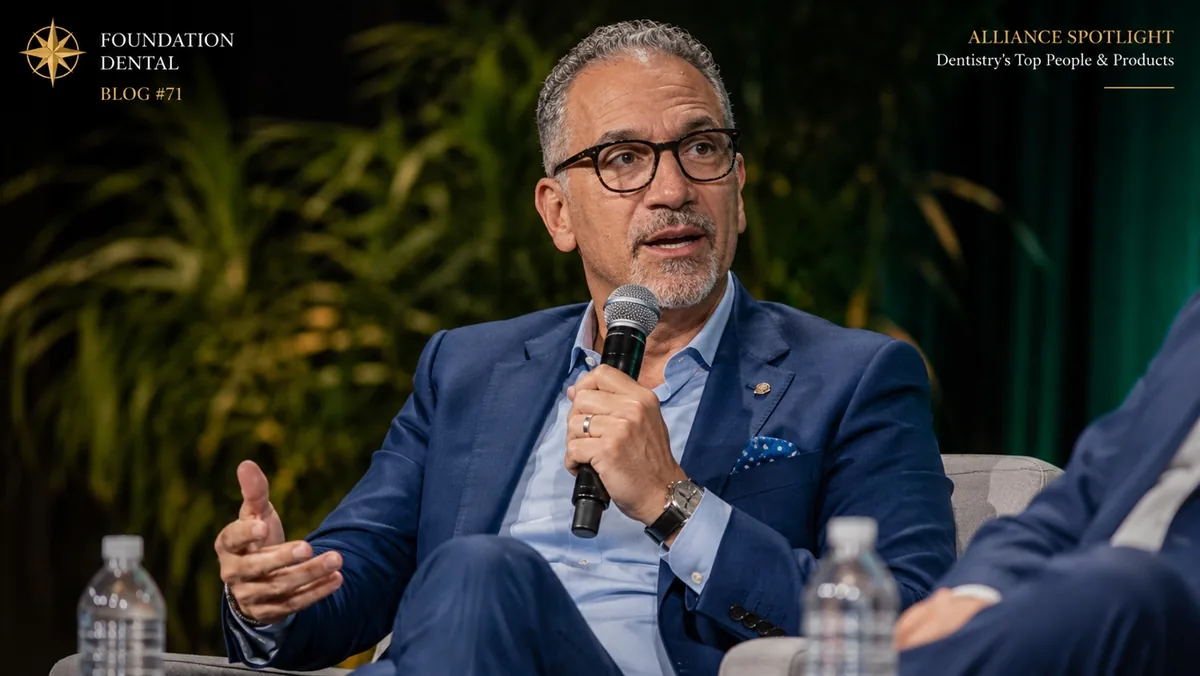
Influence is rarely built all at once. It’s earned one relationship, one decision, and one act of consistency at a time.
What Most People Miss
Brett’s story gets told as a recovery story, an athletic achievement, or a leadership ascent. It’s all of those things. But what most people miss is the operating mechanism underneath all of it - the thing that actually connects the sobriety to the practice to the Congress testimony to the ADA presidency to the Ironman finish lines.
It’s the five-year vision statement. Specifically, it’s the discipline of writing the beginning before the conditions exist to support it, and then trusting the sequence of small moves that follows.
Most people change only when circumstances force them to. Brett appears to change because growth requires it. That’s a fundamentally different operating philosophy, and it’s visible in every chapter of his story.
When he turned 50 in 2018, the five-year question produced five decisions in one year:
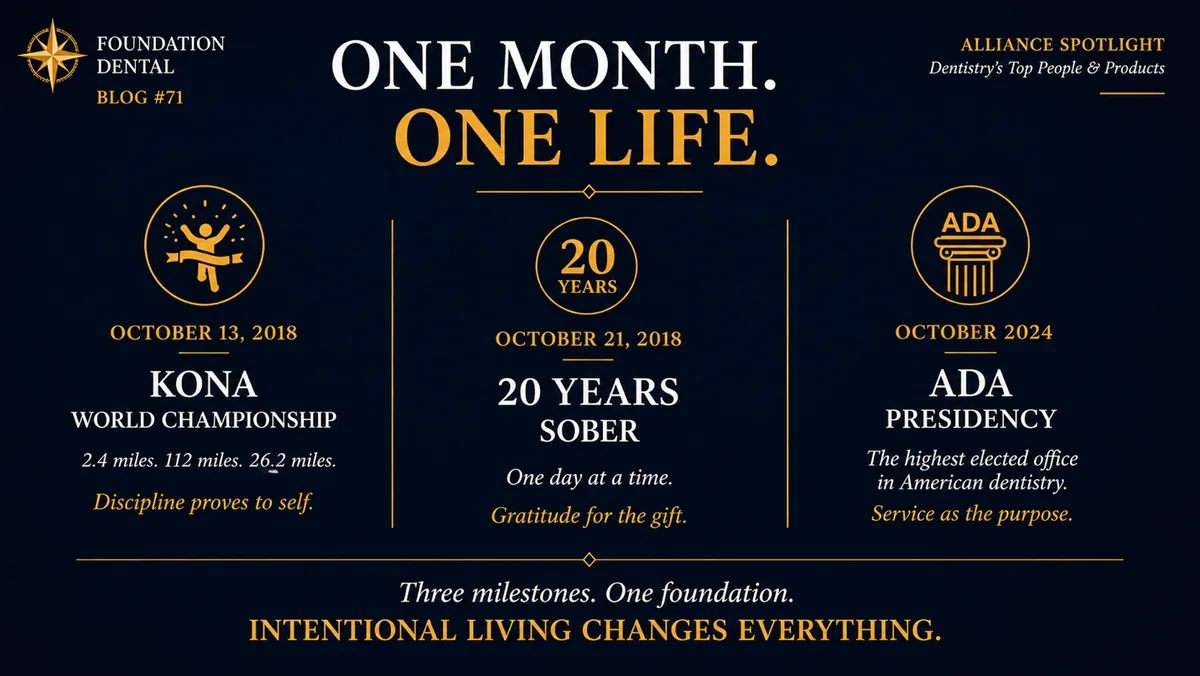
Three milestones. One foundation. Intentional living changes everything.
THE OCTOBER HAT TRICK - 2018
• Sold his practice after 15 years
• Ran for the ADA Board of Trustees
• Marked 20 years of sobriety
• Competed in the Ironman World Championship in Kona in memory of his mother Gloria
• Started the path to the ADA presidency
He calls October 2018 his October Hat Trick - twenty years of sobriety, Ironman World Championship finish, and election as ADA Trustee, all within one month. None of it was an accident. All of it started with a blank page and one question.
Kona Was Never About Athletics
Before the gun went off in Kona in 2018, a friend gave Brett unusual advice: swim out into the lagoon, dive to the sandy bottom, let out a primal scream, and ask the island for permission to race. Brett isn’t superstitious. He did it anyway. He dove, screamed into the salt and the dark, and came up to find a massive sea turtle floating right next to him. The turtle held his gaze for a moment, gave something that felt like a nod, and swam away. In that moment, every piece of tension in his body released. He knew the day was going to be okay.
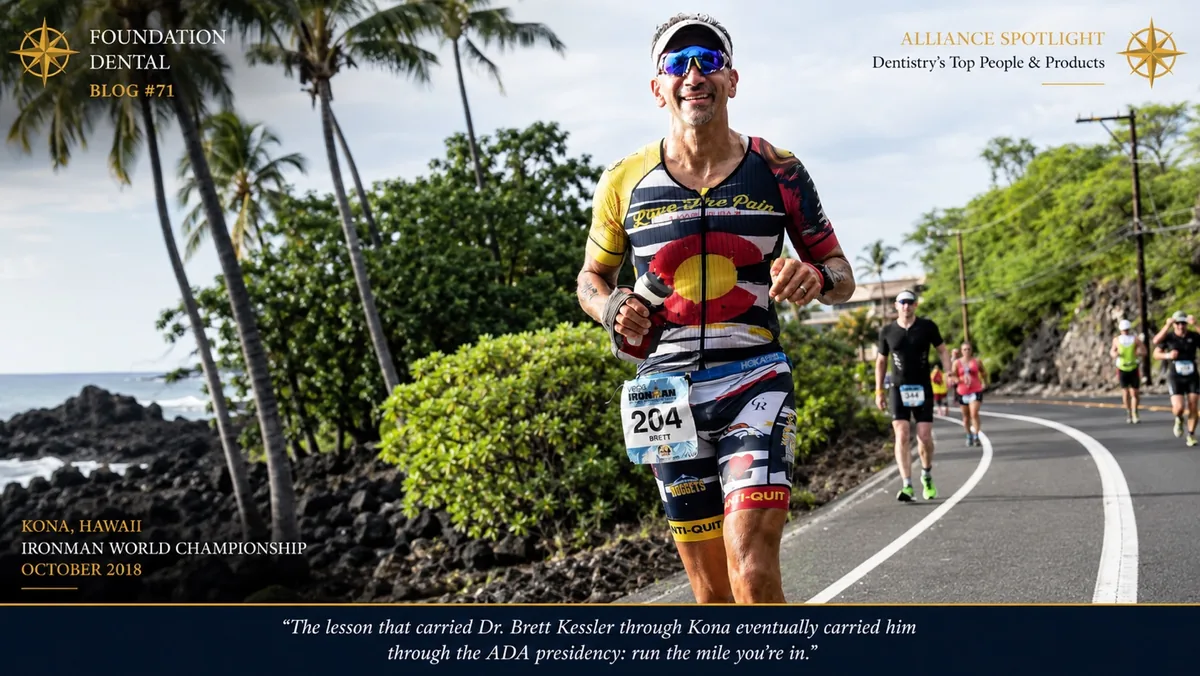
The lesson that carried him through Kona eventually carried him through the ADA Presidency: run the mile you’re in.
He crossed the finish line on October 13, 2018 with the word "ANTI-QUIT" printed on his tri kit. Eight days later he marked twenty years of sobriety.
The race wasn’t about athletics. It was gratitude in motion - a tribute to his mother, a completion of a thread that had started when his early LLS fundraising helped develop the drug that kept her alive, a recognition that purpose matters more than performance. He calls Kona one of the best days of his life. He says he still thinks about it every single day.
When the ADA felt like it was in jeopardy during his presidency and the problems stacked higher than anyone could solve in one move, he went back to a moment from that race - sitting wrecked in the changing tent after the bike, asking a volunteer how he was supposed to run 26.2 more miles. The volunteer didn’t argue. He said: “Just run one mile. Anyone can run one mile.” Brett carried that into every boardroom and crisis meeting that followed.
Stop asking how to fix everything. Start asking what you can do right now to make things slightly better. Run the mile you are in.
What He Fought For as President
161st ADA President | October 2024 - October 2025 | "The Power of Now"
Brett’s presidential theme was “The Power of Now.” His three pillars: reconnect oral health to the body, grow a culture of respect across all practice modalities, and expand wellness resources for the profession.
What actually defined the year was a fight he didn’t choose and refused to back down from. The CDC’s Division of Oral Health was eliminated. Two states banned community water fluoridation. National figures publicly misrepresented the science at the highest levels. Brett met with White House officials, testified before the FDA to preserve fluoride supplements for families without access to fluoridated water, and co-authored an editorial in the JAMA Health Forum warning that eliminating fluoridation would result in 25.4 million additional decayed teeth and $9.8 billion in added treatment costs within five years. He held the scientific line under political pressure that would have caused many leaders to find a softer position.
“Science is winning. Politics should not dictate science.”
He also laid the groundwork for the ADA’s Clinical Autonomy Statement - a formal institutional affirmation that the doctor-patient relationship is inviolable, and that no practice structure, insurer, private equity firm, or production metric has the right to dictate patient care. His position on DSOs is more nuanced than most coverage suggests - he served as a chief dental officer for a small group practice and doesn’t oppose the model. He opposes any structure that places financial returns above patient welfare, and he holds every model to the same standard.
One morning during his term, he stood in the ADA archives in Chicago holding Pierre Fauchard’s original text from the 1700s. Next to it sat G.V. Black’s first address to the profession, every word captured by a stenographer. Then he looked at the date. Black was ADA president in 1900. One hundred and sixty-one people connected those two names. He was the next one on the line. He calls it his “oh, shit moment” - the full weight of the office, the unbroken thread from Fauchard to Black to himself, landing all at once. He walked out of that archive calling the presidency a catapult, not a capstone.
What He’s Building Now
Co-Founder, Dentistry, Reimagined | Certificate in Human Centered Leadership
Brett left the ADA presidency in October 2025 and didn’t step back. He co-founded Dentistry, Reimagined - a Certificate in Human Centered Leadership built from 30 years of living the things he now teaches, not from theory. He’s assembling a book from fifteen-plus years of journals, speeches, and professional writing, a body of work that’s been accumulating since early sobriety. He launched a virtual dental student mastermind that drew 80 students at its first session and now runs with 40 to 50 attendees every four to six weeks, nationwide and virtual.
His stated goal is direct: improve leadership skills in the dental profession. He believes it starts with helping dentists rediscover and reconnect with their purpose, their why, before the system gets to them.
He still runs and rides. He still journals every morning at 5 a.m. He still writes the next version of his life on a blank page before the conditions exist to support it.
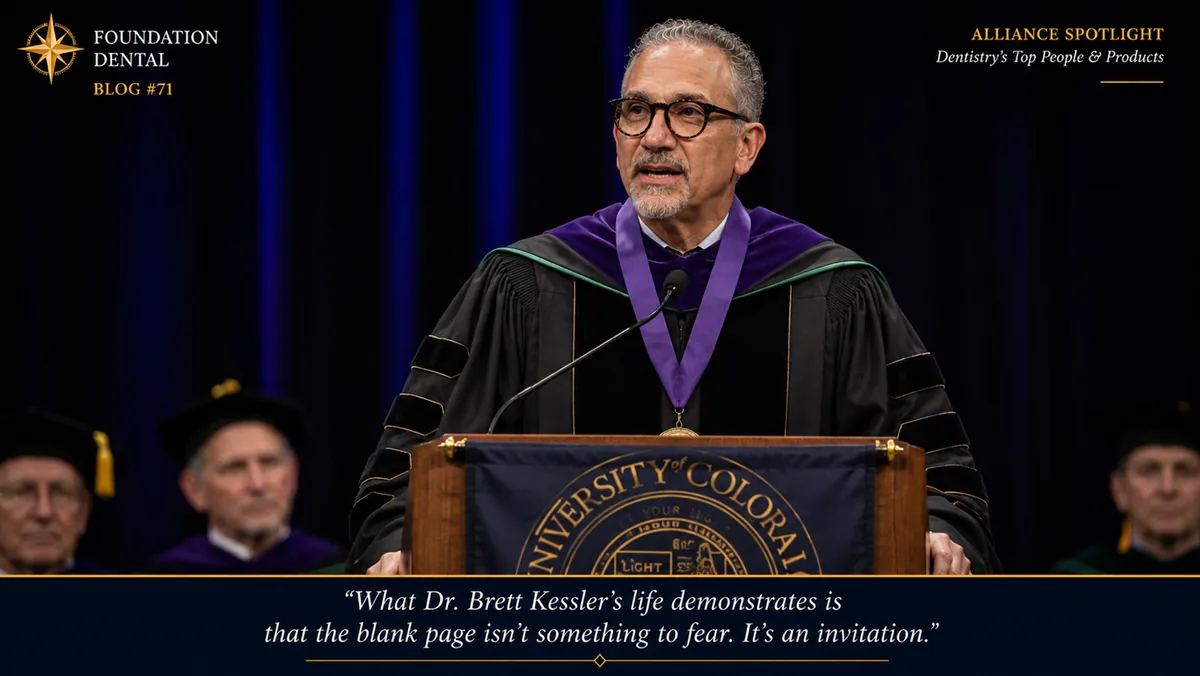
What Dr. Brett Kessler’s life demonstrates is that the blank page isn’t something to fear. It’s an invitation.
Why This Conversation Matters to This Community
The dentists who read this blog are independent practice owners. Most of them are somewhere in the tension between the practice they have and the practice they intended to build. Some are dealing with insurance decisions they’ve deferred for years. Some are looking at a production ceiling they can’t fully explain. Some are closer to burnout than they’d admit publicly. Some are starting to think seriously about what the practice is worth and what their optionality looks like when they’re ready to step away.
Brett Kessler has navigated every version of that tension. He built a scratch-start FFS practice against all conventional advice and ran it for fifteen years. He walked away from $250,000 rather than compromise his values when the money was real and the decision was genuinely hard. He spent thirty years in organized dentistry advocating for exactly what this community cares about - clinical autonomy, fee-for-service independence, insurance reform, and the wellness of the people doing the work. He processed a year of extraordinary pressure by running to the Lincoln Memorial before dawn.
And he did all of it from a foundation he built on a blank page, nine months into sobriety, at an age when most people are still waiting for better conditions before they start writing.
This Wednesday, that conversation happens on the Foundation Dental Podcast. The link will be in the newsletter and on all our channels when the episode drops.
It’s going to be worth your time.
Frequently Asked Questions About Dr. Brett Kessler
Who is Dr. Brett Kessler and why does his story matter to dental practice owners?
Dr. Brett Kessler is the 161st President of the American Dental Association - the youngest to hold that title in decades and the first dentist from Colorado. He’s a five-time Ironman triathlete, 27-year recovery advocate, and founder of the fee-for-service practice Town Center Dentistry and Orthodontics in Denver, which he ran from 2003 to 2018 seeing four to six patients per day and generating three to four times the revenue per patient of insurance-based peers nearby. He’s a faculty member of The Sweet Spot Leader and co-founder of Dentistry, Reimagined, a Certificate in Human Centered Leadership program. His story matters to practice owners because every conviction he holds publicly traces back to a specific experience that cost him something.
What did Brett Kessler accomplish as ADA President?
During his term from October 2024 through October 2025, Kessler led the ADA’s defense of community water fluoridation under its most aggressive political challenge in modern U.S. history, co-authored a JAMA Health Forum editorial documenting the projected cost of defluoridation, laid the groundwork for the ADA’s Clinical Autonomy Statement affirming the inviolability of the doctor-patient relationship, expanded wellness resources including the Talkspace Go mental health app for all ADA members and students, and advocated for dental insurance reform including ERISA amendment, dental loss ratio transparency, and Medicare dental expansion.
What is Brett Kessler’s philosophy on fee-for-service dentistry?
Kessler built Town Center Dentistry and Orthodontics from scratch in 2003 as a fee-for-service practice in a Denver neighborhood that lenders and colleagues told him couldn’t support the model. He ran it for fifteen years, seeing four to six patients daily and generating three to four times more revenue per patient than insurance-based practices nearby. His core argument is that fee-for-service isn’t primarily a reimbursement strategy - it’s a philosophy of relationship. The Pankey co-discovery process drove case acceptance: trust built through time, honest diagnostics, and patients who felt seen before they were told what they needed.
What will the Foundation Dental Podcast episode with Brett Kessler cover?
The episode covers Brett’s recovery and rebuilding, his five-year vision statement practice and how it produced his career, the $250,000 values decision early in his practice, building a scratch-start FFS practice in a neighborhood everyone said was wrong, his Congress testimony, the Kona connection to his mother Gloria, what his ADA presidential year actually looked like from the inside, his position on DSOs and clinical autonomy, and what he’s building now. The episode airs Wednesday, June 3, 2026, on the Foundation Dental Podcast.
What is The Sweet Spot Leader?
The Sweet Spot Leader is a Certificate in Human Centered Leadership program where Dr. Kessler serves as faculty. The program includes five courses and group executive coaching sessions designed for clinicians and leaders who want to build stronger teams, navigate difficulty without losing themselves, and develop a practice culture that holds without the owner at the center of every decision. Dr. Kessler co-founded Dentistry, Reimagined, a Certificate in Human Centered Leadership built from his 30 years of clinical practice, organized dentistry leadership, and recovery work.
About the Author
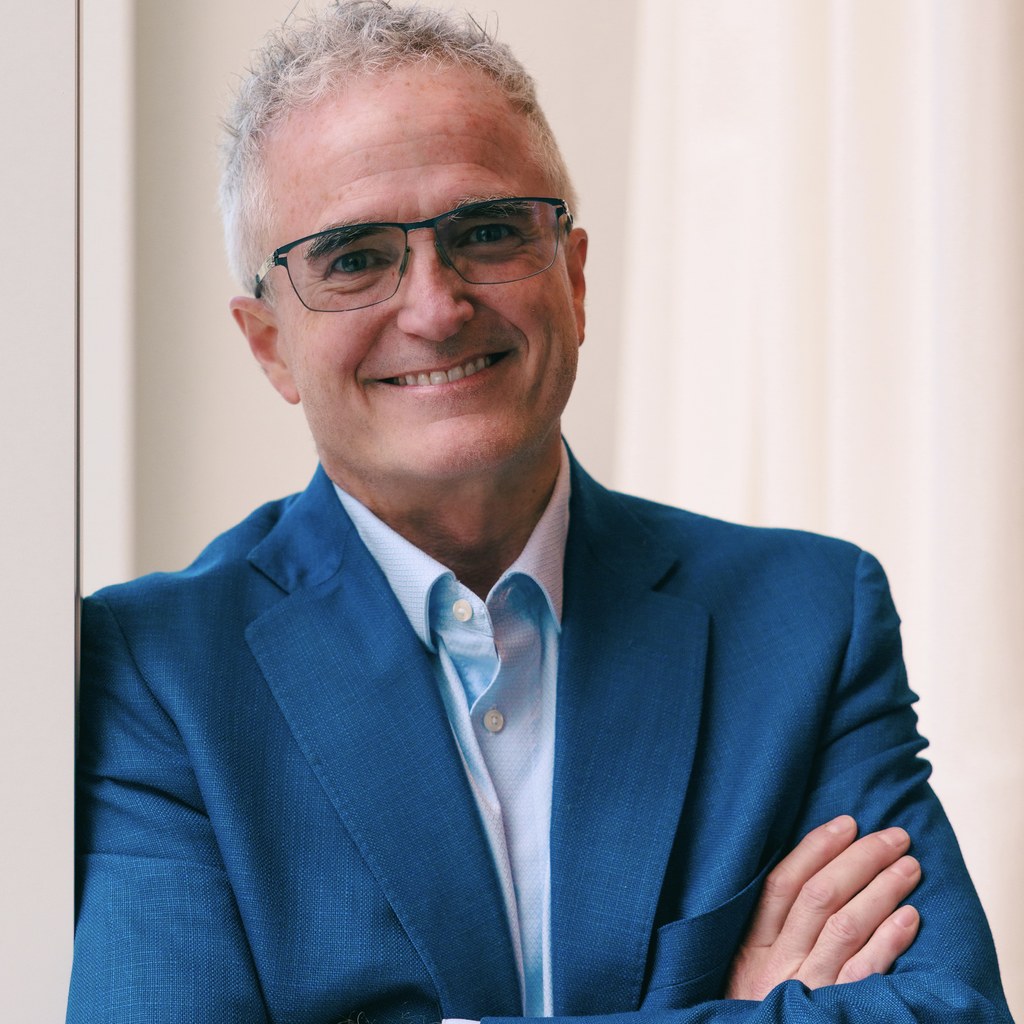
Dr. Jim Arnold, DDS is the Founder and CEO of Foundation Dental Alliance, a leadership and practice development organization serving dentists from graduation through retirement. He has 30 years of experience as a multi-practice owner and has been involved in more than 60 dental practice transitions. He leads the Foundation Dental Mastermind, Luxury Dental Retreats, co-founded Foundation Dental Transitions, and hosts the Foundation Dental Podcast. He also publishes the Foundation Dental Newsletter and Blog weekly, focused on leadership, practice design, and long-term sustainability in dentistry.
Stay Connected
Websites
FoundationDentalAlliance.com
FoundationDentalMastermind.com
FoundationDentalTransitions.com
FoundationDentalNetwork.com
LuxuryDentalRetreats.com/dubai
Social Media
LinkedIn: linkedin.com/in/arnoldjim
Instagram: instagram.com/smilesbyarnold
YouTube: youtube.com/@DrJimArnold
Facebook: facebook.com/smilesbyarnold
Twitter/X: twitter.com/smilesbyarnold
TikTok: tiktok.com/@foundationdentalalliance
Google Business Profile: tinyurl.com/2t3chcv6
Publications
Foundation Dental Newsletter: linkedin.com/newsletters/foundation-dental-newsletter-7289675134649450496
Contact
Professional Email: drarnold@foundationdentalalliance.com
Alliance Spotlight: Dentistry’s Top People and Products
© 2026 Foundation Dental Alliance. All Rights Reserved.