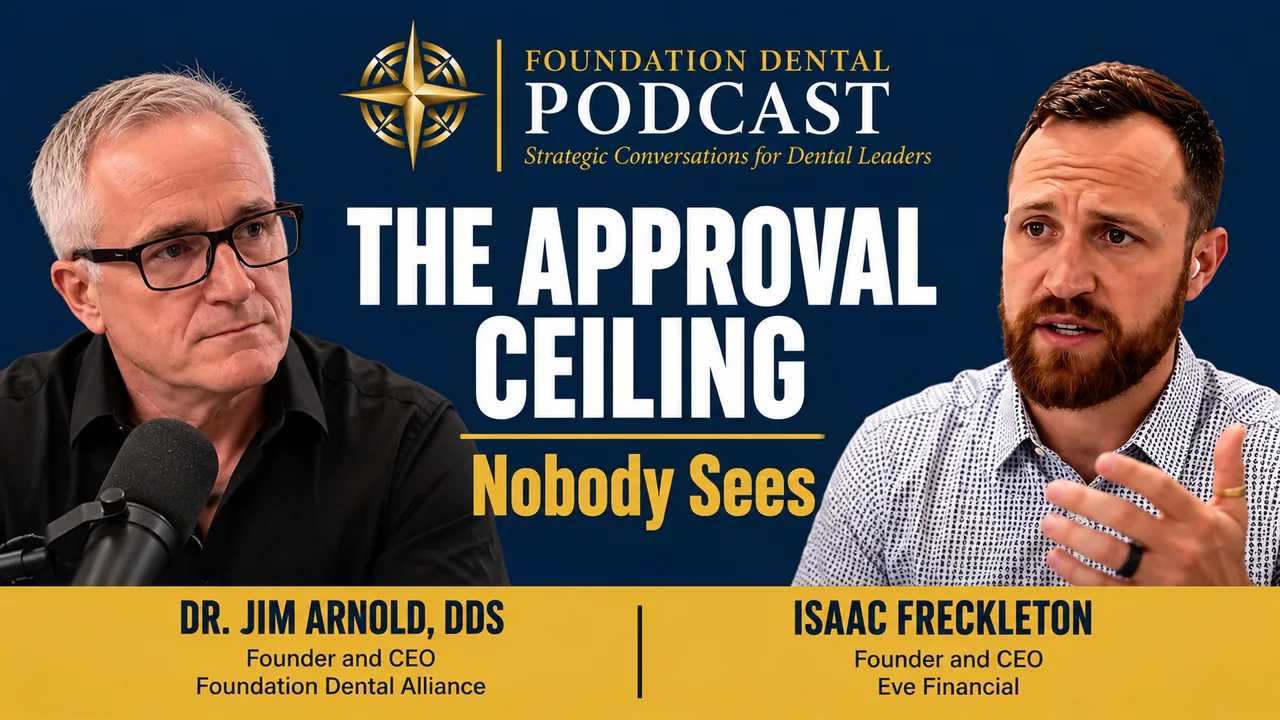
Foundation Dental Podcast
The Approval Ceiling Nobody Sees
With Isaac Freckleton, Founder & CEO, Eve Financial
Get the next conversation.
One signup. Everything we publish.
 Coming Soon
Read the full transcript
0:01Dr. Jim Arnold My guest today built a company that most people in the industry don't fully understand. And that's exactly why I wanted him on the podcast. He's not a lender, he's not a software company. He built the infrastructure layer that sits underneath the patient financing ecosystem. And he did it after losing a four million dollar company over a $50,000 loan. That experience didn't stop him. It became his thesis. Isaac Freckleton is the founder and CEO of Eve Financial, and I think this is one of those conversations you're gonna wanna hear all the way to the end. Isaac, welcome to the Foundation Dental Podcast.
0:33Isaac Freckleton Thank you, Doctor Arnold. I'm pleased to be here.
0:36Dr. Jim Arnold I'm Jim to you, man. Come on. Come on. You know what? We we we met on the cr Smiles at Sea cruise last fall and you know you've become a really good friend over that time and so I'm excited for people to hear what you've done and you know, what you're doing now too.
0:38Isaac Freckleton True. I'm I to your audience, I don't know. Yeah. Thanks, Jim. Yeah, it's it's been amazing to connect with you over the last man, man, it hasn't even been a year. But I have incredible respect for for you, the reputation you have, the audience that you've built, and I'm just humbled to be here. So thank you.
1:01Dr. Jim Arnold No, no. No, man, it's it's my pleasure. Well, hey, I'm gonna jump right in. I'm gonna start at the beginning. I'm gonna ask you a question you've never probably never been asked before, but it's what's something your parents got completely right that you didn't fully appreciate until much later?
1:25Isaac Freckleton You know, it's it's hard to appreciate the the value of working hard because when you're a kid you just you wanna be doing other things. and I think that my parents instilled a really strong work ethic. I built my first business when I was about eight years old and I I found that growing up in the heat of San Antonio, Texas, weather in in the very dry environment where water is, you know, it's very you you can go months without rain. I started a business with little plants, succulents that plants that are really drought resistant and tolerant. And yeah, I I remember I had this little green cart that I would pull from door to door filled with all of these plants that I had grown. and it's I'd I'd make a hundred to two hundred dollars a day. And yeah, yeah.
2:17Dr. Jim Arnold What? You were wait, you were eight years old? That's crazy.
2:21Isaac Freckleton Yeah. It started out first with like mint and basil and thyme in the in the garden, but not everybody wanted that. And I found that these these types of plants you can break off a leaf and put it in dirt and it'll start growing. And I was like, money may not grow on trees, but this is about as close as it gets.
2:37Dr. Jim Arnold That's amazing. That your parents they have any involvement with that? Were they totally supportive or was that one of those things you're like, what the heck are you doing?
2:47Isaac Freckleton totally supportive. Yeah. They let me do it completely myself. I would go around to local nurseries and ask for pots that you know, ask if I could pull out little plastic pots that were in their dumpsters. And I would jump into the dumpster, I'd grab out a bunch of pots, put in my cart and and bring it home. There was a nursery that wasn't too far from the house. And then I'd go dig up dirt out of the backyard and stick a leaf in it. And yeah, my parents were supportive. the
3:07Dr. Jim Arnold That's fine.
3:16Isaac Freckleton They were definitely very encouraging of of hard work. It ran a l i in in our blood, you know, all the way back generations, you know, my family you know, I come from humble, you know, a family of humble beginnings. But you know, my dad my dad was a doctor, my grandpa was just you know, a very humble man, didn't have much to his name, but he worked really hard and and made something of himself and and instilled kind of that hard work all the way through.
3:45Dr. Jim Arnold Yeah, and you have siblings who are also entrepreneurial, don't you? Yeah. Well that's that's cool. It's a great I think it's a great thing to have in a family where the parents really support that and encourage you to do those things because you know, at the end of the day, you're the best boss you'll ever have, right? man.
3:49Isaac Freckleton That's right, yeah, I do. Yeah, you know, I say that I'm actually the w the worst boss. I'll I'll joke that my boss is a jerk. And and people look at me sideways like, wait a minute, I thought you didn't have a boss. I'm like, no, I work myself way harder than I would work anybody.
4:13Dr. Jim Arnold Hey, if I if I talk to some of your old friends at BYU, what would they tell me today that hasn't changed since you were in college?
4:25Isaac Freckleton I don't know how to stop. I I had this I I had this nickname of being an energizer bunny. Just I I'd never stop. I I keep going. And you know, I even even at BYU I was in the finance core, which is, you know, one of the top finance BYU has some of the top financing and finance and accounting positions or programs in the United States, and very hardcore programs.
4:34Dr. Jim Arnold Yeah.
4:54Isaac Freckleton But at the time I had a passion for philanthropy, giving back and finding a way to make a difference and not waiting until you know, not waiting until some future milestone had been hit. And so in the middle of the finance corps, I actually put together a proposal with a philanthropy group, brought it to the dean's office of the Marriott School, presented it, and created an entirely new committee on the student council that hadn't existed before. and still still maintained a a a good GPA at the time but I just have this I I have this habit of not knowing when to slow down for for better or for worse and my my wife would tell you that nothing has changed
5:42Dr. Jim Arnold I love that. You know, and and I think that's one of the reasons why you've been so successful, you know, over the years. You know, when you've got that drive and when you believe in what you're doing and you know you're creating value for a lot of people, you know, I I really admire that in you. And I certainly try to be the same way, but but yeah, our spouses sometimes aren't completely understanding of that.
6:01Isaac Freckleton Yeah, if there's somebody I can't keep up with though, Jim, it's you, man. You definitely exude the same. I'll get messag when I get those messages from you and you've just pumped out like a twenty page article and it's like eleven o'clock at night, I'm like, man, I I'm starting to relax now. What are you doing, Jim?
6:05Dr. Jim Arnold Yeah. Hey. All right. Hey man, what do they say? As long as you love what you do, that you'll never work a day in your life, that sort of thing. And and you know what? I I feel that way for the first time in a long time. You know, I really enjoy all the things that I'm doing, which means that I can put in a lot of hours and you know, not not get worn down. So, you know, if you look at some of your work as play, then I think it's a little more it's a little easier to digest, right?
6:26Isaac Freckleton That is true. It it is.
6:45Dr. Jim Arnold So, you know, I I don't know if you were still in college or was out of college or whatever, but I I know in all the research I did about you, you were like door-to-door pest control sales and you were like in the top five percent in the nation back when you did that. You know, you had to learn a lot from that experience. Tell me about that.
6:56Isaac Freckleton Yeah. Yeah. You know, I I did. I'll I'll say Every one of us is in sales, no matter what we do. We're selling ourselves to someone. Even engineers that don't interact with people have to be able to sell their code to, you know, that you know, or their abilities was they're looking for a job. And I am a firm believer that everybody should get some kind of sales experience at some point in t in time in their life. And for me, that was in the context of door-to-door sales. And you know, even my kids when when they'll do a
7:29Dr. Jim Arnold Mm-hmm.
7:39Isaac Freckleton A little lemonade stand, or they'll bake cookies and bring them down to the to the street corner and sell them locally. I think there is value in learning how to interact with other people, how to communicate well, how to understand what people are looking for and what they're interested in, and find the thrill of being able to meet a need. And in a lot of cases, being able to identify a need that isn't even known and then meet that need is one of the most valuable skills.
7:50Dr. Jim Arnold Yeah.
8:09Isaac Freckleton That I think anybody can have. And so I learned a lot in that. you know, I I quickly excelled in selling individually and then got into team leadership and was in the top 5% working a three-month work work schedule where most you know most people were doing a a a four or five month schedule. And I I'll tell you the the second thing that I really pulled away from door-to-door sales was
8:29Dr. Jim Arnold Yeah.
8:39Isaac Freckleton an appreciation for the grind. I was willing to get up earlier. I was willing to stay out later. And I just didn't I I just didn't stop. And it taught me a lot of like tenacity and resilience. you know, being willing to just keep going, keep grinding, even despite getting a lot of no's.
8:42Dr. Jim Arnold Yeah. Mm-hmm. I was gonna say getting the nose is one of those things that I think is really intimidating. And the younger you are, the harder it is to deal with. You know, I had a similar experience in that in college, I was in a program for student athletes over the summer where we sold fire extinguishers of all things. And you know, I dude, I started that like so insecure and not confident. And like my first 10 presentations, I didn't sell a single single fire extinguisher, and that was like friends and family. But man, I fucked I fuck with it, dude. I took all those.
9:16Isaac Freckleton No kidding. Wow.
9:31Dr. Jim Arnold knows and by the end of the summer I was number four in the nation, you know, in terms of you know most sales and all that kind of stuff. But but like you with the pest control, I learned more through that experience than just about anything that I'd ever done up until that point. And some of that is is just that that kind of confidence that you know if you believe in what you're selling, if you believe in what you're doing, then you know it shows through. And I think that confidence is what I think a lot of times people are buying.
9:58Isaac Freckleton And you know, Jim, I couldn't even imagine right now today you being a, you know, hesitant, tepid, in you know, unconfident, you know salesman of any kind sitting, you know, selling fire extinguishers. But I think it's actually a really solid testament to a a valid point that, you know, I worked with a lot of people in my sales leadership days that I thought would never be able to sell anything. They were just too cool. Quiet, they were you know, they they had no confidence, and they stuck with it, and all of a sudden they became the best-selling people. And it it goes to it goes to show that it's not always the people that were, you know, the high school all-stars that end up excelling in sales. It's the people that apply themselves. So it's funny to hear you say that, because that's that's not who you are at all now, but y y you you exude a confidence.
10:34Dr. Jim Arnold Mm-hmm. Well, you know, all those all those early experiences that we both have, I mean, they make us who we are today, you know, the the good, the bad, and the ugly. And you mentioned it earlier, it's just tenacity. When you're tenacious and you are bound and determined to master whatever it is you're doing, then more times than not you're gonna come out on top. But it's so easy to give up in this world. And you know, we we've all been in situations where it was a t temptation, but as long as you keep moving forward, man, it works out. So you know
11:06Isaac Freckleton Yeah. That's the truth.
11:25Dr. Jim Arnold I wanna get into a little bit about what you're doing now. And you know, one of those things is something you say a lot is that money should be fair. And what does that really mean and where that belief actually come from?
11:34Isaac Freckleton Mm-hmm. Well, so that belief came because e ever since I was a kid my parents taught me the value of hard work and but they wanted us to pay for things ourselves. So, you know, my first car, I paid for my college education. They they helped me with the a first year's tuition, but everything else other than just tuition, the the first year and all of my future years, I I paid for everything myself. And you know, I I was always very keenly aware of the value of money. I I was I I started saving when I was a really young kid. investing. I actually paid
12:04Dr. Jim Arnold Wow.
12:18Isaac Freckleton paid for my own two year you know mission trip for my church at the time out of my own pocket out of money that I had invested through through my young years. and
12:31Dr. Jim Arnold That succulent business really paid off, man.
12:34Isaac Freckleton It did. And then I did all sorts of other things. You know, I did cut co knives. I started you know, I worked at an endodonist lab for a long time. I did financial consulting throughout my years, you know, throughout my degree years. And I was always very frugal. some would call me a cheap you know, a cheap A and but but you know, I I believed that If I worked hard and I saved smart, things would work out. A book that that really transformed the way I looked at money was was The Richest Man in Babylon, actually. Really good book. And it's yeah, I'm actually in the middle of reading through it again right now. But you know, I
13:10Dr. Jim Arnold Mm, that's a good one. Yeah. Read that a long time ago. Mm-hmm.
13:23Isaac Freckleton I clued in early to reading Tony Robbins, Robert Kiyosaki, and you know, many other books, just feeding myself as much as I could, understanding about money, because my parents made it clear that I was gonna have to, you know, take care of myself and figure things out financially myself. And one of the things that I realized is that Very a very s few number of intelligent practices with money can make all the all the difference between being poor and abundance. And so, you know, one of the most common things I I felt like that I felt like there are really two things, there are only two things that I have the ability to to influence based off of my skills and abilities that could truly change the trajectory of somebody's outcome. it's health and wealth. And I looked at going down the road of medicine, but I felt like, you know, helping people in their financial health, I had the ability to make a bigger impact. And and so I I started looking into the lending Industry as a whole, wanted to familiarize myself with it, figure out how to do business in it where you can make money but still be very fair. And I realized that so much of lending today and so much of the financial industry is built on abuse. It's built on make as much as possible and charge people the maximum amount that they're willing to pay, as opposed to charging.
14:43Dr. Jim Arnold Mm-hmm. Easy. Mm-hmm.
15:03Isaac Freckleton giving them what they really should deserve. And that doesn't mean that everybody with a 500 credit score should get a 5% APR loan, right?
15:07Dr. Jim Arnold Mm-hmm.
15:15Isaac Freckleton We choose, you know, our our actions will ultimately kind of decide to what risks other people take on us. But I felt like when lending is done differently, when lending is no longer about charging people the maximum amount that they are statistically willing to pay, and it's about giving them something that is fair based off of the position that they are in.
15:23Dr. Jim Arnold Mm-hmm. Mm-hmm.
15:39Isaac Freckleton then you can really fundamentally change their lives. So that's that's where it ki that's where it came from, Jim.
15:44Dr. Jim Arnold Well that's huge. And I I one of the things I love about you, Isaac, is that you really do see things differently. I mean and when you look at patient financing, you know, it it's clearly broken, but you know, when did you realize that? That it's solving like the wrong problem really.
16:01Isaac Freckleton Mm. Yeah. N there was a bit of an evolution. I I first started Eve in w with the intention of helping other businesses get Better financing for themselves. We did thousands, hundreds of millions of dollars of financing across thousands of loans to entrepreneurs in my previous company. And I felt like it was high touch, high service, but low tech. And I built Eve to be a more intelligent high-tech version of my last company. And again, we brokered hundreds of millions of dollars for entrepreneurs. but I found myself getting stuck, exhausted that I was spending a lot of time, energy, and money on convincing a practice owner to get that that we were the best solution for financing a new
16:57Dr. Jim Arnold Mm-hmm.
16:57Isaac Freckleton A new office or financing $50,000 of equipment. And I realized instead that if we could do patient financing, we could get them $50,000 a month in just lost productivity off of patients that are desperate to transact. They just don't have a way to afford it. So it was a it was kind of an evolution that started with financing for practices. Then it evolved into realizing that the same tools we built for practices could be used for financing patients. And then it's continued to grow and develop, the more we get involved with offices and realizing how broken lending is or how broken lending processes are, we've really come to realize that offices and the patients that they interact with are really desperate for better solutions.
17:26Dr. Jim Arnold Mm-hmm. Mm-hmm. Yeah. Mm-hmm. Mm, absolutely. And you know, when you look at the kind of the average dentist and how they think about patient financing, you know, what what do they believe you think in in your experience that just isn't even true?
17:58Isaac Freckleton Mm. What do they believe about financing that just isn't true? That's a good question. I will say there's
18:05Dr. Jim Arnold I mean I mean I look back to when I was a practicing s practicing dentist and You know, I had a lot of patients who of course couldn't afford treatment and you know, we'd pass them through what whatever patient financing company we're using at the time and you know, more than half the time they got denied and just kind of like let it go. You know, we didn't really have another alternative. And, you know, when they got denied once, it seemed like they almost never, you reapplied or tried another financing company and you know, the the work just never got done. So I think I mean, for me, I didn't really understand, you know, the
18:39Isaac Freckleton Mm.
18:41Dr. Jim Arnold the potential of y I guess what you're doing now and you know, you weren't around doing it then, but but like today, what what do dentists just not really get?
18:51Isaac Freckleton I'll t I'll tell you. I'll tell you what I think is probably one of the best answers to that question that I can give you. I think that what dentists don't realize is that their patients are really hurting to make ends meet. A lot of us are today. And what comes right in like hand in hand with that is I think that what dentists misunderstand is that if a patient can't afford treatment out of pocket, that they will say so. And so dentists will lead with a treatment cost without
19:30Dr. Jim Arnold Mm-hmm. Mm-hmm.
19:35Isaac Freckleton leading by saying, here's how I can help you make this work. Here's how I can break it down into monthly payments. And they assume that when the patient can't afford it, they're gonna say, do you offer financing? But it's really it's a deeply sensitive subject. It's, you know, perhaps a little bit embarrassing. this big study that's been done over years and years by the Fed showed that almost forty percent of Americans would have a hard time paying a $400 emergency expense.
19:39Dr. Jim Arnold Mm-hmm. Mm-hmm. Mm-hmm. That's mind boggling.
20:08Isaac Freckleton And you look at dental transactions where they're oftentimes thousand, two thousand dollars, or you know, even tens of thousands of dollars, depending on the type of treatment, more people need the flexibility and the pressure alleviation of paying over time than will ever admit it. And that's where I think things go wrong. Yeah.
20:28Dr. Jim Arnold Mm-hmm. Yeah. Like you said, people are proud. People are proud and they don't They don't want to admit that. And they'd rather just kind of disappear than, you know, have that conversation even, I think. And that was certainly, you know, my experience as a dentist. And, you know, looking back now, I know so much more now, and there's better tools now available, like like Eve Eve Financial. But, you know, one something you talk about a lot is, you know, the approval ceiling. You know, tell me about the approval ceiling and what do you understand about that that a lot of people don't.
20:59Isaac Freckleton Yeah. I think it's really easy to assume that lending is lending and all lenders are the same. But the reality is it's it's not. lenders all have their very specific credit box, and it's impossible for any one lender to be a one size fits all, as much as they will try to do so. so you'll kind of get
21:06Dr. Jim Arnold Mm-hmm.
21:26Isaac Freckleton y y you can very easily find yourself misled thinking that a patient who has declined with one lender just won't won't get approved anywhere else or a patient that's approved for a certain amount, that's as much as they're ever going to get, and you know, start building treatment plans around one lender's credit box. what we have found is that
21:44Dr. Jim Arnold Mm-hmm.
21:48Isaac Freckleton A lender that's really good at lending to somebody with an 800 credit score is gonna be very different than a lender that's really good at lending to a customer with a six hundred credit score. So, you know, the the the approval ceiling i you know, if if by approval ceiling you're referring to What is the most that a patient really can get approved for? Varies so widely from merchant to merchant. You you're from lender to lender. You may find you know, a a a customer that's approved for $35,000 with one lender, that's approved for $500 with another. You know, so we came to realize that. When you have enough data to understand what a lender actually wants and what a patient is actually looking for, and then you have a large enough network and database of data and the lenders, you can match far better than any one lender could ever hope to by themselves.
22:44Dr. Jim Arnold Because no two lenders are alike, right? They've got different policies and different procedures and have different maybe strengths and are more a better fit for the different types of people.
22:54Isaac Freckleton That's absolutely right. And you also have to consider credit types and and lending types. Most of dental financing is hyper-fixated on installment loans, things that have no collateral, high risk to the lenders, and that results in really unfriendly terms very commonly. very expensive interest rates because that's you know that's what the lending space r requires. whereas when you can cast your net a little bit wider and you can start to entertain the fact that, you know, maybe they've got a poor credit score, but they've got a little bit of equity in their home. They've been in that home for 10 years, they've made payments on their home. You know, maybe they don't have may maybe they've missed a couple of credit card payments and and they're struggling. Money is tight, but they don't have to take a 35% interest rate loan. They've got Some equity in their home and why not let them be able to take advantage of that. And so when you stop looking at only limited credit types and you take a more holistic approach to how can I help this patient and how can I put them in the best position possible, now all of a sudden you can help them transact without taking advantage of the situation that they're in.
23:57Dr. Jim Arnold Mm-hmm. Well that's that's awesome. And I know when you s started describing the Eve model to me, actually on the cruise ship, I I was kinda blown away, but do do people sometimes listen to that and think you're crazy? Or do they get it right away?
24:23Isaac Freckleton Absolutely. Yeah, they'll they they do sometimes think that we're a little bit crazy. I would say oftentimes the message is well received, but people have a hard time connecting actions to outcomes. but I find that a lot of offices will very commonly say, This is amazing, I desperately need this.
24:38Dr. Jim Arnold Mm-hmm. Yeah.
24:47Isaac Freckleton But instead of spending 15 minutes to get their business in order and get things operating efficiently, they'd rather spend, you know, 30 minutes per patient running multiple applications, hoping that they guessed which lender was going to be the right lender. And in many cases, their business is suffering and the patients that they work with are suffering. They're paying more in fees, and their patients are paying more in interest than either of them really should, because they just don't know how to do it.
25:04Dr. Jim Arnold Mm-hmm. Mm-hmm.
25:17Isaac Freckleton it. So I would say more so than than thinking that we're off base or thinking that we're crazy. We deal with offices that see the problem, they see the need, and yet they don't spend the 15 minutes that they need to to just get their their office in order.
25:17Dr. Jim Arnold Yeah. Man. It's so short sighted and it and it's so unfortunate. I and I think that some of that comes down to busyness and that feeling of overwhelm that dentists so often have when they're making, you know, two hundred decisions a day and they're dealing with you know, patients with anxiety and a a team that they have a hard time leading and, you know, dealing in tenths of millimeters. It's just, you know, there are days where it's so overwhelming that it's hard to imagine spending fifteen minutes like doing anything, you know, even when it it's something that's gonna like pay huge dividends. Yeah, and I think, you know, something that
25:41Isaac Freckleton Yeah. Yeah. Yeah.
26:03Dr. Jim Arnold some people don't really understand about Eve is that it's not a lender. You're not a lender. You're infrastructure. And why does that distinction matter?
26:12Isaac Freckleton Yeah. So we actually part way through our journey, about two years in, we became a lender. We built our own credit card. I'm still very proud of what we built. No one else, no one has yet done what we did. And I think there will still be a really big, you know, a big need for the type of credit lending that we did ourselves. But as soon as we jumped, you know, headfirst into the deep end on becoming a lender, building out our own credit policies, our own underwriting, building everything from scratch, we realized that. The the challenge was too big to be a one size fits all. And we realized that we needed to very quickly make a decision. Did we want to become another lender that had a very specific credit box that we were trying to solve for? Or did we want to become the only platform capable of actually connecting customers with fair credit? So we realized that after we built out all of the robust compliance and prop you know procedural systems. in order to be a lender. That that was actually in competition with our end goal of connecting consumers with fairly priced credit. So we sold off our credit card. We stopped. We we benefited from the infrastructure and the systems processes and compliance that we put in place and brought that back out to our lenders and said, you know what, we're no longer going to be a lender. We're going to help you get the types of customers that you want, as long as you can price yourself competitively and fairly, and we will bring
27:29Dr. Jim Arnold Interesting. Mm-hmm.
27:52Isaac Freckleton you to the patients that need you that fit your model. And so that yeah, does that does that answer your question, Jim?
28:01Dr. Jim Arnold Yeah, it really does. No, that that's pretty awesome. I I love that story and I love the kind of the arc and and how you came to that conclusion, you know, coming from that position of lender and realizing, hey, you know what, we can do so much more. And and that's I mean, that's one of the things that that I've really enjoyed learning about Eve over the last six or eight months, I guess. You know, going back to like when you're you're getting started, what what did Sean Rad see that convinced him to get involved?
28:13Isaac Freckleton Yeah. Hmm. You know, I think he b I I think what Sean Rad saw, and for those in the audience who don't know, he was the CEO founder of Tinder. I think what Sean saw was number one, we wanted to make access to credit fair and easy. we were trying to do
28:50Dr. Jim Arnold Mm.
28:54Isaac Freckleton To financing what he had done to dating. And dating is a very complex, you know, it's a very complex thing, right? How do you find somebody that you can get along with? And what Sean first realized was you don't have to convince people to get married and have kids and you know buy a house together. First, it starts with as something as simple as am I attracted to this person? And that includes physical and that includes a very, you know, quick description of what are they into. And if you can help people make those decisions very easily and make it as simple as a swipe left or a swipe right, you can distill a very complex process into something that actually helps people find love through very quick decisions. We don't need a long time. And we were trying to do the same thing in the financing space. And we saw that on one hand you had lenders that were price optimizing. How desperate is the patient? How desperate is a person in this in this situation and how
29:49Dr. Jim Arnold Mm-hmm.
29:54Isaac Freckleton How much can I charge them? How much are they willing to pay to solve that problem? And then on the other hand, you had platforms that went the other complete opposite direction of putting way too many options in front of a person, you know, almost causing paralysis of analysis, the inability to evaluate and compare one option against the other, and inadvertently.
29:57Dr. Jim Arnold Mm. Mm-hmm.
30:20Isaac Freckleton In so doing, what they were causing to happen is lending became less competitive because now Every lender was getting a small piece of a very big pie, and they had to price themselves more expensively in in order to cover the underwriting costs and the origination costs. And they couldn't, you know, it it wasn't accomplishing the bet the net effect that you would think that they all race to the bottom, they're all giving the most competitive offers. No, they're all keeping such a small piece of it that they have to cover now excessive origination and underwriting costs. And so our goal.
30:35Dr. Jim Arnold yeah.
30:57Isaac Freckleton Was to bring the two concepts together kind of under the same mentality of what Sean had done with Tinder and make financing very simple, limited numbers of decisions, where we used data to analyze what would ultimately fit both the lender's and the patient's needs and do our best to put the best offer in front of them.
31:21Dr. Jim Arnold That's that's pretty awesome. You know, I I I look at what you've built and you know, I mean, it takes real leadership skills to do this sort of thing. I mean, I know you've got a team that you lead and you know, it's one of those things that doesn't necessarily come naturally to all of us. You almost like learn through, you know, trial and error to some degree. But you know, just your time as CEO of Eve Financial and the other things that you've done, you know, what have you learned just through experience that you couldn't have learned from a book?
31:48Isaac Freckleton Hmm. don't give up. Just keep going. Honestly, that's it. It's no matter how big the problem is in front of you, there's always a solution. You just gotta keep looking for it. And if you don't have the motivation and the reason that drive the the the passion or like ultimately the the
31:54Dr. Jim Arnold Yeah. Right. Mm-hmm. Mm-hmm. Yeah. Yeah.
32:18Isaac Freckleton goal insight, it's really easy to give up, but when you find what drives you, then it's a lot easier to do that. And no bo no book can ever tell you to keep going when it gets hard 'cause it does get really hard.
32:21Dr. Jim Arnold Mm-hmm. Yeah, no, absolutely. You know, it's one of those things, it's a lesson you learned early on, you know, just persistence, tenacity and that sort of thing. And I think that no matter where what you're leading or how many people you're leading, I mean, I think that definitely comes into play. And then just giving the people you lead some grace to you know, make dis make decisions, make mistakes, learn from those mistakes. And as long as everybody's on the same page and rowing in the same direction, then, you know, things tend to to work out pretty well.
32:45Isaac Freckleton No question. Absolutely.
32:59Dr. Jim Arnold So what do you what do you believe about like the future of healthcare finance? I mean, how how are things gonna change over the next five years, for instance?
33:05Isaac Freckleton Hmm. That's great question. Hmm. How are things gonna change over the next five years? I think one of the most important and I think society building things is going to be the use of AI and alternative data to lend based off of more than just a credit score.
33:34Dr. Jim Arnold Mm-hmm. Well tell tell us how how eFinancial works. You know, tell tell walk us through that process. You know, when a patient needs fifteen thousand dollars to to pay for something, what what's the first step and what happens?
33:48Isaac Freckleton Yeah, the first step is the patient receives a text based application and in in most cases we will With a limited number of data points, even as is as little as just the first four digits of their date of birth, we can pull public records and databases in order to pre-fill their application to make sure that the the the application is filled out accurate, optimizing the chances of a lender approving them. Then we pull credit in most cases. We will analyze their credit scores because most lenders still today lend based off of credit.
34:17Dr. Jim Arnold Mm-hmm.
34:29Isaac Freckleton And then we'll use our own intelligence models to identify what lenders to submit them to, in what order. And we go first after you know, we submit the application first to the lenders that are generally going to have the lowest interest rates to the consumers and lower fees to the practice themselves. And if we find that we get an approved offer, boom, that's what they're going to see. when they're declined, yeah.
34:48Dr. Jim Arnold Mm-hmm. You know, I think I I mentioned earlier that that you're an infrastructure. Yeah, kind of kind of give our listeners a little a little insight as to what that infrastructure is because you're talking about submitting to multiple lenders, but tell us how the platform facilitates that sort of thing.
35:10Isaac Freckleton Yeah. You can you can kinda consider, Jim, that we are like an engine that you can drop into any chassis. you know, you've got your own business, you've got your own way of doing things, but we've got a h a highly customizable engine that just says, tell us what you're looking for, and we can drop it into your car and get you where you want to go. And we have many different lenders under the hood of one single patient application. So we're a tech, you know, we are a lender aggregator and a tech platform. That enables an office to be very specific on what types of offers do they want to give to their patients, what types of loan terms, what types of credit limits do they want to give. We'll customize it. And then under the surface level of one single application, consumer-facing, patient-facing application, we can now.
35:46Dr. Jim Arnold Mm-hmm.
36:00Isaac Freckleton evaluate that application across a slew of different lenders so we have the best chances of them getting approved for the highest credit limits at terms that make sense for them and at terms that make sense for the office.
36:05Dr. Jim Arnold There we go. Yes. So, you know, I understand that pretty clearly because we've had a lot of conversations about it, but to me that's been the differentiator from the beginning, you know, having the opportunity to apply for financing from multiple companies through one application. And and you guys have a really high approval rate, right?
36:33Isaac Freckleton That's right, yeah. Yeah, up to ninety-eight percent actually.
36:37Dr. Jim Arnold geez. And and what kind of range? Like how high does it generally go?
36:42Isaac Freckleton Anything from a couple hundred dollars up to right now sixty-five thousand dollars on installment loans and two hundred and fifty thousand dollars i if you consider home equity credit lines.
36:58Dr. Jim Arnold That's now that's huge. I haven't heard anybody talk about that, like in this space.
37:04Isaac Freckleton Yeah, that's that's something that's new that we are bringing to market with a lending partner that we are just very, very proud of the relationship, really grateful for what they're doing. And you know, I'm I'm so excited that someone is finally bringing a better affordability into patient financing, particularly for implant cases and larger cosmetic surgeries based off of tapping into just the equity that's sitting in the home. And the reality.
37:33Dr. Jim Arnold Mm-hmm.
37:34Isaac Freckleton is if you have equity in your home and you're out borrowing on unsecured installment loans, you're probably paying a lot more in interest than you need to. You've already got the asset of your home. You've already got some security and collateral. And so if you know you're going to pay your bills anyway, then you're doing yourself a disservice by not paying less in interest by leveraging the assets that you have.
37:45Dr. Jim Arnold Mm-hmm. Mm-hmm. Wow. You know, that's such a cool way of looking at that. And I think it's it's really unique. And I I think it's, you know, again, one of the differentiators between what you do and what some other companies do. when you look back, you know, obviously like a lot of the things that make us who we are are, you know, the things that we succeeded at and some of the challenges that we had to overcome and things like that. And, you know, kind of dip back into sort of a dark period of time, you know. I mentioned in your intro that you lost a four million dollar company over a fifty thousand dollar loan. Like I can't imagine how how terrible that felt. But going back to that, what was the worst day in that entire experience?
38:44Isaac Freckleton Hmm, I think the worst day was When I found even before I found the extent to which you know, my business partners were taking money out of the company, the worst day was when I had one of my business partners that I thought was one of my best friends, at the time call me up and say, Hey, we're taking the intellectual property that belongs to the company and we think that we can do w We think we can do this without giving you a piece of the pie. And the and a few of the business partners kind of banded together, took the intellectual property and and decided that they wanted to you know, to to cut me out of completely. They they wanted to continue to make a pay, you know, a paycheck off of the company that I would theor in in that instance start, you know, continue to run while they had the opportunity to go and duplicate their money. And it was just really depressing to me because, you know, this was intellectual property that I had largely built. This was relationships that we had, and this was, you know, finding money get in the way of friendships. And it was sad to me. It was it it was it was the hardest, probably the hardest day because I was torn then between, you know, people that should have been my advocates and a and a team that were now out there kind of stabbing me in the back is how it felt. And and you know
40:16Dr. Jim Arnold You know.
40:16Isaac Freckleton Hardest hardest day for nothing more than just the I I guess the shattering realization that people aren't always who they seem.
40:27Dr. Jim Arnold Yeah, boy, what a what a disappointment. And y you know, you look back at that and having gone through that and come through it. I mean I th I do think that fire forges us and makes us stronger. You know, those kinds of challenges, it it kind of comes down to how you deal with it, you know, where you go from there. You know, having gone through that, like what's the most important lesson you learned from that that whole situation and experience?
40:51Isaac Freckleton there are a few lessons. One the the first thing that I took away from that was Was contracts peep keep people who are generally honest honest. It's like the idea that the locks on our front doors. If you really want to get through the front door, you're gonna get in, right? The locks on the front doors are really meant to keep people who would normally be honest honest. and the realization that
41:14Dr. Jim Arnold Yeah. Mm-hmm.
41:24Isaac Freckleton Contracts just protect my ability to follow through on my word and defend that others are going to by making things very clear and obvious and in yeah and and up front. So that was the first thing that it that it taught me. the second thing that it taught me is I once sat down with one of the investors in that business, who we later found out
41:39Dr. Jim Arnold Mm-hmm.
41:50Isaac Freckleton Took a lot of money from the company and ultimately caused our our downward spiral before before we had to close our doors. And ironically, this person sat down and and we had a very frank discussion about honesty to you know, raw honesty and just radical accountability to our children. And while this individual struggled with radical accountability in the workplace, I took away a less. That I was going to be the kind of person that would never hesitate to apologize to my children and in so doing, give my children permission to see that it is okay to make mistakes and give them an example of how to own those mistakes and move on beyond them. And that was a lesson that extended beyond the business world.
42:41Dr. Jim Arnold Mm-hmm.
42:42Isaac Freckleton But it came when I sugarcoated s you know, when I sugarcoated a fact about my my personal life and he called me out and he was like, Look, you can call that what it is. You don't have to sugarcoat it.
42:56Dr. Jim Arnold Mm.
42:56Isaac Freckleton There's there's something liberating in radical transparency, radical accountability. And I changed from that moment on how I communicated with my children and started taking radical accountability over my mistakes. And I believe it's the best thing that I could have ever done for for my children.
43:07Dr. Jim Arnold Mm-hmm. Good good for you. You know, again, that's turning a a challenging situation into a learning experience and and I mean a generational learning experience, you know, one that your your kids are able to learn from as well. You know, when you look back at the the younger Isaac, you know, knowing what you know today, what's the best advice you would have given to that younger version of Isaac?
43:28Isaac Freckleton Yeah. Hm, that's a great question. Don't question that you can do the impossible.
43:45Dr. Jim Arnold Mm. Yeah. That goes back to that that whole that whole notion that anything's possible as long as you never give up, as long as you keep driving forward and try to make a little a little progress every single day. You know, it's that whole one percent principle, I think. You know, even if you're not seeing the change, even if you're not seeing the results that you want right away, no matter what you're doing, those incremental changes just one percent daily gets you to where you wanna go ultimately as long as you maintain that consistency, right?
44:17Isaac Freckleton Absolutely. Absolutely.
44:19Dr. Jim Arnold Yeah. So, you know, entrepreneurship. You said you start like you were eight years old when you became an entrepreneur. Man, I I love that. That's such a great story. You know, what what did you believe about entrepreneurship when you were a kid or a teenager or a twenty something that that that maybe you see a little bit differently now at your current age? I mean, you still look like you're in your twenties, man, don't get me wrong, but you know you have a little more life experience.
44:38Isaac Freckleton Hmm. That's why that's why I'm finally letting the the facial hair grow in so it it speaks to my true age.
44:48Dr. Jim Arnold Dude, I'm liking the beard. It looks good, man. You told me before we got on the air f three weeks. That's impressive. I don't I don't have that sort of follicular talent, unfortunately.
44:59Isaac Freckleton I still need to see proofs of your proof of your your seven year yeah, your Z top. hey that that look works for a lot of people too. man, that's a great question. I think I think something that I've I've learned more and more is
45:02Dr. Jim Arnold yeah, yeah, yeah. My Z Z top beard. Yeah, I'll I'll find it. It does, man. It does.
45:22Isaac Freckleton that I can trust myself, I can trust my own intuition, trust my own abilities. And I'm always, you know, my my nature is first to seek help and to be willing to share.
45:26Dr. Jim Arnold Mm-hmm. Mm.
45:35Isaac Freckleton To say I can admit that I can't do everything by myself. And if there's somebody else that sees the sh the vision, wants to participate in the vision, and wants, you know, wants a piece of the pie, I would love to have the help. And I'm not a greedy person. A rising tide lifts all boats, and so why not let other people share and participate in it? I I have come to be more protective, however, in realizing that I can do more than I give myself credit. I need help. you know, I I don't always need all kinds of help.
45:39Dr. Jim Arnold Mm-hmm.
46:05Isaac Freckleton and not all kinds of help are are right. And sometimes being too quick to to too quick to trust people with the king the you know the keys to the kingdom ultimately kind of limits my ability to you know to to maintain a pure vision of what you know what I'm trying to accomplish. And so I I hate to share that my insight is maybe one of those that can be seen as a little bit more pessimistic. I you know I still am very passionate about sharing and giving to my team.
46:18Dr. Jim Arnold Mm-hmm. Yeah, man. hey, what what
46:42Isaac Freckleton But I'm more selective about who gets on that team.
46:45Dr. Jim Arnold What I think about you, what I've noticed is you definitely have an abundance mindset. There's there's no question about it. And I think a lot of times when people go through difficult periods or times where, you know, their trust was really was was shattered, you know, in somebody who you thought was a good friend and everything, sometimes you can get really pessimistic. But, you know, if if you are that way, I think you hide it really well because in my experience you have an abundance mindset, you're tremendously generous. I'm sure that your team feels very blessed to work with you most days.
47:00Isaac Freckleton Mm.
47:14Dr. Jim Arnold I mean none of us are perfect, but you know, that that's a good it's a good thing to have, you know, and and not everybody can do that after, you know, tough times. Yeah, no, absolutely. So what about like just you and your your downtime? If if you ever have downtime, like what's what's your favorite thing to do? What do you guys like as a family? What do you guys enjoy?
47:16Isaac Freckleton Yes. Thank you, Jim. Yeah, I I really appreciate that. I you know, mountain biking with my kids, going out into the backyard and just tossing a baseball with my boy. I even love playing dinosaurs with my three-year-old and and stuffy's dolls or you know, figurines with my with my little girl. I just love to be able to connect, and I I will tell you, my favorite life moments ever are the slow.
47:48Dr. Jim Arnold Yeah.
48:07Isaac Freckleton calm nighttime conversations when I'm sitting on my boy's bed and just talking to talk talking to him about his day. Or, you know, same thing with a any of my children. although, you know, my younger children are still learning to have those deep conversations. And I you know, I I love that I'm starting to get to have them and I'm so excited I get to have them more as my children all grow into the age where those are
48:19Dr. Jim Arnold Yeah, okay. Mm-hmm.
48:37Isaac Freckleton interesting things to them. eight, seven, and three.
48:39Dr. Jim Arnold That's cool. How how old are they? Okay. Wow, man, you're you're in it. There's a there's a lot going on. I remember those days. Yeah, we had we had four under the age of six at one point. And you know, life was crazy. But I think you hit the nail on the head, like the times where you can just slow down and you know, when you're reading them a bedtime story, you know, talking about their day. Those those are the times that you know I miss. You know, th those years go by quickly. I mean, obviously you have different stages and every stage is fun in its own way, but there's something special about that the innocent.
48:53Isaac Freckleton God. Yes. Yeah. You're absolutely right. Yeah. I find that right now I just need time with them more than I need, you know, more more than I need anything else. And you know, or or sitting down and having coffee with a good friend, you know.
49:19Dr. Jim Arnold Ha ha. Mm-hmm. Yeah, yeah. No, absolutely. You know, if if you look like to when your kids are are adults, you know, what are they what do you want them to look back on, you know, and think, Wow, those are some great memories or what what do you want them to think about you and what you've done with your career and and with you financial and all the other cool things you've done?
49:50Isaac Freckleton Hmm. I want them to think that I provided them an abundance of opportunities. I provided them a healthy mindset and view of the world and opportunities to meaningfully give back and positively influence the world.
50:11Dr. Jim Arnold Man, that's a that's a great answer. I I love that. I really love that. You know, I think that a lot of times our kids look at us as superheroes when they're that age, you know, and then they you know they get to a you know the period where maybe they're not quite as you know, not quite as impressed with you, and all of a sudden your jokes aren't quite as funny and they don't want to spend as much time with you and they want you to drop them off a block away so their friends don't see it, know, all that sort of thing. But you know, you got you got a lot of years before you get to that point, my friend.
50:27Isaac Freckleton Yeah. Yeah. Yeah. I do, and man, I'm trying to put in I'm I'm trying to put in the work so I know it's gonna be hard and I know the you know, I I know I'm gonna go from being right to being always wrong. Yeah the the dumbest guy in the room. But you know, I'm just trying to push that date out as long as it as I can and make it as short as possible.
51:01Dr. Jim Arnold Yeah, that's that's awesome. And that I think that's what you have to do, just appreciate every day and every stage and you know, make the most of all of it. So what if if if you were writing the questions, if you were asking the questions, what's what's a question that that I haven't asked that you wish that I would have?
51:17Isaac Freckleton Hm. You know, I d I I don't know, Jim. You're actually you you asked a lot of questions I wouldn't have thought and I really appreciate. So yeah, I think you I think you covered a lot of ground. I wouldn't even know how to h how to answer that.
51:34Dr. Jim Arnold You know, when I when I look at your story and I look at your you know, kind of the arc of of everything you done and everything you accomplished, I think that most people recognize that it's not it's not a kind of a normal a normal thing. I think that your trajectory's been pretty impressive and I'm excited to like be your friend and to kind of walk this journey with you to some degree and you know just see the impact that you're making now and how much that impact is going to amplify moving forward. So you know, I'm happy Happy for you. Keep up the good work, man.
52:06Isaac Freckleton Thanks, Jim. You know, it's it's really been an honor working with you. And you know, my namesake Isaac Newton said, if I see further than others, it's by standing on the shoulders of giants. And you are one of those giants. I'm so grateful for the help and the encouragement and everything that you've done to help me see a little further, get a little further. And yeah, absolutely have loved walking this journey for eight months and looking forward to the for to many more.
52:35Dr. Jim Arnold Awesome. Well, as am I. Well, hey man, thanks thanks for being with us. Appreciate your insight and I can't wait for people to to see this, learn more about you and what you've done with Eve. And if people wanna reach out, like if people wanna get a hold of you or your team, like what what's the best way to reach you?
52:52Isaac Freckleton Yeah, it I welcome anybody to to reach me directly. My email is just my first name isac at Eve.co. Or feel free to reach out to our sales team if you're just looking for general sales inquiries, sales at eve.co. you know, we we make our team as accessible as we possibly can and would love to connect to hear your stories as as an audience or to hear about the problems that you have or take recommendations on what you think that the industry needs. please. Please you know, reach out if you want to get connected. I always love talking to people that have something to share.
53:29Dr. Jim Arnold Awesome. Well, thanks again for your time, Isaac. Look forward to getting together sometime soon, buddy. Take care. Hey, now if you got value out of today's conversation, please share this episode with a friend. Make sure that you like and subscribe. And we'll see you again next time.
53:34Isaac Freckleton Thanks. Likewise.
