Foundation Dental Intelligence
Newsletter No. 43
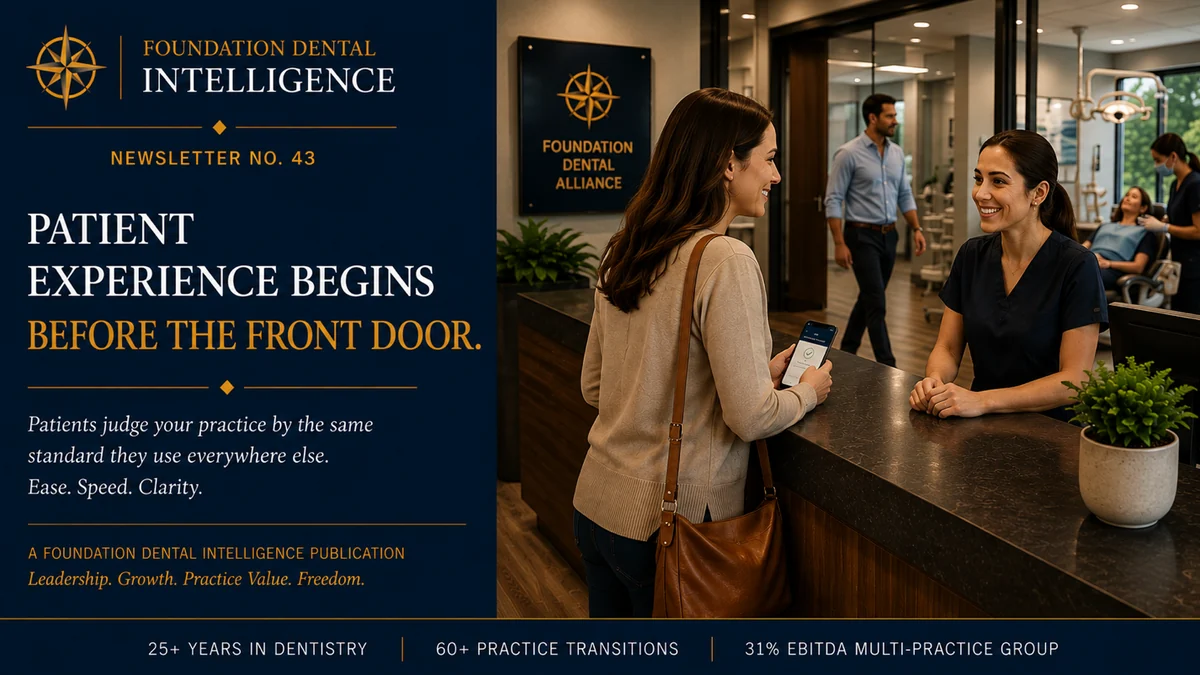
Patient Experience in the Digital Age.
How to Create a Modern Dental Experience That Builds Trust, Drives Growth, and Sets Your Practice Apart
Get the next issue.
One signup. Everything we publish.
There was a time when great dentistry and a caring team were enough to separate a practice from the office down the street. Those things still matter. They are simply the starting point now.
Patients experience the practice before they ever meet the doctor. They search on their phone. They read reviews. They decide whether the website makes sense. They look for an easy way to schedule. They notice how quickly the office responds and whether the next step feels obvious.
Then they arrive and compare the in-office experience with the expectations created online. If the digital side feels simple but the handoff inside the practice feels confusing, trust drops. If the technology is impressive but the communication feels cold, trust drops again.
The modern patient experience is one connected system. The technology matters. The workflow matters. The team matters most.
The Experience Now Starts Before the Appointment
Patient experience used to be discussed as hospitality inside the office. Today it starts during discovery and continues long after the patient leaves.
The patient wants to know whether the practice is easy to understand, easy to reach, and easy to trust. That means the website, online scheduling, mobile forms, reviews, reminders, clinical visuals, follow-up, and access to questions all contribute to the same relationship.
The practice doesn’t need more technology for the sake of looking modern. It needs fewer points of friction. That distinction matters. A complicated digital system can create just as much frustration as an outdated one.
Four Layers of the Modern Patient Experience
I organize the experience into four layers: digital access, digital clinical workflow, digital relationship architecture, and the digital feedback loop.
I like this structure because it follows the actual patient relationship. First, can the patient find you and take the next step? Second, can they understand what’s happening clinically? Third, does communication feel personal before and after the visit? Fourth, does the practice listen closely enough to improve?
When those four layers work together, technology supports the relationship instead of competing with it.
Layer One: Digital Access Is the New Front Door
Patients make decisions about the practice before the first phone call.
Digital access includes website clarity, local search visibility, reviews, online scheduling when appropriate, mobile-friendly forms, real team photos, and simple language that tells patients what to expect.
The test isn’t whether the website looks expensive. The test is whether a patient can understand what the practice does, decide whether it feels like a fit, and take the next step without unnecessary confusion. If basic discovery feels difficult, the patient may assume the rest of the experience will be difficult too.
Layer Two: Technology Should Make Dentistry Easier to Understand
Clinical technology earns trust when it helps the patient understand what the doctor sees.
Intraoral photos, digital scans, chairside visuals, and other visual tools can make a clinical conversation more concrete. A patient who can see the cracked tooth, worn edge, failing restoration, or area of concern has more context for the recommendation.
That doesn’t mean flooding the patient with images or technical language. The purpose is clarity. AI-supported explanation tools may also help organize information, but the doctor still has to interpret the findings, answer questions, and make the recommendation personal to the patient in the chair. Technology should shorten the distance between confusion and understanding.
Layer Three: Digital Communication Should Still Feel Human
I call this digital relationship architecture. The name matters less than the principle: the tools should make it easier for the team to stay connected without making the patient feel like they’re talking to a machine.
Thoughtful reminders, clear instructions, secure messaging, useful follow-up, and simple pathways for questions can all reduce anxiety. A short personal welcome message from the doctor may help an anxious new patient feel known before the appointment begins.
The standard is simple. Automation should handle repetition. People should handle reassurance, judgment, and the conversations that carry emotion.
Layer Four: Feedback Is Leadership Information
Reviews and post-visit feedback aren’t only marketing assets. They’re operational information.
If patients repeatedly mention waiting, unclear financial conversations, confusing instructions, or difficulty reaching the office, the practice is being shown where trust is breaking. Likewise, repeated praise around a specific assistant, a clear consultation, or a thoughtful follow-up reveals what the team is doing well enough to protect.
Feedback should move beyond reputation management. It should influence training, systems, and leadership decisions.
Map the Whole Patient Path
A useful exercise is to walk through the practice from the patient’s point of view.
Start with online discovery. What does the patient see when they search for you? What does the website say? Are reviews current enough to show what the practice feels like now?
Then move to appointment preparation. Can the patient complete forms easily? Are instructions clear? Do reminders reduce uncertainty or create more noise?
Inside the practice, look at check-in, handoffs, clinical explanation, treatment discussions, and checkout. After the visit, look at follow-up, access to instructions, and how easy it is to ask a question.
Every transition either protects confidence or creates friction.
Why the Best Experience Is Hybrid
The digital age didn’t make dentistry less personal. It made patients more sensitive to what personal actually feels like.
The strongest experience combines technology that removes friction, systems that reduce confusion, communication that builds confidence, and hospitality that still feels human. A patient can appreciate online scheduling and still want a real person when they’re nervous. They can value digital forms and still remember the assistant who looked them in the eye and explained what came next.
The goal isn’t digital or personal. It’s digital where digital helps and human where human matters.
Three Common Patient Scenarios
Consider the anxious new patient who prefers to schedule after hours because calling feels uncomfortable. A clear online path gets them started. A thoughtful message the next morning can lower anxiety before they arrive. Intake information gives the team a chance to prepare for what the patient is worried about.
Consider the busy professional who wants the practice to respect their time. Mobile forms, clear scheduling expectations, and efficient clinical workflows matter because unnecessary return visits or avoidable delays feel expensive.
Consider the post-op patient who wants reassurance. Clear written instructions, a simple way to ask a question, and a timely follow-up can make the patient feel supported after the procedure instead of forgotten.
Each scenario uses technology differently. The common thread is that the patient feels informed and cared for.
Where Digital Experience Usually Breaks Down
Most problems come from fragmentation, not from a lack of tools.
One system handles scheduling, another sends reminders, another stores forms, and nobody is sure who owns the follow-up when something doesn’t work. The patient feels the disconnect even if they never see the software behind it.
Robotic messaging is another problem. A message can be technically efficient and still feel indifferent. Weak mobile design creates the same issue when forms or instructions require too much effort on a phone. Ignored feedback may be the most expensive problem because it tells patients the practice is listening only when the feedback is positive.
Good leadership eliminates these problems early by assigning ownership and reviewing the entire experience as one system.
Assign Ownership to the Experience
A patient experience system fails when everybody is responsible in theory and nobody owns the result in practice. Someone should know who maintains online scheduling, who reviews failed forms, who monitors unanswered messages, who checks post-visit follow-up, and who closes the loop when a patient reports a problem.
That ownership doesn’t have to sit with one person. It does have to be clear. The patient shouldn’t feel the boundaries between software platforms, departments, or job descriptions.
Give each important touchpoint an owner, a standard, and a simple review rhythm. The team should know what good looks like, what happens when the process breaks, and when the issue needs to be escalated. This is where patient experience becomes an operating discipline rather than a collection of good intentions.
Train for Consistency Across Every Channel
A patient may move from the website to a text message, from a phone call to the front desk, and from the assistant to the doctor within a few days. The language and expectations should still feel connected.
That doesn’t mean everyone needs a script. It means the team should share the same basic standards around response time, tone, clarity, and next steps. If the website says the practice takes time to explain options, the consultation has to deliver that. If reminders promise an easy arrival, check-in should support that promise.
Consistency is what makes the digital and human sides of the practice feel like one organization.
What If You’ve Already Invested in All the Technology?
Then stop buying and start auditing. More tools won’t improve an experience that’s already fragmented. Look at whether the systems communicate well, whether the team understands how they fit together, and whether patients know what to do next. The goal isn’t to have more digital capability. The goal is to make the patient experience easier to understand and easier to complete.
That audit usually turns up the same two objections. The first is that automation feels impersonal. It can, especially when a message arrives at the wrong time or sounds nothing like the practice. The fix isn’t to abandon automation. It’s to use it for repetitive communication that benefits from consistency, like reminders or routine instructions, and to keep people on the conversations that carry emotion, judgment, or exceptions. A reminder that tells a patient when to arrive can be automated. A conversation with someone who’s worried about treatment shouldn’t be reduced to a template.
The second objection is that some patients just prefer to call. Let them. Digital access should create another good path, not remove the human one. Different patients have different comfort levels. Some want to book everything online. Others want to ask questions before they commit to an appointment. A modern experience gives patients more clarity and appropriate choice without making the office harder to reach.
The 30-60-90 Day Patient Experience Plan
Days one through thirty are for mapping and auditing. Document every major digital and in-person touchpoint. Look for delays, duplicate steps, unclear instructions, and places where patients repeatedly ask the same question.
Days thirty-one through sixty are for improvement and training. Fix the simplest friction points first. Update instructions, remove unnecessary steps, clarify ownership, and train the team on how the new process should feel to the patient.
Days sixty-one through ninety are for review. Listen to feedback, watch what’s still creating confusion, and reinforce the improved process in huddles and team meetings.
Don’t try to rebuild the entire practice at once. Improve the experience layer by layer.
Track Your Own Trends, Not Industry Benchmarks
I’ve seen benchmark percentages and target ranges published for patient experience metrics, but without traceable supporting sources behind them, I wouldn’t treat them as universal standards.
Instead, track your own trends. Watch no-show patterns, review volume and sentiment, response times, re-care follow-through, treatment acceptance, and how often patients mention convenience, clarity, or communication in feedback.
The purpose of measurement isn’t to chase an industry number. It’s to see whether the experience you designed is producing the behavior you expected.
The Standard I Would Want in My Own Practice
I don’t want technology to make the practice look modern. I want it to make the experience better.
I want patients to find us easily, understand what comes next, see what we see clinically, and know how to reach us when they need help. I want the team to spend less time fixing preventable confusion and more time having conversations that require a person.
That’s the opportunity in the digital age. Use technology to remove friction. Use systems to create consistency. Keep the human relationship at the center.
Frequently Asked Questions About Digital Patient Experience
What is digital patient experience in dentistry?
It’s the combined experience patients have with the practice across digital access, clinical technology, communication, in-office care, follow-up, and feedback.
Should every dental practice offer online scheduling?
Not necessarily. The goal is easy access. Online scheduling can be useful when it fits the practice, but patients who prefer to call should still have a clear, responsive path.
How can technology improve case acceptance?
Visual tools can help patients understand what the doctor sees and why a recommendation matters. The technology supports understanding, while the doctor remains responsible for explanation and clinical judgment.
How should automation be used without making the practice feel impersonal?
Use it for repetitive communication that benefits from consistency, such as reminders or routine instructions. Keep emotional, complex, and exception-based conversations with people.
What should a practice do with negative patient feedback?
Treat recurring feedback as operating information. Look for the system or handoff behind the complaint, correct the process, and close the loop with the team.
What is the first step in improving patient experience?
Map one part of the patient path from the patient’s point of view and identify one friction point that can be removed without adding unnecessary complexity.
About the Author
Dr. Jim Arnold, DDS is the Founder and CEO of Foundation Dental Alliance, a leadership and practice development organization serving dentists from graduation through retirement. He has 30 years of experience as a multi-practice owner and has been involved in more than 60 dental practice transitions. He leads the Foundation Dental Mastermind, Luxury Dental Retreats, co-founded Foundation Dental Transitions, and hosts the Foundation Dental Podcast. He also publishes the Foundation Dental Newsletter and Blog weekly, focused on leadership, practice design, and long-term sustainability in dentistry.
Stay Connected
Websites
FoundationDentalAlliance.com · FoundationDentalMastermind.com · FoundationDentalTransitions.com · FoundationDentalNetwork.com · LuxuryDentalRetreats.com/dubai
Social Media
LinkedIn: linkedin.com/in/arnoldjim · Instagram: instagram.com/smilesbyarnold · YouTube: youtube.com/@DrJimArnold · Facebook: facebook.com/smilesbyarnold · Twitter/X: twitter.com/smilesbyarnold
Publications
Foundation Dental Newsletter: linkedin.com/newsletters/foundation-dental-newsletter
Contact
Professional Email: drarnold@foundationdentalalliance.com