Foundation Dental Intelligence
Newsletter No. 55
The Practice Doesn’t Need a Better Dentist.
Why Leadership, Not More Clinical Excellence, Is the Missing Ingredient
Get the next issue.
One signup. Everything we publish.
Most dentists I know are already very good at dentistry. They’re disciplined, detail-oriented, highly trained, and deeply committed to doing the right thing for patients. They care about quality. They take responsibility personally. They hold themselves to standards that most professions never ask of their people.
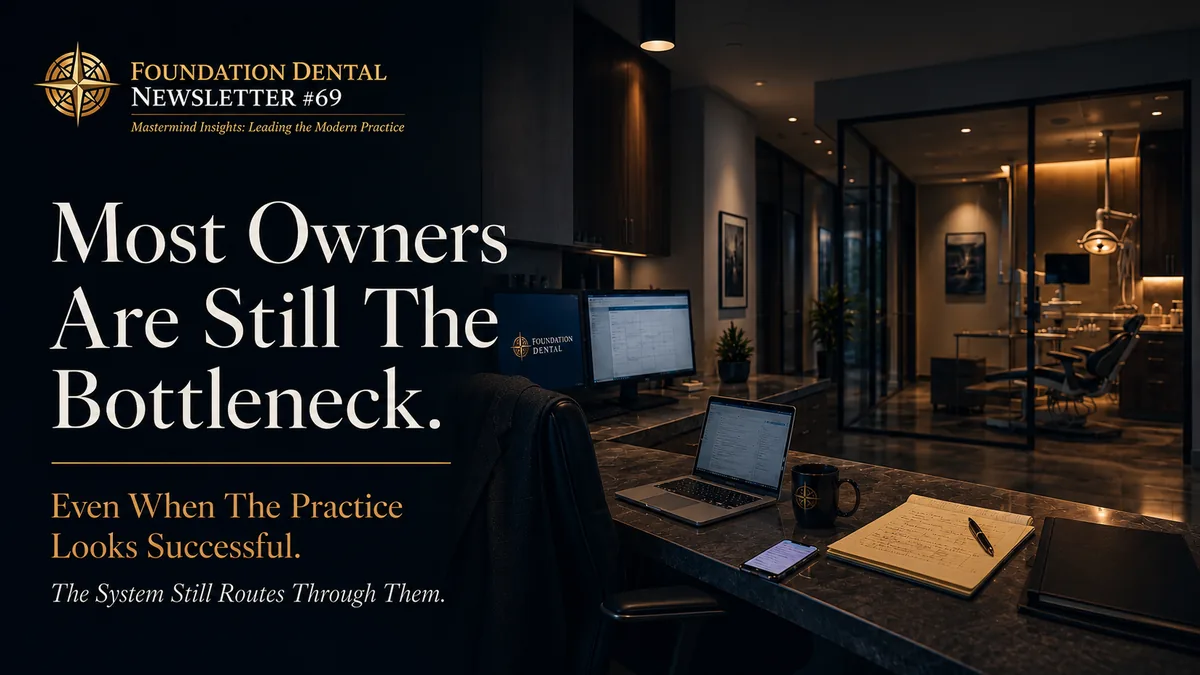
And yet many of those same dentists eventually reach a point where the practice feels harder to move. Production may still be strong. The schedule may still be full. Patients may still be happy. Nothing looks broken from the outside. Inside the business, though, the owner is answering too many questions, correcting too many details, carrying too many decisions, and wondering why all that effort is no longer creating the progress it once did.
That’s not a clinical problem. It’s a leadership problem. The practice doesn’t need the owner to become a better dentist. It needs the owner to become a better leader.
The Most Expensive Misdiagnosis in Dentistry
Dentists are trained to diagnose technical problems with precision. We look for decay, fractures, inflammation, occlusal issues, failed restorations, and other conditions where the wrong diagnosis creates the wrong treatment.
Practice ownership deserves the same discipline.
One of the most expensive mistakes an owner can make is treating a leadership problem like a clinical problem. Growth stalls, so the dentist adds another course. Stress rises, so the dentist works faster. The team hesitates, so the dentist checks more. Something slips, so the dentist takes the responsibility back.
Each response feels reasonable because it uses the skill set that has worked for years. The problem is that the practice has changed. The job at the top is no longer only to perform excellent dentistry. The job is to create a business where excellent work can happen through people, systems, and clear standards without requiring the owner to personally carry every moving part.
The Leadership Ceiling Is Hard to See
Most owners notice a clinical ceiling because it’s obvious. A procedure takes too long. A case is beyond the dentist’s current skill. A technique needs more training.
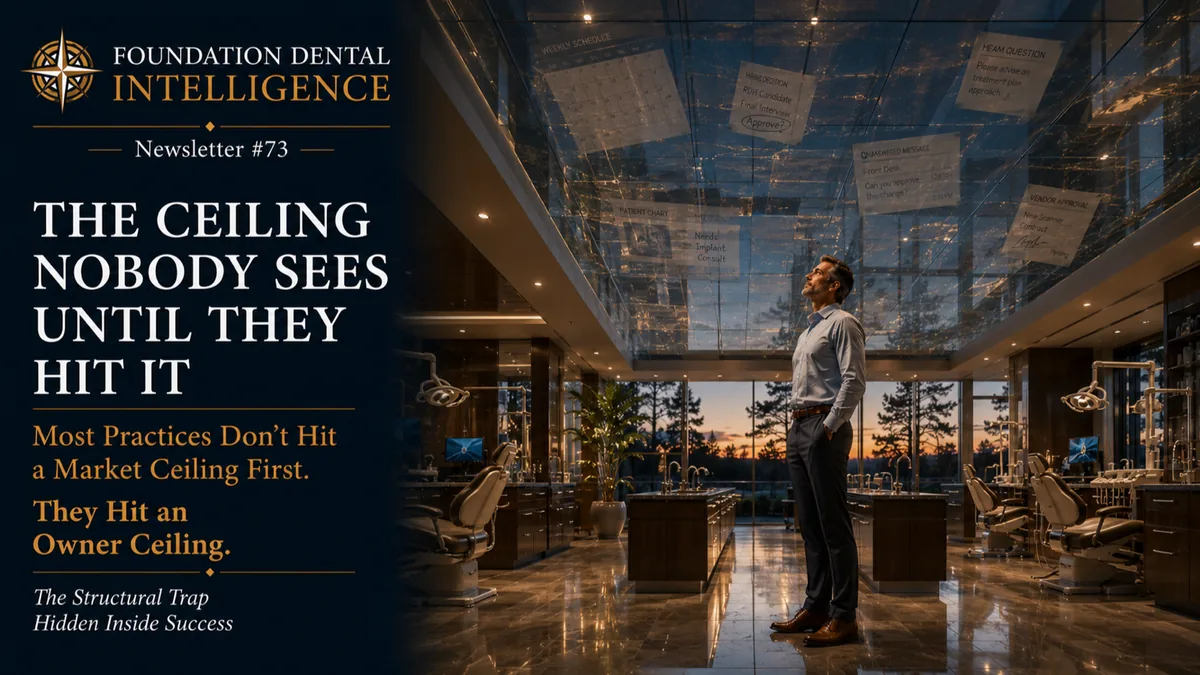
A leadership ceiling is easier to miss because the practice can continue performing while the owner is the constraint.
The dentist may be more skilled than the production suggests, more experienced than the schedule reveals, and more capable than the culture reflects. The limiting factor isn’t knowledge. It’s the amount of organizational capacity the owner has built around that knowledge.
That’s why so many dentists describe a strange tension. They feel like the bottleneck and the hero at the same time.
Both can be true.
Clinical Excellence and Leadership Reward Different Behaviors
Clinical dentistry rewards precision, control, personal responsibility, and attention to detail. Those traits aren’t problems. They’re a large part of why patients trust good dentists.
Leadership asks for something different. The leader has to create clarity, give people room to act, define authority, accept that another capable person may approach a problem differently, and build standards that can survive without constant supervision.
That tension explains why talented clinicians can struggle as owners even when their intentions are excellent. The habits that create confidence in the operatory can create dependence in the business when they’re applied everywhere.
High standards are still necessary. The difference is whether the standard lives inside the organization or only inside the owner’s head.
When Personal Responsibility Becomes Organizational Dependence
Most practices begin with a strong clinician. Quality attracts patients. Reputation grows. Volume increases. The team gets larger. More decisions appear.
The owner’s default response is predictable: produce more, oversee more, approve more, and personally step in when something important feels uncertain.
Over time, responsibility accumulates at the top instead of spreading through the organization. Team members learn that the safest answer is to ask the doctor. Managers wait for approval because the owner has trained them to. Problems that should be solved once through a better system keep arriving as individual interruptions.
The owner starts to feel indispensable. That can look like success for a long time. It also becomes the ceiling.
Leadership Is the Creation of Conditions
Leadership isn’t working harder. It isn’t producing more dentistry. It isn’t becoming the person who solves every problem fastest.
Leadership is creating the conditions in which other people can perform well without requiring your constant presence.
That requires clear expectations, defined authority, dependable systems, honest feedback, and enough trust for capable people to carry work that used to belong to the owner.
The goal isn’t to make the dentist irrelevant. The goal is to stop requiring the dentist for work that no longer needs the dentist’s unique judgment.
Decision Speed Matters More Than Endless Refinement
The first discipline is decision speed over decision perfection.
Owners can lose a surprising amount of time trying to remove every uncertainty before making a choice. The team waits. The issue stays open. More discussion creates more opinions without changing the basic facts.
A good decision made with enough information, then reviewed through real feedback, is often more useful than a perfect decision that arrives after the opportunity has passed.
That doesn’t mean impulsive leadership. It means the owner knows when additional analysis is no longer improving the choice.
Every delayed decision teaches the team something. It either teaches that leadership moves with clarity or that important questions remain open until the owner feels completely comfortable.
Build Systems Instead of Repeating Heroics
The second discipline is systems over heroics.
When the same problem reaches the owner for the third or fourth time, the question should change. The issue is no longer only how to solve today’s problem. The issue is why the practice hasn’t learned how to prevent or handle the next version without the same interruption.
A good owner can rescue a bad day. A good leader asks why the rescue was needed.
That may lead to a checklist, a clearer handoff, a written standard, a training conversation, a decision boundary, or a change in ownership of the process. The point is to make the next occurrence less dependent on the dentist.
Standards Have to Live in the Practice
The third discipline is embedded standards over enforced standards.
If a practice only feels organized when the owner is present, the standard isn’t embedded. If patient communication changes when one strong team member is off, the standard isn’t embedded. If accountability only appears when the dentist becomes frustrated, the standard isn’t embedded.
Culture is built through what’s tolerated, corrected, rewarded, and repeated.
Strong leaders make the standard visible enough that the team can recognize it without waiting for the owner to restate it. That may take more work up front. It creates far more consistency later.
Capacity Matters More Than Personal Output
The fourth discipline is capacity over output.
There comes a point where the dentist’s greatest contribution is no longer another hour in the chair. It’s what the owner makes possible through the organization.
That might be a team leader who can handle a difficult conversation well. It might be an associate who can make sound clinical and operating decisions. It might be a front-office system that keeps patient communication consistent. It might be financial reporting that gives leadership a clear view of the business without relying on guesswork.
Personal output still matters. Capacity determines whether the practice can keep improving without adding more dependence on the owner.
The Identity Shift Is Practical, Not Philosophical
At some point, every owner has to answer a basic question: am I a dentist who happens to own a business, or am I a leader who also practices dentistry?
This isn’t wordplay. The answer changes the calendar, the conversations, and the way decisions are handled.
A dentist who sees leadership as secondary will usually keep giving the best time and attention to clinical work, then try to lead in the margins. A leader who practices dentistry understands that developing people, making clear decisions, and improving the operating structure are part of the real job.
The clinical work may remain important for years. The leadership work cannot remain optional.
What If I Love Clinical Dentistry?
Then keep doing it. Leadership doesn’t require leaving the chair. It requires knowing which work only you can do and which work continues to reach you because the practice has never developed another capable owner. Many dentists want a full clinical schedule because they enjoy the work. That’s a good reason to stay involved. It’s very different from working the same schedule because the business can’t support anything else. The goal is choice.
A related question comes up when the team isn’t ready for more responsibility. Sometimes that’s true. Not every team member is ready for broader authority, and not every strong employee wants to lead. The answer isn’t to hand over important decisions without preparation. It’s to begin developing judgment where the risk is manageable. Give a person ownership of a defined outcome. Explain the standard. Clarify where they can decide independently and where they need input. Review what happened afterward. Leadership capacity grows through real responsibility, not through titles alone.
There’s also the owner who worries that delegation lowers the standard. This is one of the biggest fears strong clinicians carry, and it isn’t irrational. The owner may have spent years building a reputation around quality. The mistake is assuming the only two choices are personal control or lower standards. A stronger option is to define the standard clearly enough that another capable person can meet it. That may involve training, examples, review, and correction. It may take longer than doing the work yourself the first few times. The payoff is that quality begins to live in the system rather than depending on one person watching everything.
Why Isolation Makes Leadership Harder
Ownership can be isolating because the dentist becomes the point of gravity for the practice. The team depends on the owner. Associates look to the owner. Patients often want reassurance from the owner.
What’s missing is often a peer environment where the dentist can speak candidly, hear how other owners think, and have assumptions challenged by people who understand the weight of the role.
Information is everywhere. Perspective is harder to find.
A dentist can read ten books on leadership and still repeat the same operating habits if there’s nobody close enough to question the pattern.
Information Is Not the Same as Integration
Most experienced dentists already have plenty of information. They’ve attended courses, listened to podcasts, saved notes, joined groups, and collected ideas.
The issue is rarely access. The issue is whether the information changes behavior.
Leadership improves when a concept becomes part of the way the owner hires, delegates, runs meetings, handles conflict, reviews numbers, and makes decisions. Until then, it’s simply knowledge sitting outside the operating system of the practice.
That’s why proximity to strong operators matters. It changes reference points. It gives the owner examples of what good leadership looks like in practice, not just what it sounds like in theory.
What Changes When Leadership Improves
The first change is usually not dramatic. The owner simply becomes less necessary in places where constant involvement was never required.
Team members make more decisions within clear boundaries. Associates understand what they own. Systems hold up more reliably because the standard is visible. Meetings become more useful because the same unresolved issues aren’t carried forward week after week.
The dentist feels relief, but not because responsibility disappeared. Responsibility is shared more appropriately.
That creates room for better clinical focus, better leadership, stronger practice value, and more freedom.
A 30-Day Leadership Test
Choose one area where the practice still depends heavily on you and make it the leadership test for the next 30 days.
Define the result you want. Identify the person who should own it. Explain the standard and the decision boundary. Then let that person carry the responsibility while you review the result instead of taking the work back at the first sign of discomfort.
At the end of the month, ask three questions. Did the result improve? Did the person become more capable? Did the number of owner interruptions decrease?
If the answer is yes, repeat the process somewhere else.
The Practice Does Not Need More of the Same
A strong dentist can spend years trying to solve a leadership ceiling with more clinical effort because clinical effort is familiar and measurable.
That’s why the shift takes intention.
The next version of the practice doesn’t need a dentist who works harder, learns one more procedure, or becomes even more personally involved in every important detail.
It needs a leader who can make clear decisions, develop people, build dependable systems, protect standards, and create capacity beyond the owner.
That leader isn’t someone you need to hire. It’s the next part of the job you already own.
Frequently Asked Questions About Dental Leadership and Owner Dependence
How do I know whether my practice has a leadership problem rather than a clinical problem?
Look at where the friction lives. If production is strong but decisions, team issues, systems, and accountability still depend heavily on the owner, the limiting factor is probably leadership rather than clinical skill.
Does becoming a better leader mean I should spend less time practicing dentistry?
Not necessarily. The goal is choice. You can remain highly clinical while building a practice that doesn’t require you for every routine decision or operating issue.
What should I delegate first?
Start with a recurring responsibility that doesn’t require your unique clinical judgment. Define the outcome, the standard, and the decision boundary, then let the responsible person carry it long enough to learn from the result.
How do I keep standards high when more people have authority?
Make the standard explicit. Train it, show examples, review results, and correct drift. High standards become more durable when they live in systems and team expectations rather than in the owner’s constant supervision.
Why does peer proximity matter for leadership development?
Owners often need more than information. They benefit from candid conversations with other experienced operators who can challenge assumptions, offer context, and provide examples of how leadership decisions work in real practices.
How does stronger leadership affect practice value?
A practice with clearer systems, stronger team leadership, and lower owner dependence is generally easier to operate and transfer. Those qualities can strengthen continuity and reduce the amount of risk concentrated in one person.
About the Author
Dr. Jim Arnold, DDS is the Founder and CEO of Foundation Dental Alliance, a leadership and practice development organization serving dentists from graduation through retirement. He has 30 years of experience as a multi-practice owner and has been involved in more than 60 dental practice transitions. He leads the Foundation Dental Mastermind, Luxury Dental Retreats, co-founded Foundation Dental Transitions, and hosts the Foundation Dental Podcast. He also publishes the Foundation Dental Newsletter and Blog weekly, focused on leadership, practice design, and long-term sustainability in dentistry.
Stay Connected
Websites
FoundationDentalAlliance.com · FoundationDentalMastermind.com · FoundationDentalTransitions.com · FoundationDentalNetwork.com · LuxuryDentalRetreats.com/dubai
Social Media
LinkedIn: linkedin.com/in/arnoldjim · Instagram: instagram.com/smilesbyarnold · YouTube: youtube.com/@DrJimArnold · Facebook: facebook.com/smilesbyarnold · Twitter/X: twitter.com/smilesbyarnold
Publications
Foundation Dental Newsletter: linkedin.com/newsletters/foundation-dental-newsletter
Contact
Professional Email: drarnold@foundationdentalalliance.com