Foundation Dental Intelligence
Blog No. 40
Beyond the Bur.
Get the next article.
One signup. Everything we publish.
Independent dentists do not lose to corporate dentistry because they lack skill. They lose leverage. Dr. Glenn Vo built two communities, Nifty Thrifty Dentists and Dental Podfest, around the idea that independence gets stronger when owners stop treating isolation as the price of staying independent.
There is a point in practice ownership when clinical skill stops being the only thing determining how well your career works.
You can be excellent in the operatory and still feel exposed everywhere else. Supply costs matter. Insurance pressure matters. Hiring gets harder. Technology changes faster than most owners can evaluate it. A decision about marketing, software, equipment, or staffing can cost more than a clinical mistake ever would.
Independent dentists feel that weight because independence gives you control, but it also gives you responsibility for nearly everything surrounding the dentistry.
Dr. Glenn Vo has spent years working on one part of that problem: what happens when independent dentists stop treating isolation as the price of ownership?
His answer became Nifty Thrifty Dentists, a community built around practical information, dental deals, peer conversation, and access to people solving many of the same problems. Later, Dental Podfest created a different kind of room around media, entrepreneurship, collaboration, and the business opportunities that can exist beyond the operatory.
There is a useful lesson in both.
Independence becomes stronger when owners get better at building connections without giving away control.
Why Does It Matter That Glenn Vo Still Practices Dentistry?
Glenn is not somebody who entered dentistry from the vendor side. He and his wife, Dr. Susan Tran, built Denton Smiles Dentistry in Denton, Texas, after attending dental school together. He has continued to practice while building businesses and communities around the profession.
That distinction matters because overhead looks different when you are the person signing the checks.
The owner sees the invoice, the payroll, the empty spot in the schedule, the marketing expense that did not work, and the equipment decision that looked simple until five vendors offered five different answers.
Glenn has described his goal with Nifty Thrifty as helping level the playing field between solo practitioners and larger dental organizations. His reasoning is straightforward. Larger organizations can create purchasing leverage and gather information across many practices. Independent dentists usually have less of both unless they deliberately create access through relationships.
That does not mean the independent practice needs to behave like a corporate group. It means owners should pay attention to where independence quietly becomes unnecessary disadvantage.
How Did Nifty Thrifty Dentists Actually Start?
Nifty Thrifty did not begin as a polished business plan.
Its own history traces the community back to the Dental Garage Sale Facebook group, where dentists could connect around equipment and practical needs. That grew into a broader platform with discounts, articles, podcasts, educational material, and a private community.
That origin is probably one reason the model works. It started with an ordinary owner problem.
Dentists have equipment they no longer need. Somebody else needs it. One person has already dealt with a vendor another person is considering. Someone has solved a staffing problem that is brand new to the dentist asking about it.
The value sits in shortening the distance between the question and somebody who has relevant experience. That is more important than the size of the group.
Large online communities can become noisy quickly. A member count tells you very little about whether the information is useful. What matters is whether a dentist can separate experience from opinion, a legitimate deal from advertising, and practical advice from a solution that worked only in somebody else’s practice.
Community creates leverage only when judgment stays attached to it.
Why Does Buying Well Matter More Than Saving Money?
The obvious appeal of Nifty Thrifty is purchasing power.
Its current site includes dental deals across supplies, software, staffing, compliance, marketing, billing, communications, and other practice needs. Some discounts are modest. Others are substantial. The specific offer depends on the vendor.
That is more credible than pretending every purchase can be cut in half.
Owners should still ask the same questions they would ask without a group discount. Would I buy this if there were no special offer? Does it solve a problem I actually have? What is the full cost after implementation? Will the team use it? What happens when the promotional period ends?
A discount on the wrong purchase is still wasted money.
The deeper value of collective buying is not permission to consume more. It is the possibility of making an already necessary purchase on better terms. That sounds obvious, yet dentistry is full of equipment and subscriptions acquired because the offer felt too good to pass up.
Independent owners do not need more deals. They need better judgment about which deals deserve attention.
What’s the Other Kind of Leverage in the Room?
The part of Glenn’s work that interests me more than discounts is access to people.
Practice ownership can get strangely lonely. You can have a full team around you and still have very few people with whom you can discuss the actual ownership decision. Should I add an associate? Is this marketing company working? Am I paying too much for this service? Is my office manager really capable of taking on more responsibility? Should I open another location?
You can ask your team some of those questions, but not all of them. You can ask vendors, but they have a point of view. You can ask friends outside dentistry, but they may not understand the economics or operational reality.
Another owner may understand the question before you finish asking it. That does not make the other owner automatically right. It simply gives you a better starting point.
The best communities do not replace judgment. They improve the information available to it.
Where Does the “Pay It Forward” Philosophy Come From?
One detail from Glenn’s background helps explain why community became such a large part of his work.
On his personal site, he tells the story of growing up in Pasadena, Texas, after his family came from Vietnam. A man named Glenn Leon Rogers helped his family adjust to life in the United States, and Glenn says Rogers taught him a lesson that stayed with him: if life puts you in a fortunate position, pay that help forward.
That history is more specific than the cleaner version we sometimes hear about successful people simply deciding they want to give back. Somebody helped his family first.
Years later, after Glenn and Susan had built their practice, a mentor challenged him to think about the impact he could make beyond the walls of the office. Nifty Thrifty makes more sense when you understand those two parts of the story together.
The community is commercial in places. Vendors advertise. Deals are promoted. Glenn runs businesses. None of that cancels the original idea.
A business can make money and still be useful. The better question is whether value moves in both directions.
What Does Dental Podfest Add to the Picture?
Dental Podfest is not primarily about practice overhead.
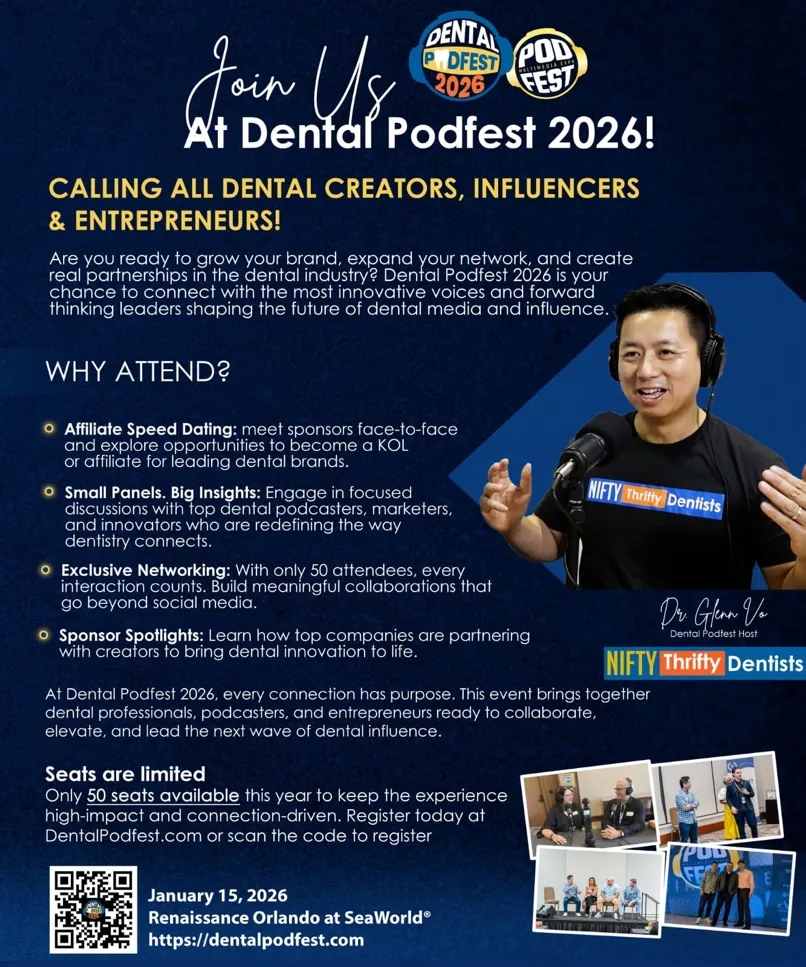
It is about dentists and dental entrepreneurs who want to communicate, build media, create partnerships, develop businesses, or become more visible inside the profession. The event is built around a small attendance model, with sessions and networking for podcasters, speakers, founders, coaches, consultants, and other people building businesses in dentistry.
That is a narrower group than Nifty Thrifty, and it should be.
A practice owner trying to find a better price on supplies does not necessarily need to learn how to build a podcast. A dentist who wants to develop an educational platform or industry business has a different set of questions.
The useful thread between the two communities is proximity. Sometimes the person who changes how you think about a problem is not the person on stage. It is the person sitting beside you who has already made the mistake you are about to make.
What I Noticed When I Attended Podfest
I have been to enough dental meetings to know that size does not determine usefulness.
When I attended Dental Podfest, what stood out was the access between the formal sessions. Conversations continued in the hallways. People who might have been competitors in another setting were sharing ideas, comparing experiences, and talking about ways to work together.
That is the part of live education that is difficult to reproduce online.
You can watch excellent content from home. You can listen to podcasts while you drive. You can learn almost anything without getting on an airplane. What you cannot reproduce as easily is the conversation you did not know you needed to have.
That has become one of my standards for deciding whether a room is worth entering. I care about the speakers, but I also care about who will be sitting at the table when the speaker stops talking.
Hypothetical Example: The Software Purchase That Needed a Second Opinion
Imagine an owner evaluating a new piece of practice software.
The demonstration looks excellent. The sales team understands dentistry. The monthly fee seems reasonable, and the owner is ready to sign.
Before doing it, she asks a group of other owners about their experience.
One person loves the platform. Another says the implementation required far more team time than expected. A third explains that the product worked well, but only after the practice changed a workflow the owner had not considered. Someone else recommends a competing system.
The owner still has to decide, but now she has better questions for the vendor. How long will implementation realistically take? Who on my team needs to own it? What data has to move? Which integrations actually work? What support is available after launch?
The community did not make the decision. It made the owner harder to sell poorly.
Does Connection Have Limits?
There is a danger in celebrating community without talking about the downside.
Large groups can create herd behavior. A product becomes popular because several respected people mention it. One practice strategy gets repeated until it sounds universal. Vendor relationships and affiliate arrangements can blur the line between recommendation and promotion.
Owners still have to do their own work. Ask whether somebody recommending a product has a financial relationship with the company. Find out whether the practice offering advice resembles yours. Consider whether the person reporting success is measuring what you care about.
Peer experience is evidence. It is not proof. The strongest dentist communities make room for that distinction.
What Can Independent Dentistry Learn From Glenn’s Model?
The lesson is not that every dentist should join the same Facebook group, start a podcast, or build a personal brand.
The more useful lesson is that autonomy and isolation are not the same thing.
Independent owners can create purchasing leverage together. They can share mistakes. They can introduce each other to better people. They can compare notes before signing a contract. They can create professional relationships that make the next hard decision a little less lonely.
The corporate model has structural advantages. Independent dentists do not have to pretend otherwise.
But the answer is not automatically to surrender independence. Sometimes the answer is to get more deliberate about the relationships and resources surrounding it.
That is a principle I believe strongly at Foundation Dental Alliance. The owner should remain the owner of the decision. The right network makes that owner more informed, not more dependent.
Beyond the Bur
Dentistry begins with clinical competence, but a career eventually gets much larger than what happens in the operatory.
The people you learn from matter. The people you call before making an expensive decision matter. The rooms you choose matter. So does knowing when a discount is useful, when a recommendation deserves skepticism, and when another owner’s experience can save you months of unnecessary trial and error.
Glenn Vo built Nifty Thrifty Dentists around the belief that dentists can help each other compete more intelligently. Dental Podfest extends that idea into media, entrepreneurship, and professional relationships.
There is something worth paying attention to in that.
Independence gets stronger when the dentist stops trying to prove that independence means doing everything alone.
Frequently Asked Questions
What is Nifty Thrifty Dentists?
Nifty Thrifty Dentists is a dental community founded by Dr. Glenn Vo. Its website provides dental deals, articles, podcasts, educational resources, and access to a private community for dental professionals.
How did Nifty Thrifty Dentists start?
According to Nifty Thrifty’s own history, it grew out of a Dental Garage Sale Facebook group. The idea expanded from practical peer-to-peer needs into a broader community focused on money-saving resources, information, and connections for dental professionals.
Who is Dr. Glenn Vo?
Dr. Glenn Vo is a practicing dentist, entrepreneur, and founder of Nifty Thrifty Dentists. He and his wife, Dr. Susan Tran, established Denton Smiles Dentistry in Denton, Texas.
What is Dental Podfest?
Dental Podfest is an event built for dental entrepreneurs, podcasters, speakers, consultants, founders, and other professionals interested in media, collaboration, and business development within dentistry.
What should a dentist consider before acting on a peer recommendation?
Ask whether the person has direct experience with the decision, whether their practice resembles yours, whether there is a financial relationship behind the recommendation, and what tradeoffs were involved. Community is most useful when it improves your questions rather than replacing your judgment.
About the Author
Dr. Jim Arnold, DDS is the Founder and CEO of Foundation Dental Alliance, a leadership and practice development organization serving dentists from graduation through retirement. He has 30 years of experience as a multi-practice owner and has been involved in more than 60 dental practice transitions. He leads the Foundation Dental Mastermind, Luxury Dental Retreats, co-founded Foundation Dental Transitions, and hosts the Foundation Dental Podcast. He also publishes the Foundation Dental Newsletter and Blog weekly, focused on leadership, practice design, and long-term sustainability in dentistry.
Stay Connected
Websites
FoundationDentalAlliance.com
FoundationDentalMastermind.com
FoundationDentalTransitions.com
FoundationDentalNetwork.com
LuxuryDentalRetreats.com/dubai
Social Media
LinkedIn: linkedin.com/in/arnoldjim
Instagram: instagram.com/smilesbyarnold
YouTube: youtube.com/@DrJimArnold
Facebook: facebook.com/smilesbyarnold
Twitter/X: twitter.com/smilesbyarnold
Publications
Foundation Dental Newsletter: linkedin.com/newsletters/foundation-dental-newsletter
Contact
Professional Email: drarnold@foundationdentalalliance.com