Foundation Dental Intelligence
Blog No. 45
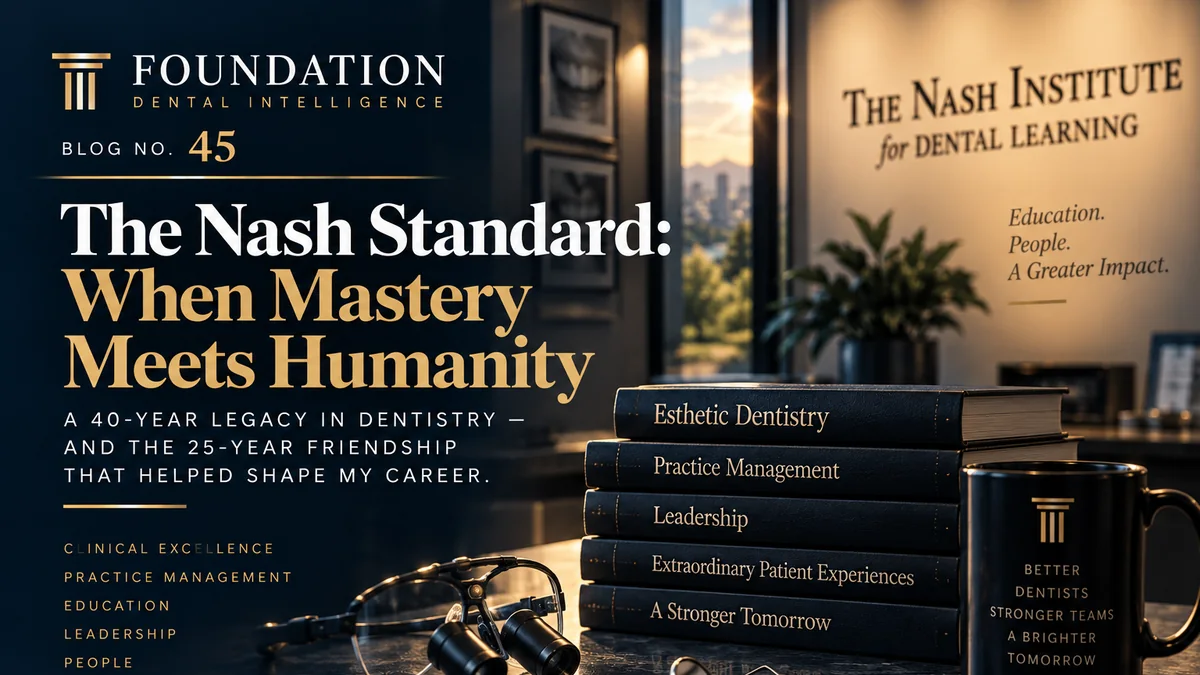
The Nash Standard: When Mastery Meets Humanity.
A 40-Year Legacy in Dentistry - And the 25-Year Friendship That Helped Shape My Career
There are people in dentistry whose influence is easy to measure. You can count the courses they have taught, the articles they have published, the awards they have received, or the clinicians who have learned from them.
Ross Nash and Debra Engelhardt-Nash have plenty of those measures. But after knowing them for nearly 25 years, I do not think any of them fully explain their influence.
Ross has spent more than four decades developing and teaching esthetic dentistry. Debra has spent more than four decades helping dentists understand the leadership, communication, and operational side of practice. Together, they built an educational model around something dentistry still has a tendency to separate: exceptional clinical work and the human systems required for patients and teams to experience its value.
That combination became the Nash standard. It began long before I knew either of them.
“The highest level of mastery can still be deeply human.”
Where Their Paths Converged
Ross and Debra met in Seattle in 1990 at an ADA Annual Meeting. Ross was already developing a reputation for esthetic artistry, combining technical precision with an unusually refined eye for beauty. Debra was teaching practice management at Oregon Health Sciences University and running a study club focused on the human and operational side of dentistry.
As they have described that period over the years, their early conversations revealed a shared idea. Clinical excellence matters enormously, but patients can only appreciate and act on that excellence when a practice knows how to communicate its value.
That insight connected two disciplines that were too often taught separately. Ross understood what was becoming possible clinically. Debra understood what had to happen around the dentistry for those possibilities to become meaningful to patients and sustainable inside a practice.
Five years after they met, they married. What followed became a professional partnership that influenced far more than their own practice.
Ross and Debra are now my friends, mentors, and members of the Foundation Dental Alliance and Luxury Dental Retreats faculties. I have had the benefit of seeing their work not only from an audience, but close enough to understand why it has lasted.
They Never Stopped Doing the Work
One of the things I respect most about Ross and Debra is that education never became a substitute for practice.
Ross has spent more than 45 years in clinical dentistry and remains chairside. His work in veneers, direct composite artistry, full-mouth rehabilitation, occlusion, and digital workflows comes from decades of treating patients. There is a different kind of authority in teaching something you continue to do.
Debra has spent more than 40 years working with dental teams on leadership, communication, treatment presentation, patient experience, case acceptance, financial dialogue, and practice performance. She works inside practices where systems have to function with real people, competing priorities, difficult conversations, and the normal constraints of running a dental business.
Their disciplines are different, but the operating principle is similar: do the work, learn from it, refine it, and teach what survives contact with reality. That is much harder to replicate than a presentation.
What They Built in Charlotte
The Nash Institute for Dental Learning grew from that philosophy.
Ross teaches the clinical side of excellence: direct composite artistry, indirect esthetics and veneers, full-mouth esthetic rehabilitation, functional esthetics and occlusal design, and digital workflow integration.
Debra teaches much of what allows that clinical capability to become a functioning practice: leadership, patient communication, treatment presentation, new-patient systems, financial dialogue, case acceptance, and the performance measures that reveal whether the practice is healthy.
The subjects reinforce each other. A dentist can become technically exceptional and still struggle to help patients understand treatment. A practice can become operationally sophisticated without giving patients clinical care worth distinguishing.
Ross and Debra have spent much of their careers working at that intersection. For me, that is what makes the Nash Institute different. It is not simply clinical education beside business education. It is an argument that the two belong together.
The Credentials Matter. They Aren’t the Point.
Ross’s career includes the AACD Lifetime Achievement Award, AACD Accredited Fellowship, recognition as a Dentistry Today Leader in Continuing Education, adjunct faculty appointments, consulting work with dental manufacturers, and extensive publication in esthetic dentistry.
Debra’s career includes leadership of the Academy for Private Dental Practice, three terms as president of the Academy of Dental Management Consultants, the Gordon Christensen Lecturer Recognition Award, recognition among the Top 25 Women in Dentistry, the ADMC Lifetime Achievement Award, and more than two decades of recognition by Dentistry Today in consulting and education.
Those accomplishments belong in any accurate account of their careers. They are not why I am writing this.
The longer I have known Ross and Debra, the more convinced I have become that the important part of their legacy is what happens after the lecture ends. It is what people do differently because they spent time with them.
What Their Work Changes
I have watched dentists arrive at the Nash Institute questioning where they were headed professionally and leave seeing their practices differently.
Part of that comes from learning better dentistry. Part comes from understanding how to communicate it. Part comes from seeing that a private practice can still be designed around clinical standards, patient relationships, strong systems, and a team that understands what it is trying to create.
Techniques change. Materials change. Technology changes. The business environment changes. The need to do excellent work, communicate clearly, lead people well, and earn trust does not disappear with the next product cycle.
Ross and Debra built their careers around those fundamentals.
What They Changed for Me
My relationship with them began nearly 25 years ago when I walked into the Nash Institute for a hands-on course. I expected to learn dentistry, and I did. What I did not expect was how much the people teaching it would influence the way I thought about everything around the dentistry.
Ross later nominated me for the IADFE Fellowship. That remains one of the great honors of my professional life, not simply because of the credential, but because the nomination came from someone whose clinical mastery I had admired for years.
Debra’s thinking about leadership, communication, patient experience, and practice systems became part of how I learned to think about organizations. Pieces of what she taught me still show up in the way I lead and teach today.
Eventually, I had the opportunity to invite Ross and Debra to join the Foundation Dental Alliance faculty. Their professional credibility matters enormously to our programs. Their character matters more to me.
After nearly 25 years, I know them well enough to have seen who they are when there is no stage, no audience, and no professional reason to impress anyone. They are kind, grounded, and generous with what they know. Their accomplishments have not made them less human.
In a profession where expertise can easily become ego, that matters.
The Nash Standard
A career as long as theirs creates a temptation to summarize the legacy through awards, courses, institutions, and titles. Those things are part of the record. They are not the whole record.
The better measure is the dentists who became more capable because Ross taught them what excellent esthetic dentistry could look like. It is the teams that became stronger because Debra gave them better ways to communicate and work together. It is the practices that became more intentional, the patients who benefited from better care, and the educators who carried pieces of their thinking into another generation.
I have been one of those dentists.
That is why The Nash Standard means something different to me than a resume of accomplishments. It means mastery without arrogance, experience that remains connected to the work, education grounded in execution, clinical excellence strengthened by communication, and professional achievement that never displaced basic human decency.
Ross and Debra have spent more than four decades showing dentistry that those qualities do not have to compete with one another. The highest level of mastery can still be deeply human.
After nearly 25 years of knowing them, that may be the lesson I value most.