Foundation Dental Intelligence
Blog No. 59
#59- Why More Data Is Making Dental Groups Slower.
Get the next article.
One signup. Everything we publish.
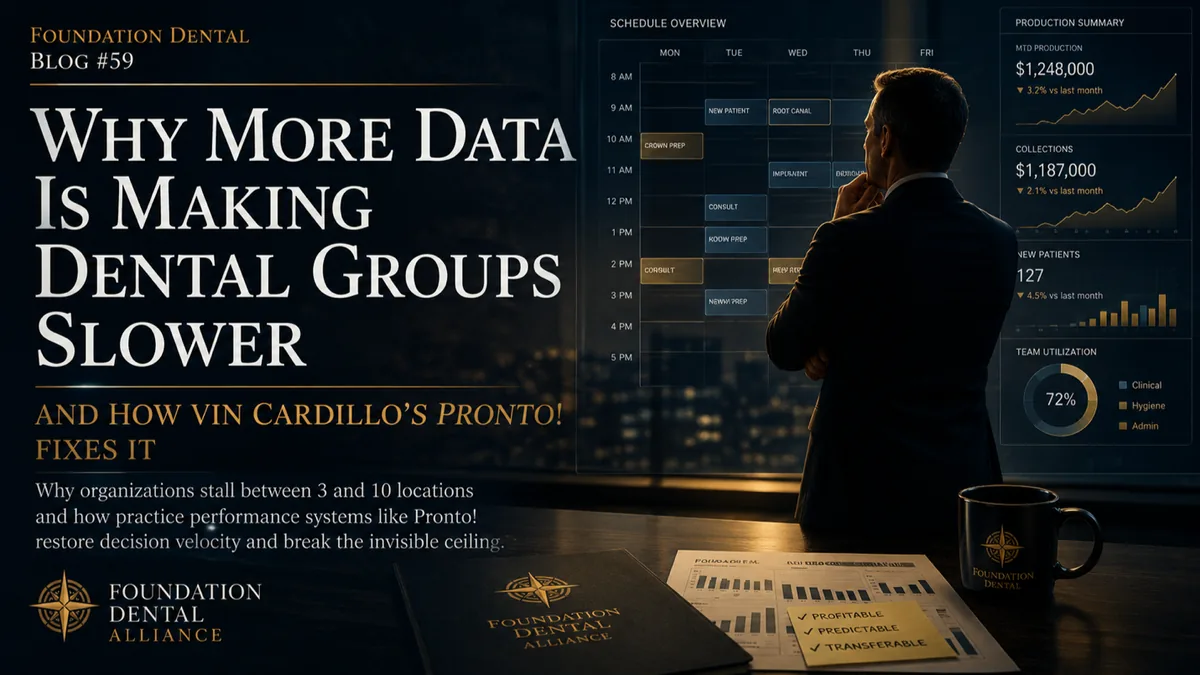
Most dental leaders today have more information than they know what to do with. Production reports arrive every morning. Collections metrics update throughout the day. Marketing dashboards track patient acquisition, HR systems monitor payroll ratios, call-tracking platforms flag missed opportunities, and financial systems generate increasingly detailed claims and overhead reports.
In theory, dentistry's never been more informed.
Yet across the country, multi-location practices and emerging dental groups are encountering a strange paradox. As organizations accumulate more data, decision making actually slows down. Meetings grow longer. Reports multiply. Leadership teams spend more time explaining numbers than executing decisions.
From the outside, the organization looks increasingly sophisticated. Inside, something very different is happening. Clarity begins to disappear - and when clarity disappears, performance eventually follows.
This pattern has become one of the most consistent and least discussed challenges in dental group growth. It's also the problem that Vincent Cardillo has spent much of his career trying to solve.
Cardillo is the founder of Pronto!, as well as the founder of Maeva Dental Advisors and a member of the advisory board of the Foundation Dental Alliance. Over more than twenty-five years working inside the dental group lifecycle - as a founder, operator, integrator, advisor, and exit architect - he's observed a structural failure that appears again and again as practices scale.
Dental organizations accumulate information faster than they accumulate clarity. Dashboards multiply. KPIs expand. Consultants introduce frameworks. Technology platforms layer on new forms of reporting. But leadership teams still struggle to answer the most important operational question in business:
What should we do next?
Cardillo describes the failure mode simply: data without decision sequence. It's a deceptively small phrase that explains a surprisingly large number of operational problems inside modern dental organizations. A group may have excellent reporting, sophisticated dashboards, dozens - sometimes hundreds - of metrics tracked. Yet if leadership can't consistently identify the handful of actions that will produce the greatest operational impact right now, the organization will struggle to maintain momentum as it grows.
That gap between information and action is where many dental groups quietly stall.
The Hidden Ceiling in Dental Growth
For most dentists, expansion begins with a straightforward assumption. If one practice performs well, additional locations should increase opportunity. More chairs mean more production capacity. More doctors increase clinical throughput. Marketing investment expands patient flow.
At first, that logic works.
But once an organization moves from one location to several - and particularly once it reaches regional scale - complexity begins to multiply faster than leadership's capacity to interpret it. Information now moves through layers. Office managers interpret operational performance. Regional leaders synthesize those reports. Finance teams analyze revenue and cost patterns. Each department contributes valuable insight, but each also introduces interpretation. Over time, the distance between seeing a problem and solving a problem widens.
This isn't a failure of leadership. It's a structural consequence of scale. As organizations grow, the volume of data expands dramatically - but the systems that translate that data into prioritized action often don't evolve at the same pace. The result is a subtle but powerful shift inside the organization. Leadership conversations become increasingly analytical and increasingly less decisive.
The Illusion of "Better Analytics"
The dental industry has invested heavily in analytics over the past decade. Practice management systems generate increasingly detailed operational reports. Revenue-cycle platforms analyze collections performance. Marketing platforms track lead attribution. Business-intelligence dashboards aggregate hundreds of performance indicators across locations.
All of this technology has value. But analytics and prioritization aren't the same thing.
Analytics answers one question: what happened?
Leadership must answer a different question entirely: what should we do next? Most platforms in dentistry are designed primarily to answer the first one.
They help groups understand trends, compare locations, and measure performance indicators that were once invisible. But they rarely tell leadership teams which operational levers deserve attention first.
Consider a typical leadership meeting inside a growing dental group. The dashboards might reveal hygiene reactivation opportunities, declining case acceptance in several locations, rising payroll percentages, supply costs drifting upward, missed calls in the call center, and marketing campaigns producing inconsistent results across markets. Every item appears important - and most of them are. But not every problem deserves equal attention at the same moment.
Without a disciplined way to prioritize action, leadership teams often spread their energy across too many initiatives simultaneously. Progress slows. Execution fragments. And the organization becomes busy without becoming more effective.
The Quiet Cost of Slower Decisions
When decision velocity slows, the financial consequences rarely appear suddenly. Value leaks quietly across the enterprise. A hygiene department underperforms for several months before anyone intervenes. Call-handling issues reduce appointment conversion without immediate visibility. Marketing investments generate leads that never fully translate into treatment acceptance. Supply costs drift upward across multiple locations. Insurance follow-up delays extend accounts receivable.
Each issue seems manageable on its own. Together, they erode margins.
By the time leadership teams recognize the pattern, EBITDA performance has already been affected. In some cases the impact becomes fully visible only during a valuation process, acquisition discussion, or recapitalization event - when outside investors begin examining the consistency and governance of the organization. At that moment, the real problem often becomes clear. The organization didn't lack information. It lacked a disciplined system for converting information into prioritized action.
The Insight That Led to Pronto!
Cardillo encountered this pattern repeatedly during his own experience scaling dental organizations. Earlier in his career, he helped build one of the earliest DSOs in Massachusetts, eventually scaling from four practices to thirty-one locations in roughly thirty months. That period of expansion earned national recognition, including a top-tier ranking on the Inc. 500 list and the 2013 Middle-Market M&A Deal of the Year.
More importantly, it exposed the hidden mechanics of organizational scale. As dental groups grow, they become increasingly sophisticated in how they collect data - yet the ability to convert that data into disciplined operational priorities often lags behind.
That realization ultimately led Cardillo to build Pronto!, which he describes not as another analytics platform but as dentistry's first true Practice-Performance System™. The distinction is deliberate. Traditional reporting systems describe what happened. Performance systems are designed to influence what happens next.
From Reporting to Ranked Action
Pronto! aggregates information across the operating systems that drive a dental organization - practice management software, financial systems, HR and payroll platforms, patient communication tools, marketing analytics, call tracking, supply-chain data, and reputation platforms.
Instead of presenting leaders with another layer of dashboards, the platform evaluates performance across the enterprise and surfaces a ranked set of opportunities. The focus is intentionally narrow. Rather than overwhelming leadership with dozens of metrics, the system highlights the ten to twenty actions most likely to produce the greatest financial and operational impact at that moment. Each opportunity is paired with context, expected financial effect, and a defined operational lever.
Leadership attention becomes focused. Execution becomes faster. Decision velocity improves. And the nature of leadership conversations begins to change - not because the data is better, but because the sequence is clearer. Instead of debating which dashboard deserves attention, leadership teams spend their time assigning owners, sequencing actions, and tracking execution. The organization stops reacting to information and begins operating from prioritized clarity.
Why Implementation Matters
One of the lessons learned repeatedly in healthcare technology is that software alone rarely changes behavior. Dental practices operate through habits developed over years of clinical and operational routines. Managers rely on familiar workflows. Front-desk teams follow established scheduling patterns. Doctors focus primarily on patient care. Introducing a new analytics platform doesn't automatically transform those behaviors.
That's why Pronto! was designed as more than a reporting tool. According to Cardillo's approach, the system is deployed alongside implementation support that helps normalize data, install operating procedures, train leadership teams, and reinforce accountability structures. The goal isn't simply to provide information. The goal is to create an operating rhythm where the organization consistently converts insight into action.
The Larger Shift in Dental Leadership
What Cardillo has built reflects something broader happening across healthcare and other complex industries. In earlier phases of digital transformation, the primary goal was visibility - if leaders could see more data, better decisions were supposed to follow. Experience has shown that visibility alone isn't enough.
As organizations grow more complex, the most valuable capability isn't gathering information. It's directing attention. The dental groups that outperform over the next decade won't necessarily be the ones with the most sophisticated dashboards. They'll be the ones that maintain clarity of priorities even as complexity increases - that identify opportunities earlier, resolve operational issues faster, and protect margins more consistently without losing strategic discipline in the process.
That's not a technology story. It's a structure story.
The Real Competitive Advantage
For dental leaders navigating expansion today, the most important question may no longer be how much data the organization has. The more important question is how quickly it can convert insight into disciplined action.
That's where the real competitive advantage lives in modern group dentistry. Not in the sophistication of the dashboard. In the speed and discipline of what happens after the dashboard loads.
The organizations that build that capability won't just grow faster. They'll build something that actually holds.
About Dr. Jim Arnold
Dr. Jim Arnold is the Founder and CEO of Foundation Dental Alliance, an ecosystem built to help dentists protect independence, increase optionality, and lead with structural clarity.
With more than 25 years as a multi-practice owner and educator, he has attended the Chicago Midwinter Dental Meeting for over three decades. He doesn't attend for continuing education credits. He attends for calibration.
His work focuses on leadership architecture, strategic positioning, and helping dentists design practices that compound in value over time rather than drift with the market.
He writes weekly for dentists who understand that information is abundant, but environment determines execution. That proximity influences standards. That judgment determines trajectory.
Stay Connected
Websites
FoundationDentalMastermind.com
FoundationDentalTransitions.com
LuxuryDentalRetreats.com/dubai
Social Media
LinkedIn: linkedin.com/in/arnoldjim
Instagram: instagram.com/smilesbyarnold
YouTube: youtube.com/@DrJimArnold
Facebook: facebook.com/smilesbyarnold
Twitter/X: twitter.com/smilesbyarnold
TikTok: tiktok.com/@foundationdentalalliance
Google Business: tinyurl.com/2t3chcv6
Publications
Foundation Dental Newsletter: linkedin.com/newsletters/foundation-dental-newsletter-7289675134649450496
Contact
Professional Email: mailto:drarnold@foundationdentalalliance.com
#FoundationDentalAlliance #FoundationDentalBlog #DentalLeadership #DentalGroupGrowth #PracticePerformance #FeeForService #EBITDA #DentalDSO #VincentCardillo #Pronto #DentalOperations #IndependentDentistry
Alliance Spotlight: Dentistry's Top People and Products
© 2026 Foundation Dental Alliance. All Rights Reserved.