Foundation Dental Intelligence
Blog No. 62
AI Won’t Replace Dentists.
What happens when everything speeds up?
Get the next article.
One signup. Everything we publish.

AI is spreading fast through dental practices, but it doesn’t fix a weak operation. It reveals one. Dr. Jim Arnold looks at what determines whether AI makes a practice faster or just louder.
AI isn’t going to replace dentists. It’s going to expose how their practices actually run. That distinction matters, because most of the conversation in dentistry is still focused on the tools. Which platform should I use? What can AI automate? How much time can it save? Those are reasonable questions, but they come too late in the sequence. The first question is simpler: what happens if everything in your practice gets faster tomorrow?
If the team already knows who owns each decision, faster information is useful. If every meaningful decision still finds its way back to the doctor, faster information creates a larger bottleneck. The technology didn’t cause the dependency. It just made the dependency harder to ignore.
I’ve watched that pattern play out across years of practice ownership, advisory work, and more than 60 transitions. The practices that get the most from technology are rarely the ones with the most software. They’re the ones where responsibility is already clear, people are expected to act inside defined boundaries, and the owner isn’t serving as the answer key for the entire organization. AI isn’t the operating system. It’s a stress test for the operating system that’s already there.
The Wrong Question Is “How Do I Use AI?”
Most owners are asking how to add AI to the practice. I understand why. Vendors are moving quickly, conferences are full of demonstrations, and there’s a growing sense that waiting too long means falling behind.
I’d ask a different question first: what part of the practice would become more difficult if it moved 30 percent faster? That question changes the conversation, because speed isn’t automatically an advantage. More follow-up is useful if the team knows what happens when a patient responds. More financing approvals are useful if financial conversations are already consistent. More data is useful if leadership knows which issue deserves attention first. More call intelligence is useful if someone owns the correction. Speed helps a good process. It punishes a confused one.
That’s why AI can create opposite experiences in two practices running the same tool. One team sees a clearer signal and acts on it. Another sees more alerts, more exceptions, and more questions landing on the owner’s desk. The software may be doing exactly what it promised in both offices. The difference is what the software walked into.
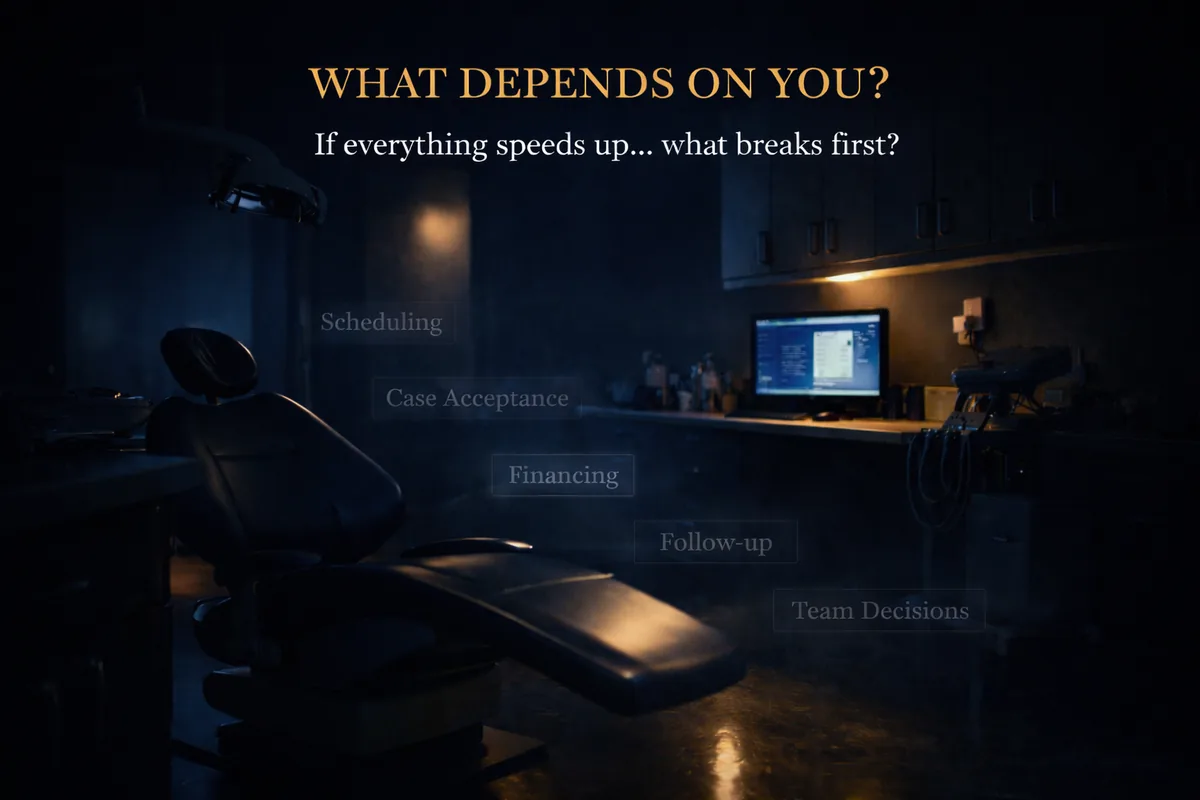
When the Owner Is Still the Bottleneck
The owner bottleneck isn’t always obvious, because capable dentists are good at compensating for weak structure. They answer the question, solve the schedule problem, review the report, approve the refund, handle the upset patient, and tell the team what to do next. That ability keeps the practice moving, but it also teaches the organization where uncertainty should go.
AI can make that pattern worse before it makes anything better. A follow-up tool may generate more patient responses. A call-analysis tool may surface more missed opportunities. A reporting system may identify more underperformance. If the team hasn’t been given the authority and judgment to handle those outputs, the owner becomes the final destination for a larger volume of information. That’s not an AI failure. It’s a leadership problem that AI made visible.
The harder part is admitting that many owners have built their professional identity around being needed. The practice rewards the doctor for knowing more, caring more, and taking responsibility when something goes wrong. Eventually those same instincts create a business where everybody is competent until a decision gets uncomfortable. AI doesn’t fix that. The owner has to change the role the practice expects the owner to play.
Hypothetical Example: The Practice That Automated Follow-Up
Imagine a practice with strong production, a good team, and several hundred patients with diagnosed treatment that’s never been scheduled. The owner adds an AI follow-up platform, expecting the tool to recover opportunities the team hasn’t had time to pursue.
Within two weeks, patients are responding. Some want to schedule. Some have insurance questions. Others want clarification about timing, financing, or what the doctor originally recommended. The tool worked, but the next problem becomes obvious, because the front desk doesn’t know which responses it can handle on its own. The treatment coordinator is already overloaded. Financial questions wait for one specific employee. Anything clinical goes back to the doctor. The practice has generated more activity without deciding who owns the activity.
The lesson isn’t to avoid the tool. The lesson is that automation creates value only when the human handoff after automation is clear.
Codent AI and the Follow-Up Problem
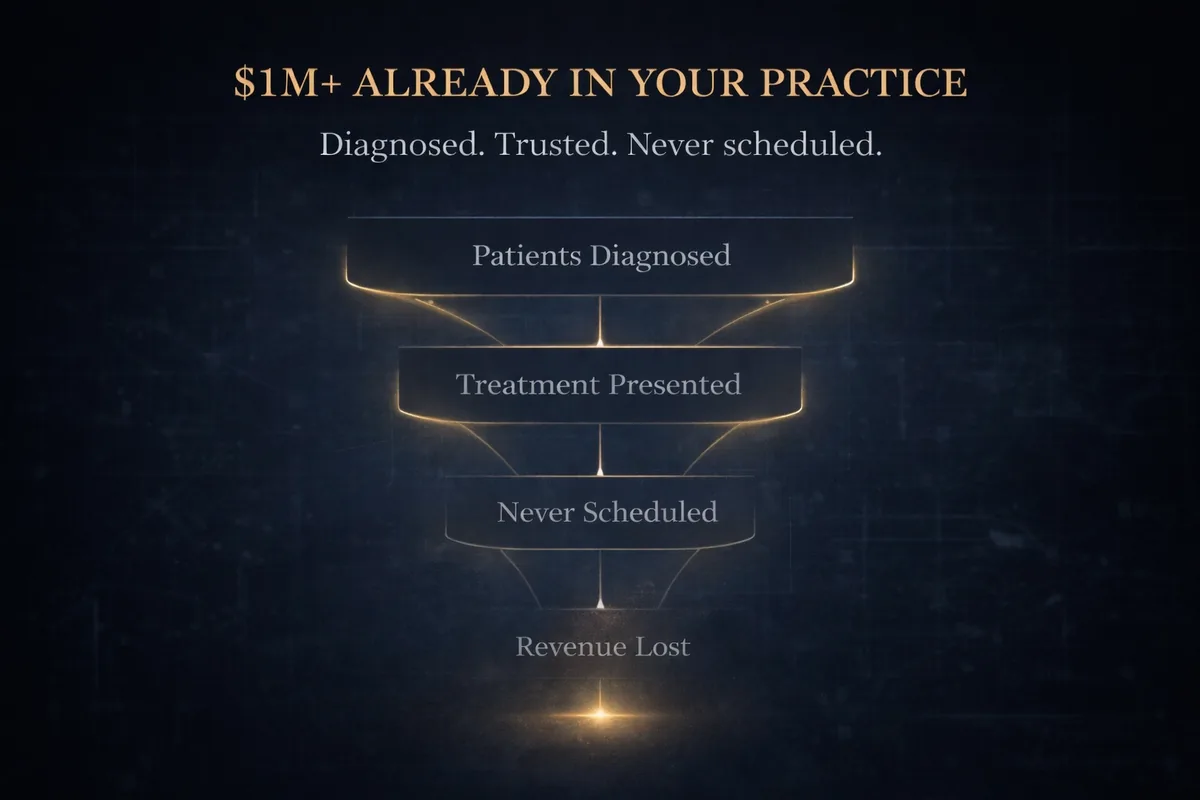
Codent AI is a useful example because it addresses a real weakness in a lot of practices: diagnosed treatment that disappears after the patient leaves. I met Janet Chen, the company’s CEO and co-founder, and she walked me through the thinking behind it directly. Codent connects to the practice management system, uses clinical notes to personalize patient messages, and automates outreach to patients with unscheduled treatment in the team’s own voice rather than a generic template.
The company currently reports that most participating practices see a 10 to 30 percent production lift, along with individual practice examples showing real dollars recovered. I want to be straightforward about that figure: it’s a company-reported result, not an outcome every office should assume it will reproduce on its own numbers.
The more interesting point is operational, not clinical. The practice has already paid the cost of acquiring the patient, diagnosing the problem, and presenting treatment. If the case disappears because nobody has time to follow up consistently, the practice is losing value after the clinical work is already done. AI can help make that follow-up more consistent. It can’t decide how the practice should respond once the patient re-engages. That’s still a people and process question.
Can Financing Create the Same Problem?
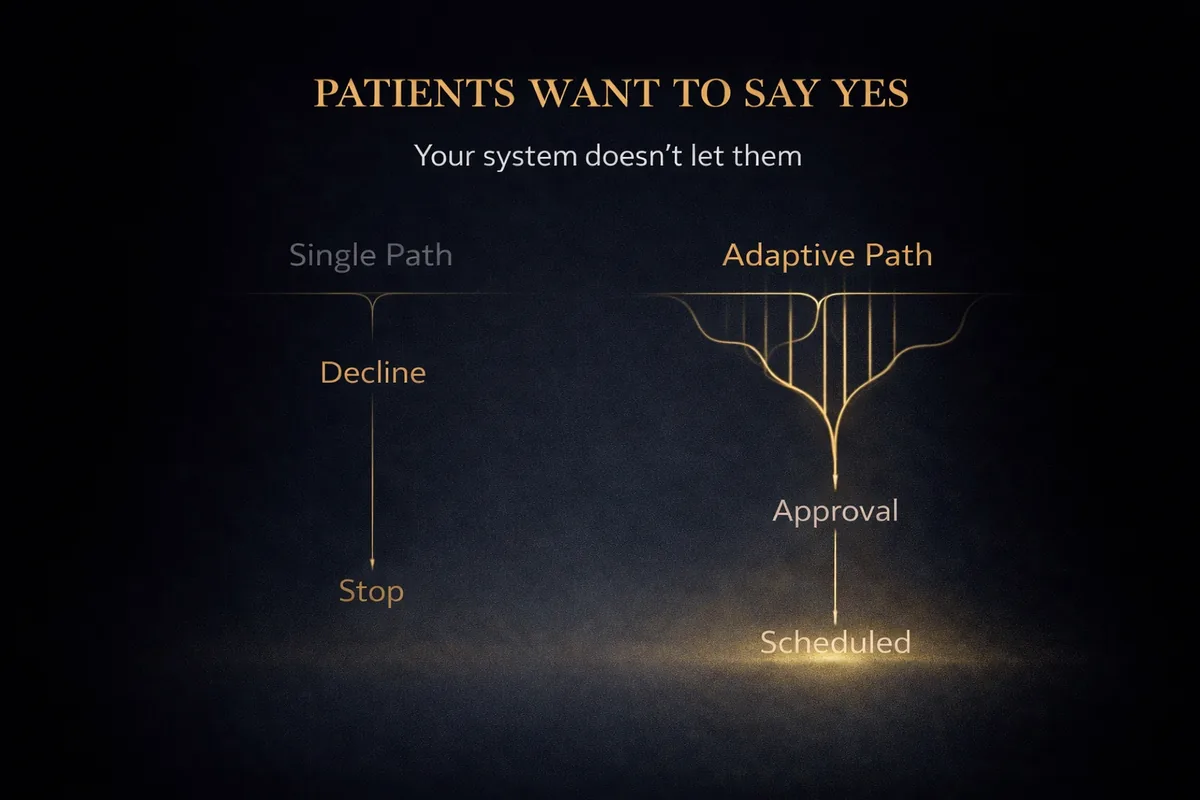
Patient financing creates a similar test. A patient may understand the diagnosis, want the treatment, and still struggle with the payment path. If the practice relies on one lender and that lender declines the application, the team may treat the answer as final even though another lender might evaluate the same patient differently.
Isaac Freckleton, CEO and founder of Eve Financial, built a different model to address exactly this. Eve isn’t a lender. It’s a multi-lender financing marketplace: one application gets routed across a network of participating lending partners, using a soft credit check at prequalification so checking eligibility doesn’t affect the patient’s score. Eve advertises approval rates as high as the high 90s, with explicit language that results vary by lender and by case, which is the right way to present a number like that.
That can remove a financing bottleneck. It still doesn’t fix an inconsistent treatment conversation, a team that’s uncomfortable discussing money, or a process where only one person knows what to do when financing gets complicated. The technology can widen the available path. The practice still has to know how to use it.
Why Can More Data Slow a Group Down?
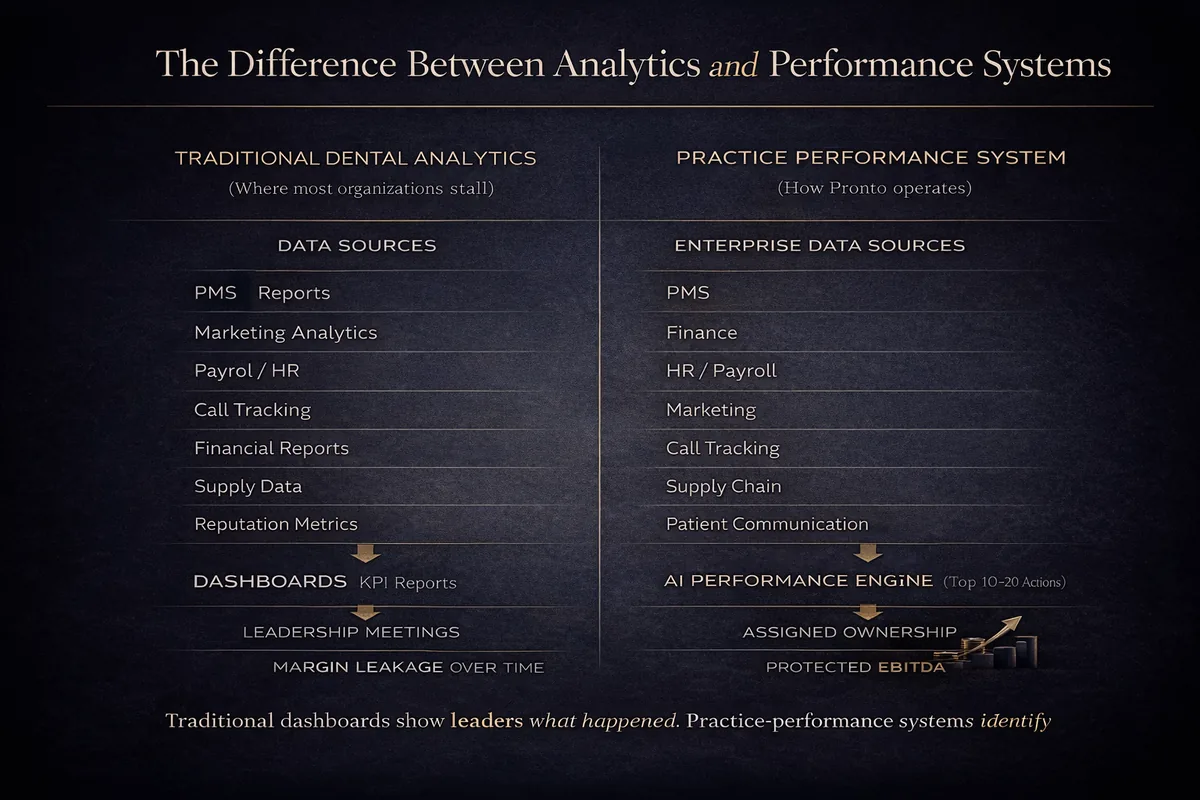
The problem becomes even more obvious in multi-location organizations. As a dental group grows, data usually grows faster than the leadership team’s ability to decide what matters. Production, payroll, marketing, call data, hygiene, case acceptance, supply expense, patient experience, and location performance can all be visible at once. The organization may have more information than it’s ever had and still make slower decisions.
That’s the problem Vin Cardillo built Pronto! around. Cardillo is CEO of Maeva Dental Advisors, the company behind Pronto!, and he’s operated inside the growth problem rather than observing it from the outside. He grew a dental group from four locations to thirty-one in twenty-eight months before it sold to private equity, which is the kind of pace that teaches you firsthand that dashboards alone don’t answer the question leadership actually needs answered: what should we do next?
Pronto! describes itself as a practice performance platform built to aggregate a dental organization’s technology stack, benchmark performance against industry norms, and surface the highest-value opportunities instead of adding another dashboard to the pile. The company’s own published materials describe it narrowing hundreds of metrics down to a ranked list of the ten to twenty opportunities worth the leadership team’s attention, each with an estimated impact attached. The point isn’t that Pronto! has the only answer. The point is that more data is useful only when the organization has a way to prioritize decisions. Information without sequence creates noise.
What AI Hears That Owners Used to Miss

Another category of AI is beginning to make patient-facing behavior measurable in ways that were difficult before. Phone calls, scheduling conversations, financial discussions, missed opportunities, and follow-up can increasingly be reviewed at volume rather than through occasional anecdote. That can be uncomfortable.
An owner may believe the phone is being answered well and discover that new patients aren’t consistently offered appointments. A team may believe financing is being presented clearly and discover that confidence changes depending on who’s speaking. A practice may believe follow-up is happening and see that it disappears during busy weeks. The technology is useful because memory is a poor management system. People remember the unusual call, the difficult patient, or the day everything went wrong. They don’t naturally aggregate hundreds of ordinary interactions into a reliable pattern. AI can help identify that pattern. Leadership still has to decide what to do about it.
The Objection: Can AI Fix Weak Systems Over Time?
Sometimes technology does force improvement. A new platform can create a cleaner workflow, standardize a step, or remove a repetitive task that never deserved human attention. But that doesn’t mean technology should be asked to solve unclear responsibility.
If a team member doesn’t know what decision belongs to them, automation won’t teach judgment. If a practice has no consistent financial-arrangement process, a better financing platform can’t create one by itself. If leadership meetings chase every metric, a smarter dashboard may simply provide more sophisticated material to chase. The sequence matters. Fix the recurring decision first. Define who owns it, what information that person needs, and when the issue should move to someone else. Then choose the technology that makes that process easier. That takes more work than buying software. It’s also more likely to produce something useful.
What Should a Practice Owner Examine Before Adding AI?
Start with the places where information currently stops. What waits for you? Which patient responses require the doctor even when they shouldn’t? Which reports arrive without producing a decision? Which team members are capable of acting but have learned to ask permission instead? Which workflows work only because one person remembers every exception?
Then look at the outcomes AI is supposed to improve. If the goal is more scheduled treatment, understand why treatment is unscheduled now. If the goal is better financing, understand what happens after a decline. If the goal is stronger performance visibility, decide who will own the response when a problem gets identified. The tool should fit the decision process. The decision process shouldn’t be invented after the contract is signed.
This connects directly to Blog No. 60, “Your Practice Isn’t Broken.” Good tools can still create a bad operating experience when the handoffs between them are weak. AI simply makes that truth arrive faster.
What’s the Thirty Percent Question?
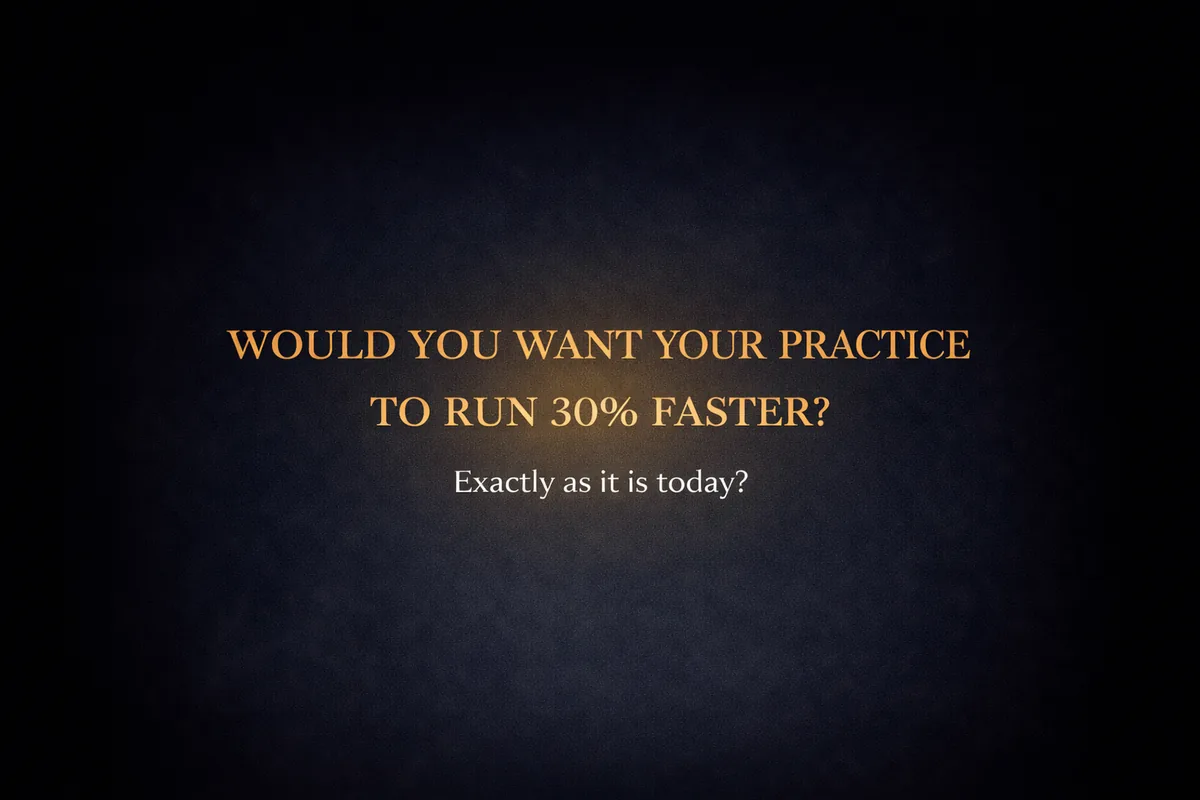
Here’s the diagnostic I’d use: if everything in your practice ran 30 percent faster tomorrow, would you want it to? Think about the current scheduling process, financial conversations, approval flow, owner dependency, patient follow-up, and leadership meetings. If you’d be comfortable with all of those moving faster, technology can probably help you do more of what’s already working.
If the answer makes you uncomfortable, that’s useful information. The hesitation points toward the part of the practice that needs attention before speed becomes an advantage. AI isn’t a replacement for leadership. It’s becoming one of the clearest ways to see where leadership hasn’t yet become structure. That’s why I think the next phase of AI in dentistry will be less about who has the most tools and more about who has built a practice capable of using them.
This is exactly the kind of operating question we work through inside the Foundation Dental Mastermind, before another platform gets added to the stack. The practices that benefit most from AI won’t necessarily be the earliest adopters. They’ll be the practices where faster information reaches people who already know what they’re responsible for doing with it.
AI is a mirror. It doesn’t change your practice. It shows you what it actually runs on. And once you see that clearly, you don’t get to ignore it anymore.
Frequently Asked Questions
Will AI replace dentists?
No. The current practical value of AI in dentistry is primarily in areas like communication, data analysis, follow-up, financing workflows, documentation, and decision support. Clinical judgment, responsibility, patient relationships, and leadership stay human responsibilities.
Why can AI make a dental practice feel more chaotic?
AI can increase the amount and speed of information reaching the team. If responsibilities and decision rights aren’t clear, that additional information creates more questions and more dependence on the owner instead of less.
What should a dentist fix before adding AI?
Start with recurring decisions and handoffs. Determine who owns each one, what information that person needs, and when an issue genuinely requires escalation. Technology works better when the underlying decision process is already clear.
Can AI improve unscheduled treatment follow-up?
Yes. AI can make patient follow-up more consistent and personalized. Codent AI, for example, currently uses practice-management data and clinical notes to support automated outreach. Results the company reports should be treated as company claims rather than guaranteed practice outcomes.
How should a practice evaluate an AI platform?
Evaluate the problem before the product. Define the outcome you want, understand how the practice handles that issue today, identify who will own the output the technology creates, and then decide whether the platform removes work or just creates more information.
Does patient financing software like Eve Financial guarantee approval?
No. Multi-lender marketplaces like Eve Financial route one application across several lending partners instead of a single lender, which can raise approval rates, but advertised figures vary by lender and by case. It widens the path to yes. It doesn’t guarantee it.
Is more data always better for a growing dental group?
Not by itself. Data helps only when leadership has a way to prioritize which issues deserve attention first. Without that, more dashboards tend to produce more noise instead of faster decisions.
About the Author
Dr. Jim Arnold, DDS is the Founder and CEO of Foundation Dental Alliance, a leadership and practice development organization serving dentists from graduation through retirement. He has 30 years of experience as a multi-practice owner and has been involved in more than 60 dental practice transitions. He leads the Foundation Dental Mastermind, Luxury Dental Retreats, co-founded Foundation Dental Transitions, and hosts the Foundation Dental Podcast. He also publishes the Foundation Dental Newsletter and Blog weekly, focused on leadership, practice design, and long-term sustainability in dentistry.
Stay Connected
Websites
FoundationDentalAlliance.com
FoundationDentalMastermind.com
FoundationDentalTransitions.com
FoundationDentalNetwork.com
LuxuryDentalRetreats.com/dubai
Social Media
LinkedIn: linkedin.com/in/arnoldjim
Instagram: instagram.com/smilesbyarnold
YouTube: youtube.com/@DrJimArnold
Facebook: facebook.com/smilesbyarnold
Twitter/X: twitter.com/smilesbyarnold
Publications
Foundation Dental Newsletter: linkedin.com/newsletters/foundation-dental-newsletter
Contact
Professional Email: drarnold@foundationdentalalliance.com