Foundation Dental Intelligence
Blog No. 77
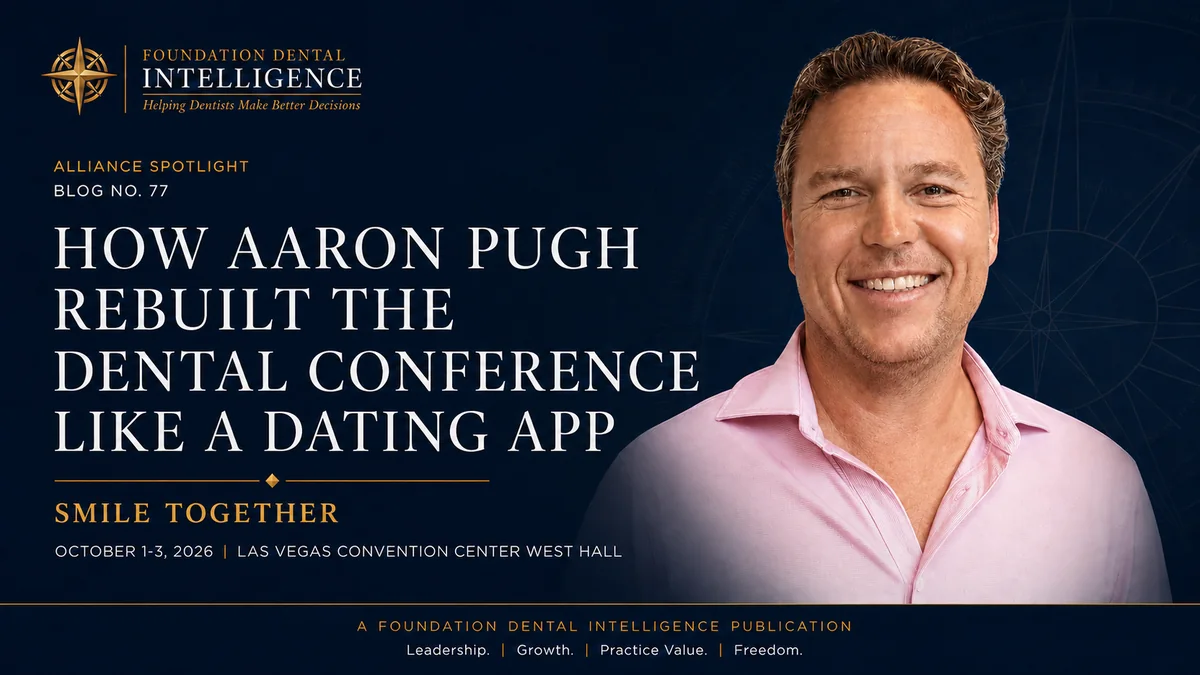
How Aaron Pugh Rebuilt the Dental Conference Like a Dating App.
Eleven Years of Operating Discipline Nobody Saw
ALLIANCE SPOTLIGHT
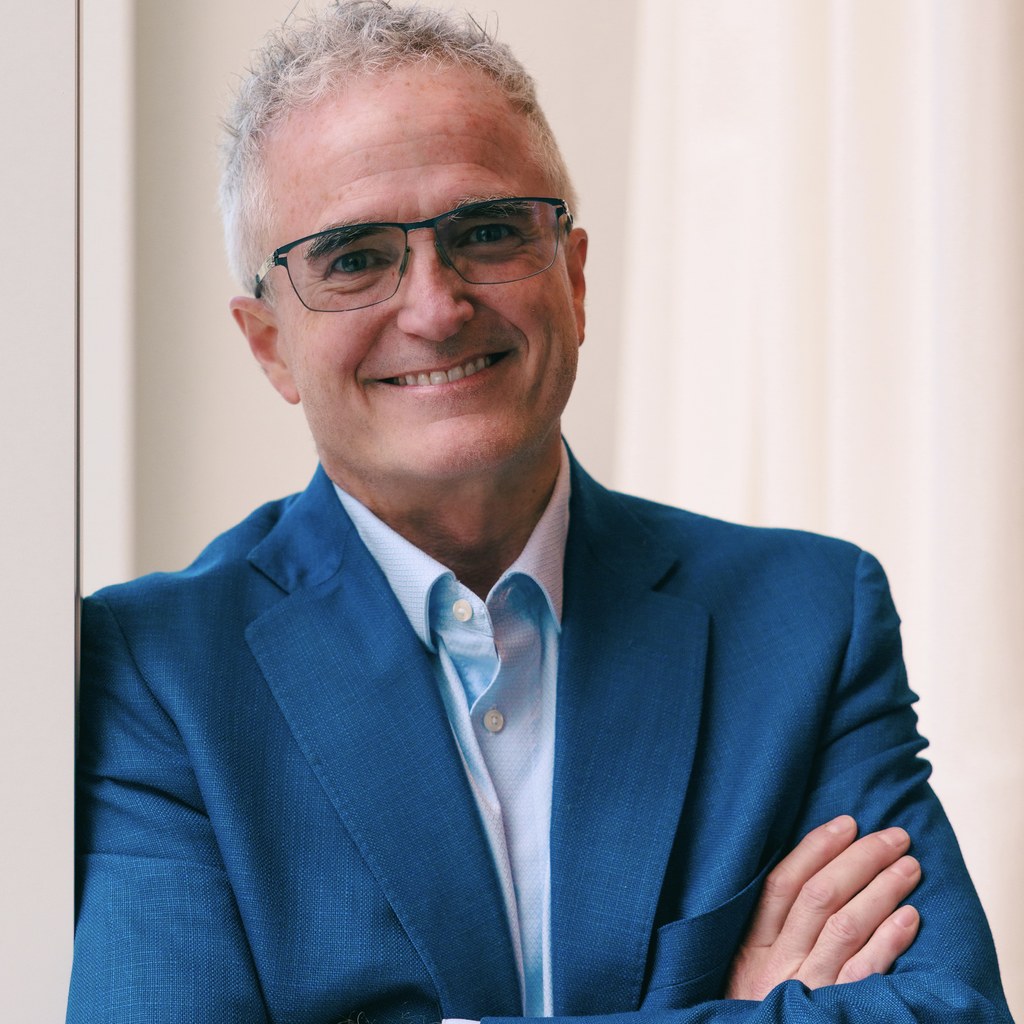
Aaron Pugh
President & Co-Founder, Together Media | Smile Together and Vet Together | Smile Together 2026: October 1 to 3, Las Vegas Convention Center West Hall
Aaron Pugh borrows a line from Mike Tyson when he talks about starting a company. Everybody's got a plan until they get punched in the face. He doesn't say it for effect. He and his partner Scott Johnson sold their first event before it existed, in four months, on nothing but twenty years of accumulated trust, and both of them had walked away from careers to do it. The punch, in Aaron's telling, is never the part you planned for.
Scott describes what they built better than anyone: "It kind of looks like a dating app." A practice owner or DSO leader applies, gets screened for purchasing authority, and picks the companies they want to meet from a matchmaking portal. The vendors fund the event, the practice's travel and hotel are covered, and by the time anyone lands, up to thirty fifteen-minute meetings are already on the calendar and both sides know why they're sitting down. That's Smile Together. Its second edition runs October 1 through 3 at the Las Vegas Convention Center West Hall, and it sold out its first edition in about two weeks.
That wasn't luck. It's a model, and the model has a story behind it that most dentists haven't heard. It starts a long way from a ballroom.
The Problem Both Men Had Already Lived
If you've owned a practice, you know the routine. You walk a floor the size of an airport for three days, dodging the reps you don't need while never quite finding the one you do. The vendors have it worse. They pay for the booth, the shipping, the staff, and the hotel, then stand there hoping the person who can sign a contract wanders past. The event counts registrations and badge scans, and neither side can say afterward what the traffic produced.
Scott Johnson spent more than twenty years representing pharmaceutical and animal-health manufacturers, most of them at Clipper Distributing in St. Joseph, Missouri. He watched trade shows get worse after COVID. Gatekeepers multiplied. Calendars tightened. The aisles stayed crowded, in his words, with people who weren't in a position to buy anything.
Aaron saw the same problem from the other side of the table. He'd spent eleven years inside a veterinary buying group, working alongside manufacturers who poured cash into reaching decision-makers and still struggled to get a meaningful conversation with anyone who could say yes. Neither of them thought the industry needed another conference. They thought it needed a harder standard, which comes down to one question: did the right people meet?
Eleven Years of Operating Discipline Nobody Saw
Here's what most people miss about him: the events business is the least interesting part of his story.
He spent the first decade of his career nowhere near healthcare, in automotive dealer technology at Digital Motorworks in Austin and then ADP Dealer Services, the arm that later became CDK Global, where he rose to director of operations. His team figured out how to pull inventory data straight out of dealership systems and push it onto Cars.com and AutoTrader, and they were the first to attach video walkarounds to individual car listings. You haven't clicked on a car listing without one since.
That decade didn't teach him veterinary medicine or dentistry. It taught him how to run complex, multi-party systems where a missed handoff has a visible cost. He has a line for it that I've started repeating to my own team: "If you're solving that same problem five or six times, you've got a broken process."
Veterinary medicine came through his wife, Starla, a practice manager at twenty-one at one of the earliest hospitals bought by Dr. Jasen Trautwein on his way to building Veterinary Growth Partners, and later its VP of Operations. Aaron joined VGP in 2013, the year it was founded, and was Chief Operations Officer by 2015, a seat he held for close to a decade. Under his operational leadership the member count grew from roughly 5,500 hospitals to more than 6,000, and thousands of independent veterinary practices got the purchasing leverage that used to belong only to the corporate consolidators.
The one program with his fingerprints on it is IGNITE, a scholarship-backed certification for front-desk and client-care teams. It's aimed at the people who decide, one phone call at a time, whether a client comes back, rather than at the doctors. That tells you where he thinks the leverage lives in a practice, and after thirty years of owning practices I'd tell you he's right.
Then private equity arrived. VGP became part of Thrive Pet Healthcare in 2021, and Aaron stayed through the transition rather than treating it as an exit. But the guardrails went up. "It was all about the bottom line at that point," he's said. I lost fifteen million dollars in equity on a forty-five-second recorded call with a private equity group, so I recognize the moment he's describing. The safer choice would have been to stay. He's been plain that it wasn't one he could live with: "The alternative for me is far worse internally."
The Phone Call From Hawaii
Scott Johnson's phone rang on an ordinary day in St. Joseph. Aaron was on the line from Hawaii, where he'd gone to think after leaving VGP. Scott assumed he was about to be asked for sponsorship money. He wasn't. Aaron had found a conference model that had reshaped other industries and had never been brought to veterinary medicine or dentistry, and he had one question: "Would you consider helping me build this?"
The two had met around 2014 at The Players Championship and talked family and business at a beach house until two in the morning. Aaron told Scott that night they'd work together eventually. He wanted a partner with aligned values, complementary skills, the willingness to challenge him, and industry relationships he didn't have. Scott was all four. He was also about to be named CEO of Clipper Distributing, and he walked away from the promotion to take the call. "There was no Plan B," he's said. "Once we committed, we'd burned the boats."
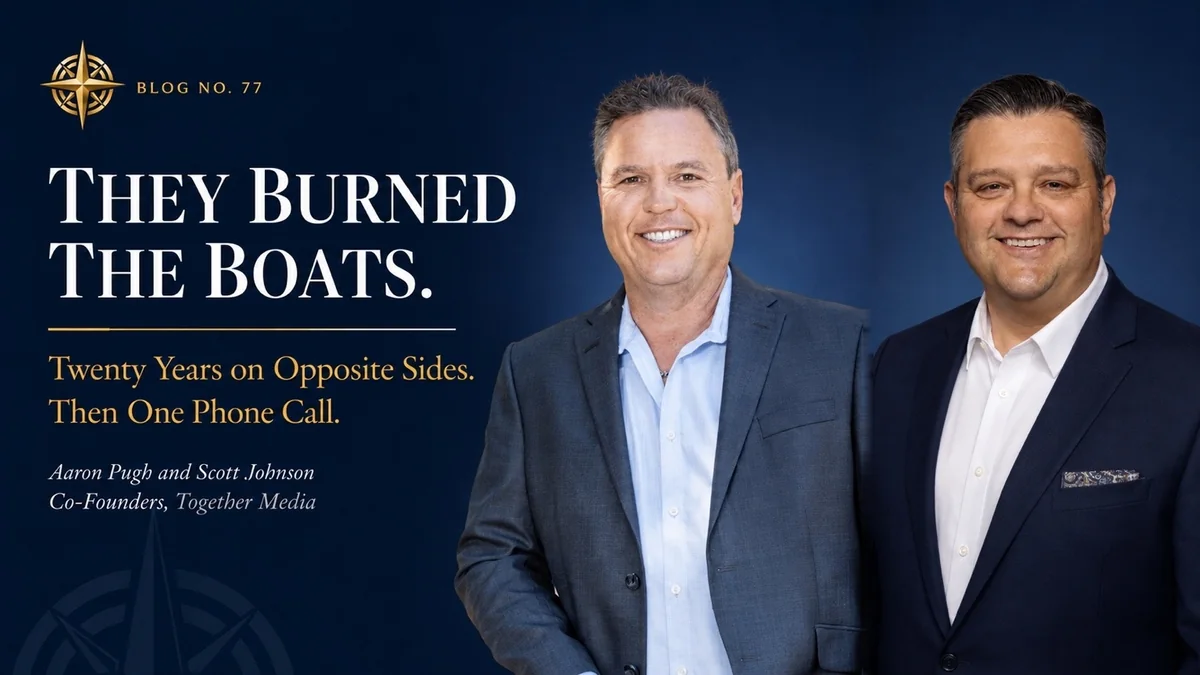
Two careers, one phone call, four months to the first event. The sponsors bought the two people before they bought the concept. |
Four months later they held the first Vet Together at the Durango in Las Vegas. Four months to sell an event that didn't exist yet, on nothing but favors earned over twenty years. Roughly a hundred hosted hospitals, seventy vendors, sold out. "The first year, people believed in us before they believed in the concept," Scott has said. "They knew our character."
They knew it worked the same day. Chris Ragland, CEO of Animalytix and a former President of Intervet, with more than thirty years in animal health and just about every industry event behind him, pulled them aside after the first round of one-on-ones and told them he'd never seen anything like it.
A Dating App for Decision-Makers
The screening questionnaire runs past two dozen questions about the practice, its purchasing authority, and what the owner is actually trying to solve this year. If approved, travel and hotel are covered. In exchange, the hosted practice commits to a schedule of up to thirty pre-scheduled, fifteen-minute meetings with vendors it selected itself from the matchmaking portal, and it still gets the continuing education, the exhibit hall, the keynote, and the social side of Las Vegas around the edges. Vendors fund the whole thing through sponsorship.
The detail that matters is buried in that paragraph. The practice picks the vendor. Nobody gets assigned thirty blind dates. I attended the New Orleans launch last October as a hosted practice and ran the full schedule myself, so I can tell you what it feels like from the chair. I chose my meetings based on what I was trying to fix in my own businesses, not on who had the biggest booth, and when I sat down across from a company, that company already knew I'd asked for the meeting. Nobody had to warm me up. Nobody had to find out whether I could sign. Fifteen minutes was enough because the first ten minutes of every trade-show conversation, the part where you work out whether you're even talking to the right person, had already happened before anybody got on a plane.
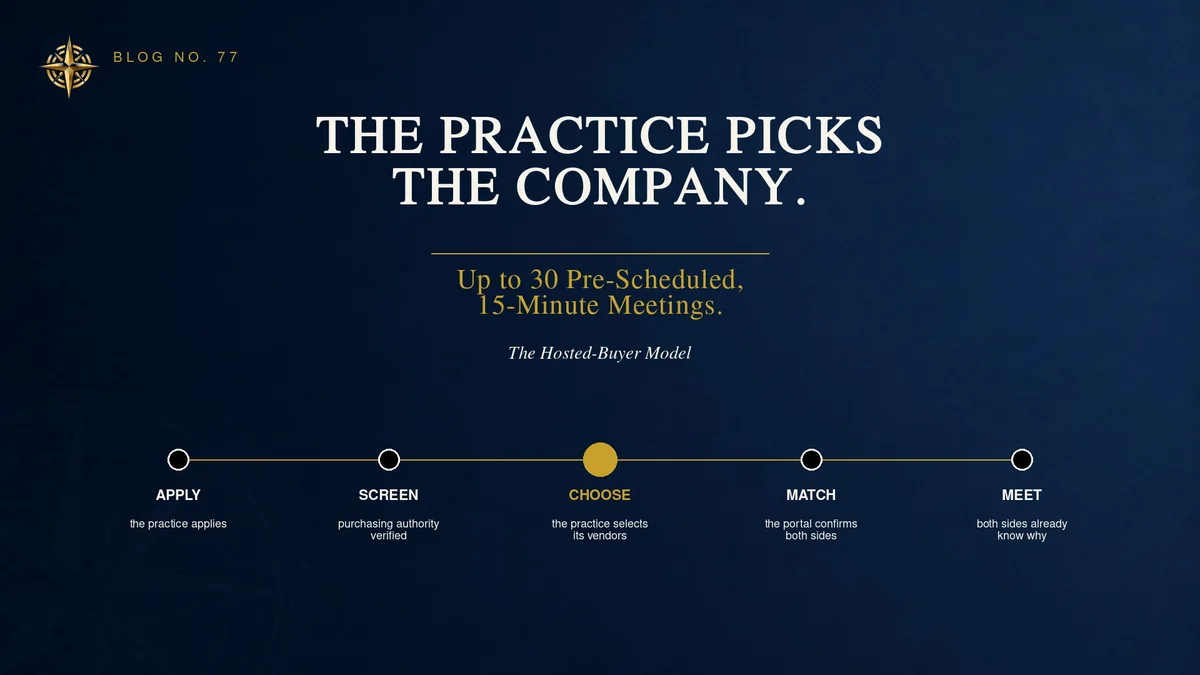
Both sides chose the meeting before anyone booked a flight. A booth can't do that. |
Aaron's stated goal for the format is narrower than most conference mission statements: "My goal was to try to create the most cost effective, time efficient way for doctors to be able to get out of their business to work on their business." The giveaways, the venues, and the parties all sit downstream of that.
“There's people that can do basically almost six months' worth of meetings within three days because of our efficiency, because of our organization, and because of the model.” - SCOTT JOHNSON, CHIEF DEVELOPMENT OFFICER, TOGETHER MEDIA |
The format itself isn't new, and neither founder has claimed otherwise. Ray Bloom pioneered the hosted-buyer model in 1988 for a trade show near Geneva, and published data from the meetings industry puts hosted-buyer conversion rates around 13 percent, against roughly 1.9 percent for ordinary floor traffic. What Aaron and Scott did was import a mature, proven format into two industries that had never seen it, and bring it to dentistry nearly three years ahead of their own timeline.
The Catch, and Why It's the Point
The travel support raises the question every owner asks, so I'll answer it plainly. The catch is the meeting commitment. Sponsors fund the model because they value qualified access, and hosted dentists get their trip covered because their time and their purchasing authority are what make the model work. You're agreeing to show up prepared and have the conversations you selected. The exchange is disclosed, structured, and easy to understand, and I'd take it over paying my own way to wander an exhibit hall every time.
That structure improves both the yes and the no. I didn't need all thirty conversations to turn into a partnership. Ten deserved a second call, which is a one-in-three rate from three days of concentrated work. Just as valuable, I left knowing which twenty didn't need another hour on my calendar. Efficiency includes the no.
The strongest fit is an owner or DSO leader who expects to make real business decisions in the next twelve to twenty-four months and is willing to prepare for them. You don't need one purchase in mind. You can test your current vendors against their competitors, clarify pricing, and build relationships before a problem creates urgency. The value drops fast for someone who wants a subsidized trip and no real conversations. Scott's advice on this is blunt, and I agree with every word of it.
“If you're not meeting with your vendors and your vendor's competitors at least once a year, you're absolutely leaving money on the table.” - SCOTT JOHNSON |
Owners get into trouble when loyalty turns into avoidance. A long vendor relationship can be an asset. It shouldn't keep you from knowing what's changed around it.
Vendors Are Voting With Their Budgets
Most sponsorship proposals lead with visibility: logo size, booth position, impressions, badge scans, foot traffic. Those have some value. They also dodge the question the person approving the budget eventually has to answer, which is who did we actually meet.
Smile Together gives a sponsor a cleaner answer. A standard package now runs about ninety one-on-one meetings, comfortably staffed by a team of four. At the far end, one vendor is booking two hundred fifty meetings across Vet Together and Smile Together with a twenty-two-person team on site. That's a compressed business-development calendar with brand exposure attached, the kind of pipeline that used to take a sales organization most of a year to build on its own.
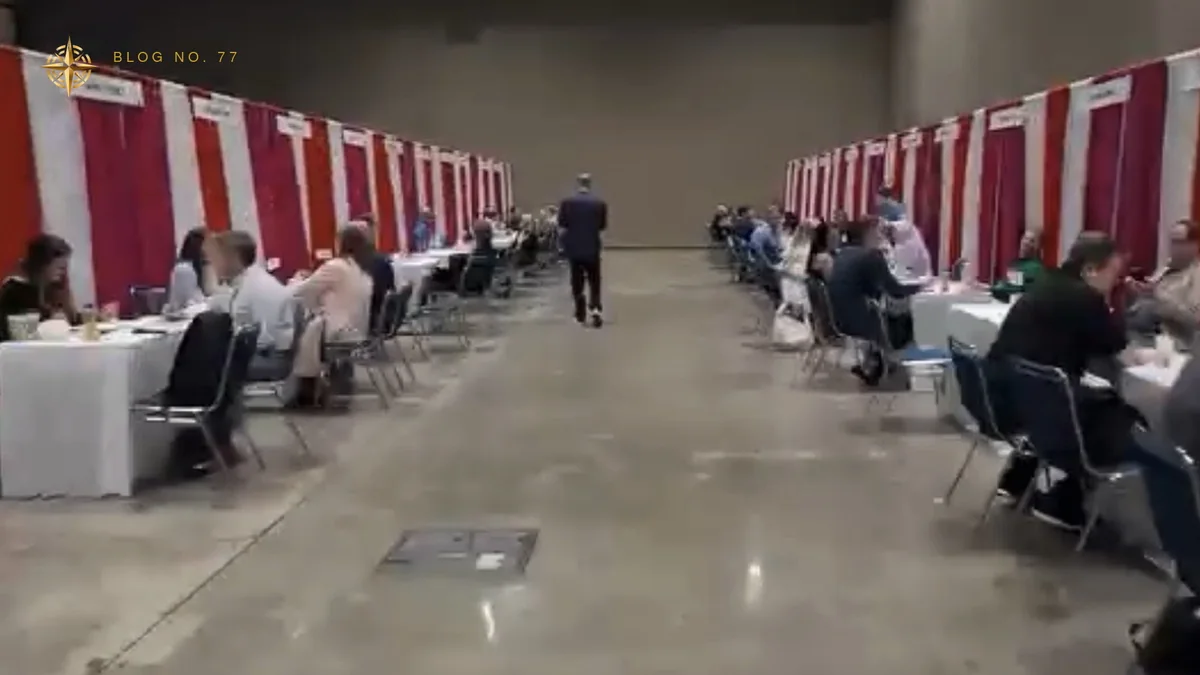
Every meeting in this room was requested by the buyer. Ninety of them is a standard package. One vendor booked two hundred fifty. |
The number I'd point a CFO to is different. By Aaron's account, roughly eighty percent of the vendors who came to New Orleans increased their spend with Together Media by fifty percent for the following year. Those figures come from Together Media, so weigh them that way, but the behavior behind them is what matters. Companies say nice things about events all the time and never come back. A larger second-year check is a different kind of evidence. Budget is behavior.
There's a second return that gets less attention. Ninety focused conversations will show a company which objections repeat, what owners are actually trying to fix this year, and whether its message lands with the person who signs. A smart sponsor leaves with pipeline and market intelligence in the same three days. An unprepared team with a generic pitch can waste ninety meetings as easily as it wastes a booth, so the companies that win here arrive with clear qualification questions, fast follow-up systems, and enough staff to keep each conversation personal. A fifteen-minute meeting starts a sales process. It isn't permission to cram the whole process into fifteen minutes.
The timing matters, and it's why the founders moved early. Owners are weighing consequential choices right now across AI, financing, scanners, labs, software, cybersecurity, compliance, marketing, equipment, and advisory services, and a booth and a brochure rarely give enough context to know how any of them will affect the practice. On top of that, DSO affiliation among U.S. dentists more than doubled in a decade, from 7.2 percent in 2015 to 16.1 percent in 2024 by the ADA Health Policy Institute's count, and more than 130 private-equity-backed DSOs now operate in the United States. Aaron and Scott are betting that as dentistry consolidates, curated access to the person who can actually make a purchasing decision gets more valuable, not less. Aaron calls the model a win-win-win: the dentist leaves with better options, the vendor leaves with qualified opportunity, and Together Media earns the right to bring both sides back. By his own logic the whole thing collapses the moment any one side stops feeling like it won.
Boutique Is the Strategy, Not the Limitation
Next to the incumbents, the scale gap is deliberate. The Greater New York Dental Meeting runs around 33,000 attendees. The Chicago Midwinter drew roughly 21,225 registrants this year. SmileCon draws about 9,300. Smile Together and Vet Together are built around 400 to 800 curated attendees per event. Large conferences will always have a place in dentistry. Smile Together solves the one part of that model they were never designed to solve well.
"We're never going to be as big as some of those other larger shows," Scott has said, "because we're really focusing on building the relationships with people who actually can make a decision for change within a practice."
Two years of running events for both professions has given Aaron a field guide to the difference between them. Vets, in his observation, run introverted. Dentists run outgoing. His one-line version: "Vets like to drive Subaru Foresters, and dentists like to drive Corvettes." He's not wrong about the Corvettes.
Smile Together 2026: Las Vegas, October 1 to 3
The second Smile Together runs October 1 through 3, 2026, at the Las Vegas Convention Center West Hall, colocated with the third Vet Together, with Resorts World as the host hotel. Smile Together is adding a full exhibit hall, SmileEx, for the first time, targeting more than 300 dentists and more than 150 vendors across more than 300,000 square feet, with more than $50,000 in prizes across both events. For scale: 218 people attended the first Vet Together in 2024, and the combined New Orleans gathering in 2025 drew roughly 1,100 with Nicole Kidman as the shared keynote.
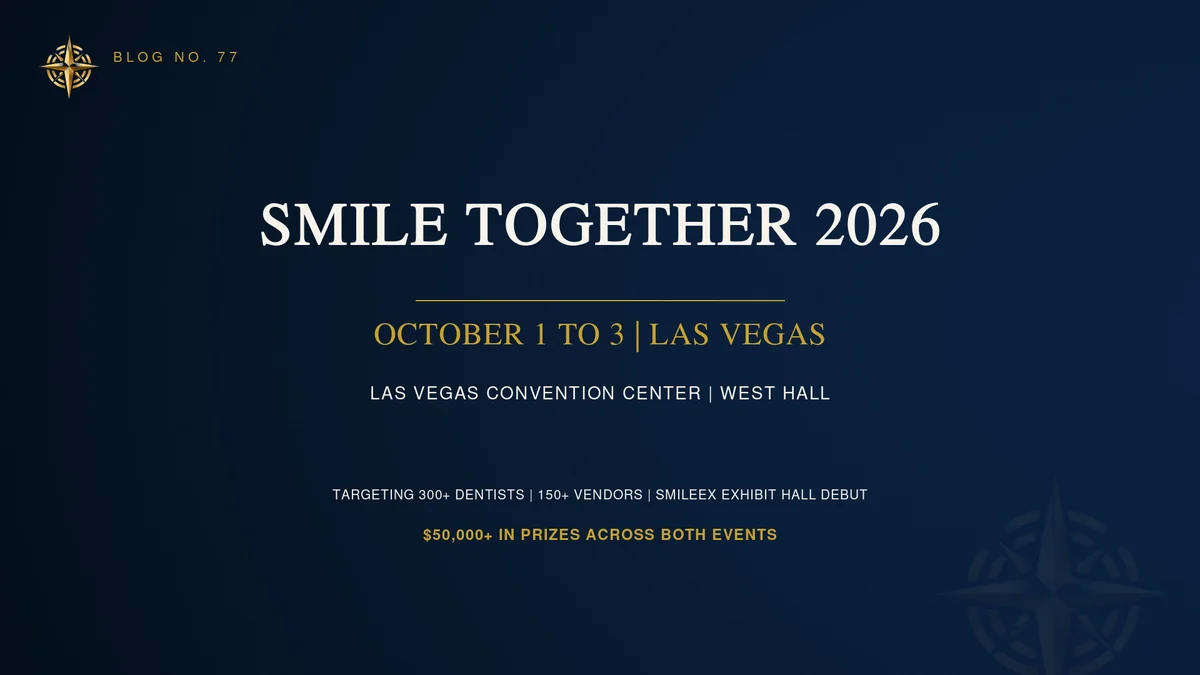
Hosted-practice registration for 2026 closed early. Expect the 2027 window to behave the same way. |
The dental sponsor list already reads like the industry's supply chain. Patterson Dental is the Platinum Sponsor. Henry Schein, A-dec, Philips, Ivoclar, Glidewell, CareCredit, Bank of America, Overjet, Weave, Cain Watters, and Rectangle Health are all on the board, alongside dozens more.
Two things you need to know if you're reading this in September. Hosted-practice registration for 2026 is closed. A year-one sellout in two weeks tells you how the 2027 window will behave, so if you own a practice or lead a DSO and you want a seat, your application goes in the day it opens. And if you're a vendor who sells to dentists, the conversation runs through Scott's side of the house, and the arithmetic above is the pitch: the cheapest sales meeting you'll ever take is the one the buyer asked for. Both conversations start at SmileTogetherLive.com.
What This Has to Do With Foundation Dental Alliance
Everything I've built in the Foundation Dental ecosystem runs on the same principle Aaron runs on. Proximity beats information. Sixty-plus practice transitions taught me that a deal gets done, or doesn't, based on whether the right two parties sat down early enough. Brian Mans and I built Foundation Dental Transitions on that, and the Mastermind and Santorini both run on it.
Aaron sat down with me on the Foundation Dental Podcast, and we spent most of the hour on the phone call from Hawaii and the eleven years before the stage, because that's where the model actually came from. His advice to anyone who wants to follow him is characteristically unglamorous: "Reach out to people that are actually in the industry and just listen." It's the same instinct that sent him to Hawaii to think instead of straight into a business plan. Watch or listen to the full conversation here:
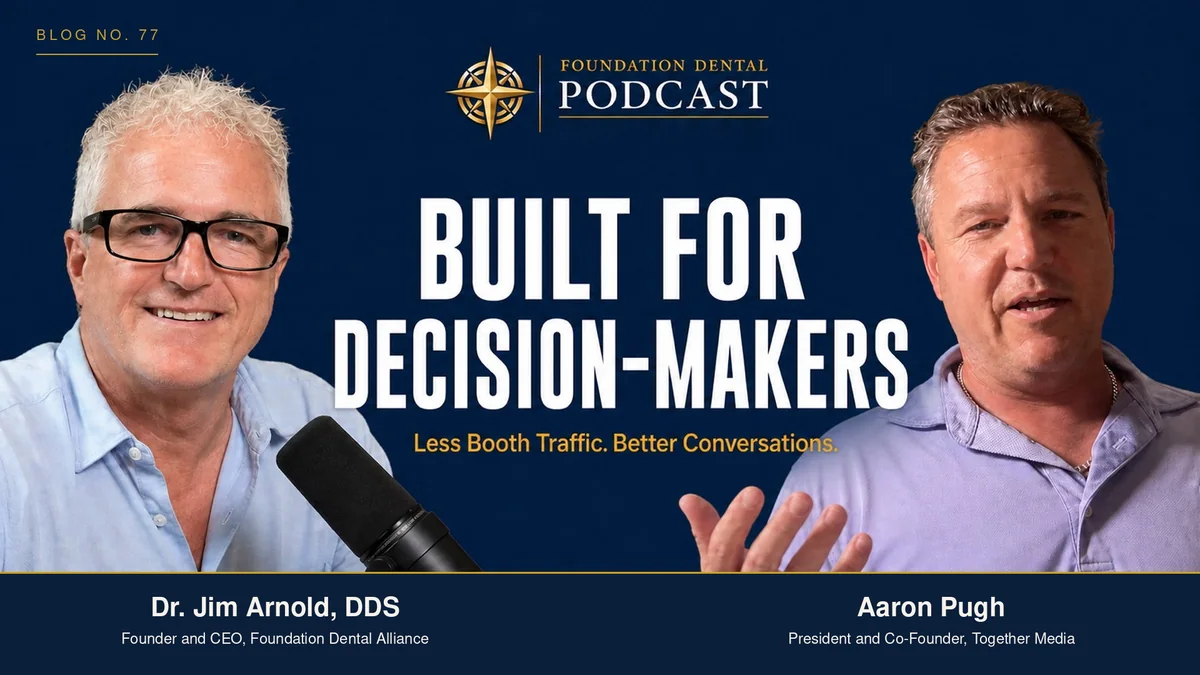
The hour we spent on the eleven years before the stage. |
Listen: Aaron Pugh: The Dental Conference Rebuilt Like a Dating App, Not Another Trade Show Floor
https://foundationdentalalliance.com/intelligence/podcast/aaron-pugh-the-dental-conference-rebuilt-like-a-dating-app-not-another
A trade show puts buyers near sellers. A hosted-buyer event puts buyers across from sellers, with the meeting already on the calendar and the authority to say yes already confirmed. That's the whole difference.
Three years ago this was a phone call between two friends, one of them standing on a beach in Hawaii with no plan beyond a question. Aaron's still the one walking the ballroom floor, making sure a few hundred meetings start on time and thanking vendors by name. The idea fits in a paragraph. The qualification system, the scheduling, the vendor-funded model, and the thousands of small handoffs Starla and the team keep from ever showing are why it'll be hard to copy.
The next hosted-practice window is for 2027. My application's going in the day it opens. Somebody across the table will already know I'm coming.
Extractable Takeaways
Smile Together replaces random booth traffic with pre-qualified, pre-scheduled conversations between dental decision-makers and the companies they chose to meet.
A larger second-year sponsor commitment is stronger evidence than any testimonial. Roughly eighty percent of New Orleans vendors raised their spend fifty percent for 2026.
The measure of a hosted-buyer event is the number of good decisions the meetings make possible, including the decision not to take a second call.
Frequently Asked Questions
What is Smile Together?
Smile Together is a hosted-buyer dental event run by Together Media, the company behind Vet Together. Qualified practice owners and DSO leaders attend with travel and hotel covered, in exchange for up to thirty pre-scheduled, fifteen-minute one-on-one meetings with vendors they choose in advance. The 2026 event runs October 1 to 3 at the Las Vegas Convention Center West Hall, with Resorts World as the host hotel.
Who is Aaron Pugh?
Aaron Pugh is President and Co-Founder of Together Media. He served as Chief Operations Officer of Veterinary Growth Partners from 2015 to 2024 and spent a decade in automotive dealer technology before that. He's based in Austin, Texas, and holds PMP and CSM certifications. He's a guest on the Foundation Dental Podcast.
How is a hosted-buyer event different from a dental convention?
Conventions sell floor space and measure success by attendance. A hosted-buyer event screens attendees for purchasing authority, lets them select the vendors they want to meet, and schedules those meetings before anyone travels. Smile Together is built for 400 to 800 curated attendees, while the Greater New York Dental Meeting draws around 33,000.
Does Smile Together pay for dentists to attend?
Approved hosted practices receive hotel accommodations and flight reimbursement. In return they complete a schedule of pre-selected vendor meetings during the three-day event.
Is Smile Together 2026 registration still open?
Hosted-practice registration for 2026 is closed. The 2025 launch sold out in about two weeks. Vendor and sponsorship inquiries go directly through Together Media.
What does a Smile Together sponsor receive?
Sponsorship centers on structured access to qualified dental decision-makers. Package details are negotiated directly with Together Media, but a standard package runs about ninety one-on-one meetings. Patterson Dental is the 2026 Platinum Sponsor, alongside Henry Schein, A-dec, Philips, Ivoclar, Glidewell, CareCredit, Bank of America, Overjet, Weave, Cain Watters, Rectangle Health, and dozens of others.
About Aaron Pugh
Aaron Pugh is President and Co-Founder of Together Media, the Austin-based company behind Vet Together and Smile Together. He served as Chief Operations Officer of Veterinary Growth Partners from 2015 to 2024 after joining at its 2013 founding, and spent the prior decade in operations and project management in automotive dealer technology at Digital Motorworks and ADP Dealer Services. He holds PMP and CSM certifications and lives in Austin, Texas, with his wife, Starla Pugh, CVPM, CPMI, who co-leads Together Media's event operations.
About the Author
Dr. Jim Arnold, DDS, is the Founder and CEO of Foundation Dental Alliance, a leadership and practice growth ecosystem that includes Foundation Dental Mastermind, Foundation Dental Transitions, Foundation Dental Network, and Luxury Dental Retreats. A multi-practice owner for thirty years, he's been involved in more than sixty practice transitions and built practices reaching 31 percent EBITDA. His work centers on leadership architecture, practice systems, enterprise value, and the freedom that comes from building a practice that no longer depends on its owner. He also serves as Chief Dental Officer of Codent AI, which is a 2026 Smile Together sponsor. He hosts the Foundation Dental Podcast and publishes Foundation Dental Intelligence weekly.
Stay Connected
Websites
FoundationDentalAlliance.com
FoundationDentalMastermind.com
FoundationDentalTransitions.com
FoundationDentalNetwork.com
LuxuryDentalRetreats.com
Social Media
LinkedIn: linkedin.com/in/arnoldjim
Instagram: instagram.com/smilesbyarnold
YouTube: youtube.com/@DrJimArnold
Facebook: facebook.com/smilesbyarnold
Twitter/X: twitter.com/smilesbyarnold
TikTok: tiktok.com/@foundationdentalalliance
Google Business Profile: tinyurl.com/2t3chcv6
Publications
Foundation Dental Newsletter: FoundationDentalNewsletter.com
Foundation Dental Podcast: FoundationDentalPodcast.com
Contact
Professional Email: drarnold@foundationdentalalliance.com
© 2026 Foundation Dental Alliance. All Rights Reserved.