Foundation Dental Intelligence
Blog No. 78
Neil Zemba, Rise DDS, and the Question Your Marketing Report Can’t Answer.
He couldn’t produce a dollar of dentistry, so he learned every number attached to it.
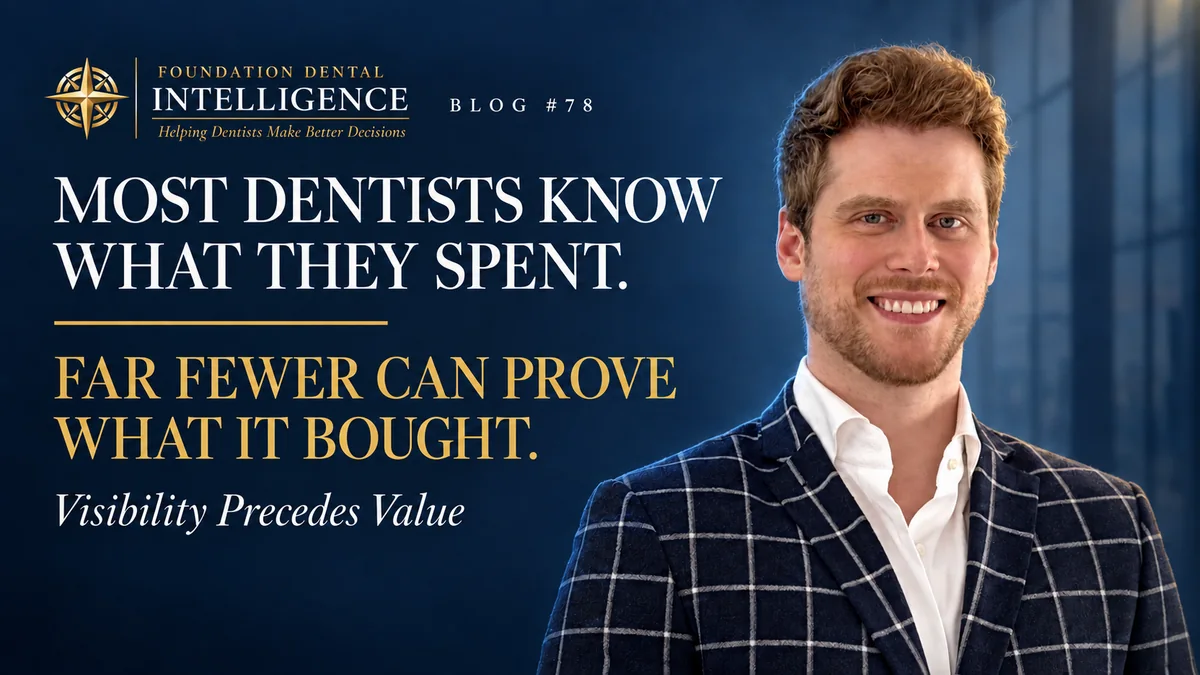
ALLIANCE SPOTLIGHT
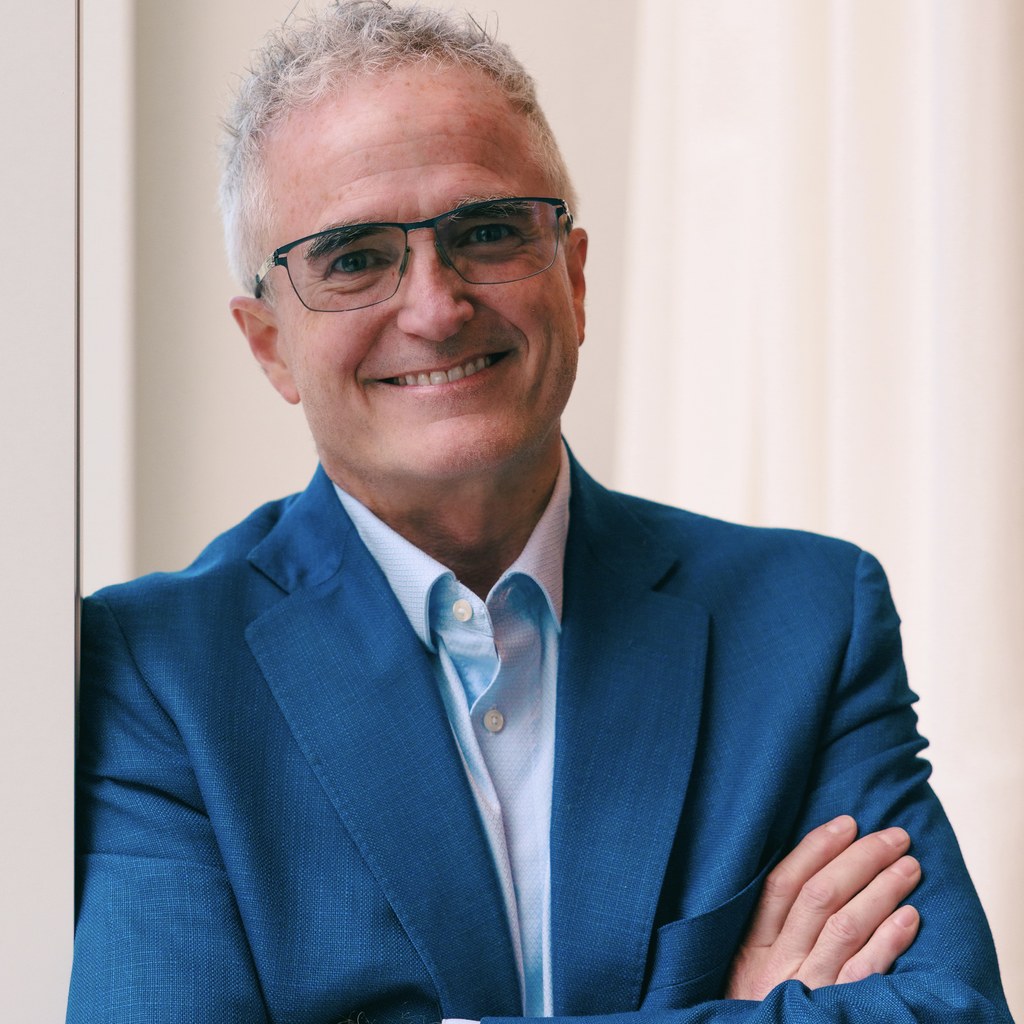
Neil Zemba
Founder and CEO, Rise DDS and Rise MD | Co-Founder and Host, Dental Mentors | Partner, Executive Dental Partners
Brian Mans and I spend a lot of our time at Foundation Dental Transitions on valuation, deal structure, buyer fit, and negotiation. Part of the job, and the part this piece is about, is advocacy. We represent sellers, so real strengths get documented and put in front of the right buyer. New patient acquisition is where I keep finding strength that never gets documented. Many owners can say what they spent on marketing last year. Far fewer can show where the patients came from, what each one cost, what they produced, and why that engine would keep running after the seller hands over the keys.
The man who built the best instrument for that in dentistry has never picked up a handpiece. Neil Zemba is the Founder and CEO of Rise DDS and Rise MD, a co-founder and host of Dental Mentors, and a partner in Executive Dental Partners. He’s this week’s Alliance Spotlight, and my full conversation with him is on the Foundation Dental Podcast. The valuation argument comes back at the end. First, the calculation that started his company.
The Calculation That Started a Company
Neil was the Chief Operating Officer of a Michigan dental group that grew from two offices to seven. One day he ran the numbers on his own leverage and got an answer he didn’t like.
If he optimized everything he actually controlled, the supplies and the staffing and the vendor terms and the scheduling, he could move roughly thirty percent to the bottom line. That was the ceiling on operational excellence. Doubling new patients would get him a hundred.
So he asked his marketing vendors what it would cost to double new patient volume. Not one of them could answer. They could talk about impressions, clicks, calls, and cost per lead. What he couldn’t see anywhere, in one place, was who called, whether that person was a fit for the practice, whether the team got them scheduled, what treatment followed, and what the practice collected.
The marketing report ended right before the business result began.
Rise DDS exists to close that gap. The platform connects a practice’s marketing channels directly to its patient management system, then ranks every campaign by the production it generated, often down to the individual ad. The standard Neil built the company around fits into three words. Show the owner who.
The Outsider’s Education
He didn’t arrive in dentistry from marketing. He arrived from design and economics, and the route explains how he thinks.
He grew up in a small town about an hour outside Detroit, with art near the center of his childhood, and he’s candid that he’s neurodivergent and that tests were never his format. He also used to interview his own dentist, unprompted, because the business model fascinated him. Recurring revenue, patients who come back, hygiene bringing them in the door. He was studying dentistry as a business two decades before he entered it.
As a freshman at Michigan he taught himself shoe design from videos, at night, and won the college division of Nike’s Future Sole competition. He wasn’t chasing a trophy. He wanted feedback from a real designer. What he did with the access is the tell. He and a classmate built a shoe design class for Detroit high school students and kept it running for years after the course credit ran out. Then came Silicon Valley, where Serve Technology built e-commerce attribution tooling, pivoted something like fifteen times, and sold in 2015.
He was running healthcare marketing work out of Franklin, Michigan in 2016 when Dr. Mazin Kizy and Nick Kizy invited him to buy into their dental practices. His first reaction, in his words, was that it sounded really awesome and exciting and also illegal, because he wasn’t a dentist. They explained the DSO model. He came in as Chief Marketing Officer, moved into Chief Operating Officer, and the group went from two offices to seven.
Here’s the part worth stopping on. Because he wasn’t the clinician, he couldn’t produce a single dollar. By his own description the Chief Operating Officer title covered light janitorial work and answering all the phones. He learned what patients experienced, what the team carried, and which numbers actually moved when an operating decision worked. The outsider’s job, as he puts it, is to come in and think like a caveman sometimes. Which is to say, think like a patient.
Four industries, one habit. He finds the place where people are guessing and he builds the instrument that lets them see.
Three Organizations, One Builder
People conflate the names, so here’s the clean version.
| Rise MD | Rise DDS | Dental Mentors | |
|---|---|---|---|
| Who it serves | Health systems, multi-location provider groups, primary and senior care, regenerative medicine | Dental practices, groups, and DSOs. Founded in 2019 with Dr. Mazin Kizy and Nick Kizy | Owners, future owners, and dental students. Launched in 2026 with Matt Ornstein and Eric Morin |
| Neil’s role | Founder and CEO | Founder and CEO | Co-founder and host |
| What it is | The medical and multi-specialty side of the same growth platform | The dental growth platform connecting marketing to patients, treatment, production, and collections | A free community, podcast, and event series |
| Why it exists | The same thesis applied outside dentistry | The report he couldn’t buy | The mentorship he wished he’d had sooner |
The two Rise brands run on the same platform. Rise DDS is the dental face of it, and Rise MD carries the same engine into medical. What matters more than the org chart is where it started. He didn’t build a product and go looking for a market. He owned the problem as an operator, built the first version by hand inside his own offices, and funded it himself. He budgeted three months and twenty thousand dollars. It took three years and over a million.
What Becomes Visible
Channel dashboards exist to optimize activity inside their own platforms. On their own, they can’t tell an owner what happened to the patient. Neil’s version of that is the one dentists remember. Imagine you’re working inside someone’s mouth and you can’t see inside the mouth. That’s what a modern marketing agency is dealing with right now. His country version is shorter. A lot of marketing makes a lot of noise, but it don’t make much money.
The platform follows the patient through the whole chain instead of stopping at the handoff. First touch, whether that’s an ad, a search, a referral, or a review. Then the conversation, where a call grader analyzes new patient calls for source, intent, outcome, and missed opportunity rather than counting every ring as equal. Then qualification by insurance, geography, treatment need, and practice fit. Then scheduling, so an owner can see whether the front desk converted the inquiry. Then case acceptance, through operatory camera and microphone integrations. Then production and collections through the practice management system.
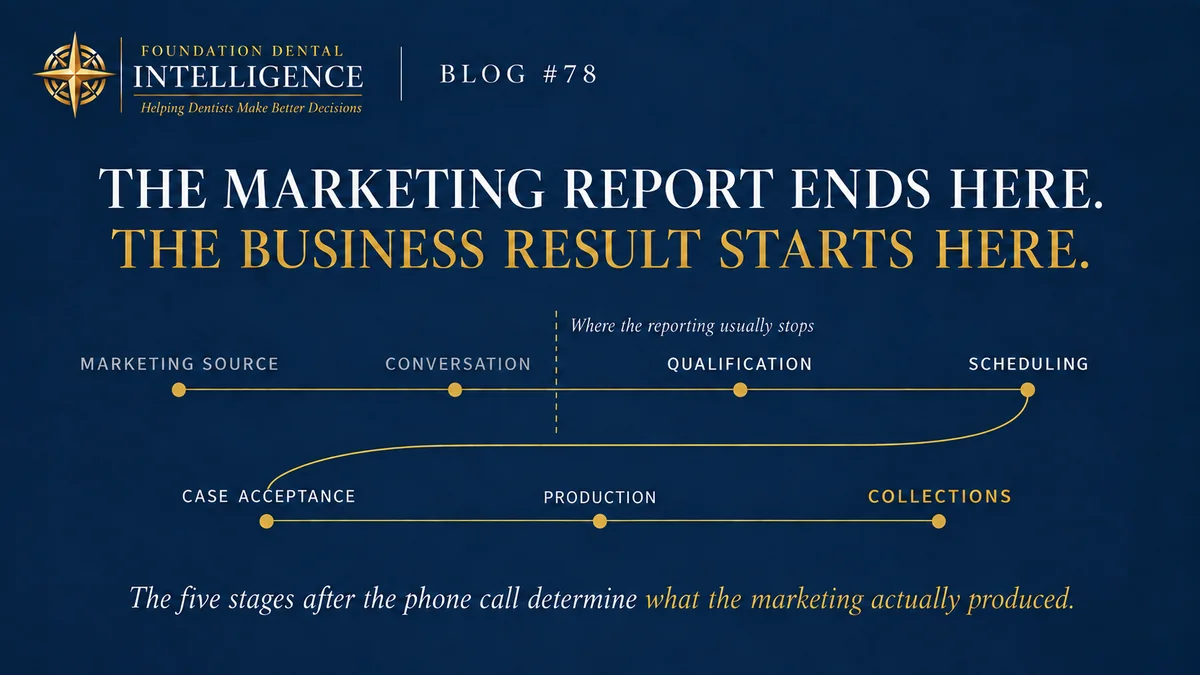
The report stops at the phone call. Five stages later is where the money gets decided.
The rest of the suite follows the same logic. Rise Recall works overdue hygiene and incomplete treatment and schedules directly into the practice system. Rise Maps heat maps a practice’s highest-spending and most loyal patients so budget follows the right neighborhoods. Research Mode prices location assessment in the hundreds rather than the thousands, because Neil doesn’t think market research should be a luxury purchase.
When Rise audited client organizations, on average only thirty percent of a group’s marketing was profitable. The other seventy percent was breaking even or losing money. That figure is company-reported, and I’d guess a fair number of owners reading this suspect their own split isn’t far off. One published case study, also company-reported, has a Michigan DSO generating roughly $3.2 million in new patient production on $160,000 in spend across twelve months.
A practice counting fifty calls from patients it can’t serve isn’t measuring demand. It’s measuring noise, and then paying for it again next month.
The Positions That Cost Him Money
What makes him worth listening to isn’t the software. It’s how often he argues against his own revenue in public.
He refuses to call a dollar returned on a dollar spent break even, because overhead and chair time sit in between. His standard is roughly 2.2 times before a campaign has earned nothing, a stricter bar than the industry sets for itself. He insists the free tier comes first, meaning reviews, provider-level profiles, hospital relationships, and employer outreach. It costs nothing, and much of it gets skipped anyway, because nobody bills for it.
He’ll also tell an owner, while selling marketing, that roughly thirty percent of the time the constraint isn’t the media buy at all. It’s intake or case acceptance. More volume isn’t growth if the practice can’t serve the people already arriving. And he puts recare and outstanding treatment in the same conversation as acquisition, because the cheapest new patient is usually an existing patient the practice lost track of.
The part I found most useful runs against what owners generally assume. Rise tracks what it calls moneyball keywords, and the results invert the obvious. The assumption is that hygiene patients are cheap to acquire and implant patients are expensive. It runs the other way more often than not, because nobody outside dentistry knows what an abutment is. They search for how to replace a missing tooth, and they’re frequently searching from the best neighborhood in town.
Dental Mentors and the Subject Dentistry Keeps Quiet
Dental Mentors grew out of a different gap. Practice ownership can build a great life, and dental school teaches almost none of the leadership, finance, investing, and risk decisions required to get there.
Neil co-founded it with Matt Ornstein and Eric Morin, two men he calls his mentors rather than his co-hosts. The premise is that money has been a taboo subject in dentistry for far too long, and the silence costs owners real money and real time. It’s free, and the founders say it always will be. Membership is limited to owners, future owners, and students, because the conversations only work if nobody has to worry about who’s listening. Neil covers AI and marketing, Matt Ornstein covers investing, and Eric Morin brings operations and leadership. Early guests included Pat Bauer of Heartland Dental and Brian Colao of Dykema.
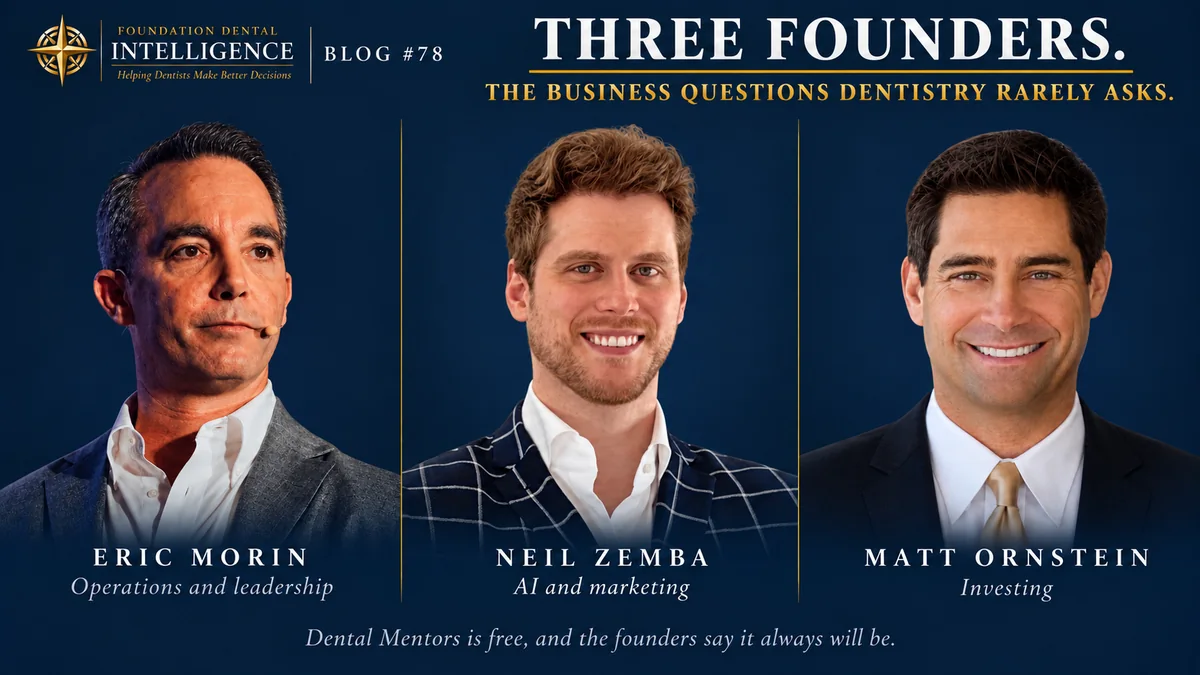
The fastest way to compress a decade of ownership mistakes is to borrow somebody else’s.
A recorded conversation runs first, then a live session inside the private group a month later, so members can ask what they wouldn’t ask on a stage. Neil calls the ambition compressing time, and that phrase ties his career together. Rise DDS created the visibility he couldn’t buy. Dental Mentors creates the candid business education he wishes he’d had sooner. It’s also close to why I built the Foundation Dental Mastermind, so I won’t pretend to be neutral about it.
Why This Is Really a Valuation Story
Now back to the seller’s side of the table.
Two practices collect the same amount. The first owner explains new patient flow with a story. Word of mouth, we’ve been here twenty years, people know us. All of that might be true. The second owner opens a dashboard and shows which channels produced which patients, what those patients accepted, what the practice collected, and what it cost to get them.
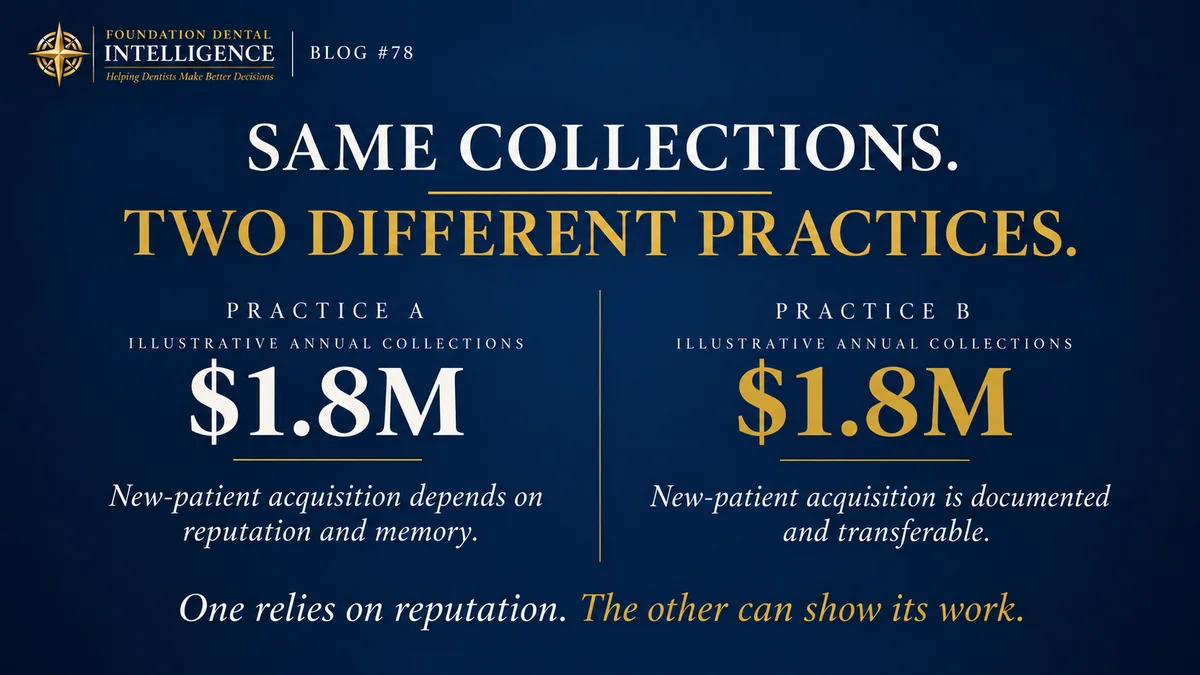
Same collections. One has to be taken on faith. The other is a system the next owner inherits.
I’m not going to tell you the first practice doesn’t sell. Plenty of good practices trade on reputation alone. But valuation is comparative, and those two practices aren’t carrying the same story into the room. Word of mouth built around a well-liked owner is goodwill that has to be taken largely on faith. A documented acquisition engine is an operating system the next owner inherits on day one. That’s the case Brian and I get to build when the data exists, and it’s a case many sellers simply aren’t equipped to make.
Marketing you can’t trace is an expense. A patient acquisition system you can prove is part of what you’re selling.
The same logic runs through EBITDA long before anyone sells. I got to 31% in a private practice group, and seventy percent of a marketing budget breaking even or losing money isn’t a line item. It’s margin. Fix it and you’ve moved profitability without adding an operatory or working an additional day.
That’s also where a lot of dentistry competes in the wrong pond. Plenty of agencies fight over impressions and cost per lead because those are the metrics the platforms hand them. Neil left that pond to compete on a number few of them were willing to publish. Production per dollar spent, attached to a patient with a name. The premium practices I work with through Foundation Dental Alliance don’t win because they outspend anyone. They win because they measure something their competitors decided not to look at.
He’s still an owner in seven dental practices and a partner in several medical offices, which is why Rise carries a permanent bias toward the decisions an owner has to make on Monday morning. The company now reports more than two thousand locations served. Ask him which venture he wants named first a decade from now and the answer has nothing to do with valuation. He says he wants to be a great operator, then adds that he isn’t there yet.
Fifteen years, four industries, and the man still thinks he’s early.
What I’d Do With This on Monday
Pull your last twelve months of marketing spend. Next to it, write the number of new patients you can trace to a specific source, and the production those patients generated. Not calls. Not leads. Patients and dollars.
If you can’t build that table, you’ve found the gap. It isn’t a reporting inconvenience. It’s an advantage you’d leave unclaimed at closing, and your margin is paying for it every month between now and then.
Neil closed the announcement of the Rise DDS product suite with a line that reads like an operating creed. Just because something is the way it is now, doesn’t mean it’s the way it should be, or the way it has to be forever. Your marketing report is one of those things.
Ask your marketing company who.
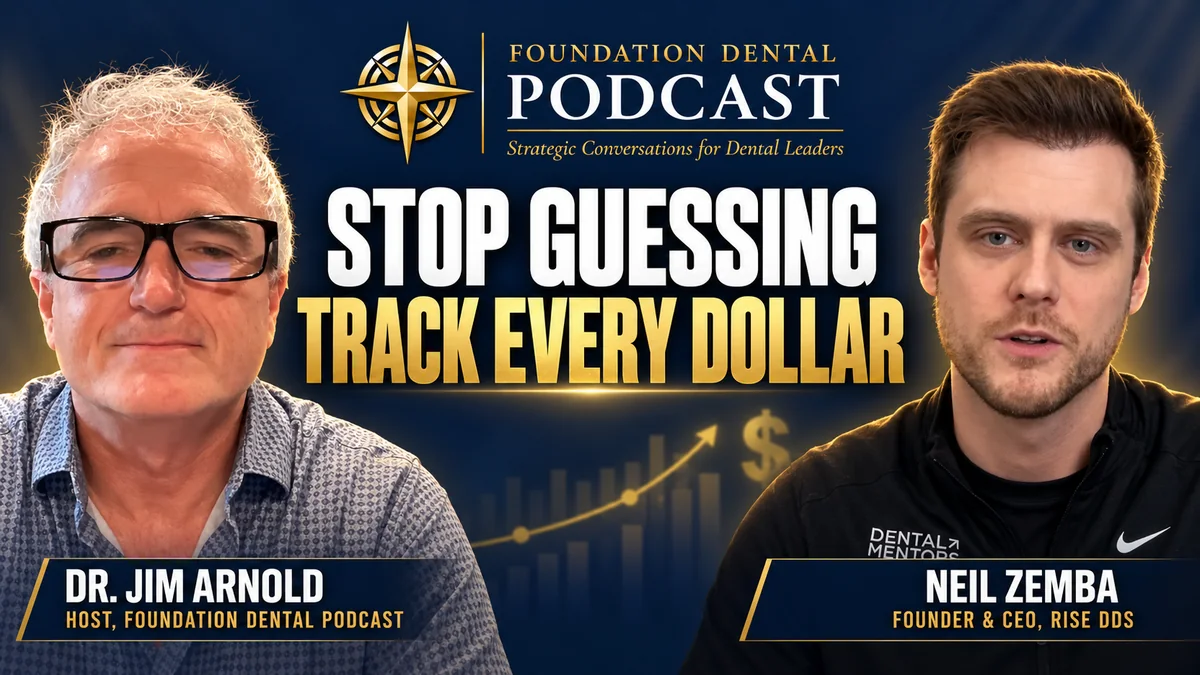
Watch the full conversation with Neil Zemba on the Foundation Dental Podcast.
My full conversation with Neil Zemba, Stop Guessing and Track Every Dollar, is on the Foundation Dental Podcast at FoundationDentalPodcast.com. You can learn more about his work at RiseDDS.com and DentalMentors.com.
Frequently Asked Questions
Who is Neil Zemba?
Neil Zemba is the Founder and CEO of Rise DDS and Rise MD, a co-founder and host of Dental Mentors, and a partner in Executive Dental Partners. His background runs through design, technology, healthcare marketing, and dental practice operations.
Does marketing attribution affect what a dental practice is worth?
It strengthens the seller’s position. Documented, repeatable acquisition is a system the next owner inherits, while new patient flow explained anecdotally has to be taken largely on faith. Valuation is comparative, so a practice that can show what its marketing produced brings evidence where many practices bring only reputation.
Why can’t my marketing company tell me how many patients they brought me?
Many agencies report from inside the ad platforms, which stop at the click or the call. Unless the reporting integrates with your practice management system, nobody can tell you which of those calls became a patient or what that patient was worth.
What return on marketing spend should a dental practice expect?
Neil’s standard is roughly 2.2 times spend before a campaign has broken even, because overhead and chair time consume the difference. A one-to-one return is a loss dressed up as neutral.
Are Rise DDS and Rise MD the same company?
They’re two faces of the same platform serving different clinical markets. Rise DDS, founded in 2019, is the dental brand and the one built inside Neil’s own Michigan practices. Rise MD carries the same system into medical, from health systems and primary care to senior care and regenerative medicine.
What is Dental Mentors?
Dental Mentors is a free community, podcast, and event series co-founded by Neil Zemba with Matt Ornstein and Eric Morin, open to practice owners, future owners, and dental students, built around the financial conversations dentistry has avoided.
About the Author
Dr. Jim Arnold is the Founder and CEO of Foundation Dental Alliance, an interconnected platform serving dentists from dental school through retirement. He has 30 years of experience as a multi-practice owner, has been involved in more than 60 dental practice transitions, was a DSO executive, and achieved 31% EBITDA in a private practice group. He leads the Foundation Dental Mastermind, Luxury Dental Retreats, co-founded Foundation Dental Transitions, and hosts the Foundation Dental Podcast. He also publishes the Foundation Dental Newsletter and Blog weekly, focused on leadership, practice design, and long-term sustainability in dentistry.
Stay Connected
Websites
FoundationDentalAlliance.com
FoundationDentalMastermind.com
FoundationDentalTransitions.com
FoundationDentalNetwork.com
LuxuryDentalRetreats.com
Social Media
LinkedIn: linkedin.com/in/arnoldjim
Instagram: instagram.com/smilesbyarnold
YouTube: youtube.com/@DrJimArnold
Facebook: facebook.com/smilesbyarnold
X: twitter.com/smilesbyarnold
TikTok: tiktok.com/@foundationdentalalliance
Google Business Profile: tinyurl.com/2t3chcv6
Publications
Foundation Dental Newsletter: FoundationDentalNewsletter.com
Foundation Dental Blog: FoundationDentalBlog.com
Foundation Dental Podcast: FoundationDentalPodcast.com
Contact
Professional Email: drarnold@foundationdentalalliance.com
Foundation Dental Intelligence | No. 78 | September 11, 2026 | © 2026 Foundation Dental Alliance