Foundation Dental Intelligence
Blog No. 80
The Reviews Doctor Built a Conference Nobody Wants to Leave
What three years at Dr. Len Tau’s Supercharge taught me about reputation, execution, and why 40 of 52 vendors signed up to come back before the next one was announced.
Get the next article.
One signup. Everything we publish.
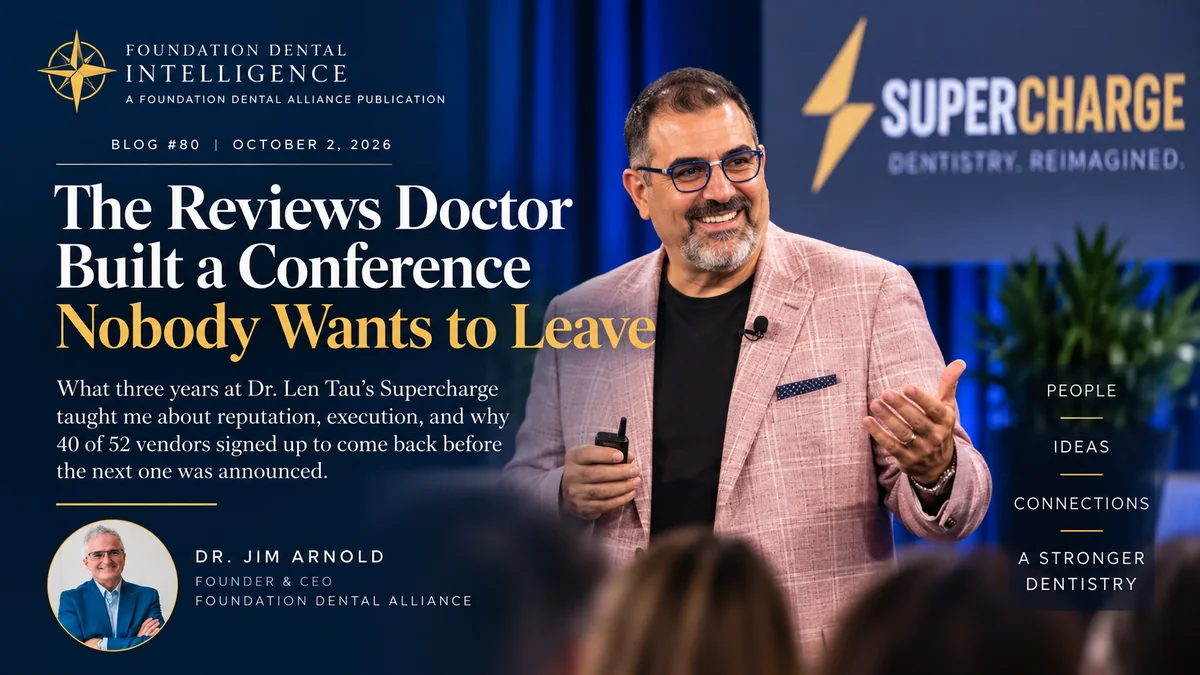
I got home from Fort Lauderdale last night after my third Supercharge in a row. Bermuda in 2024, then Pier Sixty-Six in Fort Lauderdale in 2025 and again this year, where Len also launched his new book, Raving Patients Supercharged, on opening day. And the thing I keep coming back to isn’t a speaker or a session. It’s a number Len gave me on my own podcast last November.
The 2025 event had 52 vendors. Two months later, before the 2026 dates had been announced, 40 of them had confirmed they were coming back. Five had said no, mostly for budget reasons. The rest hadn’t answered yet.
Sponsors are unusually honest judges of whether an event works. They measure return in leads, conversations, and closed deals, and they don’t come back to events that don’t produce. Forty of fifty-two re-upping before a date was announced means the math worked. Dentists leave with ideas they can use, speakers get an attentive audience, sponsors meet owners who can make decisions, and nobody feels like inventory for somebody else. The person making all of that happen, booking the speakers, selling the tickets, answering every sponsor email, is one guy.
Who Dr. Len Tau Is
If you’ve been in dentistry more than a few years, you’ve probably heard him speak. Dr. Leonard Tau, DMD, is a Tufts-trained general dentist who bought the Pennsylvania Center for Dental Excellence in Philadelphia in 2007, built it as a fee-for-service practice, cut back to two clinical days in 2018, sold it in 2021, and retired from the chair at the end of 2022. He’s the host of the Raving Patients Podcast, the author of Raving Patients, and since September 2014 he’s been General Manager of the Dental Vertical at Birdeye, the reputation platform that acquired his company, iSocialReviews. Dentistry Today has named him one of its leaders in dental consulting. Around the industry he goes by a simpler title, the Reviews Doctor.
What that resume doesn’t tell you is how he thinks. When I had him on the Foundation Dental Podcast, I asked whether he ever turns that part of his brain off when he’s ordering a pizza or booking a hotel. He said no, and then he explained why.
“I’m always on. Whatever I’m doing, something’s always ticking in the back of my brain to figure out the next best thing or to figure out how to help somebody.”
He took a call at 9:15 the night before we recorded from a practice with questions about Birdeye. He stayed on for an hour. People remember who was available.
The Night the Reviews Disappeared
Every reputation expert has a story about the moment they understood that reputation was the whole game. Len’s is specific.
Years ago, a large share of dentistry’s online reviews lived on Demandforce, and Demandforce reviews showed up in Google. Practices had hundreds, sometimes a thousand, and it made them look enormous online. Then Google stopped displaying them. Overnight.
“You had dentists who literally lost their entire reputation. They went from a thousand reviews down to ten, because they weren’t getting Google reviews.”
Len lost reviews too. But he’d already been collecting Google reviews directly, so he still had more than almost anyone around him, and when new patients walked in and he asked how they’d found him, the answer kept coming back the same way. I read your reviews. That was the light bulb. He was a fee-for-service dentist in northeast Philadelphia with no ad agency and a full schedule, and the thing filling it was a reputation he owned rather than one he’d rented from a vendor.
Here’s what really matters about that story for anyone reading this in 2026. The platform changed. The practices that had built on a platform got wiped out. The practice that had built on its own patients’ words kept going. That exact dynamic is about to repeat itself with AI search, and Len saw it coming before most of us did.
Reputation Marketing, Not Reputation Management
Len draws a line between the two terms most dentists use interchangeably. Reputation management is defensive. It starts after something goes wrong, when a negative review appears and the practice tries to answer it, remove it, or push it down the page. Reputation marketing starts much earlier. It builds an operating culture that gives patients something worth talking about, then makes those experiences visible to the next patient before they ever call.
That distinction changes where the money goes. A practice spending several thousand dollars a month on ads with eighteen old Google reviews has paid to expose a trust problem, because the people the ads reach check the reviews first and find nothing that makes them confident. Len’s argument is direct. Fix the reputation first, then spend.
On the podcast he walked me through what actually matters to the algorithm now. Not just how many reviews you have, but velocity, meaning how consistently they arrive. A practice that collected 300 reviews in a burst and then stopped ranks worse than one that gets a steady flow every week, because the algorithm reads the stop as a signal that something changed. He told me about a client who left Birdeye, kept the same total, lost the velocity, and watched his rankings fall. He reached out a couple of days before our recording asking to come back.
The other thing he keeps hammering is that reviews alone don’t rank you. Categories matter. Listing consistency matters. He’s seen practices with more than a thousand reviews go invisible after a move because their data was inconsistent across the web. The reviews were the engine, but the engine was bolted to a frame that had cracked.
What Happens When Patients Ask AI Who to Call
This is the part every owner should hear.
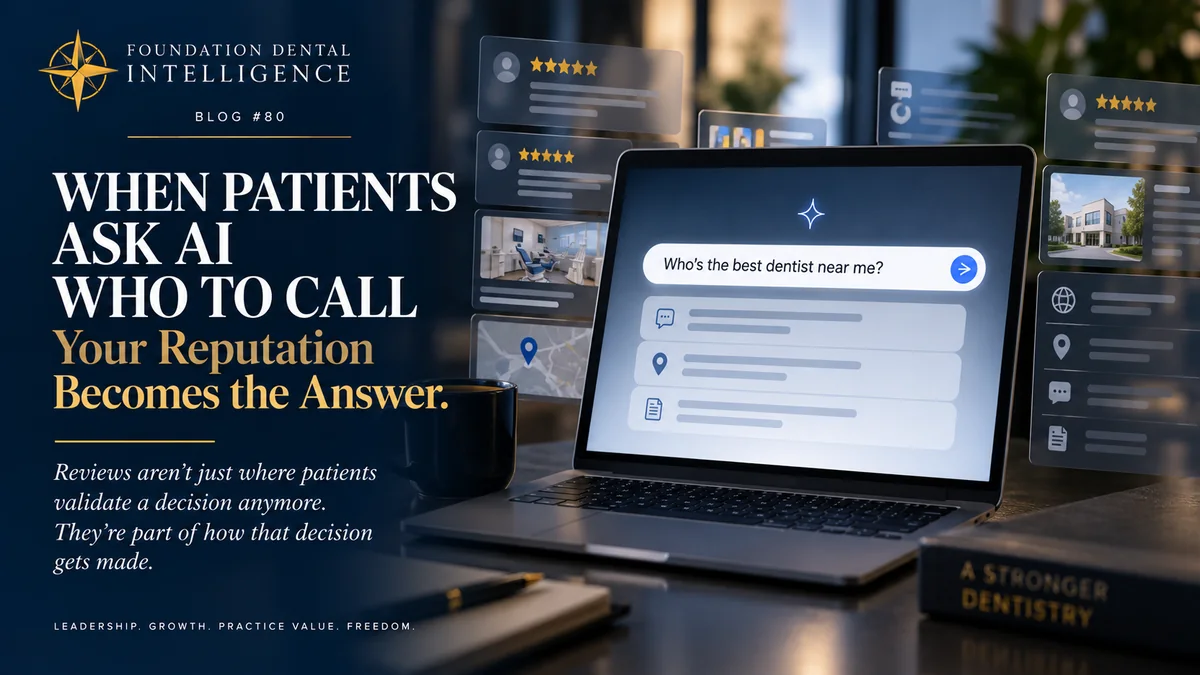
The mechanics are new. The foundation isn’t. Patients still want evidence that other people trusted the dentist.
Len is convinced the next two to four years will move a large share of patient search off Google entirely. Somebody will open ChatGPT or Perplexity and say, I’m going to a dentist, give me a list of the top dentists in my area and the reason I should choose one over the other. The engine will answer. And the answer will be built from data the engine can find: your reviews, your website content, and, he pointed out, places like Reddit that most dentists have never thought about.
He runs the test himself. He asks the AI who the best dentist in Parkland, Florida is. The answer happens to be a Birdeye client, and the reason isn’t magic. It’s volume, recency, specificity, and responses, the same levers he’s been teaching for a decade, now feeding a different machine.
That’s why my endorsement in his new book reads the way it does:
“Twenty-four years of fee-for-service practice taught me reputation is everything. I still walked away from interviewing Len rethinking how patients will find dentists next. When they ask AI who to call, there’s one answer. This book is how you become it. Every dentist I advise will hear about it.”
The Book, and the Advice He Publicly Retired
Raving Patients Supercharged: Be Seen, Be Trusted, Be Chosen launched on the opening day of this year’s event. It’s the second edition of his original Raving Patients, rebuilt for the way patients choose dentists now, and it carries 25 endorsements from across the profession, including 1-800-DENTIST co-founder Fred Joyal. I contributed one of them. Foundation Dental Alliance also has a resource page inside it, which I’ll come back to. The paperback is $29.99 and the Kindle edition is $2.99, which may be the highest-return marketing purchase a practice makes this year.
The reason I’d read it, beyond the AI material, is what Len does in the opening chapters. He tells dentists what he used to recommend, and why he doesn’t anymore.
For years, Len taught practices to have patients mention team members by name in reviews. It worked. He put it in his first book and taught it from the stage. Then Google changed its Maps review policy in April of this year, barring merchants from asking staff to solicit reviews that name them, and the advice became a liability. Google also reported blocking or removing more than 292 million policy-violating reviews in 2025 alone, so this isn’t a theoretical risk. He pulled data from two practices over six months. At an office that did no coaching, about six percent of reviews named a team member. At one that encouraged name mentions, more than half did. He calls that gap the signature of coaching, and he says Google can see it too.
Most people in his position would have quietly dropped the advice from the next edition. Len leads with the reversal. That’s the kind of credibility you can’t buy, and it’s the same trait that makes his event work.
What Makes Supercharge Different
Supercharge has been at Pier Sixty-Six in Fort Lauderdale for the last two years, and this year it ran September 25 through 27, a full Friday and two shorter days instead of the two long ones of 2025.
I’ve told everybody I mention the event to that Pier Sixty-Six is a really nice hotel, and I have very high standards and travel constantly. Len and his wife walked the property while it was still under construction in April 2024 and picked it on the spot. He told me he’s found a home there and plans to keep the event at that venue indefinitely. The one consistent complaint after 2025 was that attendees loved the property and had no time to enjoy it, so he added a day. People weren’t asking for less value. They wanted room to experience the value already there, and that’s a lesson for any owner: feedback usually arrives as a request, and the job is to find the problem underneath it.
The venue matters, but it isn’t the reason 40 vendors re-upped. Here’s what is.
Every meal and every break runs through the exhibit hall. There’s no separate lunch room where attendees go to hide from the booths. The vendors are where the food is, and the Friday evening reception is a wine tasting that strolls through the exhibitors. A scanned vendor badge is what enters you in the raffles. Traffic to the booths isn’t hoped for. It’s designed. That’s reputation marketing in physical form. Create an experience worth talking about, then design the system so the right people actually experience it.

Every meal and every break runs through the exhibit hall. Traffic to the booths isn’t hoped for. It’s designed.
Every attendee is a decision maker. Practice owners, managers, team leads. A vendor at Supercharge isn’t talking to somebody who has to go check with the doctor.
The speaker lineup is built for variety rather than volume. This year ran 17 speakers in TED-length talks, panels on profitability and AI, and 14 hours of AGD credit, and it included people I’d never heard before who were excellent. When I told Len that, he said the same thing happened with Rich Madow and Steve Rasner, both big names who came to him expecting a study club and found a full production. It’s in-person only, no livestream and no replay, which changes who shows up and how present they are. And Saturday night closes with a Spazmatics concert, which is exactly as fun as it sounds.
And the sponsorship isn’t just a booth. Top tiers get an episode on the Raving Patients Podcast, email blasts, stage time, and first right of refusal on their spot next year. Len is bundling his media assets into the sponsorship, so a vendor gets exposure for twelve months, not two days. That’s the part most event organizers miss, and it’s why his sponsors think of Supercharge as a channel rather than a line item.
One Person, Fifty-Two Vendors
When I complimented Len at the event on how smoothly everything ran, I said I was blown away that he hardly has a team. He corrected me a little on the podcast. His wife has a say in most decisions, and a logistics group handles the hotel side. Then he said the rest.
“Other than that, it’s all me. The speakers, the sponsors, the ticket sales, that’s all me.”
He described his method the same way he describes everything: systematic. If he’s talking to somebody and needs to send an email, he sends it right then, because otherwise he’ll forget. He said he dots every I and crosses every T with vendors and speakers, and having watched the event run, I believe him. The worst thing that went wrong in 2025 was that one session started fifteen minutes late.
Len also told me Supercharge was an idea he sat on for years. Mark LeBlanc told him back in 2018 or 2019 that he needed to write a book and run an event. He wrote the books. The event he held until he was out of clinical practice and could give it his full attention, because he didn’t want to launch it half-built. That patience shows up in the product.
What a Practice Owner Should Take From This
You don’t need to run a conference to learn from how Len runs his. Five things transfer directly to a practice.
Own the asset. Len’s origin story is about practices that rented their reputation from a vendor and lost it overnight. Your Google reviews are yours. Your patient relationships are yours. Everything you’ve built on somebody else’s platform can be taken away by a policy change, and the AI shift is going to test that again.
Design the traffic. Supercharge doesn’t hope attendees visit booths. It puts the food there. Your practice can do the same with the handoff from operatory to front desk, with the recall system, with the review request. Wherever you’re hoping patients do something, ask what would make it the default instead.
Stop coaching the words. Google’s 2026 policy makes scripted reviews a risk. Ask for feedback about the experience and let the patient describe it.
Know what each person needs from the exchange. Patients, team members, referral partners, and vendors all experience the same practice differently. A system that benefits the owner while exhausting the team fails eventually, and one that makes the team efficient while making patients feel processed costs you loyalty. Supercharge works because Len thought about what every group in the building came to receive.
Say what changed. Len opened his new book by retiring his own old advice. If your practice has a policy that stopped working, your team already knows. To say so out loud costs you nothing and buys you more credibility than pretending it was always this way.
Where Foundation Dental Alliance Fits
Len’s book carries a Foundation Dental Alliance resource page with a QR code, which is how a reader of Raving Patients Supercharged ends up at FoundationDentalAlliance.com/book.
Supercharge and the book share one idea, and it’s the same one we build on at Foundation Dental Alliance. Reputation isn’t a marketing project. It’s a leadership outcome. Len built a conference people talk about the same way he built a practice patients talked about, and the review strategy works because the leadership behind it is real.
Patient attraction and premium positioning is one of the six pillars inside the Foundation Dental Mastermind, and Len’s material is the reference point for the reputation side of it. If a patient asks an AI who to call and the answer isn’t you, that’s a structural problem, and structural problems are what the Mastermind exists to solve. The Mastermind is intentionally kept small. Details are at FoundationDentalMastermind.com, and the next step is to Apply for Annual Membership.
Where to Find Len
The book is on Amazon at amazon.com/dp/0998174416. Len is at DrLenTau.com, the event is at SuperchargeYourDentalPractice.com, and our full conversation, plus clips, is on the Foundation Dental Podcast at foundationdentalalliance.com/intelligence/podcast/dr-len-tau-how-review-velocity-drives-fee-for-service-growth. Supercharge 2027 will be back at Pier Sixty-Six, and tickets go faster than you’d expect for a September event.
Len closed our podcast by saying it was the most thorough interview he’d ever done. From someone who’s been on hundreds of stages and recorded more than 300 episodes of his own show, I’ll take that.
But the compliment runs the other way. He’s built one of the few dental conferences where the attendee, the speaker, and the sponsor can all leave believing the event was designed for them.
That may be the best lesson Len teaches about reputation. You don’t build it by asking people to say good things about you. You build something they want to talk about.
Frequently Asked Questions
Who is Dr. Len Tau?
Dr. Leonard Tau, DMD, is a retired Philadelphia general dentist, the General Manager of the Dental Vertical at Birdeye since 2014, the host of the Raving Patients Podcast, and the author of Raving Patients Supercharged. He founded and runs the annual Supercharge Your Dental Practice conference and is known in the industry as the Reviews Doctor.
What is Supercharge Your Dental Practice?
Supercharge is an annual marketing and business conference for dental practice owners and their teams, founded by Dr. Len Tau in 2023. For the last two years it has been held at Pier Sixty-Six in Fort Lauderdale. The 2025 event had 52 vendors, and the format routes all meals and breaks through the exhibit hall so attendees and sponsors actually meet.
What is Raving Patients Supercharged about?
It’s the second edition of Len Tau’s reputation marketing book, launched September 25, 2026. It covers how AI tools like ChatGPT and Gemini surface dental recommendations, how to build review volume and velocity, how to respond to unfair reviews, and why Google’s April 2026 policy change means practices should stop coaching patients to name staff in reviews.
Why does review velocity matter more than review count?
Because the algorithm reads consistency as a signal that the practice is still active and still earning trust. A practice that collected many reviews in a burst and then stopped ranks worse than one receiving a steady flow, even with a smaller total, and the same pattern feeds AI recommendations.
How do AI tools decide which dentist to recommend?
From the data they can find: review volume, recency, and specificity, whether the practice responds to reviews, website content, and third-party mentions on platforms like Reddit. Practices with a strong, consistent, well-responded-to review footprint appear. Practices without one don’t, regardless of ad spend.
Should dentists still ask patients to mention staff by name in reviews?
No. Google’s Maps content policy changed in April 2026 to bar merchants from asking staff to solicit reviews that name them. Len Tau taught name mentions for years and publicly retired the advice in his 2026 book. Ask for feedback about the experience and let the patient decide what to say.
The Foundation Dental Blog publishes every Friday at FoundationDentalBlog.com. If this reached you through a colleague, that’s where you can subscribe.
About the Author
Dr. Jim Arnold, DDS is the Founder and CEO of Foundation Dental Alliance, an interconnected platform serving dentists from dental school through retirement. He has 30 years of experience as a multi-practice owner, has built and led multiple successful dental practices, achieved 31% EBITDA, and has been involved in more than 60 dental practice transitions. He leads the Foundation Dental Mastermind and Luxury Dental Retreats, co-founded Foundation Dental Transitions, hosts the Foundation Dental Podcast, and serves as Chief Dental Officer of AlignerOff. He publishes Foundation Dental Intelligence to help dentists lead stronger teams, build more profitable practices, increase practice value, and create greater freedom at every stage of their careers.
Stay Connected
Websites
FoundationDentalAlliance.com
FoundationDentalMastermind.com
FoundationDentalTransitions.com
FoundationDentalNetwork.com
LuxuryDentalRetreats.com
Social Media
LinkedIn: linkedin.com/in/arnoldjim
Instagram: instagram.com/smilesbyarnold
YouTube: youtube.com/@DrJimArnold
Facebook: facebook.com/smilesbyarnold
Twitter/X: twitter.com/smilesbyarnold
TikTok: tiktok.com/@foundationdentalalliance
Publications
Foundation Dental Newsletter: FoundationDentalNewsletter.com
Foundation Dental Blog: FoundationDentalBlog.com
Foundation Dental Podcast: FoundationDentalPodcast.com
Contact
Professional Email: drarnold@foundationdentalalliance.com
Foundation Dental Intelligence | No. 80 | September 28, 2026 | © 2026 Foundation Dental Alliance