Foundation Dental Intelligence
Newsletter No. 10
Mastering Hiring & Retention.
How to Build a Team That Actually Makes Your Life Easier
Get the next issue.
One signup. Everything we publish.

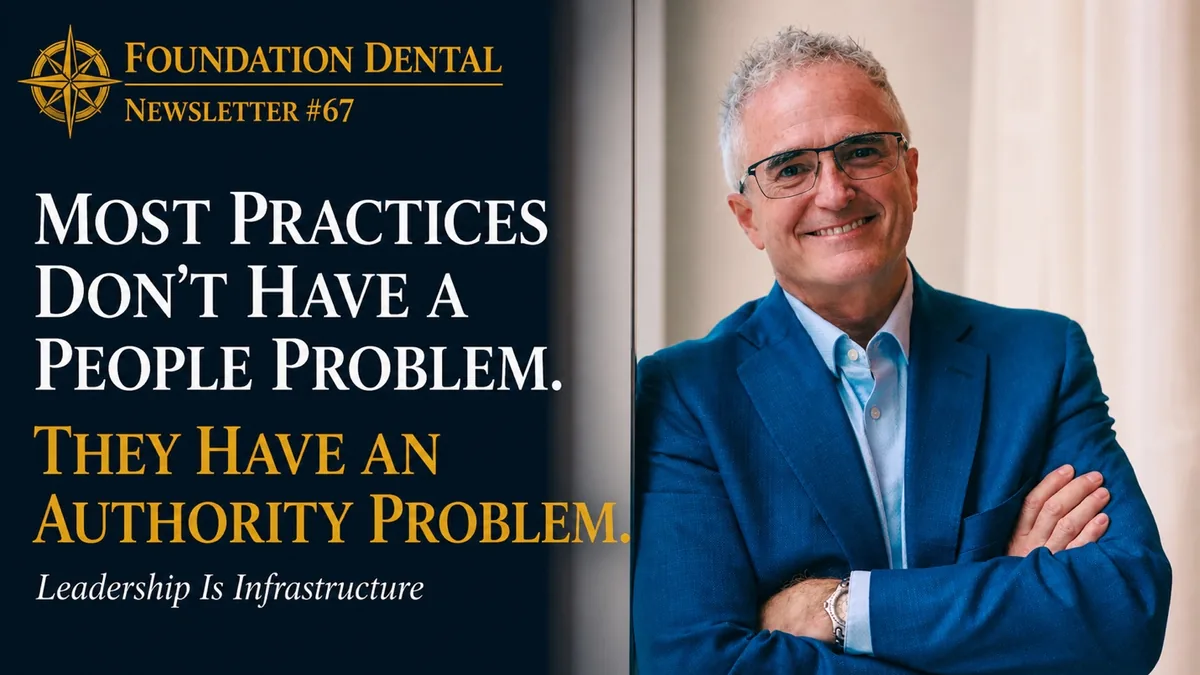
Hiring matters, but hiring is only the beginning. The team you keep is shaped by what happens after someone joins the practice. People need to know what good work looks like, what they own, how their performance is measured, and what happens when commitments are missed.
That is where accountability becomes part of hiring and retention. Without it, even good people start working inside a vague system where deadlines move and responsibilities blur. Strong performers compensate for weaker ones, and the doctor becomes the fallback for problems that should never have reached the doctor in the first place.
I've learned that accountability is not about being the bad guy. It is about creating an environment where people know the standard, understand the consequences of missing it, and can trust that leadership will follow through consistently. When that structure is in place, the team gets clearer, stronger, and easier to lead.
What Does Accountability Actually Mean?
Most practice owners hear the word accountability and think of correction. They picture a difficult conversation after something goes wrong. That is only one small part of it.
Accountability begins before the problem. It starts when the expectation is clear enough that the team member knows exactly what success looks like. It continues when progress is visible, feedback is timely, and the same standard applies to everyone.
It is not micromanagement, assigning blame, or punishing mistakes by rechecking every task because you assume people will fail.
Real accountability is ownership. Team members follow through without needing repeated reminders. People hold themselves and each other to a shared standard, and the practice has systems that make good performance easier to repeat and poor follow-through harder to hide.
High performers usually appreciate that environment because they know where they stand. They do not have to wonder whether the person next to them will be held to the same expectations.
Why Do Dentists Avoid Accountability?
The most common reason is simple: conflict is uncomfortable. Most dentists would rather solve a problem themselves than have a direct conversation with a team member they like.
That avoidance feels easier in the moment, but over time it creates a much bigger problem. Strong team members notice when poor follow-through is tolerated, and they start covering for other people, carrying extra work, and wondering why the standard only applies to them.
The owner feels the same pressure from the other side. When commitments are missed and nothing changes, more work rolls uphill. The doctor becomes the backup plan for unfinished tasks, unresolved patient issues, and decisions nobody wants to own.
Accountability does not create tension when it is done well. It removes much of the tension that comes from vague expectations, inconsistent follow-through, and leadership that waits too long to address what everyone already sees.
How Do You Start With Crystal-Clear Expectations?
If someone drops the ball, the first question should be whether the expectation was actually clear.
A vague request creates a vague result. “Can someone look at the insurance backlog?” leaves too much room for interpretation. Who owns it? What exactly needs to be delivered? When is it due, and why does it matter?
I like a simple Who + What + When + Why model: name one person, define the result, set the deadline, and explain how the task connects to patient care or the health of the practice.
A better instruction sounds like this: “Jessica, I need a summary of the insurance aging report by Friday at 2 PM. We want to avoid surprises for patients next week.”
That level of clarity gives the team member something they can own. It also gives the leader something objective to review later. Nobody has to argue about what was meant because the expectation was clear from the beginning.
How Does Visibility Keep Accountability From Becoming Personal?
Accountability fails when the only time performance gets discussed is after something goes wrong. The team starts to associate feedback with trouble, and the leader starts postponing conversations until the problem is too large to ignore.
Create regular places where commitments are visible. Weekly huddles can include a brief review of what was promised, what is complete, what is still open, and where support is needed. Monthly one-on-ones give each team member a place to discuss goals, performance, roadblocks, and development without waiting for a crisis.
The purpose is not surveillance. It is visibility. You cannot lead work you cannot see.
A strong system also makes it safer to bring up problems early. If a team member knows they can say, “I am stuck here and need help,” before the deadline passes, the practice has a chance to solve the problem instead of discovering it after the patient or team has already felt the impact.
Why Do Recognition and Consequences Both Matter?
If missed commitments never create a response, deadlines become suggestions. If strong performance never gets noticed, your best people eventually wonder why they are carrying the standard.
Consequences do not need to be dramatic. A first miss may require a private coaching conversation. Repeated issues may require a formal improvement plan. Continued breakdowns may mean changing the person's role or deciding that the practice and the employee are no longer a good fit.
The point is not punishment, but making sure repeated underperformance means something.
Recognition should be equally specific. Tell people what they did well and why it mattered. “Great job” is fine. “You followed through on every patient callback before lunch, and that prevented three scheduling problems this afternoon” teaches the team exactly what good performance looks like.
Culture is shaped by both sides of that equation. People pay attention to what leadership corrects and what leadership celebrates.
What you permit becomes part of the culture, whether you intended it or not.
How Do You Build Systems That Support the Standard?
Motivation is not enough. A good team still needs mechanisms that make expectations visible and repeatable. Use simple dashboards or boards for the metrics your team actually needs to see. Document recurring processes so people are not forced to reinvent them. Train team members to support one another and speak up when something important is slipping. Review results at regular intervals instead of relying on memory.
The system does not have to be complicated. In fact, complicated systems often create more work than they solve. The goal is to remove ambiguity.
When the process is documented, the owner can coach the standard instead of personally explaining the same task over and over. That is what makes accountability feel less personal. The conversation moves from “I do not like how you did this” to “Here is the process we agreed on, and here is where the result missed the standard.”
Why Is Leadership Consistency the Part Nobody Gets to Skip?
You cannot build accountability in the team if leadership is inconsistent. If you promise the team something, do it, and if you make a mistake, admit it. If the standard applies to one person, it has to apply to the person you like best too, because exceptions that appear arbitrary will weaken the culture faster than almost anything else.
Team members are watching how leaders respond when the schedule gets hard, when someone makes a mistake, and when a high performer misses a commitment. They learn what the real standard is from those moments.
Leadership credibility is built when what you say and what you do match often enough that people trust the pattern.
How Does Accountability Help You Keep Good People?
Retention is not only about compensation, schedules, or perks. The daily work environment matters too. Strong team members want to know that good work is recognized, that problems will be addressed, and that they are not expected to carry people who repeatedly miss the standard. They want clarity about their role and a reasonable path to grow.
That is why accountability and retention are connected. When the environment feels fair, expectations are clear, and leadership follows through, strong people have more reason to invest in the practice.
The opposite environment wears them down. They see inconsistency and watch low performance go unaddressed, and they become the dependable person who gets every extra assignment because leadership knows they will handle it. Eventually, being good at the job starts to feel like a penalty, and keeping good people requires protecting the culture they are being asked to contribute to.
Addressing the Objections I Hear Most
“I don't want to create conflict.”
Neither do I. The goal is not to create conflict, it is to stop avoiding conversations until the conflict becomes bigger.
Direct feedback can be calm. Start with the expectation, describe what happened, explain the impact, and ask what needs to change. Keep the conversation about the work and the standard rather than turning it into a judgment about the person.
Most people can handle clear feedback much better than leaders imagine. What creates resentment is inconsistency, surprise, and months of unspoken frustration that suddenly appear in one oversized conversation.
“I'm afraid good people will leave.”
A strong employee may leave for reasons you cannot control. But keeping standards low to avoid losing people creates a different problem: the people who care most about doing good work are the ones who feel the inconsistency first.
Good retention is not about making every employee happy with every decision. It is about building an environment where expectations are fair, feedback is useful, and growth is possible. If someone can only stay when standards are optional, the practice has a bigger issue than retention.
“My team already knows what I expect.”
Maybe they do, but if the same misses keep happening, test that assumption. Ask a team member to explain the outcome they own, how success is measured, and when you expect the work to be complete. If the answer is different from yours, the problem is not accountability yet. The problem is clarity.
Leaders often communicate expectations once and assume the message is permanent. Teams change, roles change, and priorities change. Expectations need to be reinforced often enough that nobody has to guess what matters now.
How Do You Build the Infrastructure Over Four Weeks?
Start with the basics instead of trying to rebuild the culture in one meeting. During the first week, audit every role and identify the most important outcomes attached to it. Look for responsibilities that are vague, duplicated, or undocumented.
In the second week, install the check-in rhythm. Use weekly huddles to review commitments and schedule one-on-one conversations so each person has a predictable place to discuss performance and support.
The third week is about feedback. Decide how coaching conversations will work, what repeated misses will lead to, and how strong performance will be recognized. Leaders need to agree on those standards before they expect the team to trust them.
During the fourth week, ask what is working and what is not. Refine the process without abandoning the structure. The system should become easier to use as the team gains experience with it.
What Happens When Accountability Becomes Normal?
The shift is noticeable when people stop waiting for reminders and start closing loops on their own. Projects move without the doctor chasing them, underperformance gets addressed earlier, and strong team members feel more protected because the standard is not theirs alone to carry.
Patients feel the difference too, not because they know anything about your accountability system, but because consistency shows up in the experience: calls get returned, handoffs are cleaner, follow-up happens, and the team knows who owns what.
That is when leadership begins to feel lighter. The doctor is still accountable for the practice, but no longer has to personally carry every commitment inside it.
What's the Hiring and Retention Standard I'd Want in My Own Practice?
I do not want to hire someone into a vague culture and then blame them for failing to read my mind. I also do not want to keep someone indefinitely when they understand the standard, receive support, and repeatedly choose not to meet it.
The standard is clarity on the front end, consistent coaching in the middle, and real follow-through when the result does not improve.
That is better for the owner, better for the strong people already on the team, and more fair to the person being held accountable. Everyone knows where they stand.
At Foundation Dental Alliance, this is the kind of leadership infrastructure we keep coming back to because a practice gets easier to lead when responsibility is clear. If you want to build that kind of team, our Mastermind and Luxury Dental Retreats are designed around the same operating principles: clear standards, stronger leaders, and a practice that depends less on the owner carrying everything personally.
Frequently Asked Questions About Hiring, Retention, and Accountability
How does accountability affect employee retention in a dental practice?
Clear expectations, consistent feedback, recognition, and fair follow-through create a more predictable work environment. Strong team members are less likely to feel that they are carrying the standard alone.
What is the Who + What + When + Why accountability model?
Who names one person responsible for the outcome. What defines the result. When sets a specific deadline. Why explains how the work connects to patient care or practice success.
How often should dental team members receive feedback?
Weekly huddles work well for progress visibility, and monthly one-on-one conversations give room for goals, performance, and challenges.
What should happen when a team member repeatedly misses commitments?
Start with private coaching. If the problem continues, move to a formal improvement plan. Continued breakdowns may require changing roles or ending the employment relationship.
How do you hold people accountable without micromanaging them?
Define the standard clearly, make progress visible at agreed check-in points, and coach the result instead of constantly controlling each step.
What is the leader's role in building an accountable culture?
The leader has to model the same standard, keep promises, admit mistakes, apply expectations consistently, and avoid exceptions that make accountability feel arbitrary.
About the Author
Dr. Jim Arnold, DDS is the Founder and CEO of Foundation Dental Alliance. Over a career as a clinician, multi-practice owner, DSO executive, educator, and transition advisor, he's been involved in more than 60 dental practice transitions and has built multiple top-tier dental teams. He leads the Foundation Dental Mastermind, Luxury Dental Retreats, co-founded Foundation Dental Transitions, hosts the Foundation Dental Podcast, and publishes Foundation Dental Intelligence for dentists who want stronger leadership, better systems, greater practice value, and more freedom.
Stay Connected
Foundation Dental Alliance: FoundationDentalAlliance.com · Foundation Dental Mastermind: FoundationDentalMastermind.com · Foundation Dental Transitions: FoundationDentalTransitions.com · Luxury Dental Retreats: LuxuryDentalRetreats.com · LinkedIn: linkedin.com/in/arnoldjim · Instagram: instagram.com/smilesbyarnold · YouTube: youtube.com/@DrJimArnold · Email: drarnold@foundationdentalalliance.com